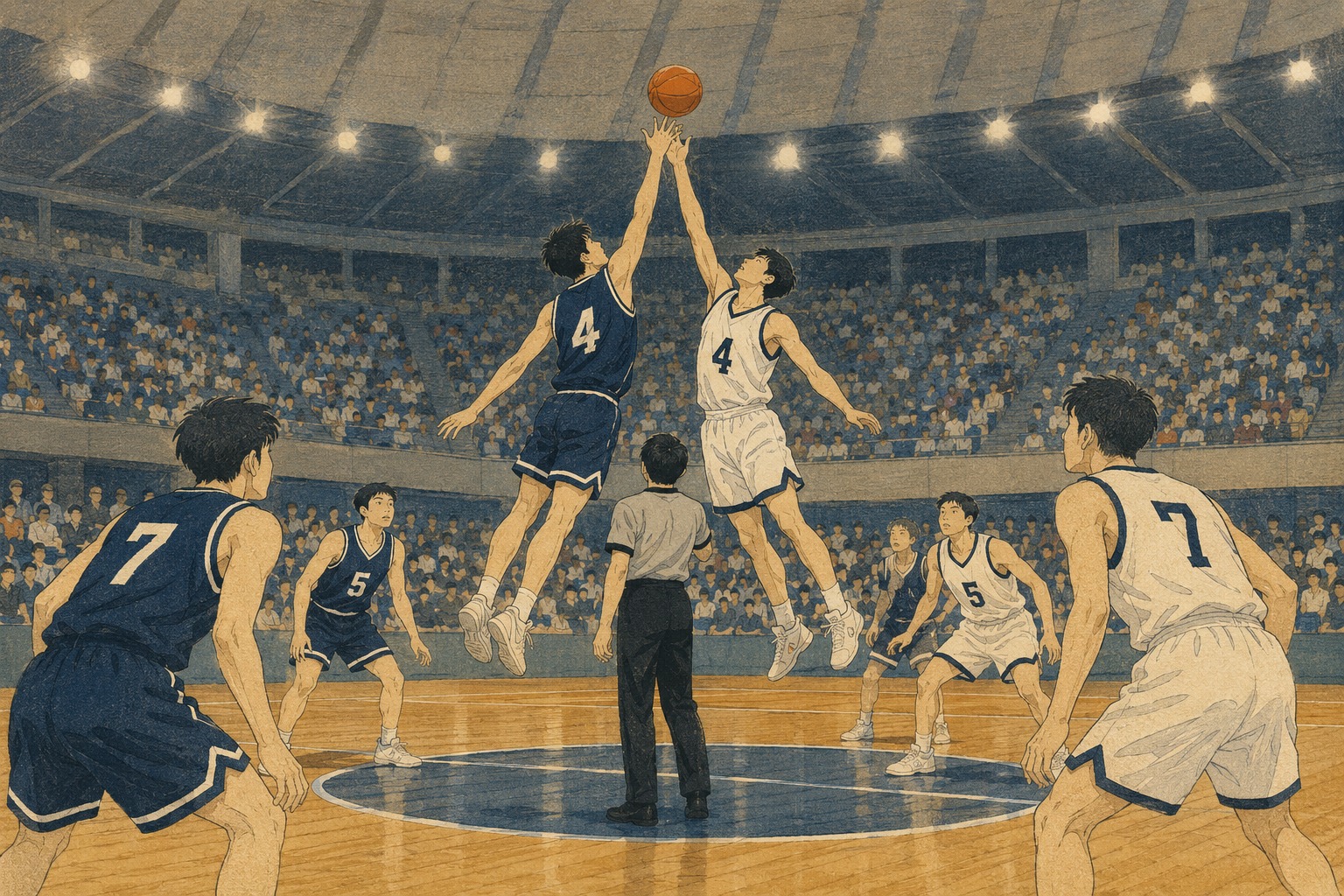
Japan has added a different kind of national test to high-school basketball. A knockout champion must be ready when the bracket arrives. A league champion must be ready, fail, adjust, travel and be ready again. The U18 Nissin Foods Top League gives each Division 1 team seven games from late August to mid-November. The title is not awarded to the best forty minutes. It is awarded to the best record that can survive a season.
That distinction was visible before every contender had even played. On August 22, first-time women’s entrant 四日市メリノール学院高等学校—Yokkaichi Maryknoll Gakuin—edged 岐阜女子高等学校, Gifu Girls’ High School, 61–60. First-time men’s entrant 柳ヶ浦高等学校, Yanagigaura, then beat 鳥取城北高等学校, Tottori Johoku, 67–57.
The next day brought a correction and a warning against instant rankings. Tottori Johoku recovered to defeat 藤枝明誠高等学校, Fujieda Meisei, 61–59. On the women’s side, 岐阜女子 lost 78–33 to 2022 champion 桜花学園, Ohka Gakuen. After four Division 1 games, only three of the eight teams in each gender had appeared. Five had not tipped off at all.
The opening table therefore records sequence, not hierarchy. Tottori had played twice while most of the field had played none. Gifu had lost two games, yet its season was not over. That is the league’s most important departure from Japan’s better-known school tournaments: an early defeat creates a problem to solve, not an exit.
The opening scores—and their limits
The official competition pages support a modest set of conclusions. Yokkaichi Maryknoll won by one after trailing 33–26 at halftime. Yanagigaura led Tottori 18–9 after the first quarter and won by ten. Ohka held Gifu to single digits in every quarter. Those are results and quarter scores, not a complete tactical diagnosis.
It would be premature to turn them into season identities. A one-point win does not establish that a team is “clutch”; a 45-point margin does not guarantee a championship; two losses in two days do not scientifically identify a weak program. Public box scores can show shooting, rebounds, turnovers and minutes. They cannot show every instruction, injury limitation, academic conflict or decision that shaped a roster.
| Date | Competition | Result | What is established |
|---|---|---|---|
| Aug. 22 | Girls, Division 1 | Yokkaichi Maryknoll 61–60 Gifu Girls | A first-time entrant won its Division 1 debut by one. |
| Aug. 22 | Boys, Division 1 | Yanagigaura 67–57 Tottori Johoku | A first-time entrant won after a 18–9 first quarter. |
| Aug. 22 | Boys, Division 2 | Yokkaichi Maryknoll 82–67 Chiba Jets U18 | A school team and a B.League U18 team shared the new national tier. |
| Aug. 23 | Boys, Division 1 | Tottori Johoku 61–59 Fujieda Meisei | Tottori split its opening back-to-back; Fujieda returned to the top tier. |
| Aug. 23 | Girls, Division 1 | Gifu Girls 33–78 Ohka Gakuen | The inaugural 2022 champion won its first 2026 game. |
What, exactly, has opened?
The formal Japanese title is 「U18日清食品トップリーグ バスケットボール競技大会 2026 ディビジョン1」. JBA gives the competition name as 「U18日清食品トップリーグ2026」 and publishes its official reading as 「ユージュウハチ ニッシンショクヒントップリーグ ニセンニジュウロク」. Japan Basketball Association organizes and administers the event; Nissin Foods Co., Ltd. is the special sponsor. The current outline lists Japan’s Ministry of Education, Culture, Sports, Science and Technology and the Ando Foundation as supporting bodies.
Eight teams per gender play one another once. A win is worth two table points, an ordinary loss one and a forfeited loss zero. Ties in the final win-loss record are separated first through results among the tied teams, beginning with point differential and points scored, then through overall differential and scoring. A tied game after the fourth quarter goes to repeated five-minute overtime periods until it is decided.
A game roster may contain up to 15 players. The rules permit no more than two foreign-national players on that roster and one on court at a time. They also create distinct age tests for school and technical-college teams, and for B.League youth and club teams. The latter must be at least 12 and under 18 on April 1, 2026; school players generally must have been born on or after April 2, 2007, with the competition’s grade-repeat restriction also applying.
Every Division 1 entrant happens to be a high school this year. The eligibility architecture is broader than the field. It is built to admit B.League youth and independent club programs if they earn their way into the competition.
| Boys | Prefecture | Girls | Prefecture |
|---|---|---|---|
| Sendai University Meisei | Miyagi | Fukui University of Technology Fukui | Fukui |
| Teikyo Nagaoka | Niigata | Gifu Girls | Gifu |
| Hokuriku Gakuin | Ishikawa | Ohka Gakuen | Aichi |
| Fujieda Meisei | Shizuoka | Yokkaichi Maryknoll Gakuin | Mie |
| Higashiyama | Kyoto | Kyoto Seika Gakuen | Kyoto |
| Tottori Johoku | Tottori | Osaka Kun-ei Jogakuin | Osaka |
| Fukuoka University Ohori | Fukuoka | Seika Girls | Fukuoka |
| Yanagigaura | Oita | Tokai University Fukuoka | Fukuoka |
A league inserted between two knockouts
JBA describes the Top League as one part of the U18 “triple crown”: the summer Inter-High, the autumn league and the winter national championship known as the Winter Cup. That calendar asks different questions of a team. The two cups test survival under compressed knockout pressure. The league tests whether quality can be reproduced across known opponents and dates.
The organizer’s case for the format is explicit. Guaranteed fixtures can make playing time possible for more athletes. Advance schedules make scouting and targeted practice possible. Repeated games against comparable opposition can train mid-game adjustment. The defending boys’ and girls’ coaches, in comments published by JBA before the season, likewise emphasized preparation, tactical response and the way players learn to set the next objective for themselves.
Those are serious development theories. They are not yet proof that every team distributes minutes more widely or that every player improves more than in another setting. The difference matters. A league creates an opportunity structure; coaches, schools and athletes determine how it is used.
The format guarantees seven games. It does not guarantee seven equal opportunities, safe workloads or seven units of growth. Those outcomes have to be measured.
From a Kanto experiment to a national ladder
The 2026 division names are the latest layer of a project that began regionally. JBA launched the Kanto Block League in fiscal 2021. In 2022 it added the national Top League and expanded block competition to Kanto, Tokai, Chugoku and Shikoku. Tohoku, Hokushinetsu and Kinki joined in 2023, producing seven regional blocks.
By fiscal 2025, prefectural U18 leagues were operating in all 47 prefectures. The old block league was reorganized into eight groups that crossed conventional regional borders. Its group winners gained a route toward a new promotion playoff. In 2026, JBA renamed the old Top League Division 1 and the reworked block competition Division 2 to reflect the hierarchy already emerging on court.
2021 JBA establishes the Kanto Block League.
2022 The national Top League begins. Fukuoka Daiichi wins the boys’ title; Ohka Gakuen wins the girls’ title.
2023 Seven block regions operate. Kaishi Kokusai and Kyoto Seika Gakuen become champions.
2024 Fukuoka University Ohori wins its first boys’ title; Kyoto Seika repeats.
2025 Prefectural leagues reach all 47 prefectures. Ohori repeats and Kyoto Seika completes a three-peat.
March 2026 The first Top League playoff awards eight Division 1 places, four per gender.
August 2026 Division 1 and Division 2 open on the same day at Yoyogi.
Promotion changed the meaning of selection
Earlier Top League fields depended heavily on a selection formula combining the previous season, Inter-High results and a team-points assessment. The 2026 field was constructed differently. The top four from each 2025 Top League earned automatic places. Teams fifth through eighth were sent to the new playoff, where they faced winners of the old block league’s eight groups for the four remaining spots per gender.
Only Teikyo Nagaoka among the four affected boys’ Top League teams survived. Hokuriku Gakuin, Fujieda Meisei and Yanagigaura came through from below. On the girls’ side, all four places changed hands: Fukui University of Technology Fukui, Yokkaichi Maryknoll, Osaka Kun-ei Jogakuin and Tokai University Fukuoka won promotion. Hokuriku Gakuin, Yanagigaura, Fukui and Yokkaichi were all first-time Top League entrants.
The pathway continues this season. Finish in the top four and a team receives a 2027 Division 1 berth. Finish fifth through eighth and it must defend its place in the 2027 playoff. Division 2’s eight group champions also go to that playoff. It is not automatic promotion and relegation, but the result on court now carries more authority than an invitation alone.
- Division 1 places one through four qualify automatically.
- Places five through eight enter the promotion/relegation playoff.
- Each of Division 2’s eight group winners also reaches the playoff.
- Twelve teams per gender compete for four Division 1 places.
Division 2 is national—but it is not one table
The second tier is enormous beside the top flight. It has 64 teams per gender: one designated place for every prefecture, added places for nine prefectures with larger registration totals, and eight team-specific places for unsuccessful 2026 playoff participants. Eight groups of eight play a single round robin, producing 448 games.
Calling it Division 2 can suggest a conventional nationwide second table. It is not. Groups A through H do not all play one another, and each sends only its winner toward the playoff. Group composition, travel distance, venue access and the competitive balance between groups can therefore affect the difficulty of the route.
Its importance lies elsewhere. The field includes school clubs, independent clubs and B.League youth programs. On opening day, the Yokkaichi Maryknoll boys beat Chiba Jets U18 82–67 at Yoyogi. That game placed a school and a professional-club academy in the same official pyramid, with a possible future route to the top tier. The system is not yet dominated by clubs, nor does it erase school basketball. It makes the two pathways legible to each other.
Seven venues turn geography into part of the competition
Division 1 will move from Yoyogi to Mito, Kobe, Niigata, Oita and Tokushima before returning to Tokyo. Oita is hosting the competition for the first time; the Tokushima dates are the league’s first in Shikoku. Teikyo Nagaoka receives a home-prefecture week in Niigata. Yanagigaura, new to the Top League, receives one in Oita.
The final weekend will be held November 14–15 at Yoyogi National Stadium First Gymnasium, another first for the competition and a larger stage than the second gymnasium that hosted the opener. JBA has also added its first local youth clinics at the Yoyogi and Niigata rounds for fifth- and sixth-grade elementary pupils and first- and second-year junior-high students.
National circulation serves spectators and outreach. It also creates a hidden schedule: trains and flights, hotel nights, recovery, missed classes and school examinations. The official outline allows adjustments around team schedules. The public materials reviewed for this article do not itemize who pays travel costs, how many class periods athletes miss or how recovery differs between programs with unequal resources.
| Week | Dates | Venue | Significance |
|---|---|---|---|
| 1 | Aug. 22–23 | Yoyogi National Stadium Second Gymnasium | Division 1 and Division 2 open on the same day. |
| 2 | Aug. 29–30 | Adastria Mito Arena | The competition moves to Ibaraki. |
| 3 | Sept. 19–21 | Green Arena Kobe | The only three-day event week. |
| 4 | Sept. 26–27 | Niigata City Higashi General Sports Center | Teikyo Nagaoka’s home-prefecture round. |
| 5 | Oct. 10–11 | Crasus Budokan Sports Center | First Oita round; Yanagigaura’s home prefecture. |
| 6 | Nov. 7–8 | Amino Value Hall | The competition’s first Shikoku round. |
| Final | Nov. 14–15 | Yoyogi National Stadium First Gymnasium | First final week in the larger Yoyogi arena. |
The champions waiting offstage
Fukuoka University Ohori won the 2025 boys’ league at 6–1, securing its second consecutive title. Kyoto Seika Gakuen went 7–0 in the girls’ competition for a third consecutive championship. Neither defending champion played on the opening weekend. Their title defenses begin later, one reason no responsible reading of the early table can identify a favorite from the standings alone.
The short history already shows different kinds of excellence. Fukuoka Daiichi and Ohka Gakuen were the inaugural 2022 winners. Kaishi Kokusai won the 2023 boys’ title while Kyoto Seika began its three-year run. Ohori replaced Kaishi in 2024 and repeated in 2025. A four-season archive is not a permanent order; this year’s playoff removed former regulars and brought in four debutants.
Ohka’s 78–33 opener may be read as an attempt to restore its first-year status. Yokkaichi’s 61–60 win may be read as evidence that promotion can immediately produce a competitive result. Both are fair observations. Neither is yet a season conclusion.
A development league needs a development audit
The league’s theory is plausible: more scheduled games, more preparation, more adaptation, and a route open to different team forms. Its rules also require teams, in principle, to have a trainer at games and to arrange accident coverage. Those provisions recognize that development is inseparable from care.
But the outline also states that local organizers provide first aid for illness or injury during competition without assuming subsequent responsibility. A rule requiring a trainer does not mean every school has the same sports-medicine capacity. A 15-player game roster does not mean 15 players receive meaningful minutes. More games do not automatically produce safe loads.
The public platform supplies extensive competitive data. It publishes schedules, scores, box scores, play-by-play and individual rankings. What it does not yet offer as a league-wide public evaluation is equally important: injury incidence, cumulative load, academic disruption, travel expenditure, access for reserve players, or player-reported welfare. Those gaps do not invalidate the competition. They define the evidence needed to substantiate its development mission.
- How many of the 15 game-roster players received meaningful minutes across seven games?
- How were injuries, illness, back-to-backs, travel and recovery managed?
- How did schools protect classes, examinations and ordinary student life?
- Did the Division 2 groups provide a reasonably fair path across regions and team types?
- Can athletes and coaches demonstrate better scouting, decision-making and in-game adjustment—not merely more appearances?
The first weekend proved that the door works
Yanagigaura and the Yokkaichi Maryknoll girls did something structurally important before they did anything historic. They won the old block league route, survived the first promotion playoff and then won their Division 1 debuts. The arrow on JBA’s competition diagram became an actual score at Yoyogi.
Whether that arrow reaches the championship remains open. Ten of the 16 Division 1 teams had not played by the end of August 23. Ohori and Kyoto Seika had not begun their defenses. Sendai University Meisei, Teikyo Nagaoka, Hokuriku Gakuin, Higashiyama, Fukui, Osaka Kun-ei, Seika Girls and Tokai University Fukuoka were also waiting for their first game.
The next round comes August 29–30 in Mito. The league then crosses Japan before returning to Yoyogi in November. It will measure shooting and defense, but also repeatability: whether a team can absorb an opponent’s plan, change its own, recover from travel, use a roster and return after a loss.
That is the deeper news in the 2026 opening. Japanese high-school basketball has not abandoned the dramatic national cup. It has placed another definition of strength beside it—one in which the result matters, but so does what a team can do with the days after the result.
- JBA U18 Nissin Foods League — 2026 overview, divisions, teams and venues
- JBA — Division 1 schedule and official pre-season comments
- JBA — 2026 Division 1 regulations
- JBA — purpose, league structure and institutional history
- JBA — 2026 Division 1 boys’ schedule and results
- JBA — 2026 Division 1 girls’ schedule and results
- JBA — 2026 Division 1 boys’ standings and matchup grid
- JBA — 2026 Division 1 girls’ standings and matchup grid
- JBA — official box score, Yanagigaura vs. Tottori Johoku
- JBA — official box score, Yokkaichi Maryknoll vs. Gifu Girls
- JBA — official box score, Gifu Girls vs. Ohka Gakuen
- JBA — 2026 Division 2 boys’ schedule and results
- JBA — final results of the first 2026 playoff
- JBA — announcement establishing the promotion playoff
- JBA — Division 2 renaming and August schedule
- JBA — 2025 boys’ final standings and champion
- JBA — 2025 girls’ final standings and champion
- JBA — 2023 overview identifying the inaugural 2022 champions
- JBA — 2023 boys’ final result
- JBA — 2023 girls’ final result
- JBA — 2024 boys’ final result
- JBA — 2024 girls’ final result
- JBA — local youth clinics at the 2026 competition
Editor’s note: Official Japanese competition, school and organization names, the competition reading, rules, specialist terms, dates and results were checked against Japanese primary sources. The opening snapshot is through the end of August 23. Personal-name readings were not inferred. English school renderings are descriptive; Japanese names are provided at first reference where needed. The hero is editorial art, not documentary evidence. The exchange-rate source time of August 24, 2026 at 7:47 p.m. UTC was converted to August 25 at 4:47 a.m. Japan Time. The rate was not used to convert a figure in this article.