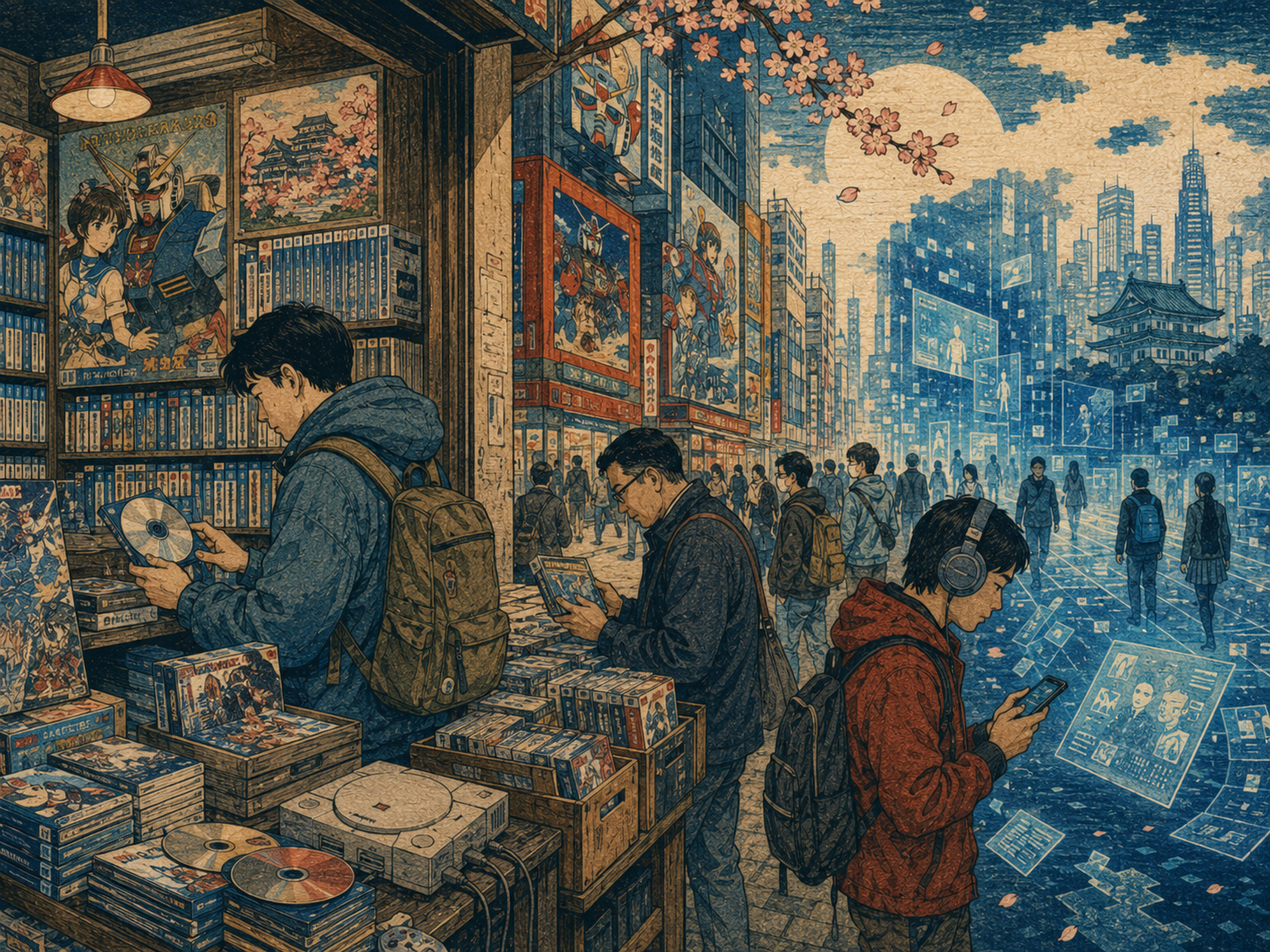
There is time inside the used-game shelves of Akihabara. Scratched plastic cases, bent manuals, spine logos, paper obi strips, handwritten price labels. They are not only games. They are birthdays, after-school nights, brothers fighting over controllers, the first boss someone finally beat, the trip to Tokyo when a cartridge or disc was carried home like treasure. That is why Sony’s decision to end production of physical discs for new PlayStation games from January 2028 is not just a distribution change. It is the beginning of the end of the game shelf as a living culture.
Sony Interactive Entertainment announced on July 1, 2026 that it will discontinue physical disc production for all new games releasing on PlayStation consoles starting in January 2028. New titles will be sold digitally through the PlayStation Store and digital-code retailers. Existing disc games and releases scheduled before the cutoff are not affected. But the direction is unmistakable: after more than three decades of buying PlayStation games as objects, the platform is moving fully into the age of access.
The decision is not shocking in industry terms. PC gaming is already overwhelmingly digital. Mobile games never had physical media. The PlayStation 5 launched with disc and digital editions, and the PS5 Pro era made the disc drive feel increasingly optional. Sony says consumer preference has moved decisively toward digital media. Convenience, instant purchase, sales, patches, storage, subscriptions and online services all push in that direction. The numbers favor digital.
Why the backlash is emotional
The anger is not only about discs. Physical media stands for ownership, lending, resale, preservation, discovery, gift-giving and price competition. You can buy used. You can lend to a friend. You can put it on a shelf. In some cases, you can play without a storefront existing. If a game disappears from the store, a disc may still remain. Modern discs are not perfect; many games need patches, downloads or authentication. Still, the disc gives players a feeling that something is theirs.
Digital games are convenient, but they are fragile in different ways. Stores close. Licenses expire. Accounts are suspended. Distribution agreements end. Prices are controlled inside a platform. There is no used market. Lending becomes restricted. The player increasingly buys not an object but a conditional right to access one.
The timing intensified the anxiety because Sony is also winding down legacy storefronts for the PS3 and PS Vita, according to multiple reports. Even if previously purchased content remains downloadable for the foreseeable future, older-store closures make the digital-ownership question sharper. When the end of discs and the shrinking of legacy stores arrive in the same news cycle, players naturally ask: will the game I buy today still be available in twenty years?
The late era of PlayStation physical media in numbers
Why PlayStation was a disc machine
When the original PlayStation launched in Japan in 1994, CD-ROM was not merely storage. It expanded what games could be. Bigger video, music, voice acting, 3D worlds and lower manufacturing costs helped bring third-party developers into Sony’s ecosystem. Games moved closer to film and music.
The PlayStation culture of the late 1990s was disc culture. Multiple-disc RPGs. Demo discs. Memory cards. Thick manuals. Strategy guides. The package art that sold a game before you knew anything about it. You could carry a disc to a friend’s house, sell it when you were done or discover it in a bargain bin.
The PlayStation 2 made DVD central to the home. The PS3 carried Blu-ray into living rooms. The PS4 was the transition generation, with discs and downloads coexisting. The PS5 made the split visible by offering disc and disc-less models. The 2028 decision is the end point of that long shift.
What Akihabara’s shelves mean
Akihabara was once an electronics district: radio parts, vacuum tubes, appliances, computers, games, anime, figures, doujin culture, maid cafes and inbound tourism. The products changed, but the district’s core was the presence of things. You climbed stairs, checked shelves, compared condition, read price labels and found something you did not know you wanted.
A game-shop shelf is not the same as a search bar. Search finds what you already know. A shelf creates accidents. A 1990s RPG, a limited edition, a guidebook bundle, a foreign release, a junk item, a sealed copy, a game whose cover art makes you stop. Akihabara’s shelves have sold chance as much as inventory.
When new games become digital-only, those shelves will thin. New physical stock will no longer flow into the used market. Shops will lean further into retro games, merchandise, cards, repairs, collector goods, tourism and experience-based retail. Akihabara will not disappear. But the meaning of the game shelf will change. In a district where future PlayStation games no longer arrive as discs, shelves become more like museums of the playable past.
The used market and price competition
Physical discs created a secondary economy. Buy new, sell used, buy used, wait for price drops, collect limited editions, compare retailer discounts. The price of a game was not determined only by the platform holder and publisher.
Digital changes that structure. Sales still exist, but inside the store. There is no used copy. There is no scratched case or complete-in-box premium. Retailers may sell digital codes, but the economics of condition, scarcity and shelf competition weaken. The player gains convenience while losing some forms of market freedom.
Used-game stores will not empty in 2028. PS1, PS2, PS3, PS4, PS5, Switch, Xbox and retro systems will continue to circulate. The end of new discs may even raise interest in existing physical copies. But over time, the new supply of physical PlayStation media stops. For collectors, that is a historic break.
Preservation: who keeps games alive?
Games are culture, but they are harder to preserve than books or films. They may require hardware, operating systems, servers, accounts, patches, DLC, online authentication and storefront access. A disc is not a complete solution. But without discs, preservation becomes even more dependent on platform companies.
For historians, libraries, museums, fans and retro shops, physical copies are evidence. Boxes, manuals, bonus items, version differences, regional releases, bugs, patched editions and original prices preserve not only the game, but the culture around it.
The digital era needs new preservation rules: long-term platform archives, partnerships with libraries and researchers, rights clearing, post-server preservation, offline builds, source-code management and legal clarity around emulation. Sony’s decision is not only a convenience story. It asks whether the game industry is ready to preserve its own history.
Japan’s package culture
Physical packaging has special meaning in Japan. Obi strips, first-print bonuses, limited editions, art books, soundtracks, figures, store-specific extras and reservation gifts all turn a game into an object of fandom. Buying a game has often meant owning a piece of the work’s world, not merely the executable file.
This connects to anime, manga, music, idol, figure and doujin culture. CDs, Blu-rays, art books, pamphlets, acrylic stands, posters. Japanese fan culture has long expressed love through objects. That is why the end of discs hits emotionally. Digital data cannot easily become a shrine, a shelf, a gift or a conversation piece.
How retailers may adapt
Akihabara shops have adapted before: electronics, PC parts, doujin, anime, figures, cards, duty-free retail, cafes and tourism. As new physical games fade, stores will search for different value. Retro specialization, repairs, authentication, buyback, exhibitions, events, streaming spaces, overseas shipping, high-end collector items and experiential retail are all plausible directions.
Used-game stores may become less like ordinary retailers and more like preservation spaces. Complete copies, working consoles, repaired hardware, tested discs and boxed limited editions become cultural assets. Akihabara’s shelves may stop being where the future arrives and become where the past remains playable.
Digital has real advantages
The digital shift is not all loss. It reduces logistics. It eliminates stockouts. It lets players buy at launch instantly. It helps small developers reach global audiences. It supports patches, DLC, cloud saves and accessibility features. It may reduce plastic cases and shipping.
The question is not digital bad, physical good. The question is what must be protected when digital becomes the only option: ownership, preservation, price competition, lending, gift-giving and cultural discovery. Convenience increases dependence on platform companies. That gives platform holders a heavier responsibility around long-term access, transparent licenses, refunds, family sharing, archiving and store-closure policies.
Japan.co.jp’s view
Sony’s move follows the logic of the market. The numbers point to digital. But culture does not live by numbers alone. Games are made of childhood shelves, friend-to-friend lending, accidental used-shop discoveries, manual reading, collector editions and the smell of opening a case.
Akihabara will show this transition better than anywhere. The more digital the future becomes, the more valuable the physical shelf becomes as memory. When new releases stop arriving as discs, the shelf becomes a museum. The disc becomes not obsolete technology, but cultural evidence.
2028 will not be the end of games. Games will become bigger, faster and more global. But as the PlayStation disc ends, players should keep asking one question: in a more convenient future, do we still own the games we love?
Reader guide
| Question | Answer |
|---|---|
| What happened? | Sony will stop producing physical discs for new PlayStation releases beginning in January 2028 and move new titles to digital distribution. |
| What is not affected? | Existing disc games and titles scheduled for disc release before the cutoff are not covered by the change. |
| Why does it matter? | It affects ownership, used-game markets, price competition, lending, preservation and package culture. |
| What happens to Akihabara? | New physical-game shelves may shrink, while retro, collector, repair, exhibition and tourism value may rise. |
| Japan.co.jp’s view | This is not only the end of a technology. It is a turning point in ownership and preservation. The game shelf becomes a place that protects the past. |
Sources and references
This article draws on public information from PlayStation Blog, Reuters, Ars Technica, The Guardian, Wired, Business Insider, The Verge and TechCrunch.
- PlayStation Blog: Physical disc production ending in January 2028
- Reuters: Sony to end discs for new PlayStation releases
- Ars Technica: Sony announces end of PlayStation discs
- The Guardian: Sony will kill PlayStation games on discs in 2028
- Wired: Sony’s PlayStation puts a nail in physical media’s coffin
- Business Insider: Backlash against Sony ditching PlayStation discs
- The Verge: Akihabara and Japan’s love for physical media
- TechCrunch: Sony to end physical PlayStation game discs in 2028