A low mechanical hum is difficult to place. It may be more vibration than melody, present through a wall after every sharper sound has disappeared. Outdoor climate-control units, heat-pump water heaters, ventilation systems, lifts and traffic can all contribute energy near the bottom of the audible range. The discomfort is real for some residents; the organ-level biology is much harder to establish.
A new mouse study from Nagoya University enters that disputed territory with an unusually specific question. Instead of asking whether “noise” as a whole affects the kidney, the researchers recorded operating machinery, split the sound at 100 hertz and exposed mice to the resulting bands under controlled conditions.
The low-frequency fraction raised serum creatinine and blood urea nitrogen, two conventional markers of renal filtration, while a physically level-matched fraction above 100 Hz did not. The team then found enlarged glomerular and mesangial areas, thickening of the glomerular basement membrane and activation of a vascular pathway involving endothelin-1.
The paper, led by assistant professor Takumi Kagawa with professor Masashi Kato as corresponding author, was published online June 18 in Environmental Science & Technology. Nagoya University issued its Japanese research announcement on August 24. Its central achievement is a controlled animal mechanism. Its central limitation is translation: the study used young male mice, high sound pressure and only five days of exposure.
The study’s most important instrument was a frequency boundary
Environmental-noise epidemiology usually measures an entire sound field. That is useful for describing transport or occupational exposure, but it makes biological attribution difficult. A roadway or machine generates a shifting mixture of frequencies, intensities and temporal patterns. If a health marker changes, no single component can automatically be blamed.
Kagawa’s team recorded an air-conditioner outdoor unit and a heat-pump water heater. The recordings were separated into whole environmental noise, low-frequency noise at or below 100 Hz, and non-low-frequency noise above 100 Hz. Six-week-old male C57BL/6 mice were exposed for 12 hours per day on five consecutive days.
In the first comparison, whole noise and its low-frequency component each raised serum creatinine and BUN; the higher-frequency component did not. These initial groups contained five mice each. The result was suggestive, but the bands did not carry the same physical sound pressure.
The researchers therefore brought both fractions to 100 dBZ, a frequency-unweighted measure. At that common physical level, the low-frequency fraction raised both kidney markers after 12- and 24-hour daily exposure, while the >100 Hz fraction did not. The 24-hour schedule produced larger changes than the 12-hour schedule. Those groups contained six or seven animals.
This was not simply a loud-versus-quiet comparison. The experiment asked whether two frequency bands with the same linear sound-pressure level produced different renal outcomes.
Why 100 dBZ can also be 70 dBA
Decibels are logarithmic, and the letter after “dB” matters. A-weighting, expressed as dBA, discounts frequencies to which human hearing is less sensitive. It is indispensable for many hearing and community-noise applications, but it can make substantial low-frequency sound pressure look numerically modest. Z-weighting, dBZ, is approximately flat across the relevant range and reports physical pressure without the same hearing-based discount.
At 100 dBZ, the low-frequency fraction in this experiment measured 70 dBA. The >100 Hz fraction at the same 100 dBZ measured 87 dBA. If the A-weighted figures were considered alone, the low-frequency exposure would appear much quieter even though the physical comparison had been equalized.
A dose experiment sharpened the pattern. With 12-hour daily exposure for five days, 100 dBZ of the low-frequency fraction raised creatinine and BUN; 80 and 90 dBZ did not produce statistically significant changes. Each group contained seven mice.
That finding is not a 90-dBZ safety threshold for humans. It is a no-significant-effect result in one short mouse protocol. Frequency spectrum, room reflections, distance, duration, intermittency and biological susceptibility all change exposure. Nor can dBA and dBZ values be substituted for one another without the full spectrum.
| Question | Reported result | Limit on interpretation |
|---|---|---|
| Did frequency matter? | At a common 100 dBZ, the ≤100 Hz fraction changed creatinine and BUN; the >100 Hz fraction did not. | Small animal groups and one set of recorded sources do not represent all low-frequency sound. |
| Did level matter? | The marker change appeared at 100 dBZ, not 80 or 90 dBZ, under the five-day schedule. | This is not a residential, occupational or clinical limit. |
| Was the effect persistent? | Creatinine and BUN returned to baseline after a two-day cessation. | The experiment did not show that every structural change resolved at the same speed. |
| Was endothelin causal? | Ambrisentan reduced the functional-marker and glomerular changes. | The intervention supports pathway involvement; it does not establish a treatment for exposed people. |
The blood test pointed toward the glomerular filter
Creatinine and BUN are useful but nonspecific. Hydration, metabolism and other physiology can move the values, especially in a small animal experiment. The investigators looked for a matching tissue target.
After five days at 100 dBZ for 12 hours per day, renal expression of Et1, encoding endothelin-1, and eNos, encoding endothelial nitric oxide synthase, increased. Two proximal-tubule injury markers, Kim1 and Lcn2, did not. An eNOS increase can be a compensatory response to vascular stress, so it is not itself proof of injury. Together, however, the molecular pattern directed attention away from the tubules and toward the vascular-rich glomerulus.
Periodic acid–Schiff staining showed increases in glomerular surface area and the mesangial fraction. Transmission electron microscopy showed thickening of the glomerular basement membrane, a core layer of the filtration barrier. The histology groups included four mice, and basement-membrane thickness was quantified in three per group—small numbers, but evidence at a different biological level from the blood markers.
The team also reproduced the creatinine and BUN response in ICR mice, providing a check against a single strain-specific effect. In the cessation experiment, both markers returned to baseline after two days without exposure. What happened to the ultrastructure over the same interval was not established.
An endothelin blocker turned an association into a stronger mechanism
Endothelin-1 is a potent vasoconstrictor. The researchers tested its role with ambrisentan, an endothelin A-receptor antagonist. In groups of nine mice, the drug reduced the low-frequency-noise-associated increases in creatinine and BUN and mitigated enlargement of the glomerular and mesangial areas.
Malondialdehyde, a marker of oxidative stress, also rose in the kidney after low-frequency exposure and fell with endothelin-pathway inhibition. The sequence—pathway activation, structural change and pharmacological mitigation—supports an endothelin-mediated vascular mechanism more strongly than correlation alone.
But one important link remains inferential. The authors propose that vasoconstriction increased pressure inside the glomerulus, contributing to basement-membrane and mesangial changes. Intraglomerular pressure was not directly measured. Nor did the experiment identify the molecular sensor that could convert low-frequency mechanical energy into endothelin signaling.
Ambrisentan’s role in the experiment should not be mistaken for clinical advice. It is a prescription medicine with defined indications and risks. The paper did not test it as prevention or treatment for people reporting low-frequency-noise exposure.
A sound mice could not hear still leaves more than one pathway
The paper places the mouse auditory range at roughly 2 to 100 kilohertz. Its low-frequency fraction, ≤100 Hz, sat well below that range. This helped the researchers distinguish a non-auditory effect from a classic stress response to perceived loudness.
Supporting experiments found no significant changes in echocardiographic measures including heart rate and cardiac output. Serum corticosterone, a systemic stress marker, showed an upward trend that did not reach statistical significance. Renal inflammatory transcripts Il6 and Tnfα were similar to controls.
Those negatives make auditory stress and altered cardiac output less persuasive as the principal explanation. They do not prove absence. A small experiment can miss a real change, and an organism may register a physical stimulus without hearing it. The authors discuss the possibility that long-wavelength pressure traveled through the body wall and mechanically affected the renal vasculature, but they did not directly demonstrate that route.
Translation to humans adds the opposite complication. People can hear part of the ≤100 Hz band. Perception, annoyance, sleep disruption, autonomic responses and direct mechanical effects could overlap. The very feature that makes mice useful for isolating a non-auditory mechanism makes the human environment more complex.
Japan’s low-frequency-noise history was built around complaints, not kidney limits
Japan’s Ministry of the Environment groups difficult-to-hear sound from 20 to 100 Hz with normally inaudible air-pressure fluctuations below 20 Hz under the broad administrative label teishūha-on, low-frequency sound. It uses chōteishūha-on for the sub-20-Hz portion specifically. The mouse paper used ≤100 Hz but did not isolate infrasound as a separate health exposure.
Official records place local-government complaints at roughly 100 a year in fiscal 1973 and 1974. They declined for a period, then began rising again around fiscal 1993, including reports inside otherwise quiet homes. Authorities needed a way to connect a reported sensation to a source before prescribing mitigation.
The ministry published a measurement manual in 2000, a prevention casebook in 2002 and its “Handbook for Addressing Low-Frequency Sound Problems” in 2004. The process begins with listening to the complainant, inspecting the site, measuring frequency-specific pressure and testing whether changes at the source correspond to changes at the receiving location.
The handbook’s reference values are routinely misunderstood. The ministry says explicitly that they are neither regulatory ceilings nor environmental quality standards. They are diagnostic aids in complaint investigations, not targets for environmental assessment or occupational guidance. Notices since 2008 have repeated that distinction. The 100-dBZ mouse exposure cannot be dropped into this framework as a new human limit.
1973–74 — Japanese local authorities record about 100 low-frequency-sound complaints per fiscal year.
Around 1993 — Complaints begin rising, including low-level sound in quiet residences.
2000 — The Environment Ministry issues a measurement manual.
2004 — The ministry publishes a complaint-investigation and assessment handbook.
2008 onward — Repeated notices stress that handbook reference values are not regulatory standards.
2021 — A Korean cross-sectional analysis reports associations between self-reported noise exposure and renal function.
2026 — The Nagoya team reports frequency-separated low-frequency exposure and glomerular injury in mice.
Human studies supplied the question, not the answer
The paper’s premise did not arise from mice alone. A 2021 analysis of 17,154 Koreans aged 40 to 79 found associations between reported occupational or environmental noise exposure and kidney outcomes. Among some women, long-term occupational exposure was associated with a higher prevalence of chronic kidney disease, and longer exposure correlated with lower estimated glomerular filtration rate.
That study was cross-sectional. Exposure came from questionnaires, not long-term frequency-resolved monitoring. It could not determine whether noise preceded the renal change or fully remove confounding by occupation, blood pressure, chemical exposure, income or other health risks. A 2024 petrochemical-worker study likewise reported renal associations, but its scientific problem was joint exposure to noise and a solvent mixture.
The mouse experiment contributes what epidemiology could not ethically create: deliberate isolation of frequency and pressure. Epidemiology contributes what the mouse cage cannot: actual human lives, chronic exposure and clinical outcomes. The two kinds of evidence are complementary, not interchangeable.
The World Health Organization’s 2018 environmental-noise guidelines assess transport, wind-turbine and leisure noise against outcomes including sleep disturbance and cardiovascular, metabolic, cognitive and hearing effects. They do not establish a human kidney limit for the ≤100 Hz fraction. Comparisons between WHO exposure recommendations and the mouse protocol require care because the endpoints, weighting, spectrum and duration differ.
The decisive study would measure homes, bodies and time together
A credible human program would begin with exposure. Researchers would continuously measure low-frequency spectra inside and outside homes or workplaces, record operating cycles and distance from sources, and preserve unweighted as well as A-weighted levels. A single spot dBA reading would not be enough.
It would then follow participants forward. Blood pressure, diabetes, medication, heat, chemical exposure, sleep, age and socioeconomic conditions would need to be measured alongside eGFR, urinary albumin and more sensitive renal biomarkers. Pre-existing kidney disease could change susceptibility, and the present male-mouse design says nothing about sex-specific effects.
Animal work also has unfinished business: females, older mice, kidney-disease models, lower levels sustained for weeks or months, and repeated cycles of exposure and recovery. Direct renal blood-flow and intraglomerular-pressure measurements could test the proposed vascular step. Mechanosensory experiments could ask how the physical wave becomes an endothelin signal. Independent replication would test whether the result survives a different room, playback system and laboratory.
The Nagoya study does not close a decades-old dispute over low-frequency sound. It does something more disciplined. It converts a broad complaint into a testable chain: a defined frequency band, a duration and level, renal filtration markers, glomerular ultrastructure, oxidative stress and an endothelin intervention. That chain is meaningful in mice. Whether it runs through the kidneys of people living with a nightly hum remains an open scientific question.
- Established in the model: Five days of the ≤100 Hz fraction at 100 dBZ raised creatinine and BUN in young male mice.
- Established in the model: The exposure changed glomerular and mesangial dimensions and thickened the glomerular basement membrane.
- Supported mechanistically: Endothelin-pathway inhibition reduced the functional-marker and structural effects.
- Not established: That ordinary residential or occupational low-frequency sound causes chronic kidney disease in people.
- Not established: A human safety threshold, a hazardous duration, the isolated effect of infrasound or full long-term reversibility.
- Nagoya University — official Japanese research announcement (August 24, 2026)
- Kagawa et al. — “Glomerular Injury Induced by Daily Exposure to the Low-Frequency Component of Environmental Noise via Endothelin Signaling in Mice”
- U.S. National Library of Medicine — final-paper bibliography, authors, abstract and figure descriptions
- PubMed Central — open-access full text, methods, results, limitations and funding
- Nagoya University Department of Occupational and Environmental Health — official names, romanizations and titles
- Japan’s Ministry of the Environment — low-frequency-sound definitions, complaint history and reference-value Q&A
- Japan’s Ministry of the Environment — 2004 Handbook for Addressing Low-Frequency Sound Problems
- Japan’s Ministry of the Environment — official background on frequency ranges, sources, effects and complaint counts
- Kim et al. — cross-sectional study of noise exposure and renal function in Korean adults, Scientific Reports (2021)
- World Health Organization — Environmental Noise Guidelines for the European Region (2018)
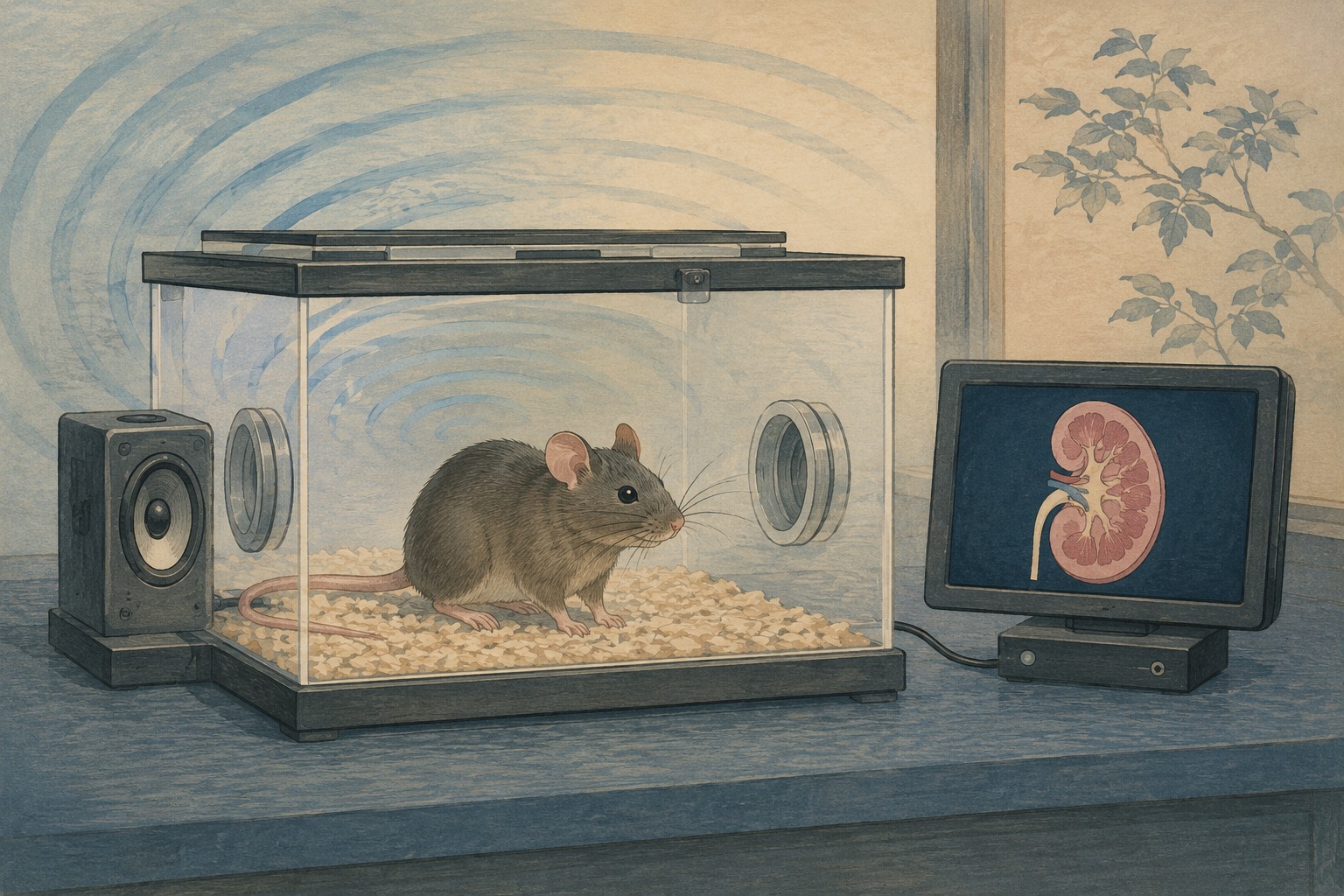
Editor’s note: Japanese names, romanizations, institutional titles and specialist terms were checked against Nagoya University’s Japanese release, official laboratory roster and the Environment Ministry’s primary materials. The university release uses wording that can be read as “long-term exposure”; the paper itself describes 60 to 120 total hours as short-term, so this article uses the precise phrase “five-day repeated exposure.” Mouse experiments, human observational associations and policy reference values are kept distinct. The image is editorial art, not research evidence. The exchange-rate source time, August 24, 2026 at 7:47 p.m. UTC, was converted to August 25 at 4:47 a.m. Japan Time. The reference rate was not used in reporting the science.