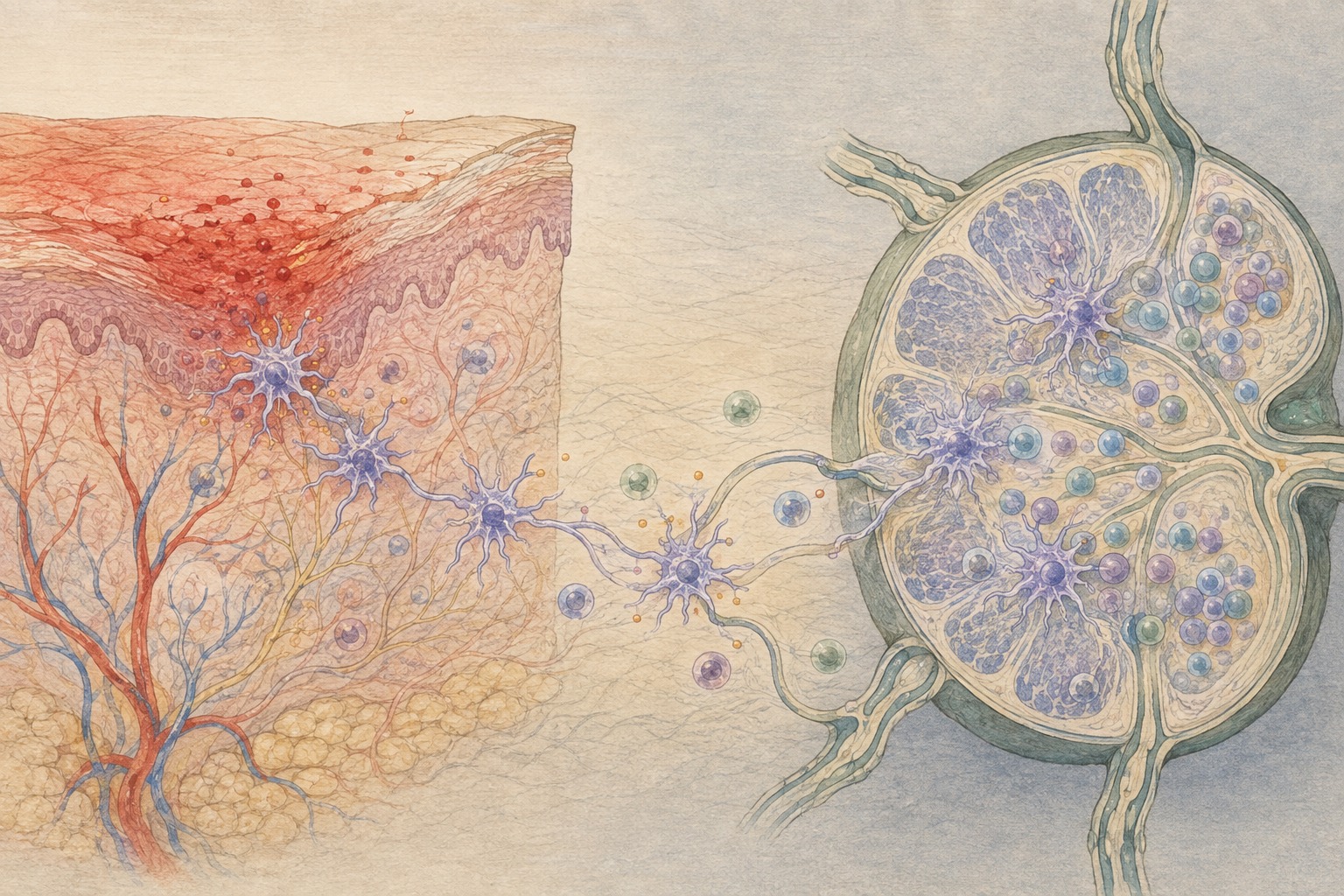
The rash is local. The immune memory is not. Skin can teach the immune system to recognize an allergen, and a later encounter can produce a response far from the original patch of inflammation. In some children, eczema or atopic dermatitis is followed by food allergy, asthma or allergic rhinitis—a variable pattern clinicians call the atopic march.
A paper involving Tokyo University of Science, Kyoto University and a broad Japanese–American team now identifies a cellular relay capable of carrying that story from skin to systemic reaction. In a mouse model, interleukin-13 did not need to signal directly to T cells or B cells to generate the dangerous, high-affinity form of IgE. Its critical recipient was a subset of type 2 conventional dendritic cells, or cDC2.
Those cells expressed the IL-13 receptor together with CX3CR1 and CD301b. IL-13 increased their antigen-presenting machinery. CX3CR1 helped them move into secondary lymphoid tissue. Once licensed, the cDC2 cells promoted IL-13-producing T follicular helper cells, germinal-center activity and high-affinity IgE—the antibody class capable of priming mast cells and other effectors for anaphylaxis.
The final paper, “IL-13 signaling in cDC2 is required for systemic anaphylactic responses,” was published online in Proceedings of the National Academy of Sciences on July 9 and appeared in its July 14 issue. Yasuyo Harada is the first author. Masato Kubo, a specially appointed professor at Kyoto University’s KU Immunomonitoring Center and professor emeritus at Tokyo University of Science, is a corresponding author.
The experiment asked a cellular question, not merely a cytokine question
IL-13 was already familiar territory. It is a signature cytokine of type 2 inflammation, implicated in skin-barrier dysfunction, mucus production, tissue remodeling and the biology of allergic disease. Drugs that block IL-13 are used for inadequately controlled atopic dermatitis. The open question was more precise: Which cell must receive the IL-13 signal for skin sensitization to generate high-affinity IgE and systemic anaphylaxis?
The team developed a cutaneous allergen sensitization, or CAS, model. Mouse skin was treated with MC903, a chemical used to induce dermatitis-like inflammation, together with the model protein ovalbumin. The animals were later challenged at a distant site by intraperitoneal injection of ovalbumin carrying the NP hapten. Only the skin-sensitized animals generated a strong high-affinity IgE response to NP and developed systemic anaphylactic responses.
The researchers then removed the IL-13 receptor alpha-1 subunit, encoded by Il13ra1, from selected cell lineages. Removing the signal from T cells or B cells produced little change in the IgE response described in the university release. Removing it from dendritic cells sharply suppressed both high-affinity IgE and the anaphylactic response.
That distinction matters. B cells manufacture antibody, but the decisive IL-13 instruction in this experiment was delivered one step upstream—to a cell that captures antigen, displays it and supplies the additional signals that determine what T cells do next.
The cytokine did not simply turn up the antibody factory. It upgraded the courier and instructor that brought antigen into the lymphoid conversation.
What “licensing” changed inside cDC2
Single-cell RNA sequencing narrowed the target from all dendritic cells to a cDC2 subset with high expression of the IL-13 receptor, the chemokine receptor CX3CR1 and CD301b, encoded by Mgl2. After secondary antigen exposure, memory Th2 cells released IL-13. The cytokine then altered the cDC2 state.
MHC class II increased, allowing the dendritic cell to present more antigen-derived material. Costimulatory molecules—including CD80, CD86 and ICOSL—also rose, as did CD301a and CD301b. The research team calls this functional upgrade “licensing”: the cell became better equipped to activate and direct helper T cells.
The licensed cDC2 cells promoted differentiation into TFH13 cells, a follicular-helper population capable of producing IL-13. That response amplified germinal-center reactions, where B cells refine antibody affinity. The result was pathogenic, high-affinity IgE rather than a story about IgE quantity alone.
| Link in the relay | What the study found | What remains open |
|---|---|---|
| Skin sensitization | MC903 and ovalbumin created memory that enabled a later systemic response in mice. | The protocol is not a replica of ordinary infant eczema or eating a food. |
| IL-13 recipient | Lineage-specific receptor deletion pointed to dendritic cells, not the tested T- or B-cell pathways. | The result concerns this model and outcome; it does not mean IL-13 never acts on T or B cells. |
| Cell movement | CX3CR1-positive cDC2 circulated and entered secondary lymphoid tissue; an inhibitor reduced accumulation and IgE. | Clinical efficacy, dose, timing and safety of such inhibition are unknown. |
| Human relevance | Patient datasets showed related cDC2 signatures associated with disease activity and allergen-specific IgE. | Association cannot determine whether the cells caused, followed or merely accompanied disease. |
The traveling cell gives a local reaction systemic reach
Location is the study’s second major idea. The CX3CR1-positive cDC2 cells circulated in peripheral blood and moved into secondary lymphoid tissues, including the spleen, through a CX3CR1-dependent process. When the researchers pharmacologically inhibited that receptor in mice, fewer dendritic cells accumulated in the lymphoid compartment and the subsequent allergen-specific IgE rise was reduced.
This offers a physical bridge between a skin event and an antibody response organized elsewhere. A dendritic cell can carry antigen, alter its presenting machinery in response to IL-13 and enter a tissue where T and B cells build longer-lived, higher-affinity immunity.
But “traveling from skin to spleen” is too simple a cartoon. The university account refers both to draining lymph nodes and to secondary lymphoid tissue such as the spleen. Skin, blood, node, spleen, gut and airway do not sit on one conveyor belt. Determining which route matters for food allergy, asthma or rhinitis will require tissue-specific tracking in models designed for each disease.
The human evidence is a correspondence, not a replay
The researchers also examined public datasets from skin affected by atopic dermatitis and peripheral blood from people with allergic rhinitis or food allergy. They found increases in cDC2 populations expressing CX3CR1, CLEC10A—the human counterpart used for CD301b-related characterization—and IL13RA1. Those populations correlated with disease activity or blood allergen-specific IgE.
That is an important translational check. A molecularly related population appears in human disease rather than only in an engineered mouse. It is not, however, the same evidentiary operation as deleting a receptor from a mouse cell lineage. No receptor was selectively removed from human dendritic cells, and no child was followed from dermatitis through a later food-allergy diagnosis.
A prospective human test would need repeated measurements before and after disease transitions: skin severity, barrier status, cDC2 phenotype, IL-13 activity, allergen-specific IgE, clinical food reactions and respiratory disease. Only then could investigators ask whether the cell signature precedes progression, merely accompanies inflammation or identifies one of several different atopic trajectories.
The atopic march began as a clinical pattern—and remains an imperfect metaphor
Allergy medicine has spent a century trying to name the common ground beneath apparently different organs. Clemens von Pirquet introduced “allergy” in 1906. Arthur Coca and Robert Cooke coined “atopy” in 1923 for a familial group of spontaneously arising hypersensitivities. Marion Sulzberger and Fred Wise proposed “atopic dermatitis” in 1933.
The invisible serum factor once called reagin became clearer in the late 1960s, when the Ishizakas’ work and Gunnar Johansson’s group helped establish IgE as a fifth immunoglobulin class. Skin, airway and food reactions could now be investigated through a shared antibody system rather than clinical resemblance alone.
In 1997, German researchers described an “allergy march” in which food sensitization and early dermatitis preceded respiratory allergy. The modern atopic-march literature broadened the list and weakened the straight-line metaphor. Some patients develop only one condition. Some acquire them in a different order. Shared genes and early environment may create parallel risk rather than one disease literally causing the next.
The new cDC2 paper should therefore be read as a mechanism for one biologically coherent route, not as proof of a universal childhood itinerary. It explains how skin sensitization could create systemic, high-affinity IgE in a defined model. It does not convert a heterogeneous epidemiological concept into a single pathway.
1906 — Von Pirquet introduces the term allergy.
1923 — Coca and Cooke coin atopy.
1933 — The name atopic dermatitis is proposed.
Late 1960s — Reagin is identified with the newly established IgE antibody class.
1997 — A longitudinal sequence of early food and skin allergy followed by respiratory allergy is described as the “allergy march.”
2026 — The PNAS study places an IL-13-sensitive, mobile cDC2 subset in the relay to high-affinity IgE.
A mechanism for current drugs is not evidence for preventive prescribing
Two IL-13-targeting antibodies, tralokinumab and lebrikizumab, are among the biologic options used in Japan for atopic dermatitis that has not responded adequately to existing treatment. Dupilumab blocks signaling through IL-4 receptor alpha and thereby inhibits both IL-4 and IL-13 pathways. The cDC2 findings provide a plausible cellular explanation for part of the benefit produced by suppressing type 2 signaling.
They do not establish a preventive indication. Improving dermatitis today and preventing a different allergic disease years later are different outcomes. The PNAS study did not randomize children to an IL-13 biologic, measure subsequent food allergy or asthma and compare long-term risk.
The university release says the work supports a mechanism by which existing biologics could interrupt the atopic march. That is the research team’s translational interpretation. The prospective clinical question remains unanswered: Who would need treatment, how early, for how long, at what risk and with what durable reduction in objectively diagnosed disease?
CX3CR1 is likewise a target, not yet a therapy. Blocking the receptor reduced cDC2 accumulation and IgE in the mouse experiment. Immune-cell trafficking also contributes to host defense and tissue maintenance. Before a pathway inhibitor becomes a drug strategy, researchers have to establish selectivity, exposure, safety and whether the intervention improves a human outcome rather than only a biomarker.
Four distinctions keep the finding both exciting and honest
First, mouse causation is not human causation. Genetic deletion is powerful precisely because it creates a manipulation unavailable in people. Second, sensitization is not clinical allergy. Detectable allergen-specific IgE does not by itself prove that eating a food produces symptoms.
Third, systemic anaphylaxis is not the whole atopic march. The model did not separately reproduce the onset of asthma, rhinitis and food allergy. Fourth, a druggable node is not a validated treatment schedule. Mechanistic elegance can identify the right question for a trial without answering it.
Those boundaries sharpen the accomplishment. The team moved from a broad cytokine to a cellular recipient, from a broad dendritic-cell class to a molecularly marked subset, and from a stationary skin model to a migratory route. It linked memory Th2 cells, cDC2 licensing, TFH13 differentiation, germinal centers and high-affinity IgE in one experimental chain.
The 19-author study was supported by AMED-CREST, Japanese scientific grants, the MOST–RIKEN program, the Kobayashi Foundation, U.S. public and philanthropic funders and LEO Pharma. The PNAS disclosure reports no competing interests. Funding does not invalidate a result, but it is relevant context when a paper’s significance section invokes the clinical success of IL-13-targeted medicines.
The next study must follow children, cells and time together
The most consequential test would begin before the outcome. A birth cohort could identify infants with persistent dermatitis, characterize barrier damage and cDC2 phenotypes, and then follow objectively confirmed food reactions, asthma and rhinitis. A treatment trial could ask whether controlling the pathway changes not just eczema severity and IgE, but later clinical disease.
Such work will also need to separate heterogeneous patients. An IL13RA1- and CX3CR1-rich cDC2 signature might identify a subgroup in whom the pathway is dominant. Other children may progress through different immune routes—or not progress at all. Precision medicine begins with discovering such differences, not assuming one mechanism fits every rash.
The paper does not justify changing medication or eliminating foods at home. Japan’s health ministry warns that infant rashes are not automatically food allergy and advises families not to remove foods on their own without medical assessment. A mechanism paper is not a diagnostic test or a prescription.
Its durable contribution is more exact. The skin can create memory. A later encounter can release IL-13. A mobile dendritic cell can receive that signal, become a stronger instructor and help produce IgE with enough affinity to support a systemic reaction. The atopic march is not a parade on one road. This study has illuminated one road, named the travelers and shown where the relay may be interrupted.
- Established in the model: Dendritic-cell IL-13 receptor signaling was required for the reported high-affinity IgE and anaphylactic responses.
- Established in the model: A CX3CR1- and CD301b-marked cDC2 subset became licensed and promoted TFH13 and germinal-center activity.
- Observed in human data: A related cDC2 signature correlated with disease activity or allergen-specific IgE.
- Not established: That this pathway causes clinical food allergy in people.
- Not established: That anti-IL-13 therapy or CX3CR1 inhibition safely prevents the atopic march in children.
- Tokyo University of Science and Kyoto University — official Japanese research release (August 24, 2026)
- Harada et al. — “IL-13 signaling in cDC2 is required for systemic anaphylactic responses,” PNAS
- U.S. National Library of Medicine — final-paper bibliography, authors and abstract
- PubMed Central — full preprint methods and figures; this is not the final PNAS version
- Kyoto University — KU Immunomonitoring Center
- Japan’s Ministry of Health, Labour and Welfare — allergy, IgE and infant-food-elimination guidance
- Japanese Dermatological Association — lebrikizumab appropriate-use guidance
- Japanese Dermatological Association — tralokinumab appropriate-use guidance
- Japanese Dermatological Association — dupilumab appropriate-use guidance
- Bergmann et al. — “The allergy march: from food to pollen” (1997)
- American Academy of Allergy, Asthma & Immunology — biologics and the nonlinear atopic march (2023)
- PubMed — history of atopic-dermatitis terminology
- RIKEN Center for Integrative Medical Sciences — K. and T. Ishizaka and the discovery of IgE (Japanese)
Editor’s note: Japanese names, titles and specialist terms were checked against the joint Japanese university release and official institutional pages. “Licensing,” “type 2 conventional dendritic cell,” “cutaneous allergen sensitization,” “high-affinity IgE” and “TFH13 cell” follow the research team’s usage. Mouse manipulations and human correlations are kept distinct throughout. The image is an editorial illustration, not research evidence. The exchange-rate source time, August 24, 2026 at 7:47 p.m. UTC, was converted to August 25 at 4:47 a.m. Japan Time. The reference rate was not used in reporting the science.