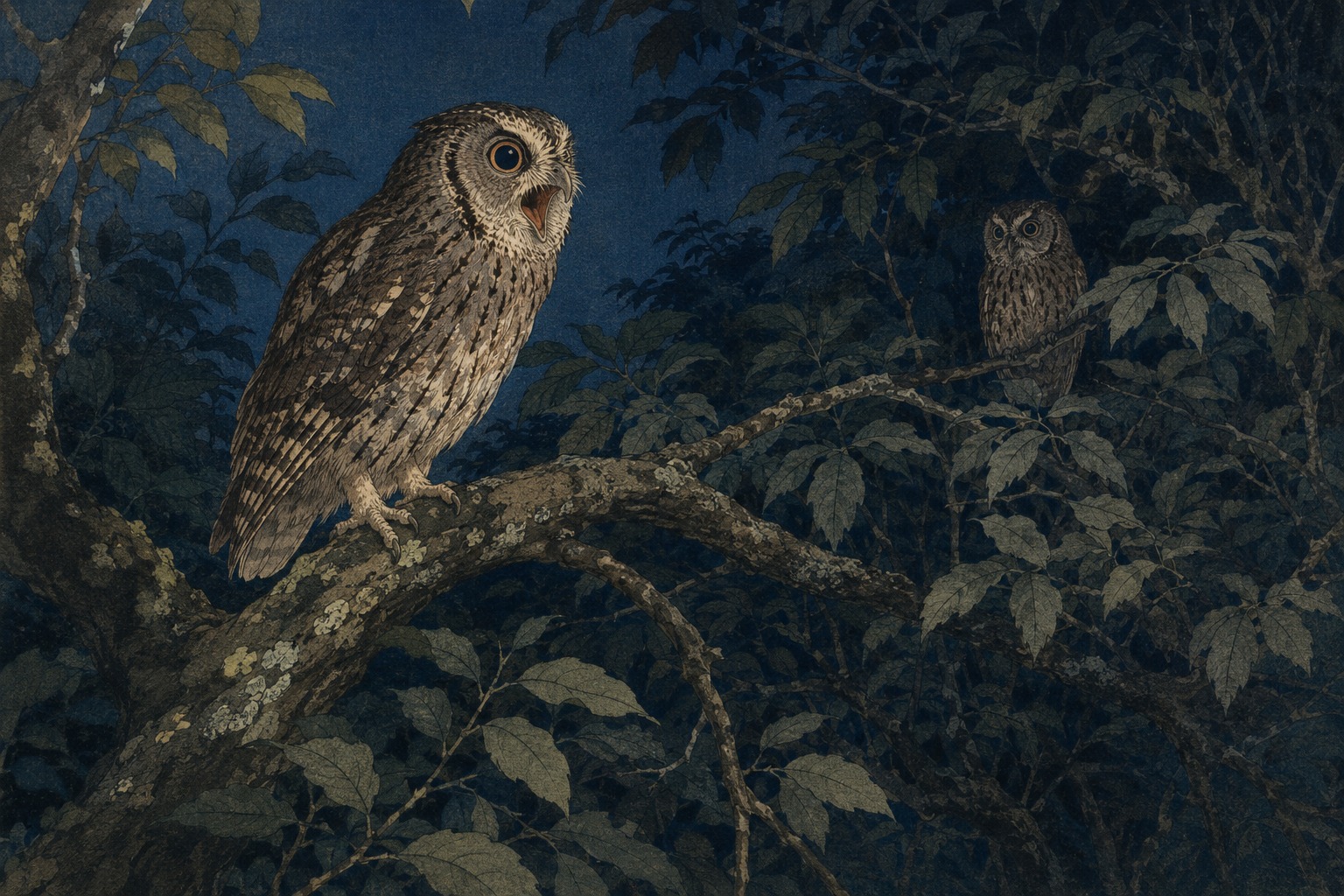
The most intimate sound in the forest had an audience. A male owl made it during copulation; another owl, hearing a recording from inside its territory, answered. So did a female. The call, it appears, may carry information beyond the pair producing it.
Researchers from Hokkaido University studied the Daito scops owl, the South Daito Island subspecies of the Ryukyu scops owl. They first recorded when the sound occurred naturally across the breeding cycle. They then played pre-laying pairs audio sequences with and without the copulation call and counted their vocal responses.
Both sexes called back more often when the copulation call was present. The owls also produced more copulation calls when audio simulated the presence of other individuals inside a territory. Together, those results are consistent with the sound helping to announce or defend a pair’s space, according to the university team.
The paper, “Ryukyu Scops Owl exhibits strong vocal responses to copulation calls produced by non-partner individuals,” appeared online in Animal Behaviour on August 22. Its authors are Naoki Kanasugi, Akira Sawada, Haruka Nakamura, Ryuta Sasaki, Junpei Hosoe and Masaoki Takagi.
First record the night; then ask the night a question
The study began with natural history rather than an immediate experiment. From February through June 2022, recorders were installed beneath nest boxes used by owls in the long-monitored South Daito population. They ran through the night during four stages: before egg laying, while eggs were being laid, during incubation and while nestlings were being raised.
The copulation call was heard only before laying. It was not detected during the other three stages. During the pre-laying period, the team recorded an average of 2.58 calls per night and detected the behavior at least 54 days before laying. From that span, the researchers estimated that a pair copulates more than 100 times in one breeding attempt.
That number requires careful reading. It is an estimate derived from the call record, not a census of every copulation by every pair. The nightly rate is not a universal constant for the subspecies. What the recordings establish more securely is timing: this was a repeated feature of a long pre-laying phase, not a sound scattered indiscriminately across incubation and chick care.
Calling is not free. It consumes energy and can disclose the caller’s position to predators and rivals. A conspicuous vocalization during a vulnerable act is therefore a reasonable candidate for adaptive function rather than incidental noise. The first season identified when the behavior occurred; the second created a controlled contrast to ask what listeners did with it.
The field test changed one element: the copulation call
In March 2023, the researchers played audio to pairs that had not yet laid eggs. One treatment included a copulation call; the comparison did not. The team recorded the experiment and quantified how often the owls called back.
Ryukyu scops owls normally answer other individuals with an advertisement call rendered in the university’s Japanese release as “kopporo.” That call can advertise a territory and attract a female—the functional counterpart of song in many small birds. The copulation call was different: a conspicuous, rapid sound rendered as “piriririri.”
The birds answered the sequences containing the copulation call more often. Both males and females changed their response in the same direction. Because the stimulus came from non-partner individuals, the result is not easily reduced to private coordination between mates.
The experiment also generated a second piece of evidence. When playback created the acoustic situation of an intruder inside the territory, the resident owls made copulation calls more frequently than under ordinary conditions. A sound tied to copulation was itself sensitive to social intrusion.
The signal begins between two birds, but its effective audience may be the neighborhood: a mate, a rival, a floater and any territorial pair within earshot.
Three hypotheses, separated by who answers
Copulation-associated vocalizations occur across mammal and bird groups, yet several different functions can produce superficially similar sounds. The Hokkaido release frames three major hypotheses. Sex-specific responses help distinguish among them.
| Hypothesis | Expected listener pattern | Fit with this experiment |
|---|---|---|
| Attract additional mates | Responses should be concentrated in the opposite sex. | The absence of a male–female response difference is difficult to reconcile with this as the sole primary function. |
| Claim or defend territory | Both sexes may answer non-partners, and the signal may increase when outsiders appear. | Both patterns were observed, making this the best-supported interpretation among the three. |
| Strengthen the pair bond | If this were the only function, a pair should not respond more to strangers’ copulation calls. | Higher call-back rates to non-partner calls make a pair-private explanation insufficient on its own. |
The logic does not require one function to exclude all others. A call can affect a mate and a rival at the same time. A behavior that originated in pair coordination might later become useful as a public territorial signal, or vice versa. What the experiment changes is the burden of explanation: a complete account now has to explain why both sexes respond to non-partners and why the call becomes more frequent in an intrusion context.
The researchers suggest that such signalling could discourage entry, help preserve the pair’s territory and reduce uncertainty over paternity for the resident male. Those are plausible downstream functions, not direct outcomes measured in the university’s summary. Playback response is several inferential steps away from fewer intrusions, genetic parentage or more surviving offspring.
What an owl “recognizes”
Recognition in a behavioral experiment has a narrow, operational meaning. An animal encounters two classes of stimulus and responds differently. Here, the presence of the copulation call altered call-back rate. That demonstrates auditory discrimination with behavioral relevance.
It does not show exactly which acoustic feature carried the distinction. The owls may attend to temporal pattern, frequency, individual identity, the juxtaposition of call types or some combination. Nor does a call-back count alone reveal whether the resident intends to approach, warn, monitor or coordinate with its partner.
Anthropomorphic labels would add drama and remove precision. The response is not evidence of jealousy, embarrassment or conscious knowledge that another pair is copulating. The study’s strength lies in the opposite move: separating stimuli, comparing sexes and counting behavior.
Hokkaido University describes the work as the first study to test sex differences in avian responses to copulation calls. That priority claim belongs to the researchers’ literature assessment; Japan.co.jp has not independently screened the complete historical literature of every bird group. The broader point is secure: the enormous literature on bird song has left many non-song vocalizations functionally underexplored.
A small owl on an isolated raised atoll
South Daito lies roughly 360 kilometers east of Okinawa’s main island, a raised coral atoll with cliffs around its coast. Permanent settlement began in 1900 when a pioneering party led by Han’emon Tamaki arrived from Hachijo Island. Sugar-cane cultivation and milling transformed the economy—and large-scale clearing transformed the forest.
The Daito scops owl, Otus elegans interpositus Kuroda, 1923, is a Japanese endemic subspecies of the Ryukyu scops owl. The Ministry of the Environment describes it as about 20 centimeters long and 90 grams, with yellow irises and intricate brown-to-rufous plumage. It is monogamous, holds a territory throughout the year and lays from late March into April.
Its principal habitat is the island’s narrow belt of woodland known locally as hagu, together with shelterbelts and small wooded sites among fields. A patchwork of nest boxes, cavities, fields and forest strips makes pairs observable. Isolation makes individuals traceable. Years of banding turn anonymous nocturnal calls into the histories of known birds.
That same isolation is dangerous. The latest national assessment says the subspecies now survives only on South Daito. A former North Daito population is presumed extinct after decades without a record. There is no large neighboring population ready to refill the island if numbers collapse.
The experiment rests on more than two decades of names and nests
Continuous banding and breeding work on South Daito began in 2002. A demographic analysis published in 2021 used the capture histories of 903 individual owls and 2,526 cumulative count observations from 2012 through 2018. It estimated a long-term average population of about 570 birds for that period and an annual population growth rate of 0.98, indicating a modest decline.
The same program found female survival slightly lower than male survival and identified predation by introduced cats and weasels during the breeding season as a likely contributor. Because females alone incubate for roughly a month, their reproductive role can expose them differently to risk. Long-term data made the sex-specific demographic pattern visible.
Other studies from the population have examined immune-gene-based mate choice, reversed sexual size dimorphism, division of parental labor, fine-scale genetic structure and voice differences among islands. In June 2026, Hokkaido University and the Yamashina Institute for Ornithology reported that plumage differed between northern and southern genetic lineages of Ryukyu scops owls. In July, another playback study found that South Daito nestlings did not distinguish related from unrelated males by hoots.
The copulation-call paper adds a new dimension: call category and listener sex. A known population allows researchers to choose the same reproductive stage, use non-partner recordings and place an experimental response inside a documented life history. The scientific asset is not merely “22 years.” It is a chain linking identity, territory, mating, nesting, survival and sound.
1900 — Permanent settlement and intensive development begin on South Daito.
1923 — The Daito scops owl is formally described as a subspecies.
2002 — Continuous banding and breeding monitoring begin.
2012–18 — Capture–recapture and count data support a detailed demographic analysis.
March 2026 — Japan’s fifth national Red List evaluates the subspecies as Critically Endangered.
August 2026 — The copulation-call response paper is published online.
The forest that remains is both habitat and historical compromise
Japan’s fifth Red List places the Daito scops owl in Critically Endangered category IA, a higher-risk category than the Vulnerable listing shown in the previous national list. Its known location count is one. The assessment estimates an extent of occurrence below 100 square kilometers and occupied habitat below 10.
Field consolidation and forest removal continue to reduce habitat. Typhoons have toppled cavity-bearing trees. Cats and weasels prey on adults, chicks and eggs. Other listed pressures include vehicles, pesticides, collisions with structures and climate change.
The nesting history resists a simple native-versus-invasive story. Native Daito fan palms once supplied cavities, but many were removed. Introduced Australian pine became a major nest tree in the altered landscape. Those trees are now aging and vulnerable to storms. The ministry describes them as a temporary bridge until a mature native palm forest can again maintain the population. Abruptly removing them would remove habitat before the replacement is ready.
Could the newly identified call help conservation? Potentially, but indirectly. A vocalization restricted to the pre-laying stage might improve acoustic estimates of breeding timing or pair activity. Passive recorders could cover places that human observers cannot watch all night. Yet playback is not passive: broadcasting a socially potent call may change behavior. Any monitoring gain has to be weighed against disturbance to a Critically Endangered island population.
The next experiment begins after the reply
The present study establishes response, not consequence. A stronger test of territorial function would follow movement: Do residents approach the speaker, patrol a boundary, remain near the nest or coordinate with a mate? Microphone arrays, thermal imaging or carefully designed location tracking could connect vocal response to space.
A second test would connect signalling to fitness. Are territories of frequent callers invaded less often? Are extra-pair offspring rarer? Do pairs retain nest sites or raise more young? Those outcomes would move “territorial claim” from a supported behavioral interpretation toward a demonstrated evolutionary benefit.
Replication matters too. This was a distinctive subspecies on one oceanic island. Ryukyu scops owl populations across the archipelago differ in genetic lineage, plumage and hoot structure. A response found on South Daito may be ancestral, locally evolved or shaped by the island’s unusually dense, year-round territorial society. Other islands and other owl species are not interchangeable controls.
Still, the result changes how the sound should be heard. It is not merely a vocal by-product leaking from an intimate act. Another owl detects it, classifies it as behaviorally different and answers. The caller may be doing two things at once: mating with its partner and broadcasting that the occupied space has a pair inside it.
On South Daito, a strip of forest can hold a nest, a year-round boundary and two decades of recorded identity. A brief call crosses all three. Its meaning will not be settled by translating “piriririri” into a human sentence. It will be settled by tracing what callers, listeners and intruders do next.
- Established: Audio containing the copulation call produced more call-backs than audio without it.
- Established: Both males and females responded, with no clear sex difference reported.
- Established: Natural calls were confined to the pre-laying stage and became more frequent in a simulated intrusion context.
- Not established: That calling actually prevents entry, preserves genetic paternity or increases breeding success.
- Not established: That the function generalizes to other islands, owl species or birds as a whole.
- Hokkaido University — Japanese research release on the copulation-call study (August 24, 2026)
- Hokkaido University — Full methods, results, figures and terminology release (Japanese PDF)
- Kanasugi et al. — “Ryukyu Scops Owl exhibits strong vocal responses to copulation calls produced by non-partner individuals,” Animal Behaviour
- Ministry of the Environment — Daito scops owl Red List assessment, life history, habitat, population and threats (Japanese)
- Ministry of the Environment — Fifth Red List for birds, reptiles and amphibians (March 17, 2026)
- Hokkaido University Faculty of Science — South Daito capture–recapture and population-demography research (Japanese, 2021)
- Hokkaido University Faculty of Science — MHC genes and mate choice in the long-term owl population (Japanese, 2020)
- Hokkaido University and Yamashina Institute for Ornithology — Ryukyu scops owl plumage variation (Japanese, June 2026)
- Hokkaido University Faculty of Science — Owlet kin-recognition playback study (English, July 2026)
- South Daito Village — Settlement history and the 1900 landing (Japanese)
- South Daito Village — Official island geography and natural setting (Japanese)
Editor’s note: The Japanese terms kōbisei (copulation call), kōkokusei (advertisement call), nawabari (territory) and the subspecies name Daito scops owl follow Hokkaido University and Ministry of the Environment usage. The university’s “first” claim is attributed to the research team’s literature assessment. The rates of 2.58 calls per night, at least 54 days and more than 100 estimated copulations are the team’s reported results, not an independent reanalysis. The four-page university release does not report the playback sample size, effect sizes or confidence intervals, so this article does not invent them. The image is an editorial illustration, not research evidence. The exchange-rate source time, August 24, 2026 at 7:47 p.m. UTC, was converted to August 25 at 4:47 a.m. Japan Time. The reference rate was not used in reporting the science.