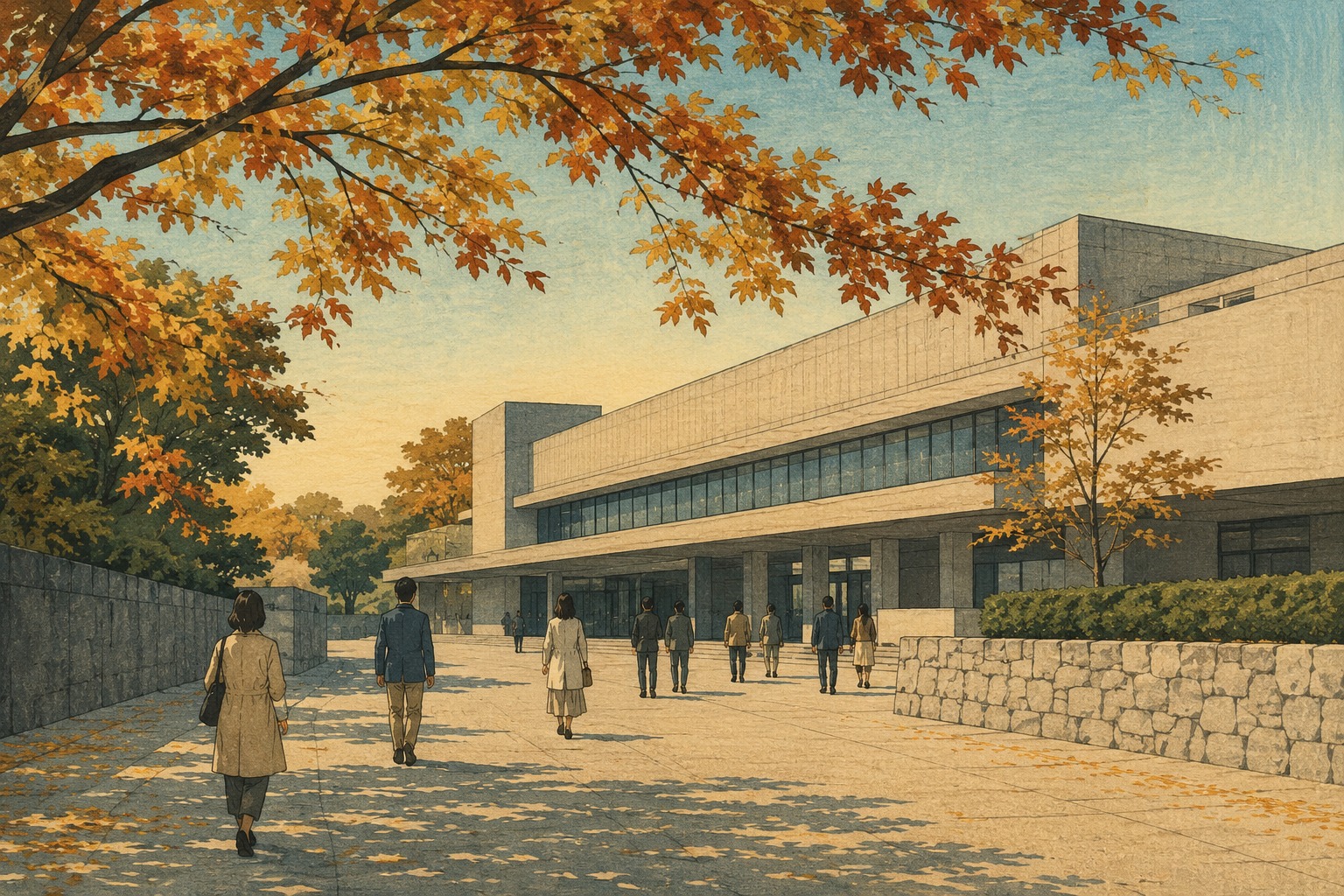
A blockbuster exhibition asks you to come once. A collection asks you to build a relationship. Japan’s national art museums have often relied on the first model: a heavily promoted loan show, a fixed run, an expensive ticket and an attendance total that becomes the story. This autumn, the National Museum of Modern Art, Tokyo is placing the quieter second model at the center.
From September 29 through November 15, the museum in Takebashi will hold the first MOMAT秋びより, pronounced MOMAT Aki-biyori. The 48-day umbrella combines a “premium” rotation of the MOMAT Collection, a magazine partnership, family programming, a Yoshitomo Nara talk and food service outside. Its title is casual rather than monumental: biyori suggests a favorable day for doing something. The proposal is that an art-museum day can be made, not merely scheduled.
That informality needs an accurate map. Aki-biyori is not a single exhibition with one start-to-finish ticket. Its core collection exhibition and the related small focus display あみ・ど・ぱり 巴里の日本人芸術家たち continue until January 11, 2027. The autumn umbrella and the display of Kaburaki Kiyokata’s three celebrated hanging scrolls end November 15. A separately ticketed Takehisa Yumeji retrospective opens downstairs on October 23. One building will therefore contain several clocks and several admission rules.
An autumn wind from 1927
The season’s headline work is not a painting of red leaves. Kiyokata’s 築地明石町 (Tsukiji Akashi-cho), made in 1927, shows a woman drawing her sleeve close on an early autumn morning. Morning glories have almost finished. A pale blue Western-style fence and ship masts dissolving into mist recall Akashi-cho when the district was a foreign settlement. Her coiffure and gold ring carry other signals of cosmopolitan Meiji life. Kiyokata made the invisible air legible through a hand at a sleeve.
In 1930, he added 新富町 (Shintomi-cho) and 浜町河岸 (Hamacho-gashi). Japan’s official cultural-heritage record treats the three scrolls as a sequence in which places personally meaningful to the Tokyo-born painter stage the streetscape and women’s dress of the late Meiji era, already receding into memory by the early Showa years. On June 27, 2023, the government designated the group an Important Cultural Property.
The works also carry a modern museum story. They disappeared from public knowledge after 1975. The museum acquired all three in 2019, returning Tsukiji Akashi-cho to view after 44 years, and presented them in a special display that November. They appeared again in the 2022 Kiyokata retrospective. The announcement’s “first time in seven years” therefore does not mean seven years without public display. It means the three will be together in the regular collection exhibition, and—according to the museum—for the first time since acquisition at the ordinary collection price.
A collection is an argument made from storage
MOMAT holds almost 14,000 objects dating from the late nineteenth century to the present: Japanese-style and oil paintings, prints, watercolors, drawings, sculpture, photography, video, calligraphy and related material. As of March 2025, 18 works or groups in the collection were nationally designated Important Cultural Properties. Roughly 200 objects appear in each edition of the MOMAT Collection, arranged across twelve or thirteen rooms and refreshed about five times a year.
This is why “permanent collection” is a misleading phrase. Light-sensitive works cannot stay out indefinitely. Conservation, new acquisitions and research continually alter the sequence. The collection is permanent as a public responsibility, not as a frozen wall arrangement. A visitor sees a temporary thesis made from long-term holdings.
Aki-biyori makes the act of selection unusually visible. The November issue of the Japanese lifestyle magazine Fujingaho, released October 1, will devote about 40 pages to “Welcome to MOMAT: An Introduction to Modern Japanese Art.” Nine figures connected to the magazine each chose one work they want to see now. The selectors named by publisher Hearst Fujingaho are Her Imperial Highness Princess Takamado, Ono Masatsugu, Sakamoto Miu, Shoji Kohei, Sugimoto Hiroshi, Nakatani Miki, Hashimoto Mari, Lee Ufan and Wada Ayaka. Their choices will form a “dream highlight room” in Gallery 1 on the fourth floor.
QR codes in the gallery will lead to the publisher’s digital material; social video will extend the collaboration off-site. This can give non-specialists a human route into an intimidating national canon. It also raises a useful institutional question. When celebrity preference, a lifestyle brand and curatorial research share one room, which voice sets the terms? The answer need not be curators alone. But the labels should let visitors understand why each work matters beyond the fame of its selector.
A national collection becomes public not when everything is displayed, but when the reasons for choosing, conserving and interpreting are made visible.
Family access is an operating system, not a children’s corner
From October 8 through 16, MOMAT will run Family Day Kodomo-MAT. The museum is closed October 13, leaving eight open days within the date range. A first-time presentation in Gallery 10, titled 物語を「みる」—literally, “Seeing a Story”—will combine works involving narrative with plot summaries and prompts for looking. On weekdays, volunteer MOMAT guides will join visitors in the gallery.
During the three-day holiday weekend of October 10–12, participatory programs will be added. The museum says it will expand nursing, diaper-changing and resting provision. Restaurant L’Art et Mikuni will bring a food truck to the forecourt, and picnic sheets will be available. These details may appear secondary beside an Important Cultural Property. They are actually the infrastructure that determines whether a caregiver can remain long enough to see it.
The family day is not new. MOMAT describes it as part of the National Museum of Art initiative “Connecting Children with Museums,” supported by the Adobe Foundation since 2024. Its premise is sharper than a conventional children’s activity: families who have avoided museums because they worry about disturbing others should be able to enter without apology. The institution, rather than the child, adjusts.
On October 9, Yoshitomo Nara will speak about his 1994 work Harmless Kitty, one of the museum’s popular holdings. The date is firm; the advance announcement did not yet provide a time, capacity or registration method. That absence should prevent third-party listings from hardening guesses into instructions. Prospective visitors should use the museum’s event page when details are posted.
| Program | Dates and place | Admission and caution |
|---|---|---|
| Autumn premium collection | Sept. 29–Nov. 15, floors 4–2; Kiyokata, Hishida Shunso, Higashiyama Kaii and others. | Adults ¥500; university students ¥250. Friday/Saturday after 5 p.m.: ¥300/¥150. |
| Family Day Kodomo-MAT | Oct. 8–16 throughout the museum; closed Oct. 13. | Collection admission rules apply to the display. Check updates for individual activities. |
| Yoshitomo Nara talk | Oct. 9; further venue and time information pending. | Capacity and registration method were not in the launch notice. |
| Forecourt food truck | Family weekend, then again from Oct. 23. | Food costs extra. Hours, menu and availability require current confirmation. |
First in name, not without precedent
The museum is correct to call Aki-biyori a first. It is the first event under that name and with this autumn-wide structure. Seasonal programming itself has a history at Takebashi. The 2026 Spring Festival brought Kawai Gyokudo’s Important Cultural Property Parting Spring out for its annual display, gathered cherry-blossom works in one room and installed a rest area and food service where visitors could see the surrounding blossoms. The MOMAT Summer Festival has used evening hours and tours. Autumn is being added to an existing rhythm, not invented from nothing.
The institution behind that rhythm opened in 1952 in Kyobashi as Japan’s first national museum of art. Its home was a converted prewar Nikkatsu headquarters building. The shortage was basic: it lacked adequate exhibition and storage space, including rooms where the collection could remain accessible.
On June 11, 1969, the museum moved to the present building near the Imperial Palace. Architect Taniguchi Yoshiro designed it; Ishibashi Shojiro, then chairman of Bridgestone Tire, donated it. From 1999 through 2001, a major project strengthened the structure and enlarged it. The Kanto Regional Development Bureau and Sakakura Associates preserved the familiar modernist exterior while extending the galleries, information facilities, restaurant and barrier-free provision.
That lineage complicates any easy opposition between a “public” museum and “private” collaboration. MOMAT’s public architecture itself arrived through private philanthropy. The relevant test for the Fujingaho partnership, foundation-supported family program or restaurant service is not whether an outside organization participates. It is whether purposes and editorial authority are transparent, public access expands, and the collection remains more than scenery for a brand.
1927 — Kiyokata paints Tsukiji Akashi-cho.
1930 — Shintomi-cho and Hamacho-gashi complete the three-scroll sequence.
1952 — MOMAT opens in Kyobashi as Japan’s first national art museum.
1969 — The Taniguchi Yoshiro building opens in Takebashi.
1999–2001 — Seismic strengthening and expansion update the museum.
2019 — MOMAT acquires and publicly presents the long-missing Kiyokata works.
2023 — The three scrolls are designated together as an Important Cultural Property.
2026 — The first MOMAT Aki-biyori begins.
What the ¥500 ticket includes—and what it does not
The collection galleries open from 10 a.m. to 5 p.m., extending to 8 p.m. Friday and Saturday. Final admission is 30 minutes before closing. Standard admission is ¥500 for adults and ¥250 for university students; after 5 p.m. Friday and Saturday, it falls to ¥300 and ¥150. High-school students and younger visitors, people under 18, those 65 and older, and a person with a disability plus one companion enter free with the required identification. Collection admission is free for everyone on Culture Day, November 3.
“Museum-wide event” does not mean every gallery is covered by ¥500. Takehisa Yumeji—An Artist Who Defined His Era opens in the first-floor special exhibition gallery on October 23 with a separate price schedule: ¥2,100 for adults, ¥1,200 for university students and ¥700 for high-school students. A collection ticket alone does not admit its holder to that special exhibition. Visitors buying a Yumeji ticket should confirm the same-day collection benefit shown by the ticket seller rather than assume two independent admissions.
Mondays are normally closed. October 12 is an exception, followed by closure on October 13; the museum also closes October 22. Takebashi Station’s Exit 1b is a three-minute walk but has no elevator. The museum directs wheelchair and stroller users to Exit 2, about 500 meters away. There is no general visitor parking at the museum.
- Go by November 15 if the complete Kiyokata triptych is the priority.
- Remember that the family program spans October 8–16 but the museum closes October 13.
- Use Friday or Saturday evening for discounted collection admission and an 8 p.m. closing.
- Treat November 3 free admission as a collection benefit; the Yumeji exhibition has separate terms.
- Recheck the official calendar for talk times, activity booking and temporary program changes.
The measure is not how autumnal it looks
A seasonal campaign can become a decorative shortcut: red leaves in the poster, a themed dessert, a slogan about the arts in autumn. MOMAT’s version will matter only if the framing changes behavior. Does a first-time family return on an ordinary day? Do readers who arrive for nine recognizable names spend time with works those selectors did not choose? Does a visitor understand why a fragile scroll disappears after November 15 rather than complain that a “permanent” work is missing?
The museum should measure more than attendance. It can study repeat visits after Family Day, dwell time beyond the highlight room, use of the evening discount and free-admission categories, transitions between forecourt and gallery, and whether digital reading sends people back to the physical object. Seasonal attention is valuable when it becomes durable public knowledge.
Kiyokata’s autumn offers the right standard. The season is not announced by a spectacular canopy. It arrives in spent morning glories, a misted mast and the pressure of a hand against a sleeve. The deepest institutional change may be equally quiet: a caregiver who no longer expects disapproval, a young visitor who recognizes a museum as a place to talk, a reader who returns after the magazine issue has left the newsstand.
If Aki-biyori produces those changes, it will have done more than make the museum look seasonal. It will have changed who can imagine having a good day there.
- The National Museum of Modern Art, Tokyo — Official MOMAT Aki-biyori announcement: dates, works, family program, talk and admission
- The National Museum of Modern Art, Tokyo — Official event page
- Hearst Fujingaho — Magazine collaboration, nine selectors and publication details
- The National Museum of Modern Art, Tokyo — Kiyokata’s Tsukiji Akashi-cho object record and interpretation
- Agency for Cultural Affairs cultural-heritage database — Official titles, readings, dates and designation of the Kiyokata triptych
- Tokyo National Research Institute for Cultural Properties — 2019 acquisition, rediscovery and display record
- The National Museum of Modern Art, Tokyo — Official review of the 2022 Kiyokata retrospective
- The National Museum of Modern Art, Tokyo — Collection size, Important Cultural Properties and rotation system
- The National Museum of Modern Art, Tokyo — Family Day Kodomo-MAT purpose and history
- The National Museum of Modern Art, Tokyo — 2026 Spring Festival seasonal display and forecourt program
- The National Museum of Modern Art, Tokyo — Kyobashi opening, Takebashi move, Taniguchi Yoshiro and Ishibashi Shojiro
- Cultural Heritage Online — Opening as Japan’s first national museum of art
- Ministry of Land, Infrastructure, Transport and Tourism — Expansion, preservation, seismic and accessibility work
- The National Museum of Modern Art, Tokyo — Takehisa Yumeji—An Artist Who Defined His Era dates and admission
- The National Museum of Modern Art, Tokyo — Collection prices, evening discount, free categories and Culture Day
- The National Museum of Modern Art, Tokyo — Hours, closure policy, transport and barrier-free route
- Imperial Household Agency — Official English title of Her Imperial Highness Princess Takamado
Editorial note: Japanese primary sources were used to verify official institutional and artwork names, Japanese readings, honorifics, dates and specialist terminology. The “seven years” claim is explicitly limited to the triptych’s appearance together in a collection exhibition; the 2019 and 2022 public displays are retained in the history. MOMAT Aki-biyori is used as a romanization of the announced Japanese event name rather than asserted as an official English title. The hero image is editorial art, not documentary photography or a foliage forecast. The supplied exchange-rate timestamp of August 24, 2026 at 7:47 p.m. UTC was converted to August 25 at 4:47 a.m. JST; the rate is not used to convert admission prices.