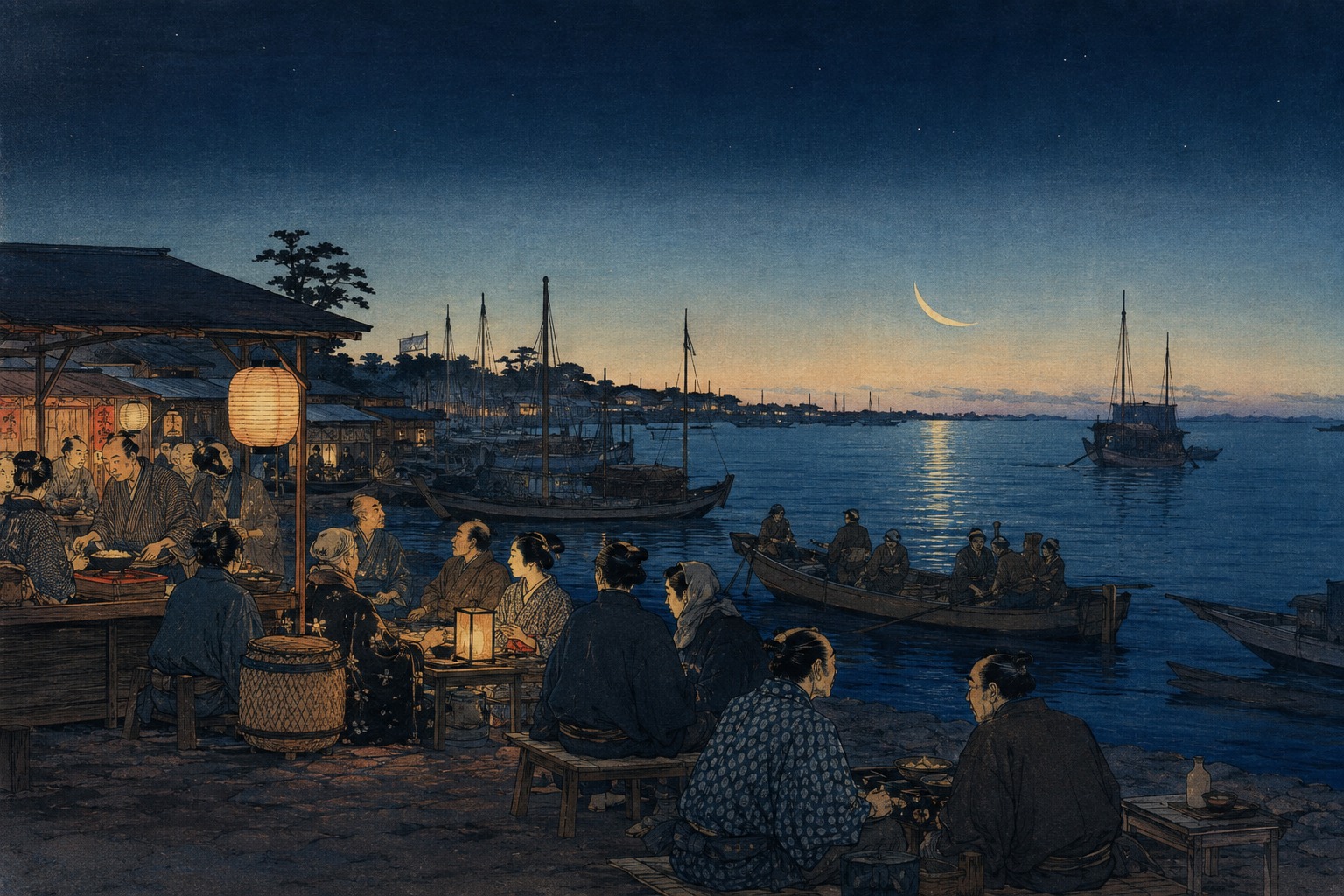
The moon was late by design. On the twenty-sixth night of the seventh lunar month, people left Edo for the open water at Takanawa and Shinagawa. They ate, drank, listened, bargained and waited. Only after midnight would a narrow waning moon lift above the bay. Tradition held that three Buddhist figures—Amida, Kannon and Seishi—could be perceived in its light.
That horizon has disappeared. The former shore now lies beneath railway infrastructure, roads and the towers of Takanawa Gateway City. Beginning September 7, MoN Takanawa: The Museum of Narratives will turn the district into a 28-day “MoON MONTH.” Its centerpiece, opening September 9, is Stories of an Edo Moonlit Night: Kitagawa Utamaro’s Moon at Shinagawa and Takanawa’s Twenty-Sixth-Night Moon Waiting.
On the fourth floor, visitors will sit or stand across roughly one hundred tatami mats while a monumental screen presents ultra-high-resolution imagery derived from Utamaro’s painting. The third-floor Sun Lab will use Utagawa Hiroshige’s art to introduce the public custom; Land Lab will give what the organizer calls “narratives” to 20 figures in Utamaro’s scene. MoN Takanawa is the host. Canon Marketing Japan planned the program, Canon directs its art, the Smithsonian’s National Museum of Asian Art supervised it, and the Tsuzuri Project run by Canon and the Kyoto Culture Association is cooperating. Admission to this installation is free and does not require a reservation.
One program, two historical nights
The exhibition’s compelling premise also creates its first danger. Utamaro’s Moon at Shinagawa is not a documentary image of the Twenty-Sixth-Night crowd at Takanawa. The Smithsonian catalogues the work as Moonlight Revelry at Dozo Sagami. It is a unique painting in ink and color on paper, mounted as a hanging scroll on a panel—not a woodblock print. Its image measures 147.4 by 321 centimeters and belongs to the Freer Gallery of Art.
The painting looks through rooms of Dozo Sagami, an entertainment establishment in Shinagawa, and outward toward the water. Music, serving, conversation and preparation occur at once across the wide surface. Tochigi City Art Museum dates the original to around 1788. Okada Museum of Art groups it with Snow at Fukagawa and Cherry Blossoms at Yoshiwara as Utamaro’s monumental “Snow, Moon and Flowers” paintings and says they are thought to have been commissioned by Tochigi’s wealthy Zenno family.
“Thought to have been” matters. The Smithsonian’s own 2017 exhibition preserved questions about the commission, dates, original display and even the nature of Utamaro’s authorship across the three works. A masterpiece can be securely attributed in a museum catalogue while parts of its production history remain unsettled. Responsible interpretation holds those two facts together.
The crowded shore comes from another image: Hiroshige’s triptych 東都名所 高輪二十六夜待遊興之図, or Amusements While Waiting for the Moon on the Night of the Twenty-sixth at Takanawa. The Edo-Tokyo Museum dates it to about 1841–42 and identifies publisher Sanoya Kihei. The British Museum describes a market and teahouses lining the waterfront. Utamaro’s room and Hiroshige’s public night are separated by site, medium, date and social scale.
A moon-viewing party without a moon
Western descriptions often flatten every Japanese lunar custom into “moon viewing.” This one was structurally different from the familiar full-moon observance on the fifteenth night. A full moon rises around sunset. A moon on the twenty-sixth lunar day is a waning crescent approaching new moon. It rises after midnight and appears briefly in the predawn sky. Waiting was not incidental; it occupied most of the event.
In 2026, the seventh month’s twenty-sixth day falls on September 7. The National Astronomical Observatory of Japan calculates moonrise in Tokyo just after that civil date begins, at 12:24 a.m. from an azimuth of 57.3 degrees, with lunar age 25.4 at noon. Anyone beginning the vigil after sunset on September 7 would encounter the next moonrise at 1:37 a.m. on September 8; on September 9 it comes at 2:50 a.m. An Edo “night” should not be severed mechanically at the modern midnight boundary. The new moon follows at 12:27 p.m. on September 11. The festival month begins on the traditional calendar date, but the Utamaro installation and the separate planetarium program start September 9. This is a cultural season, not a literal overnight reenactment.
The National Diet Library describes a belief that Amida, Kannon and Seishi appeared in the moon on the twenty-sixth nights of the first and seventh months. Astronomy can explain why the crescent rises late; it cannot authenticate a devotional image in moonlight. The point is not to ridicule belief with a timetable. It is to see how celestial mechanics created a long period in which prayer, commerce and entertainment could accumulate before the object of attention appeared.
The true subject of Twenty-Sixth-Night waiting was not simply the moon. It was the social use of the hours when the moon was absent.
The waterfront became a temporary city
The National Diet Library’s landmark history identifies Takanawa and Shinagawa as an especially active center of the custom. Its 1834 source, Edo Meisho Zue, includes an illustration titled “The Takanawa Seashore: Waiting on the Night of the Twenty-Sixth Day of the Seventh Month.” Less than a decade later, Hiroshige spread the event across three sheets.
The result is not a hushed congregation. Temporary shops and teahouses face a shore crowded with customers. Boats carry the night offshore. Performance, food and looking become inseparable. Takanawa worked because the geography did: the eastern side of Ushimachi opened directly to the sea. The Takanawa Okido gate, established in 1710, marked a boundary of Edo; the Tokaido continued south into Shinagawa, its first post station. People and goods already flowed through the corridor. Moon waiting added a different traffic after dark.
“Bustle” can conceal as much as it reveals. Every festive customer depended on cooks, sellers, servers, musicians, boat operators and people who assembled and removed temporary structures. Utamaro’s painting idealizes a celebrated pleasure district. If visitors see only graceful leisure, they may miss the gendered and hierarchical labor that produced it. An immersive show can magnify a textile pattern to architectural scale; it should also make visible who carried the meal into the frame.
| Layer | What the record supports | What it does not establish |
|---|---|---|
| Utamaro’s painting | A monumental painted interior associated with Dozo Sagami in Shinagawa; now in the Freer Gallery. | A direct record of Takanawa’s Twenty-Sixth-Night crowd. |
| Hiroshige’s triptych | An early-1840s print of market activity, teahouses, people and boats on the Takanawa waterfront. | A sequel populated by the same people as Utamaro’s room. |
| The 2026 presentation | A spatial, digital interpretation linking art, urban history and the moon-waiting custom. | Proof that its sequence or 20 character stories are Edo-period testimony. |
The shoreline was replaced by a railway
A visitor can stand in approximately the right district and still occupy a radically different landscape. In 1872, Japan’s first railway opened between Shimbashi and Yokohama. Takanawa Gateway City’s historical project says approximately 2.7 kilometers of the 29-kilometer route crossed an embankment built in the sea from earth and stone. The Takanawa Embankment placed the future of national transport directly across the moon-viewing horizon.
Later reclamation buried the structure. Parts of its stonework reappeared in 2019 during Shinagawa Station improvement work. Archaeological investigation confirmed remains from the opening railway, and in 2021 they were added to the nationally designated historic site officially named 旧新橋停車場跡及び高輪築堤跡—the Former Shimbashi Station and Takanawa Embankment Site. Two preserved sections are planned to open to the public in spring 2028.
The transition is not a simple morality tale of natural Edo destroyed by industrial Meiji. The embankment enabled a railway and included passages for fishing boats. It also initiated a physical separation between shore and open water that reclamation would complete. The site now carries several urban eras at once: coastal observance, railway engineering, rail yard and mixed-use redevelopment. The most valuable illusion the giant screen could offer may not be animated figures. It may be the return of a horizon at human scale.
1710 — The Takanawa Okido gate is established at Edo’s boundary.
About 1788 — Date assigned to Moon at Shinagawa by Tochigi City Art Museum.
1834 — Edo Meisho Zue publishes the Takanawa waterfront moon-waiting scene.
About 1841–42 — Hiroshige’s three-sheet view of the gathering is published.
1872 — Japan’s first railway opens over the Takanawa Embankment.
1903 — Charles Lang Freer acquires Utamaro’s painting in Paris.
2019–21 — Embankment remains are found, investigated and nationally designated.
September 2026 — The painting becomes the center of an immersive presentation in Takanawa.
A painting that cannot travel returns as data
The painting has its own geography of removal. Okada Museum says the earliest record of all three “Snow, Moon and Flowers” works together is an exhibition at Joganji temple in Tochigi on November 23, 1879, where the Zenno family displayed them. The pictures later reached the Paris art market and were dispersed. Freer bought Moon at Shinagawa through dealer Siegfried Bing at the 1903 sale of Hayashi Tadamasa’s collection.
Freer’s will prevents his collection from leaving the institution. When the three monumental pictures were reunited conceptually for the 2017 exhibition Inventing Utamaro, a facsimile stood in for Moon at the partner museums. The restriction is central to the Tsuzuri Project’s purpose: high-resolution imaging, color management, printing and Japanese mounting techniques allow works held abroad or rarely displayed to become accessible elsewhere.
MoN Takanawa takes another step, treating the captured image as material for a screen-based environment. Scale and guided detail can help viewers comprehend a painting far wider than the reach of both arms. But a painting presents simultaneous action and lets the eye choose its route. Projection assigns duration, sequence and emphasis. It is not only a method of approaching the original. It is a new authored work made from the original.
- Does it visibly distinguish original image data, historical interpretation and newly created scenes?
- Are names, relationships and emotions for depicted people tied to identifiable evidence?
- Does it show the labor of hosting, cooking, carrying and performing, not only the customers’ pleasure?
- Does it preserve the differences between Takanawa and Shinagawa, interior and shore, 1788 and the 1840s?
- Can visitors return from the spectacle to the complete painting, Hiroshige’s triptych and primary records?
Whose voices are the “20 narratives”?
The organizer’s promise to tell an individual story for each of 20 depicted people could counter the flattening category of “beauties.” A server turning through a doorway, a musician preparing an instrument and a figure seen only in profile can become distinct presences once attention slows down.
Yet a narrative is not a biography. The advance materials reviewed for this article do not state which texts, costume studies or establishment records support each character story, or how conjecture will be labeled. Supervision by a major museum is valuable but not a substitute for visible sourcing. An invented name or inner monologue may create empathy while also making a historically constrained worker seem to speak freely across 238 years.
The same applies to “revival” and “recreation.” No continuous communal or devotional practice is being restored on the former shore. The custom is being reinterpreted through high-resolution imagery, a planetarium, costume performance, food and workshops. Cultural transmission need not duplicate an old form. It does need to say what changed.
A practical guide to four overlapping programs
The free Utamaro-centered installation runs September 9 through October 4, from 10 a.m. to 9 p.m., in Tatami, Sun Lab and Land Lab. The venue warns that spaces may close during other events.
A separate immersive planetarium, Evening of Moon Waiting, runs September 9–26, except September 12, in the second-floor Box300. Takayuki Ohira created the program, Kenjiro Tsuda narrates and Kundo Koyama is planning producer. The 20-minute daytime presentation costs ¥500; evening admission is ¥1,500 with one drink. “MoON MONTH” itself runs September 7–October 4 and mixes free, paid, reserved and walk-in activities. The broader Takanawa Tsukimachi event across Takanawa Gateway City is September 7–13.
| Program | When and where | Admission |
|---|---|---|
| Stories of an Edo Moonlit Night | Sept. 9–Oct. 4, 10 a.m.–9 p.m.; Tatami, Sun Lab and Land Lab. | Free, no reservation. Temporary closures possible. |
| Evening of Moon Waiting | Sept. 9–26, closed Sept. 12; Box300. | ¥500 daytime; ¥1,500 evening with one drink. |
| MoON MONTH | Sept. 7–Oct. 4 throughout MoN Takanawa. | Conditions vary by activity. |
| Takanawa Tsukimachi | Sept. 7–13 across Takanawa Gateway City. | Food, art and performances have separate terms. |
Do not consume the waiting
There is no need to sentimentalize Edo residents as people who knew how to live slowly. Twenty-Sixth-Night waiting was also a business opportunity, a crowd-control problem and a night shift. Yet nobody could accelerate moonrise. Guests, vendors and boat operators shared submission to the same celestial clock.
Immersive exhibitions generally move in the opposite direction. Images change, sound directs emotion and highlights arrive on schedule. A show about moon waiting therefore faces an unusual artistic test: can it respect the interval when nothing happens? If every figure moves, every mystery receives narration and the moon appears exactly when the program needs a climax, the experience may make Edo’s night too efficient.
Success should be measured by more than atmosphere. Can a visitor leave remembering that Utamaro and Hiroshige made different images? Can the absent water be connected to the stones of the railway embankment underfoot? Can the pleasure of the customers be held beside the work of those who served them? Can a dark window remain interesting after the screen goes black?
At 12:24 a.m. on September 7, the moon will still rise over Tokyo. It will not emerge from the open horizon Edo residents knew. The exhibition cannot return that shore. It can return a measure of how much the landscape has changed—and perhaps make room, among one hundred tatami mats, for the old discipline of attending to what has not yet appeared.
- JR East Culture Foundation — Official MoON MONTH announcement, program credits, dates and admission
- MoN Takanawa — Official program page for the Utamaro presentation
- Takanawa Gateway City — Official Takanawa Tsukimachi guide
- National Diet Library — Takanawa, the Twenty-Sixth-Night custom and historical sources
- Tokyo Museum Collection / Edo-Tokyo Museum — Hiroshige triptych catalogue record
- British Museum — Hiroshige triptych title, format and scene description
- Smithsonian Institution — Moonlight Revelry at Dozo Sagami object record
- National Museum of Asian Art — Inventing Utamaro, provenance and open research questions
- Okada Museum of Art — The “Snow, Moon and Flowers” paintings and their dispersal
- Tochigi City Art Museum — Official Japanese title, approximate date and original collection
- Canon — Tsuzuri Project purpose and reproduction process
- National Astronomical Observatory of Japan — Tokyo moonrise, azimuth and lunar age for September 2026
- National Astronomical Observatory of Japan — 2026 lunar phases
- Takanawa Gateway City — Takanawa Embankment history, discovery and public-access plan
- Cultural Heritage Online — Official historic-site name for the former Shimbashi Station and Takanawa Embankment
Editorial note: Japanese primary sources were used to verify official titles, readings, institutional names, program credits and specialist terms. The Smithsonian’s primary records support the English object title, dimensions, collection history and unresolved scholarly questions. The specific content and sourcing of the exhibition’s “20 narratives” could not be reviewed before opening and is therefore not presented as historical fact. The hero image is editorial art, not documentary photography or a reproduction of the exhibition or any historical artwork. The exchange-rate timestamp supplied as August 24, 2026 at 7:47 p.m. UTC was converted to August 25 at 4:47 a.m. JST; the rate is not used to convert the program’s yen prices.