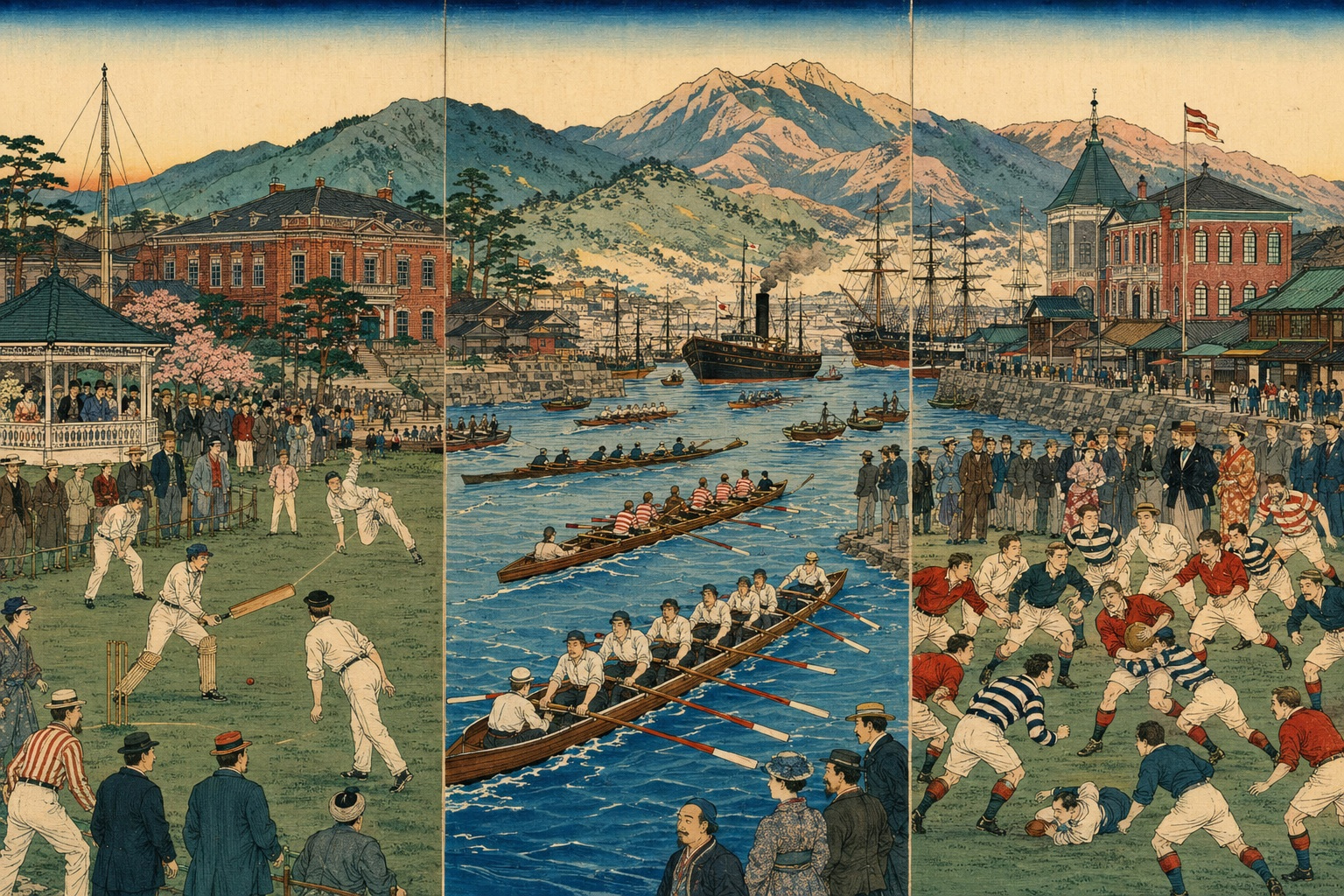
The live story is a tale of two construction sites
Kobe’s two oldest international clubs have reached 2026 in opposite physical conditions. At Isogami Park, Kobe Regatta & Athletic Club—KR&AC—operates two artificial-turf courts opened in 2025, takes visitor bookings and advertises weekly indoor soccer, battodo and hockey. In Kitano, the Kobe Club’s permanent premises are closed for a complete rebuild, with reopening scheduled for spring 2027.
The contrast is more than real estate. KR&AC was created to make sport happen: boats, a gymnasium, a shared ground, fixtures and rivals. Kobe Club was created to make community happen: a bar, library, billiards, conversation and the durable rituals of a small foreign population. Their functions overlapped, but they were never interchangeable.
Together they form a missing half of Japan’s treaty-port story. Yokohama supplied older clubs and an essential rival; Kobe supplied a compact port where the settlement, the mixed-residence district, the mountains and the sea pressed close together. Modern sport did not move along a one-way route from “the West” to “Japan.” It moved between ports, ships, clubs, schools and Japanese organizations. Kobe was one of the network’s busiest switches.
Kobe opened late—and developed fast
Hyogo port opened to foreign trade on January 1, 1868. Kobe City’s official modern-history project says the planned settlement was still unfinished, and construction was not completed until June 26. The formal enclave covered a seaside grid of a little more than 25 cho, bounded approximately by today’s Flower Road in the east and Koikawa-suji in the west.
The delay produced a feature that distinguished Kobe. Authorities allowed Japanese and foreign residents to live in a wider mixed-residence district stretching west of the old Ikuta River toward the Uji River and north to the foothills. Foreign merchants worked in the settlement but often lived on higher ground. The city credits this proximity with helping create Kobe’s tolerant, cosmopolitan haikara culture.
That does not make the unequal-treaty order benign. Extraterritoriality and the designated settlement embodied an unequal legal system. But Kobe’s urban form created repeated points of contact outside the office: the promenade, hills, harbor, gymnasium, club bar and Recreation Ground. Sport was especially portable. It needed rules and equipment, but it also needed bodies, opponents and space. Once Japanese residents watched, joined, copied or built their own institutions, the club could no longer control what the game became.
Kobe Club came first as the settlement’s living room
On May 1, 1869, 27 foreign men founded the English Club—also called the International Club—in the “Native Town” near present-day Motomachi. The following year it moved into the foreign settlement and took the name Kobe Club. In 1879, growing membership prompted another move to Kano-cho.
The building completed there in 1890 was designed by British architect Alexander Nelson Hansell. Kobe City Library describes it as one of his masterpieces, a harmonious stone-and-brick structure south of the Recreation Ground. The Club’s own history remembers a bar with what it says was Japan’s longest counter, together with a library, billiards room, bowling alley and lounge.
Those rooms mattered to sport even when no match was played inside them. Clubs stabilized a transient merchant population. They provided committees, notices, introductions, team selection and the afterlife of a fixture. They also enforced membership boundaries. “International” in 1869 did not mean socially universal; the founders were foreign men in a legally privileged settlement. The institution’s later history is partly the story of how that narrow constituency widened.
The 1890 building was destroyed in the 1945 air raids. After the war, the Club sold the Kano-cho property, acquired the former Tor Hotel site in 1955 and completed the Kitano clubhouse and facilities in 1956. When the Great Hanshin-Awaji Earthquake struck in 1995, the building survived and sheltered about 200 displaced people. A private social club briefly became civic emergency infrastructure.
A pharmacist, an hotel notice and 32 enthusiasts
KR&AC began on September 23, 1870, at a meeting in the Oriental Hotel. A notice in the Hyogo News brought Scottish pharmacist and all-round athlete Alexander Cameron Sim together with 31 other enthusiasts. The foreign population, excluding Chinese residents, was only about 300. Organizing 32 people was therefore not a casual turnout; it represented a substantial share of the small Western community.
Within six months the new club had a prefabricated boathouse and gymnasium at the southern edge of the settlement, near the present Kobe Customs House at the foot of Flower Road. KR&AC says it held the first regatta in Kobe and Kansai there on December 24, 1870, with Sim as umpire and starter.
The Japan Rowing Association independently places KR&AC in its national chronology. It records the 1870 formation by Sim and other British merchants and the match with Yokohama Rowing Club as the beginning of Japan’s first regular regatta series. Its chronology also prevents overclaiming: competitive boat racing had already been documented in Nagasaki in 1861 and Yokohama in 1863. Kobe’s distinction was not the first boat race anywhere in Japan. It was the creation of a recurring club and interport system in Kansai.
The steamer to Yokohama made a national circuit
In 1871, according to KR&AC, the Kobe crew traveled by steamer to Yokohama to face Yokohama Rowing Club and Nippon Rowing Club. The railway did not yet connect the two ports. Athletes, boats, rules and results therefore moved along the same maritime routes as mail, news and trade.
This was the core technology of the “interport” match. A small local club could maintain standards because it had a distant rival. Annual travel turned scattered expatriate pastimes into a calendar. The rivalry later encompassed football and other sports, and it survived changes in clubs, grounds and political orders.
Interport competition also complicates birthplace claims. If a Kobe–Yokohama fixture was essential to both cities, neither city alone owns the beginning. The innovation was the relationship: notice, voyage, agreed rules, return match and memory. Modern Japanese sport was being assembled as a network before it became a national bureaucracy.
The Recreation Ground was the breakthrough
Facilities were precarious. In 1872, KR&AC sought more secure athletic space with assistance from Hirobumi Ito, later Japan’s first prime minister. In 1875, land was designated “as a perpetual trust for the common recreation of Foreigners and Japanese” and became the Recreation Ground—the site associated with today’s Higashi Yuenchi.
The wording matters. It did not erase the settlement’s hierarchy, but it stated a shared civic purpose. KR&AC records its first athletic sports there in May 1877 and a new gymnasium the next year. Kobe City notes that the gymnasium also functioned as a theater, known as the “gymnasium theater” or “settlement theater.” Sport, drama and sociability were housed in the same institution.
Cricket, tennis, athletics, regattas, football, yachting, billiards and cycling all appear in the city’s account of settlement life. That list is evidence of an active sports ecology, not proof that KR&AC single-handedly introduced each activity to Japan. Other foreign clubs existed, visiting ships supplied opponents, Japanese schools developed separate programs, and different ports have earlier documented claims for some sports.
Football’s oldest rivalry needs a precise label
KR&AC’s history dates a match against Yokohama’s YC&AC to February 18, 1888, calls it Japan’s first official football match and records Kobe as the winner. The Japan Football Association’s centenary chronology independently identifies the YC&AC–KR&AC interport meeting as Japan’s oldest club rivalry.
The safe claim is therefore strong but narrow: the Kobe–Yokohama fixture is recognized by JFA as Japan’s oldest interport club match, while the exact February date and the “first official match” wording come from KR&AC’s own archive. “Football” in the late nineteenth century also did not always map cleanly onto today’s separation of association football and rugby.
JFA’s broader chronology shows why this distinction matters. It dates Yokohama’s first foreign-resident football club to 1866 and the standard account of Japanese students learning the game in Tokyo to the 1870s. The interport match was a landmark in club competition; it was not the moment at which every Japanese football history began.
Cricket and rugby deserve the same discipline. Kobe City confirms that cricket and several forms of football were played actively in the foreign community. KR&AC says it helped develop rugby, tennis and hockey and staged cricket, baseball and other sports. Public primary evidence available for this article does not justify a single “first cricket match” or “first rugby match” claim for the Club. Kobe’s importance lies in continuity, breadth and repeated exchange.
When the settlement ended, the clubs had to become Japanese institutions
The revised treaties took effect in July 1899, ending the foreign settlement and extraterritorial order. KR&AC could no longer exist inside a semi-autonomous enclave. Port expansion also pushed its waterfront facilities east. In 1900 it moved its rowing and aquatic base roughly four miles to Mirume, while retaining the Recreation Ground center.
The next four decades were a sporting high period in the Club’s account: athletics, rowing, swimming, water polo, sailing, yachting, lawn bowls and tennis. In 1905, Japanese authorities registered KR&AC as a shadan hojin, a nonprofit corporate body. This legal change is crucial. The foreign club survived by becoming an entity recognized under Japanese law.
The relationship with the wider country was not confined to sport. After the 1923 Great Kanto Earthquake, KR&AC says it opened facilities to refugees from Yokohama. That response prefigured both Kobe clubs’ roles after the 1995 disaster.
War removed the water, the ground and finally the club
By the 1930s, reclamation had left the Mirume boathouse effectively inland. KR&AC added a seawater pool, but in 1939 it was forced to sell the property to Kobe Steel as wartime industry expanded. A replacement at Fukae was acquired and built in 1940, then forced into sale before it could be used.
The pressure intensified. Police closed the Club at the end of 1941 and later allowed it to reopen under monitoring. The army commandeered the Recreation Ground clubhouse and gymnasium in January 1944. A Kitano property was destroyed in air raids. By July 1945, the wartime committee suspended all activity.
Kobe Club likewise halted operations, and Hansell’s 1890 clubhouse was lost in the bombing. These histories should not be softened into generic “challenges.” The Asia-Pacific War broke the clubs’ property base and international community, while the air raids devastated the city around them.
Postwar survival required another move
KR&AC resumed limited life at its Shoiya premises in October 1945. The Recreation Ground passed from Japanese military control to Occupation control. The town premises were returned in June 1952, and the Club formally reopened on February 14, 1953.
Its old central position did not last. Kobe City wanted to reshape the area and relocate the Club to Isogami Park. Members accepted terms in December 1961, transferred the Recreation Ground premises on February 6, 1962 and opened the present Isogami base about six months later.
That move changed the institution’s geography but kept it astonishingly close to its origin. Isogami Park lies east of Sannomiya, within walking distance of the old settlement and the waterfront. In the 1995 earthquake, KR&AC opened its building to victims and surrendered its sports ground for more than a year as debris storage. President Kenichi Mikitani’s current message adds that city staff issued disaster certificates from the Club building after the damaged city hall became unusable.
KR&AC in 2026: old name, public-facing facilities
KR&AC remains a members’ club, but its official facilities page repeatedly says nonmembers may use facilities and asks visitors to call reception. The current complex lists a gymnasium, fitness room, ballet studio, meeting and reception hall, billiards, darts and table tennis, two lit tennis courts and two artificial-turf courts. The restaurant is currently closed for regular dining; the Club says a coffee shop remains open to nonmembers.
The newest investment is the KR&AC Field. The two 34-by-17-meter artificial-turf courts began operation on February 1, 2025. The field page, updated with 2026 annual-booking information, advertises use for futsal and other sports and recreation, with changing rooms, showers and visitor or recurring reservations. Published field hours are 10:00–22:00, Tuesday through Sunday, with telephone reservations taken 10:30–17:30.
The weekly program is strikingly hybrid. Japanese and international participants are invited to indoor soccer, indoor hockey and battodo. A ballet studio led by Ukrainian dancers offers age-based and adult classes. Tennis courts accept visitor rental. The modern club is less a preserved British sporting enclave than a small urban platform on which imported, Japanese and newly international activities coexist.
Kobe Club in 2026: rebuilding continuity
Kobe Club incorporated as a general association in 2014 and says its membership now represents more than 30 countries across diplomatic, academic, medical, research and private-sector life. Its 150th anniversary in 2019 affirmed continuity with the 1869 founders—but the physical institution is again between buildings.
The Kitano clubhouse at 4-15-1 Kitano-cho is closed for reconstruction. The official plan targets spring 2027, retains the front gate, about 70 percent of existing greenery, the swimming pool and driveway, and adds 15 condominium residences. The project is a collaboration with Hankyu Hanshin Properties, with construction by Takenaka Corporation.
The development poses the defining question for an old international club: how much continuity is architectural, and how much is social? Preserving trees, gate and pool gives the new complex visible memory. The harder test will come after reopening—whether the Club can again convert an exclusive address into exchange that matters to the wider international city.
Verified addresses, telephone numbers and direct websites
Details below were checked July 18, 2026 against each club’s live contact pages. KR&AC’s access-page body contains an extra punctuation mark in the email address; the correct address below is corroborated by the site footer. Kobe Club’s Kaigan-dori office is the operating contact during construction; the Kitano property is not open for visits.
| Organization or service | Verified contact | Direct website |
|---|---|---|
| Kobe Regatta & Athletic Club | 1-20, 2-chome, Hachiman-dori Chuo-ku, Kobe 651-0085 Tel: 078-231-2271 Fax: 078-221-5702 kobe.regatta.and.ac@gmail.com Club: Tue–Sun 10:30–21:00 Office: 10:30–18:00 | official home page access and current hours history |
| KR&AC facilities and field | Same Isogami Park address and telephone Field: Tue–Sun 10:00–22:00 Last reception 21:00 Telephone booking 10:30–17:30 Closed Monday; holiday Mondays can shift closure to Tuesday | facilities field availability and booking sports and classes |
| Kobe Club reconstruction office | Second Wanli Building, Room 200 2-2-1 Kaigan-dori, Chuo-ku Kobe 650-0024 Tel: 078-958-9952 Fax: 078-958-9957 kobeclub@office.email.ne.jp | kobeclub.org current office and contact reconstruction plan |
| Kobe Club permanent property | 4-15-1 Kitano-cho, Chuo-ku Kobe, Hyogo 650-0002 Closed during reconstruction Reopening scheduled spring 2027 | official history official notices |
| Public transport | KR&AC: about 15 minutes on foot from Sannomiya stations; about 4 minutes from Port Liner Boeki Center Station Kobe Club: do not travel to Kitano during closure; contact the Kaigan-dori office | KR&AC directions Kobe Club office map |
Upcoming events and recurring programs found
No public, one-off post–July 21 event was posted by either club when checked July 18. Kobe Club’s public news page carries the reconstruction notice rather than an event calendar. KR&AC does publish recurring programs and accepts visitors for several of them. Dates below show the next normal session after publication, calculated from the weekly schedule; holidays, private bookings and instructor changes can override it. Telephone confirmation before travel is essential. Times are Japan Standard Time.
| Next normal time | Program | Published access and fee |
|---|---|---|
| Thu, Jul 23 13:30 | Battodo / “Samurai Team” KR&AC third-floor gymnasium | Beginners, Japanese and international participants welcome. Member free; visitor ¥1,500; first visit advertised free. Confirm the session with the office. |
| Thu, Jul 23 19:00 | Indoor soccer KR&AC third-floor gymnasium | Beginners welcome. Member free; visitor ¥1,500; first visit advertised free. The facilities page contains an older Wednesday reference, but the dedicated class listing says Thursday; confirm. |
| Sun, Jul 26 10:00–12:00 | Indoor hockey KR&AC third-floor gymnasium | Beginners, women and men welcome. Member free; visitor ¥1,000; first visit advertised free. Confirm before attending. |
| Tue–Fri 10:00–16:00 | Tennis court rental | Members free; visitor rate published as ¥2,500 per court per hour. Reservation required. |
| Tue–Sun 10:00–22:00 | KR&AC artificial-turf field bookings | Visitor single bookings and recurring-use inquiries accepted subject to the current annual schedule. Telephone 078-231-2271. |
| Date by inquiry | Ukrainian Odessa ballet / Just Dance and KR&AC English | The Club advertises visitor participation, but its English-class page contains conflicting third- and fourth-Saturday wording and says dates may change. Ask the office rather than relying on a calculated date. |
| Through spring 2027 | Kobe Club reconstruction | Not a public event. The Kitano premises are closed. The project page says completion and reopening are scheduled for spring 2027; current inquiries go to the temporary office. |
What “birth of modern sport” should mean
The phrase is useful only if it describes a process. Kobe’s foreign residents organized clubs, bought equipment and wrote fixtures into calendars. Ships provided teams. Yokohama provided a recurring rival. Japanese spectators, students, officials and later governing bodies observed, participated, translated rules and built institutions of their own.
The documentary record supports several specific propositions. KR&AC was founded on September 23, 1870. It held an early Kansai regatta that December. The national rowing body recognizes its 1870 interport link as the beginning of Japan’s first regular regatta series. The JFA recognizes the Kobe–Yokohama game as the oldest interport football match. Kobe City identifies KR&AC as Kobe’s first full-fledged sports club and the Recreation Ground as a center of both sport and entertainment.
The evidence does not support saying KR&AC invented every modern sport in Japan. Nagasaki has the earlier documented competitive rowing race. Yokohama has earlier football and cricket clubs. Japanese schools and associations created their own lineages. Cricket, rugby and athletics moved through multiple channels. Accuracy makes Kobe’s achievement more interesting, not less: the Club made isolated play into durable infrastructure and connected Kansai to a national and international circuit.
The clubs survived by becoming more local
Both clubs began as shelters for foreigners. Their most honorable moments came when they served people beyond that founding constituency: refugees in 1923, earthquake victims in 1995, municipal disaster work after city hall was damaged. Legal incorporation, relocation to Isogami Park, Japanese membership and public visitor programs gradually tied the institutions more closely to Kobe.
That adaptation continues. KR&AC’s rowing disappeared when the waterfront moved, yet the word “Regatta” keeps the origin visible. Two compact futsal courts now occupy its field, while indoor hockey shares a gym with battodo and Ukrainian ballet. Kobe Club’s new home will preserve trees and a pool while embedding residences in the site. Neither is a museum piece.
The lasting geography is the city itself. From Kaigan-dori and the former settlement to Higashi Yuenchi, Isogami Park and the Kitano foothills, Kobe still compresses port, public space and international community into a walkable corridor. Foreign clubs helped modern sport take root there. The deeper achievement was that the roots escaped the clubs.
Sources and further reading
- Kobe Regatta & Athletic Club: official history, including formation, early regatta, interport competition, Recreation Ground, war, relocation and earthquake service; current home page and president’s message.
- Kobe City: formation of the foreign settlement and mixed-residence district; Western culture and sport in the settlement.
- Japan Rowing Association: national rowing chronology; Japan Football Association centenary chronology.
- Kobe Club: official history; Kobe City Library on A.N. Hansell and the 1890 clubhouse.
- Kobe Club reconstruction plan; temporary office and contact; current notices.
- KR&AC facilities; field hours and booking status; sports and classes; address, hours and access.
Editor’s note: Research was checked through July 18, 2026. Historical “first” claims are attributed at the level the evidence supports. KR&AC supplies the February 18, 1888 date and “first official football match” wording; JFA independently describes the YC&AC–KR&AC fixture as Japan’s oldest interport match. The Japan Rowing Association’s national chronology is used to distinguish the regular Kobe–Yokohama regatta tradition from earlier recorded races in Nagasaki and Yokohama. No post-publication one-off event was found on either club’s public site; recurring KR&AC sessions are listed with a confirmation warning. The exchange-rate strip supplied for this edition is reproduced exactly, with its UTC update converted to July 19, 2026 at 4:07 AM JST. The hero is a contemporary digital editorial illustration, not a historical print, photograph or match record.