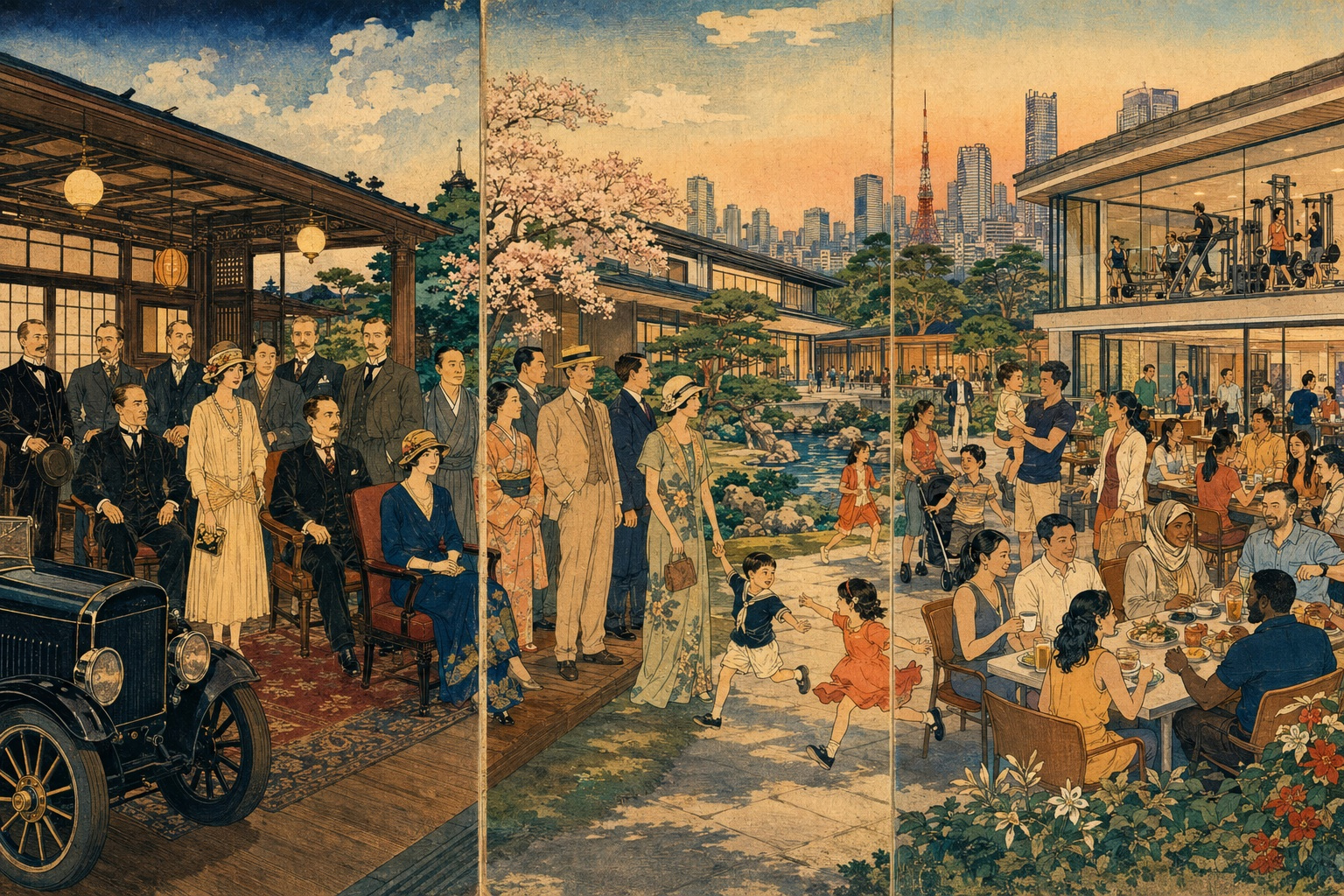
The institution between the embassy and the living room
Tokyo has organizations that argue policy, represent countries and report the news. Tokyo American Club does something quieter. It supplies the repeated encounters that happen before a formal relationship exists: a new arrival asks another parent about schools, an executive meets a neighbor over breakfast, children join a team, a family marks a holiday, a volunteer learns about a Tokyo nonprofit, and a visiting speaker faces a ballroom containing several worlds at once.
That makes the Club the social counterpart to the American Chamber of Commerce in Japan, but not a branch of it. ACCJ is a business association whose committees advocate on trade, taxation, technology and regulation. Tokyo American Club is a private, member-owned and member-governed nonprofit whose mission is social, recreational, business and cultural life “in the American tradition.” The constituencies overlap; the mandates do not.
The overlap is visible. On July 1, 2026, ACCJ staged its United States 250th-anniversary “Night of Stars and Stripes” at Tokyo American Club. The chamber supplied the institutional network and program; the Club supplied the room, hospitality and social setting. This division of labor is one reason foreign institutions cluster in Tokyo: advocacy needs places where trust can be practiced informally.
1928: an American club in a strained bilateral moment
Fifty-one American members of the established Tokyo Club created their own organization and opened it on May 23, 1928. The context was not neutral. Four years earlier, the United States Immigration Act of 1924 had excluded immigration by people ineligible for naturalization, a provision directed in practice at Asians and bitterly received in Japan. Tokyo American Club’s own history says the law probably was not the practical cause of the breakaway, but it correctly places the founding inside that atmosphere.
The immediate motive was more social. Contemporary accounts described American businessmen wanting an evening venue where they could bring wives or companions. Each charter member contributed $500. They leased the top three floors of the Iwamoto Building in Yurakucho, opposite Frank Lloyd Wright’s Imperial Hotel, with views toward the Imperial Palace.
The first premises already reveal more than a men’s bar. There were two restaurants, a general lounge, a women’s lounge, a women’s card room and modern conveniences including heat and a telephone. Demand arrived quickly: within months the Club counted 200 active resident members and 75 associates. In seven years, it had outgrown its first home.
Marunouchi elegance, surveillance and closure
In 1935 the Club moved to a remodeled pair of connected buildings at Naka 10 No. 8 in Marunouchi. With a canopied entrance, library, billiard room, dining rooms and separate bars for men and women, it became a center of expatriate social life in the business district.
Politics followed members through the door. The Club’s history records suspicions that Japan’s military police had bugged tables and that Soviet spy Richard Sorge visited. With the outbreak of the Pacific War, the Club closed. Two Japanese members protected its property while interned members signed a liquidation agreement, allowing the assets to be sold for ¥43,000. A 1942 newspaper item speculated about liquor left in the building; the story survives because even in dissolution, the bar had become part of the legend.
The closure is the sharpest reminder that private sociability does not float above international relations. When the state relationship collapsed, the expatriate room disappeared with it.
1949: reopening, families and a new public purpose
Tokyo American Club reopened in its former Marunouchi quarters on July 4, 1949, with 350 members. Regaining both its name and the lease took intervention associated with General Douglas MacArthur; three American banks extended credit and allowed overdrafts while the organization re-established itself.
Postwar membership was different. Businesspeople arrived with spouses and children, and from 1951 to 1953 the board made two decisions that would define the modern Club. Family services became a priority. The organization also became a Foreign Ministry-sanctioned nonprofit incorporated association, or shadan hojin, with cultural exchange written into its purpose.
This was more than administrative housekeeping. A prewar expatriate refuge was being recast as an institution with obligations to the society around it. The tension between sanctuary and exchange—between a “home away from home” and a bridge into Japan—has remained ever since.
Seven chapters in bricks and geography
| Period | Club home | What changed |
|---|---|---|
| 1928–1935 | Iwamoto Building, Yurakucho | Fifty-one founders created an evening social club; membership expanded within months. |
| 1935–1945 | Naka 10 No. 8, Marunouchi | An elegant expatriate institution encountered espionage fears and closed during the war. |
| 1949–1954 | Reopened Marunouchi clubhouse | The Club returned with 350 members, emphasized families and took on a cultural-exchange mission. |
| 1954–1974 | First Azabudai clubhouse | A controversial one-vote move brought space, the first pool and a growing Japanese membership. |
| 1974–2007 | Rebuilt Azabudai complex | Larger family and recreation facilities drew Americans, Japanese and many other nationalities. |
| 2008–2010 | Temporary Takanawa clubhouse | Members used a custom-built temporary site while Azabudai was comprehensively redeveloped. |
| 2011–present | Current Azabudai clubhouse | A formal and family two-wing design opened in 2011; Nihonbashi followed as a satellite in 2021. |
Azabudai was once “too far out of town”
In 1954, the proposal to leave Marunouchi for Azabudai passed by a single vote. Some members resigned, convinced the hill was too remote. The site, then associated with the old name Mamianacho—often rendered as “badgers’ den”—offered what the central business district could not: land, quiet and a swimming pool.
Its history reached well beyond the Club. The property had been connected to the Miharu domain’s Edo residence and later to naval statesman Sumiyoshi Kawamura, whose Meiji-period house was designed by British architect Josiah Conder. Excavations decades later found Edo pottery fragments and evidence of a bomb shelter.
By the 1960s, success again produced overcrowding. A teen recreation building and golf range helped, but facilities strained under everyday use and sold-out entertainment. The membership itself was changing. In one 1972 intake, ten new Japanese members nearly matched twelve Americans. The Club was becoming international before it described itself with today’s figure of more than 60 nations.
Rebuilding the hill—and the idea of home
A new Azabudai complex was dedicated in December 1974 and celebrated with a gala in January 1975. The larger building drew applications from Americans, Japanese and other nationalities, supported family programs and became a venue for diplomats, business figures, entertainers, athletes and community groups. Boy Scout Troop 51 began there in 1975. During the Vietnam War era, the Club also hosted entertainment for American service members.
By the late 1990s, the same building exposed a familiar institutional problem: a club designed around one generation’s habits no longer fit the next. Member research identified inadequate parking, insufficient family facilities and friction between casual and formal spaces. In May 2006, 93 percent of participating members approved redevelopment. The Club moved to a purpose-built temporary facility in Takanawa from 2008 through 2010 while Azabudai was demolished and rebuilt.
The timing was punishing. The global financial crisis reduced international assignments and membership. The new Club opened on January 18, 2011; less than two months later, the earthquake, tsunami and Fukushima nuclear disaster disrupted life and sent more expatriate families away. The Club says it renegotiated its redevelopment loan and used lower entrance fees to rebuild foreign membership.
A “big house” with two social codes
Pelli Clarke Pelli designed the current clubhouse around the idea of a large home. Takenaka gives the building 25,788 square meters over five floors above ground and three below. The architects describe 167 individually treated rooms, ten dining venues able to serve 1,354 people at once and a 25-meter all-season rooftop pool. The program includes restaurants, bars, ballrooms, meeting rooms, a library, business center, gymnasium, squash courts, bowling, childcare, spa and seven Guest Studios.
The plan divides formal and family wings around a glazed Winter Garden. That is architecture as social governance. A child in swimwear and an executive meeting a client can use the same institution without every space having to serve both at once. The layout answers the conflict members had identified in the former building, but it also shows that “community” is not a single room. It is a system of spaces, expectations and permission.
The Club also changed legal form to an ippan shadan hojin, a general incorporated association. Its current mission still combines social, recreational, business and cultural activity in an American tradition, while the United States ambassador to Japan serves by tradition as honorary president.
Nihonbashi moved the club back into business Tokyo
On March 31, 2021, Tokyo American Club opened its first satellite, on the sixth floor of Nihonbashi Muromachi Mitsui Tower. The adult-only weekday club offers dining, fitness and meeting facilities in Tokyo’s historic commercial center. Full Club members can use both locations; a separate Nihonbashi category is aimed at adults seeking a business-focused base.
In historical terms, the move closes a circle. The organization left Marunouchi for a family campus on the Azabudai hill in 1954. Sixty-seven years later, it returned to the downtown business geography without giving up that family center. A two-node Club can serve both the expatriate household and the working city.
Its reciprocal network extends the geography further. The Club says members can access more than 150 private clubs worldwide, turning a Tokyo membership into a form of travel infrastructure for dining, meetings and, at some clubs, accommodation.
How a private club makes—and limits—community
Tokyo American Club’s official figure of 4,500 members from more than 60 nations is evidence of diversity, not automatic proof of openness. This is a private club, not a public cultural center. Applicants must demonstrate character, financial standing and reputation, submit recommendations from two eligible existing members, attend an interview reception and orientation, pass Membership Committee review and receive final Board approval.
Members own and govern the organization through a Board of Governors, committees and task forces. That structure can create unusually strong responsibility: users of the institution help choose priorities, volunteer and bear its costs. It can also reproduce a closed network. Knowing two sponsors, paying substantial fees and understanding unwritten club customs are not evenly distributed advantages.
Guest access makes the line concrete. Members must register and accompany guests. The current policy limits a guest to four visits to Azabudai and four to Nihonbashi per calendar month; photo identification and recreation charges apply. Nihonbashi itself requires a membership card for entry, with guests registered by a member.
Connections turned the social calendar outward
The strongest answer to the charge of insularity is the work that leaves the building. The Club’s Women’s Group reached its 70th anniversary in 2019 and adopted the name Connections, reflecting a broader mission of social ties, learning, cultural programs and charity. Classes, tours, speaker sessions, drives and fundraising give members—especially new arrivals—a structured way to understand Tokyo beyond their professional circle.
Its International Bazaar brings more than 40 artists, artisans and vendors into the Club and has become the group’s largest annual fundraiser. Public Club reports show the scale: nearly ¥4 million raised by the 2020 bazaar; ¥7.8 million distributed to twelve local causes in 2022; ¥6.4 million granted to six charities in 2023; and ¥2 million donated in 2024 for communities affected by disasters in the Noto Peninsula and Hawaii.
Recipients have included the Sanyukai homeless-support organization, Multicultural Center Tokyo, the Salvation Army, a long-term residential shelter for women and networks supporting children with serious illnesses or disabilities. These sums do not turn a private club into a welfare agency. They do show how social infrastructure can convert member time, attention and purchasing power into relationships with local institutions.
What TAC does that ACCJ cannot
A chamber can submit a policy paper, convene a chief executive and maintain a government-relations committee. It is less suited to becoming the place where an executive’s spouse finds a first friend in Tokyo, children form a team, a family celebrates Thanksgiving or a retired member continues to belong after a corporate posting ends. Those are not decorative benefits. International assignments fail or succeed partly through household adaptation and social continuity.
Tokyo American Club’s business value therefore hides inside nonbusiness life. The pool, library, childcare center, dining table and volunteer committee reduce the friction of relocation. The friendships formed there can later carry information and opportunity, but the Club is most useful when the relationship does not have to justify itself as networking.
The risk is that “international community” becomes a polished synonym for a narrow transnational elite. The corrective is not to pretend the institution is public. It is to widen nationality, gender, age and professional pathways within the membership; sustain outward-facing cultural and charitable work; make the application process intelligible; and remain attentive to the Japanese city that makes the Club possible.
Verified addresses, telephone numbers and direct websites
Both clubhouses are access-controlled. Call ahead, confirm whether the event is public, member-only or requires a member host, and carry photo identification. The membership office says fees can change without notice; applicants should use the live official page rather than copied price tables.
| Service | Verified contact | Direct website |
|---|---|---|
| Azabudai clubhouse / main line | 2-1-2 Azabudai, Minato-ku Tokyo 106-8649 03-4588-0381 | tokyoamericanclub.org access and stations |
| Membership Office | B1, Azabudai clubhouse 03-4588-0687 Mon–Fri 9:00–18:00 Sat & holidays 9:30–18:00; closed Sun | membership types membership enquiry application requirements |
| Nihonbashi clubhouse | Nihonbashi Muromachi Mitsui Tower 6F 3-2-1 Nihonbashi Muromachi, Chuo-ku Tokyo 103-0022 03-6262-6976 | Nihonbashi welcome and hours visiting rules |
| Private events and meetings | Azabudai function enquiries 03-4588-0308 | events and meeting enquiry |
| Member guests | Main line: 03-4588-0381 Advance registration by host member recommended | guest policy and current fees |
| Calendar and club history | Many event registrations require member login; outside organizers set their own admission rules | event calendar seven-part official history |
Upcoming events found
Tokyo American Club’s public pages describe programs, but much of its date-specific calendar and registration flow is member-facing. The list below therefore distinguishes Club programs from events organized by outside groups at the venue. Inclusion does not imply Club sponsorship. Details were checked July 18, 2026; confirm availability, age limits, guest rules, tax and cancellation terms with the linked organizer before travelling.
| Date and time, JST | Event | Access and organizer |
|---|---|---|
| Tue, Jul 28 07:00–08:00 | Champions Breakfast | Weekly Bible-based breakfast listed by Victory Word Center at Azabudai; outside organizer. Check its event page for attendance arrangements. |
| Tue, Jul 28 evening | Squash Night | Club program published for the final Tuesday and second Thursday of each month; members only, all ages, with parental permission required under 16. Verify the 2026 session in the member calendar. |
| Sat, Aug 1 18:00–21:00 | Swiss & Austrian Wine Dinner | Public ticketed dinner by Tokyo Wine Events GK at Azabudai, not listed as a TAC-produced event. Organizer publishes ¥22,980–¥25,980 plus 12% service charge; age 20+. |
| Thu, Aug 13 Tue, Aug 25 | Squash Night recurring sessions | Dates follow the Club’s published second-Thursday/final-Tuesday recurrence. Members only; verify time and any changes after login. |
| Thu, Aug 27 18:30–20:30 | 40th U.S.-Japan Council Business Advisory Board | Keynote and networking dinner with Financial Services Agency Commissioner Yutaka Ito; outside organizer; ¥15,000. Contact the U.S.-Japan Council through its listing to request registration. |
The next test is generational, not architectural
Tokyo American Club has repeatedly solved change through space: a larger building in 1935, Azabudai land in 1954, a new family complex in 1974, a complete redevelopment in 2011 and a business satellite in 2021. The present challenge cannot be answered by another clubhouse alone.
International Tokyo now includes more dual-national households, permanent foreign residents, Japanese returnees, entrepreneurs, women executives, remote workers and people whose identity is not organized around a three-year corporate posting. The Club’s future depends on whether those groups see it as a place they can help shape, not merely a preserved expatriate service.
The 51 founders wanted a room of their own. The 4,500 members who followed inherited something more complicated: a private institution with a public-facing cultural role, an American tradition carried by more than 60 nationalities, and a border that creates community by limiting access. If Tokyo American Club can make that border legible, its membership more representative and its outward contribution more visible, it will remain one of the quiet systems connecting Japan to the world.
Sources and further reading
- Tokyo American Club: About the Club; official seven-part Club history; Yurakucho, 1928–35.
- Marunouchi, 1935–45; Marunouchi, 1945–54; Azabudai, 1954–74.
- Azabudai, 1974–2007; Takanawa, 2008–10; Azabudai, 2011–present.
- current membership formats; application and governance requirements; guest rules; reciprocal-club network.
- Pelli Clarke & Partners project account; Takenaka building data; Nihonbashi clubhouse.
- International Bazaar; Tokyo American Club public reports on Connections’ 2020 fundraising and 2019 name change, 2022 giving and 2023–24 community support.
- ACCJ 2026 Stars and Stripes venue listing; August 1 wine-dinner organizer; August 27 U.S.-Japan Council event.
Editor’s note: Research was checked against official Tokyo American Club, architect, contractor, ACCJ and event-organizer pages available through July 18, 2026. “4,500 members from over 60 nations” is the Club’s current stated figure, not an independently audited census. Historical interpretation distinguishes the Club’s own account from independently verifiable building data. Event access can change; outside events at the venue are not necessarily produced or endorsed by the Club. The exchange-rate display supplied for this edition is reproduced exactly—“1 US Dollar = 162.39 Japanese Yen”—with its UTC update converted to July 19, 2026 at 4:07 AM JST. The hero is a contemporary digital editorial illustration, not an archival print or documentary photograph.