The word “expat” no longer describes the room
The old model assumed motion. A foreign company transferred an employee to Japan, a spouse followed, children entered an international school, and a club supplied familiar food, sport, introductions and a place where nobody needed a cultural briefing. Three or five years later, the household moved again. The institution remained while the members rotated.
That cycle still exists. It is no longer an adequate map of international Japan. The Immigration Services Agency counted 4,125,395 foreign residents at the end of 2025, the first year-end total above four million and 9.5 percent higher than a year earlier. Permanent residents were the largest status category, at roughly 947,000. Tokyo’s resident register counted 783,701 foreign residents on January 1, 2026, up 8.66 percent in one year; the largest five-year age group was 25–29. These are not visitor statistics. They describe neighbors, workers, parents, students and people building a future in Japan.
The labels inside old institutions have therefore begun to break down. A Japanese national may have spent half a life abroad. An American may have permanent residence, a Japanese spouse and children in local schools. A second-generation member may be culturally at home in several places and fully explained by none. A woman who arrived as an accompanying spouse may become an entrepreneur, lawyer or board chair. “Foreign,” “Japanese,” “member,” “family” and “professional” no longer line up neatly.
The first clubs were products of separation
Japan’s treaty ports created the original institutional geography. Yokohama opened in 1859 and Kobe in 1868 under a system that placed foreign settlements, consular jurisdiction and commercial life partly apart from Japanese administration. Merchants, sailors and diplomats needed places to exchange news, play sport, eat, drink and reproduce the routines of home. Clubs made a small, mobile population socially durable.
Yokohama’s predecessor sporting bodies began with football in 1866, cricket in 1868, athletics in 1872 and baseball in 1876, merging into the Yokohama Cricket & Athletic Club in 1884. Kobe Club began on May 1, 1869 when 27 foreign gentlemen created the English Club, also called the International Club. A.C. Sim and 31 others founded Kobe Regatta & Athletic Club in 1870. These were not multicultural centers in the contemporary sense. They were institutions of a privileged foreign settlement, overwhelmingly organized around men, nationality, trade and leisure.
Yet their boundaries were never perfectly sealed. Ships brought opponents; Japanese students watched and learned; Yokohama played Kobe; employees and local suppliers moved through the settlement; sport crossed the line faster than club membership. When extraterritoriality ended in 1899, the organizations had to survive under Japanese law. KR&AC registered as a shadan hojin in 1905. YC&AC eventually became a public-interest incorporated association. Their persistence depended on becoming Japanese legal institutions even while preserving foreign names.
Tokyo American Club: family changed the institution before diversity became a slogan
Tokyo American Club opened in Yurakucho on May 23, 1928 with 51 American founders. Its own history places the moment beside the anti-Asian U.S. Immigration Act of 1924, although it says the law probably did not cause the split from the Tokyo Club. The immediate purpose was social: American businessmen wanted an evening venue where they could bring wives or companions. The first premises had a women’s lounge and card room as well as restaurants and a bar. Women were present; the structure was still designed around male members.
The Club closed during the Pacific War and reopened in Marunouchi on July 4, 1949 with 350 members. The decisive shift came from 1951 to 1953, when family services became a priority and cultural exchange entered the purpose of a Foreign Ministry-sanctioned nonprofit. The move to Azabudai in 1954 added space and a pool. Japanese membership grew: in one 1972 intake, ten Japanese members nearly matched twelve Americans. A much larger family complex opened in 1974; the current clubhouse opened in 2011, and an adult business satellite followed in Nihonbashi in 2021.
Today the Club states about 4,500 members from more than 60 nations. Its architecture recognizes that a single “club atmosphere” cannot serve everyone: formal and family wings meet in a Winter Garden, while the program includes childcare, a library, fitness, swimming, dining, business rooms and guest studios. The former Women’s Group, founded in the postwar era, marked its 70th anniversary in 2019 by becoming Connections. Its cultural programs and charity work turn member sociability outward, including support for homeless services, multicultural education, women’s shelters, children with serious illness and disaster-affected communities.
Diversity behind a private gate is still a gate
Sixty nationalities are evidence of international range, not proof of public openness. Tokyo American Club applicants still need recommendations from two eligible members, an interview reception and orientation, Membership Committee review and Board approval. Guests require a host, registration and identification, with visit limits and charges. The fee structure is substantial. These rules can sustain trust and member responsibility; they also favor people who already know the network and can pay for it.
That distinction matters across the sector. YC&AC calls itself inclusive and explicitly describes foreign and Japanese members forging connections. It also reviews applications, conducts an interview and generally requires guests to be accompanied. Kobe Club reports members from more than 30 countries across diplomacy, government, academia, medicine, research and business, but it remains a private club and its Kitano premises are closed during reconstruction. The label “international” describes composition and ambition. It does not mean unrestricted entry.
A club can therefore become more diverse while remaining socially narrow. Nationality may widen faster than income, occupation, age or access. A corporate membership may bring a Japanese executive into the room while an unaffiliated permanent resident living two stations away remains outside. The serious test is not the number of flags at a reception. It is who can join, vote, lead, afford the dues, bring a partner, enroll a child, start a program and enter without already knowing an insider.
Yokohama and Kobe are adapting through sport, children and public use
YC&AC’s most persuasive bridge is not a mission statement but repeated play. Its Yaguchidai campus serves baseball, cricket, football, rugby, hockey, tennis, squash, swimming, bowling, fitness and social programs. Japanese and foreign members share the same teams and facilities. Youth soccer and basketball academies, bilingual summer camps and partnerships with local professional organizations make the club a two-way conduit rather than a protected repository of foreign sport.
The 2026 summer camp for children aged six to twelve combines English with swimming, football, rugby, tennis, baseball and pickleball, with support advertised from Yokohama teams and academies. The Bon Odori festival places an international club inside a Japanese neighborhood ritual. YC&AC’s public-interest legal status and published governance documents create obligations beyond a membership lounge, even though particular facilities and programs remain gated.
KR&AC in Kobe has made a similar transition through practical visitor access. Its weekly program welcomes Japanese and international participants to indoor soccer, indoor hockey and battodo; its studio hosts ballet led by Ukrainian dancers; visitors can rent tennis courts and book the artificial-turf field. The mix is revealing: a British-settlement institution named for rowing now houses a Japanese sword art, Ukrainian ballet and urban futsal. Continuity lies less in preserving one expatriate culture than in maintaining a platform where cultures can meet.
Disaster service also changed the meaning of membership. KR&AC says it sheltered refugees from Yokohama after the 1923 Great Kanto Earthquake and opened its building after the 1995 Great Hanshin Earthquake, when the ground supported municipal recovery. Kobe Club sheltered about 200 people in 1995. The clubs’ most legitimate civic moments arrived when the boundary around the member community temporarily dissolved.
Women did not simply enter old clubs; they built alternatives
Legacy histories often describe women as wives, companions, hostesses, volunteers or leaders of an auxiliary group. That is part of the story, not the end of it. Women who found the existing institutional map inadequate formed organizations around their own needs.
FEW Japan began on October 29, 1981 when Elyse M. Rogers, Jane Waugh and a small group met after work at the Tokyo Prince Hotel. They deliberately rejected the home-based social model then common for women’s groups. Meetings would take place in a club or hotel like those of male professionals, and programs would address women actively working in Japan. The name meant Foreign Executive Women. In 2008, members voted to admit Japanese women and changed the meaning to For Empowering Women.
That is institutional adaptation in unusually clear form: the acronym survived while both “foreign” and “executive” ceased to be membership boundaries. FEW incorporated in Japan in 2020. Its current site reports more than 270 women across Japan, over 25 nationalities and more than 150 entrepreneurs. The 2025–26 all-woman board, led by representative director Bree Fabig, describes an explicitly trans-inclusive community open across cultural background, mother tongue and sexuality. Events are conducted in English, but Japanese women are part of the constituency rather than guests invited to validate an expatriate room.
The organization also changes the geography. A volunteer board includes leadership based outside central Tokyo, and hybrid programming allows members with jobs, care responsibilities or regional homes to participate. Lower-cost workshops, startup programs and structured networking speak to freelancers and younger professionals who may not enter a corporate club through an employer. FEW does not solve every barrier—English itself can exclude, and volunteer labor has limits—but it demonstrates that leadership diversity changes program design, not only photographs.
Mixed families created institutions the clubhouse could not
In September 1969, American Joan Itoh Burk asked Japan Times columnist Jean Pearce to help find other foreign women with Japanese partners. About 50 women came to a gathering at Tokyo American Club. The surprise was not simply the turnout; it was recognition. People who could be isolated inside individual marriages discovered a constituency and formed the Association of Foreign Wives of Japanese.
AFWJ now says it connects more than 450 women through over 40 online groups, regional activity, in-person events, an annual national convention and a quarterly journal. Its eligibility has broadened beyond the literal old name: an international woman may be engaged to, married to, formerly married to or in a past or present de facto relationship with a person of Japanese nationality or cultural origin. The association explicitly includes transgender women and nonbinary or gender-fluid people. Annual dues are ¥6,000.
Its rule still contains a boundary worth stating: a Japanese-born person raised in Japan is excluded. That makes AFWJ a support association for a defined experience, not a universal mixed-family body. The complementary history of the Japan Association of Intercultural Families, or JAIF, shows why more than one institution is needed.
JAIF began in 1979 with seven Japanese women married to foreign men. At the time, Japanese mothers could not automatically transmit nationality to their children on the same basis as Japanese fathers, and foreign husbands did not receive the spousal treatment available to foreign wives of Japanese men. The members petitioned government and joined the campaign that preceded the 1984 nationality-law reform and its 1985 introduction of parent-line equality. In 2026, JAIF reported 96 regular members living in 13 countries and family links across 30 countries. Its current subjects include multiple nationality, children’s language and education, divorce, transnational elder care, passports, retirement abroad and return visits with children.
These are not “expat lifestyle” topics. They are the infrastructure of long lives lived across legal systems. AFWJ began with foreign wives. JAIF began with Japanese wives of foreign men. Both evolved toward more complex relationships and dispersed households. Together they reveal a truth the traditional club could ignore: international community is made at city halls, schools, hospitals, immigration counters, family courts and aging parents’ homes as much as at a bar or ball field.
FCCJ’s broader membership is a survival strategy—and a mission test
The Foreign Correspondents’ Club of Japan began on October 5, 1945 among journalists who needed beds, telephones, information and access in occupied Tokyo. Its present membership of about 1,500 includes Regular foreign correspondents, Professional Associates who work as journalists outside that definition, and Associates from business, diplomacy, academia, law, culture and other fields. Younger, regional, fixed-term and corporate variants acknowledge that the old permanent bureau model has weakened.
This broadening keeps a costly physical institution viable. It also creates a governance obligation: correspondents must retain control of the journalistic program, and a press conference cannot become a prestige service for social members or sponsors. Scholarships, the Number 1 Shimbun, a Freedom of the Press Committee, livestreams and an archive give younger journalists and audiences routes into the public-interest mission. Dining, concerts and screenings supply community and revenue. The future depends on keeping those functions visibly distinct.
FCCJ is a useful warning for every international club. Adding categories can slow demographic decline, but a younger membership is not created by a discounted label alone. Early-career people need affordable dues, meaningful work, transparent leadership routes, digital access and reasons to spend scarce time governing an institution. Otherwise the “young member” becomes a customer segment, not a successor.
Five tests for a genuinely international community
| Test | What progress looks like | What remains insufficient |
|---|---|---|
| Membership | Japanese and international applicants can understand eligibility, fees, partner and family rights, and routes to full voting status. | A multinational roster without data on age, gender, occupation, region or who holds voting rights. |
| Leadership | Women, Japanese members, long-term residents and younger professionals chair committees, control budgets and win board seats. | Diverse speakers and event photographs while executive authority remains unchanged. |
| Family | Rules recognize spouses, partners, children, former partners, dual-cultural households, caregiving and nontraditional family forms. | A “family” package designed only around a male corporate member, accompanying wife and dependent children. |
| Access | Public programs, visitor prices, scholarships, trials, hybrid events and regional chapters create entry points without insider sponsorship. | Calling a private, recommendation-based club “open” because members hold many passports. |
| Civic return | Facilities, expertise, archives, sport and fundraising create measurable benefit beyond the membership. | Culture presented as entertainment inside the enclave with little reciprocal relationship to the city. |
Few organizations pass all five. They do not need identical models. A private social club may reasonably screen members; a journalists’ association must protect editorial control; a peer-support network may restrict eligibility so members can speak safely. The obligation is clarity. Say who the community is for, what the gate protects, whom it excludes and how leadership can change the rule.
Verified addresses, telephone numbers and direct websites
Details were checked against official organization pages available through July 18, 2026. Private clubs are access-controlled; an address is not an invitation to walk in. AFWJ and JAIF intentionally operate as dispersed member networks and do not publish a public street office or telephone. FEW publishes a legal address but says its volunteer operation is fully remote and does not publish a telephone number. Those absences are shown rather than replaced with third-party or obsolete data.
| Organization | Verified contact | Direct website |
|---|---|---|
| Tokyo American Club | 2-1-2 Azabudai, Minato-ku, Tokyo 106-8649 Main: 03-4588-0381 Membership: 03-4588-0687 Nihonbashi: 03-6262-6976 | tokyoamericanclub.org membership · guest rules |
| Yokohama Country & Athletic Club | 11-1 Yaguchidai, Naka-ku, Yokohama 231-0831 Tel: 045-623-8121 · Fax: 045-623-1233 concierge@ycac.jp | ycac.jp contact · membership |
| Kobe Regatta & Athletic Club | 1-20, 2-chome, Hachiman-dori, Chuo-ku, Kobe 651-0085 Tel: 078-231-2271 · Fax: 078-221-5702 kobe.regatta.and.ac@gmail.com | kr-ac.org access · classes |
| Kobe Club | Temporary office: Second Wanli Building 200, 2-2-1 Kaigan-dori, Chuo-ku, Kobe 650-0024 Tel: 078-958-9952 · Fax: 078-958-9957 kobeclub@office.email.ne.jp Kitano clubhouse closed during reconstruction | kobeclub.org current office · reconstruction |
| Foreign Correspondents’ Club of Japan | Marunouchi Nijubashi Building 5F, 3-2-3 Marunouchi, Chiyoda-ku, Tokyo 100-0005 Tel: 03-3211-3161 · Fax: 03-3201-0677 front@fccj.or.jp | fccj.or.jp membership · events |
| FEW Japan | Legal address: Toranomon RAPO-TO Building UCF703, 1-16-6 Toranomon, Minato-ku, Tokyo 105-0001 Fully remote volunteer operation; no public telephone president@fewjapan.com | fewjapan.com board · events |
| AFWJ | National and overseas member network; no public street office or telephone listed General/media: info@afwj.org Membership inquiry through official site | afwj.org history · membership |
| Japan Association of Intercultural Families | Japan/overseas voluntary association; no public street office or telephone listed jaif@kokusaikazoku.com | kokusaikazoku.com history and current facts |
Upcoming events and programs found
Public calendars were checked July 18, 2026. A webpage does not guarantee public admission: some items are members-only, require a member host, use an outside organizer or were already full. Confirm the live page, registration, fee, language, identification and cancellation rules before travelling. Times are Japan Standard Time unless another zone is stated.
| Date and time | Event or program | Access note |
|---|---|---|
| Thu, Jul 23 13:30 / 19:00 | KR&AC battodo / indoor soccer | Beginners and Japanese/international participants welcome. Published visitor fee ¥1,500, first visit advertised free. Confirm normal weekly session. |
| Sun, Jul 26 10:00–12:00 | KR&AC indoor hockey | Women, men and beginners welcome. Published visitor fee ¥1,000, first visit advertised free. Confirm with the Club. |
| Sun, Jul 26 17:00–21:00 | Swiss National Day Celebration at YC&AC | Organized by Swiss Club Tokyo. Published nonmember prices ¥7,500 adult / ¥3,000 child; register with organizer. |
| Jul 27–Aug 14 Mon–Fri, 09:00–15:00 | YC&AC Summer Camp 2026 | Ages 6–12; Week 4 still appeared bookable at cutoff. Published weekly fee ¥61,000, member fee ¥40,000; verify availability. |
| Mon, Jul 27 10:00–20:30 | FCCJ Takeyama Jewelry Exclusive Sales Event | Members and guests; contact FCCJ reception for access. |
| Tue, Jul 28 evening | Tokyo American Club Squash Night | Members only; recurring final-Tuesday/second-Thursday program. Verify time after login. |
| Tue, Jul 28 18:00–21:00 | FCCJ screening: Ghost of Ueno | Japanese with English subtitles and Q&A; primarily members and guests. |
| Fri, Jul 31 18:30 JST | FCCJ “Last Friday” Imperial Palace Run | Free 5 km run, jog or walk; guests welcome; registration recommended. |
| Fri, Jul 31 12:00–14:00 PDT Aug 1, 04:00–06:00 JST | JAIF 16th Overseas Members’ Online Tea | Online, for overseas members; themes include local/Japanese friendship and summer travel or return visits. Organizer publishes time as GMT−7; Japan conversion shown. |
| Sat, Aug 1 17:30–21:00 | 47th International Bon Odori Festival at YC&AC | Event and pool access restrictions apply; an FCCJ reciprocal invitation was already closed when checked. Ask YC&AC at events@ycac.jp / 045-623-8121. |
| Fri, Aug 7 18:30–21:00 | FCCJ Tokyo Sinfonia English Serenade Dinner-Concert | Published ¥11,000, or ¥10,500 each for two or more; reservation and cancellation rules apply. |
| Through Sep 30 | YC&AC 2026 membership campaign | One-week trial and two months free advertised for qualifying Full or Term applications; review, interview and current fee rules apply. |
FEW Japan’s public calendar still displayed June programs as “upcoming” at the research cutoff but did not publish a dated post–July 21 event, so none is promoted here as current. AFWJ’s active event calendar is a member benefit rather than a public listing. Kobe Club’s public notices concern reconstruction, with reopening scheduled for spring 2027. These are useful boundaries: an honest event guide distinguishes “not publicly found” from “nothing happens.”
The next generation will judge the institution by agency
Older clubs often describe succession as recruitment: find more young members, more Japanese members, more women, more families. Recruitment is only the first step. The real issue is agency. Can a young professional change the calendar rather than merely buy a reduced membership? Can a Japanese member become president without being treated as the local bridge? Can a spouse retain community after divorce, widowhood or the end of an assignment? Can a permanent resident shape the institution as a citizen of the city, even without Japanese nationality?
The newer networks supply several answers. FEW changed who the name included and put its members on the board. AFWJ built national and online support around relationships too private for a corporate club. JAIF converted family experience into legal reform and intergenerational policy work. The sports clubs created public programs because a field becomes socially valuable when more people can play. FCCJ is digitizing conferences and archives because the room’s audience can be larger than the room.
The old clubs still offer something hard to replace: continuity, physical space, repeated encounter, institutional memory and the practical care that makes an unfamiliar city livable. Their history need not be disowned. It needs to be understood. A refuge can become a bridge, but only if people on both sides can help decide where it leads.
Japan’s international community is no longer a small foreign settlement at the edge of a port, nor a postwar lobby rotating with company transfers. It is embedded in schools, neighborhoods, marriages, startups, newsrooms, sports leagues and aging households. The clubs that recognize that permanence will become less “foreign” without becoming less international. The ones that count passports while preserving the same gatekeepers will remain diverse enclaves—impressive rooms increasingly detached from the society outside.
Sources and further reading
- Immigration Services Agency: foreign residents at the end of 2025; Tokyo Metropolitan Government: population register, Jan. 1, 2026.
- Tokyo American Club official history, application process, guest policy, and Connections’ 2019 name change.
- YC&AC profile and current events, governance, membership, and 2026 summer camp.
- Kobe Regatta & Athletic Club history, visitor classes, and Kobe Club history, current membership and reconstruction notice.
- FCCJ history, membership categories, scholarship, and calendar.
- FEW Japan founding and 2008 opening to Japanese women, 2025–26 board, current membership snapshot, and legal contact and membership terms.
- AFWJ founding history, current membership and programs, eligibility and dues, and event formats.
- Japan Association of Intercultural Families: history, mission and 2026 membership facts, advocacy history, and current issues and July 31 event.
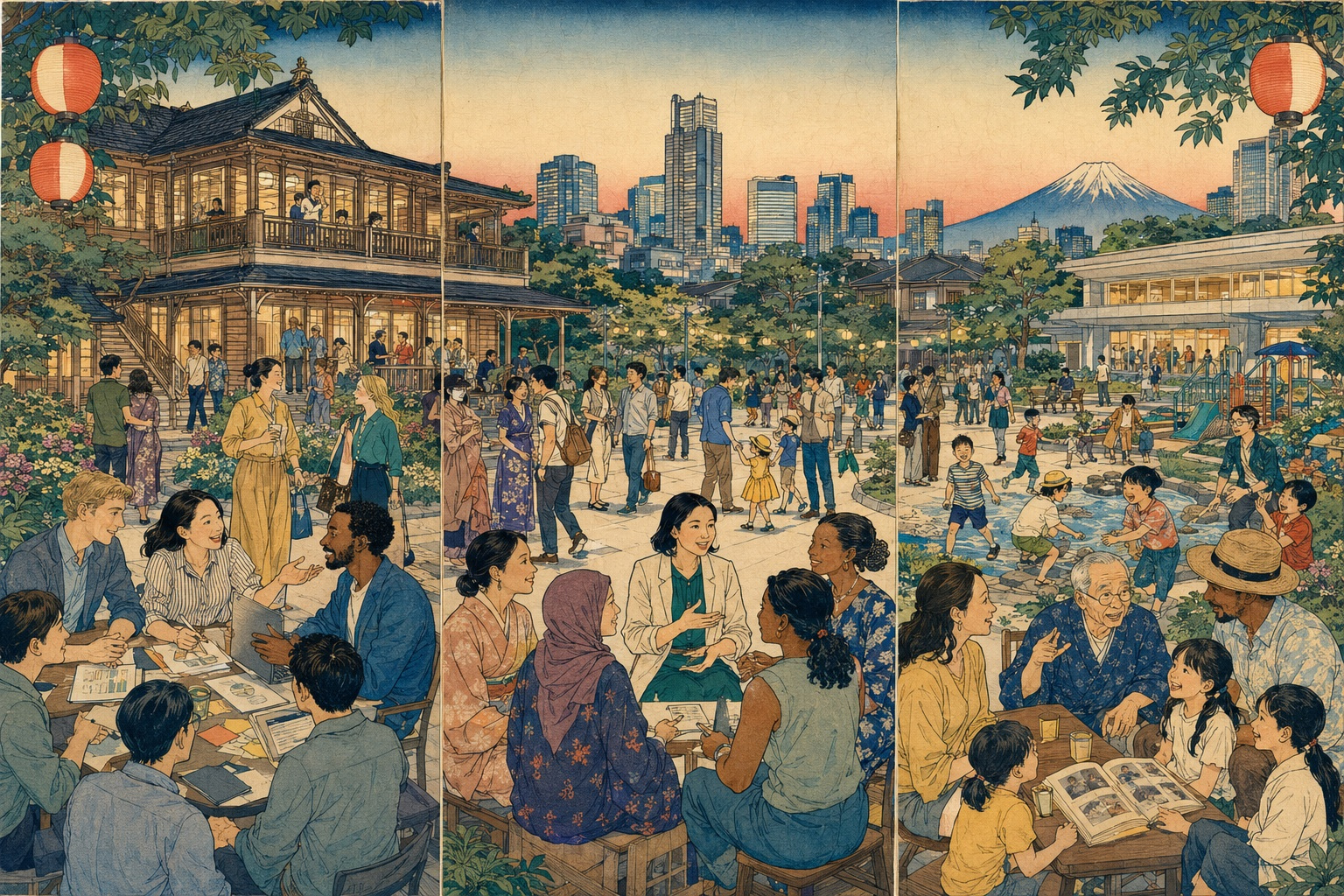
Editor’s note: Research was checked through July 18, 2026. Membership totals and diversity counts are organizations’ own published figures, not independent demographic audits. “International,” “inclusive” and “public-interest” do not mean that every facility or event is open to nonmembers; access is stated event by event. No third-party address or telephone was invented for networks that do not publish one. The exchange-rate display supplied for this edition is reproduced exactly, with its UTC update converted to July 19, 2026 at 4:07 AM JST. The hero is a contemporary digital editorial illustration, not a historical print, documentary photograph or record of an actual gathering.