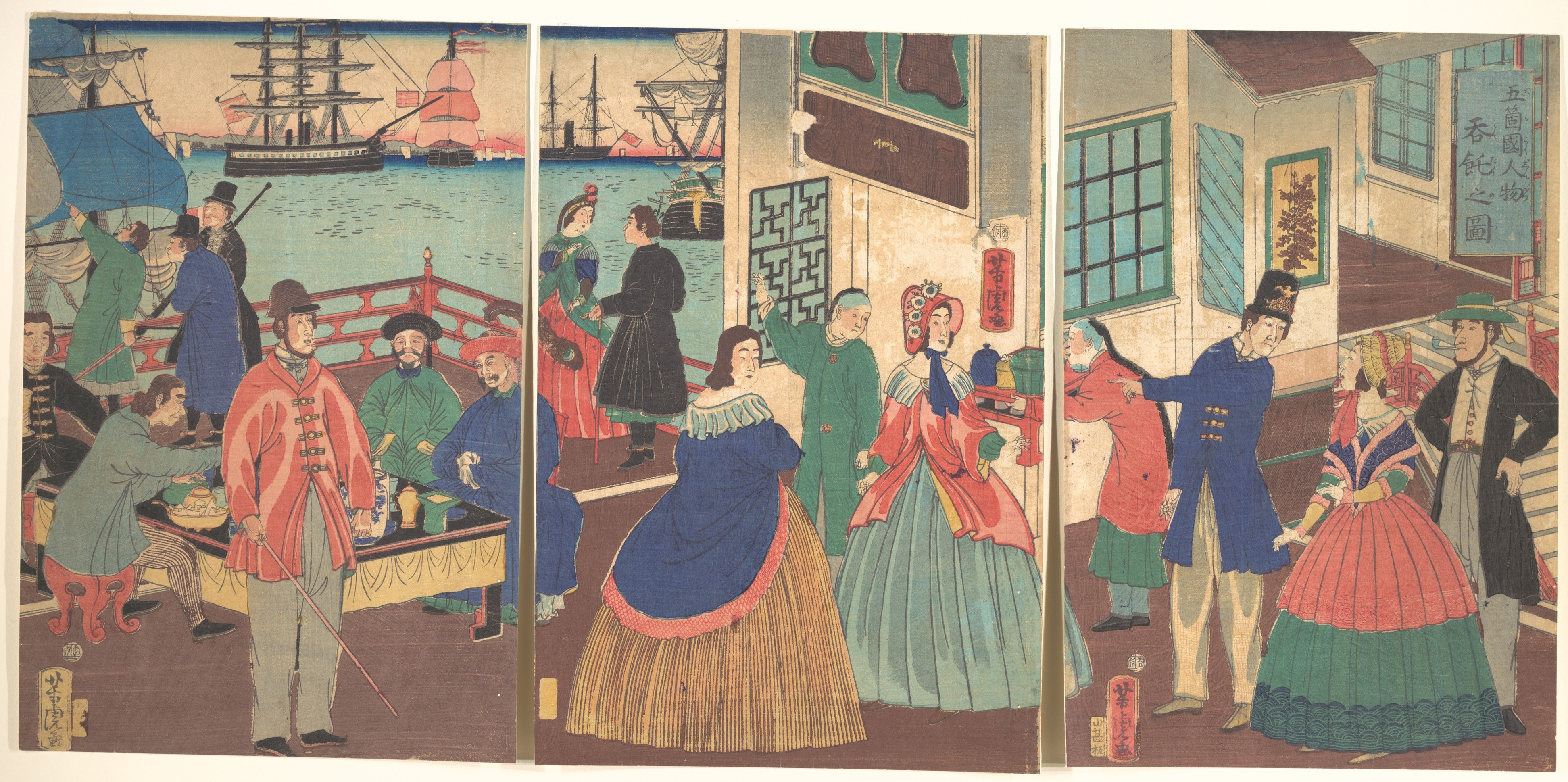
The first correction: this is Yoshitora, not Sadahide
The triptych reproduced above can be identified precisely. It is People of the Five Nations Drinking and Eating, designed by Utagawa Yoshitora and dated by the Metropolitan Museum of Art to the tenth month of 1861. The three-sheet color woodblock print belongs to the Met’s Asian Art department under accession number JP3248. Its dimensions, 35.6 by 72.4 centimeters, match the broad, cinematic field presented here. The digital image is part of the Met’s Open Access program and is marked public domain.
That identification matters. Utagawa Sadahide, Yoshikazu, Yoshitora and other Utagawa-school designers worked the same brief in the same feverish years. They drew foreign houses, national costumes, steamships, merchants, military bands, banquets and imagined overseas cities. Similar titles recur across collections; different impressions of the same design can also acquire different English translations and dates. A generic caption such as “Sadahide view of the foreign settlement” would erase the maker of the image actually in front of us.
| Object field | Verified record for the supplied hero |
|---|---|
| Japanese title | 五箇国人物 呑飥之図, as transcribed in the Met object record |
| English title | People of the Five Nations Drinking and Eating (Gokakoku jinbutsu dontaku no zu) |
| Artist and date | Utagawa Yoshitora, active ca. 1850–80; 1861, 10th month |
| Format | Triptych of polychrome woodblock prints (nishiki-e); ink and color on paper |
| Dimensions | 14 × 28½ in. (35.6 × 72.4 cm) |
| Collection | The Metropolitan Museum of Art, Asian Art; Gift of Lincoln Kirstein, 1959; JP3248 |
| Reuse status | Public Domain / Met Open Access; the downloadable image is released for unrestricted use |
There is a useful catalog lesson inside the title. The Library of Congress holds another impression of the design, credits publisher Yamashiroya Jinbei, reads the date seal as the twelfth month of the Cock year and translates dontaku as “Sunday.” The Met record used for this exact hero translates the activity as drinking and eating and dates it to the tenth month. Rather than silently force historical cataloging into false agreement, this article follows the Met record for JP3248 and notes the Library’s variant. Object records are arguments built from marks, impressions and earlier scholarship; they can be refined.
What the three sheets ask us to see
Yoshitora opens a waterfront compound as though its walls have been peeled back. Foreign men and women eat, drink, smoke and converse. Some sit on chairs; others stand in pairs. Frock coats, top hats, bonnets, full skirts and bright patterned garments operate almost as labels. Behind them, ships and flags compress the harbor into an international stage. Red rails and tiled roofs make the setting feel partly Japanese or Chinese, while furniture, clothing and tableware advertise Western domestic novelty.
The space refuses to settle. Floors rise at awkward angles; rooms fracture behind columns; perspective lines do not agree. That is not simply technical failure. It is evidence of translation. The Met’s record for another impression of the composition describes a place resembling a Chinese courtyard, Western-inspired shading on the clothes and an attempted linear perspective that fragments the background. Yoshitora was making foreign pictorial space legible inside the established grammar of a Japanese triptych.
The picture rewards close looking, but it punishes literalism. The figures are not verified portraits of a documented party. The nationalities cannot safely be assigned from faces and costumes alone. The “five nations” were a geopolitical category—the United States, Britain, France, Russia and the Netherlands, the principal treaty powers represented in early Yokohama prints—not a census of everyone who made the port work. The table is social theater, not minutes from an event.
Not Japan’s first encounter with the world
The headline’s phrase “first encounters” needs a historical warning label. Japan did not awaken to an outside world in 1853, and Yokohama was not a blank fishing village suddenly introduced to foreignness. Portuguese and Spanish traders and missionaries had arrived centuries earlier. Chinese and Dutch trade continued at Nagasaki. Korean embassies crossed the archipelago. The Ryukyu Kingdom and Ainu trade connected Japan to wider regional systems. Maps, imported books, rangaku and Nagasaki pictures gave many viewers vocabularies for imagining people and places they had never seen.
The National Museum of Japanese History describes four regulated gateways in early modern Japan: Nagasaki for Chinese and Dutch commerce, Tsushima for relations with Korea, Satsuma for relations with Ryukyu, and Matsumae for trade with the Ainu. The Yokohama Archives of History puts the comparison more sharply: Nagasaki’s history as an international trading city began in 1571, almost three centuries before Yokohama opened.
What changed was the political and visual regime. Commodore Matthew Perry arrived at Uraga in 1853. The Convention of Kanagawa was signed at Yokohama in 1854. The 1858 U.S.–Japan Treaty of Amity and Commerce, followed by parallel Ansei treaties with the Netherlands, Russia, Britain and France, created treaty-port trade under unequal terms. Yokohama opened on July 1, 1859 by the Gregorian calendar, corresponding to the second day of the sixth month in the old calendar. Two new piers were built; customs, warehouses, roads, residences and a pleasure quarter followed.
The shogunate preferred Yokohama to the busy Kanagawa post town on the Tōkaidō. Water and checkpoints made contact easier to supervise, and keeping the settlement away from the highway reduced uncontrolled encounters. The result was the district now called Kannai—literally “inside the barrier”—with foreign and Japanese commercial zones engineered beside one another. The settlement expanded into Yamate and remained a distinct legal geography until the treaty system’s residential restrictions ended in 1899.
A print boom larger than the population it described
Edo publishers saw a market immediately. The newly opened port lay close enough to the capital to excite curiosity but far enough—and was controlled enough—to remain inaccessible to many buyers. A color print could cross the checkpoint more easily than its owner. According to the Smithsonian-based “Yokohama Boomtown” study from MIT Visualizing Cultures, an estimated 31 artists and more than 50 publishers produced over 500 Yokohama designs between 1859 and 1862. The total number of impressions may have reached 250,000.
The Met emphasizes the mismatch between image supply and foreign population: only 34 Western merchants lived in Yokohama in 1860, and the Western population totaled about 200 by roughly 1862. Artists nevertheless filled triptychs with women, children, military units, carriages, musicians and servants. The foreign city of the prints was more populous, orderly and spectacular than the settlement itself.
That commercial system was collaborative. Yoshitora supplied the design, but a publisher chose and financed the product; a carver transferred the drawing to cherry blocks; a printer registered the key block and separate color blocks on strong paper. The Met’s account of ukiyo-e production describes four specialists—designer, engraver, printer and publisher—and notes that a polychrome image might require as many as 20 blocks. A triptych multiplied the coordination. What looks like a single author’s vision was also a small media industry responding to demand.
On a nineteenth-century sheet, title cartouches, signatures, publisher seals and approval marks functioned like a compact masthead. The image promised news, but it was news sold through visual pleasure. Clothes are exaggerated because clothes identify. Ships multiply because ships announce modernity. Food, chairs and pipes matter because the foreign world becomes imaginable through habits.
Eyewitness reporting, borrowed illustration and productive error
Some Yokohama-e designers visited the port and sketched. They also borrowed. Western newspapers reached Japan, Nagasaki prints supplied ready-made foreign types, and older Japanese conventions for daimyo processions or roofless interiors offered compositional frameworks. The result was not a binary of fact or fiction but a layered image assembled from sources with different distances from the subject.
Sadahide’s celebrated Picture of People of the Five Nations: Walking in Line, for example, packs more than 150 figures into a fantasy parade. The Smithsonian catalog commentary calls it a construction combining the artist’s observation with illustrations from Western newspapers and magazines. It includes Chinese and Indian people who were essential to port life but were not counted among the five treaty nations. In another foreign-house interior, figures can be traced to the Illustrated London News and Frank Leslie’s Illustrated Newspaper.
Yoshitora’s triptych belongs to that mixed practice. The harbor grounds the fantasy in Yokohama; the courtyard may derive from a more generalized Asian idea of elite foreign residence; modeled color and depth quote Western printmaking; the three-sheet format and flattened decorative rhythm keep the work inside Edo visual culture. The spatial “mistakes” tell us how a foreign optical system was being tested, not merely that the artist had failed to master it.
Catalog titles expose the same process. The Library of Congress’s “Sunday” reading connects dontaku with a foreign weekly rhythm; the Met’s “Drinking and Eating” reading centers visible action and the title’s characters. In either case, leisure is the subject. The print domesticates international politics by making it a day off, a cup, a conversation and a meal.
The five flags conceal a larger, unequal port
“Five nations” sounds comprehensive and was visually convenient. It was neither. Chinese merchants, interpreters, compradores, artisans and workers were fundamental to Yokohama. South Asian employees and sailors appear in period images. Japanese wholesalers, brokers, laborers, officials, sex workers and household staff made the settlement possible. By 1898, the Yokohama Archives says roughly two-thirds of the approximately 5,400 registered foreign residents were Chinese. Yet the five Western treaty powers dominated the emblematic title.
Look again at Yoshitora’s foreground. Well-dressed foreigners consume and converse; Asian-looking figures occupy different positions in the compound. Clothing invites viewers to sort people into types, but the picture does not give us reliable personal identities. The safest interpretation is structural: an imagined Western leisure class occupies the center, while the labor and brokerage that sustained it are less legible. The image records hierarchy even where it invents individuals.
Gender is similarly unstable. Foreign women were scarce in the first settlement years, but Yokohama-e crowded them into streets and parlors because dresses, hats and family scenes were saleable novelties. Women make the foreign world appear settled and domestic rather than temporary and overwhelmingly male. Elsewhere the genre turned interracial sex and the Miyozaki pleasure quarter into spectacle. The Gankirō and women who worked in the treaty-port economy cannot be reduced either to a cheerful “cultural exchange” story or to decorative atmosphere.
Nor was the opening peaceful. Extraterritoriality, tariff limits and treaty privilege made the new order unequal. Anti-foreign violence and reprisals marked the 1860s. The Namamugi Incident of 1862 and the Anglo-Satsuma conflict that followed belong to the same world as these convivial images. A banquet scene offered a reassuring counterimage: nations eating together while ships rest at anchor. Its harmony was aspirational and commercial.
Yoshitora changed subjects as Japan changed eras
Biographical certainty about Yoshitora is limited; the Met identifies him by an active period, approximately 1850 to 1880, rather than firm birth and death dates. He was a pupil of Utagawa Kuniyoshi. Early work followed his teacher’s strength in warriors and legends. When Yokohama became the visual subject of the moment, Yoshitora turned to foreigners, foreign countries and the port.
That shift was not a retreat from tradition. It demonstrates how adaptable the Utagawa system was. A designer trained to organize warriors across a triptych could organize diplomats, steamships and hoop skirts across the same format. A procession of foreigners could inherit the cadence of a daimyo retinue. A harbor became one of the conventional Eight Views. New content entered through old frames.
Yoshitora continued to follow technology into the Meiji period. His 1872 Imported Silk Reeling Machine at Tsukiji in Tokyo records female workers, steaming vats and a mechanized spinning system installed with Swiss expertise. Other designs pictured traffic, railways and ballooning. The curiosity visible in the 1861 courtyard therefore belongs to a longer career of making unfamiliar systems visible. Yokohama-e was a beginning within that career, not its limit.
From novelty sheet to public-domain global object
The physical triptych traveled into a New York collection; its scan now travels back across the network that the print tried to imagine. The Met’s Open Access policy makes public-domain images and data available without permission or a fee for commercial and noncommercial use. That is why a 2026 edition can reproduce the actual object at high resolution instead of commissioning a pastiche.
Public domain does not mean authorless or context-free. A responsible caption still names Yoshitora, the work, date, medium, dimensions, collection, credit line and accession number. It distinguishes the historical image from an illustration newly made “in the style of” a dead artist. It links the object record so a reader can inspect the museum’s evidence and download the source file. Legal freedom is not a license for historical vagueness.
Digitization also makes comparison possible. The Library of Congress impression can be placed beside the Met impression; the Yokohama Archives historical image index groups local Yokohama ukiyo-e; MIT and the Smithsonian reconnect individual sheets to illustrated newspapers and urban maps. A single spectacular image becomes a research path.
Where to continue the story now
Yoshitora’s JP3248 is listed by the Met as not on view. None of the Japanese events below is advertised as displaying this exact impression. They are valuable for different reasons: one reconstructs the treaty port through maps, another presents Kanagawa through ukiyo-e, and a September exhibition asks how “Yokohama pictures” expanded beyond late-Edo Yokohama-e into Meiji painting and export art. The distinction is important.
| Institution | Verified address and telephone | Direct website |
|---|---|---|
| Yokohama Archives of History 横浜開港資料館 | 3 Nihon-odori, Naka-ku, Yokohama, Kanagawa 231-0021 Tel: 045-201-2100 Reading room reservations: 045-201-2150 | kaikou.yokohama-history.org historical image index |
| Yokohama Urban Development Memorial Museum 横浜都市発展記念館 | 12 Nihon-odori, Naka-ku, Yokohama 231-0021 Tel: 045-663-2424 | tohatsu.yokohama-history.org current map exhibition |
| Yokohama History Museum 横浜市歴史博物館 | 1-18-1 Nakagawachuo, Tsuzuki-ku, Yokohama 224-0003 Tel: 045-912-7777 | rekihaku.yokohama-history.org “Depths of Yokohama Pictures” |
| Yokohama Museum of Art 横浜美術館 | 3-4-1 Minatomirai, Nishi-ku, Yokohama, Kanagawa 220-0012 Tel: 045-221-0300 | yokohama.art.museum 2026–27 schedule |
| Kawasaki Ukiyo-e Gallery 川崎浮世絵ギャラリー | Kawasaki Station Front Tower RiverK 3F, 12-1 Ekimae Honcho, Kawasaki-ku, Kawasaki 210-0007 Tel: 044-280-9511 | ukiyo-e.gallery access and hours |
| The Metropolitan Museum of Art | 1000 Fifth Avenue, New York, NY 10028, USA Tel: +1-212-535-7710 | Yoshitora object JP3248 collection search |
Upcoming exhibitions, talks and viewing dates
Public calendars and registration pages were checked through July 18, 2026. “Upcoming” means on or after this article’s July 21 publication date. Confirm the live page before traveling: museums may change displays, and an exhibition related to Yokohama or ukiyo-e does not guarantee that Yoshitora’s exact print is present.
| Date and time | Program | Access note |
|---|---|---|
| Through Sun, Jul 26 11:00–18:30 | “Kanagawa for Ukiyo-e Lovers: Its Surprisingly Deep Appeal” Kawasaki Ukiyo-e Gallery | General admission ¥500; high-school age and younger free. The gallery is closed on publication day, Tue, Jul 21, as a substitute holiday, then the exhibition continues through Jul 26. |
| Through Sun, Sep 27 09:30–17:00 | “Traveling through Bakumatsu Yokohama with Pictorial Maps” Yokohama Urban Development Memorial Museum | About 80 maps and pictorial plans trace the village, planned port, settlement and city. General ¥800; the ticket also admits the permanent displays and Yokohama Museum of EurAsian Cultures. Closed Mondays except holidays, then the next weekday. |
| Fri, Jul 24–Mon, Nov 23 10:00–18:00 | Yuko Mohri: Recompose Yokohama Museum of Art | Free. A contemporary homecoming presentation of the 2024 Venice Biennale Japan Pavilion project; relevant to the continuing movement of ideas between Yokohama and the world. |
| Sat, Aug 1 14:30–16:00 | Lecture: “Iwahashi Noriaki and Yokohama” Yokohama Archives of History lecture hall | ¥1,000; capacity 40, lottery if oversubscribed. The official page gives an application deadline of Jul 24 at 17:00. |
| Sat, Aug 1–Thu, Feb 11, 2027 | Collection Exhibition: “Women Artists Crossing the Sea” Yokohama Museum of Art | Adults ¥500; lower rates by category. The collection show explicitly examines women whose work crossed borders. Check closure dates and concurrent-ticket rules. |
| Sat, Aug 1–Mon, Nov 23 | “Marie Antoinette Style” Yokohama Museum of Art | International touring exhibition created by the V&A. Separate ticket; the same-day ticket includes the collection exhibition through Nov 23. |
| Sat, Aug 15 15:00 | Curator’s gallery talk for “Traveling through Bakumatsu Yokohama” | About 45 minutes; no advance application; exhibition admission required. A further talk is scheduled Sep 21. |
| Sat, Aug 22 14:00–16:00 | Special lecture: tracing Kannai from Bakumatsu to postwar Yokohama through maps | ¥1,000; capacity 40, lottery if oversubscribed. Published application deadline: Aug 5 at 17:00. |
| Sat, Aug 29 14:30–16:00 | Lecture: “Pictorial Maps of Bakumatsu Yokohama” | ¥1,000; capacity 40, lottery if oversubscribed. Published application deadline: Aug 12 at 17:00. |
| Sat, Sep 5–Sun, Oct 18 09:00–17:00 | “The Depths of Yokohama Pictures: A Genre, an Image, or Export Art?” Yokohama History Museum | General ¥1,000. The broader term Yokohama pictures here centers the Goseda school, Meiji painting, watercolor and export art while also situating Yokohama ukiyo-e. Do not assume the Yoshitora hero is displayed. |
| Sep 6, 19, 23; Oct 4, 10, 17 14:00 | Gallery talks for “The Depths of Yokohama Pictures” | About 40 minutes; exhibition ticket required; no advance registration; approximately 20 participants each. |
| Sep 12, 22, 26; Oct 3 14:00–15:30 | Four-lecture series on Yokohama painting, ceramics, art business and watercolor | ¥900 each or ¥3,500 for all four; capacity 150; advance online ticket required. Deadlines vary by session, beginning Sep 2. |
A method for looking at Yokohama-e
| Question | What to inspect | Why it matters |
|---|---|---|
| Who made it? | Signature, artist name, publisher seal, date/approval marks, collection record and differences between impressions. | “Ukiyo-e artist” is only one role in a publisher-led collaborative product. |
| What is observed? | Local geography, commodities, uniforms, ship types, written labels and features corroborated by maps or photographs. | The print can preserve evidence even when the whole scene is invented. |
| What is borrowed? | Western shading and perspective, newspaper illustrations, Nagasaki types, procession formats and conventional interiors. | Borrowing shows the routes by which visual information moved. |
| Who is centered? | Treaty-power nationals, affluent consumers, men or women, and who is placed as servant, broker, spectacle or absence. | The “international” image reproduces the settlement’s legal and racial hierarchy. |
| What did buyers want? | Novel clothes, food, machines, flags, romance, danger and an orderly picture of change. | Yokohama-e reports the domestic market’s desires as much as foreign life. |
The world in the room—and the room in the world
Yoshitora’s courtyard is neither a transparent window nor a wall of stereotype. It is a screen on which information, power and curiosity meet. The print tells us less about how one documented group of foreigners spent a particular afternoon than about what a publisher believed Edo buyers wanted the foreign world to look like: prosperous, sociable, fashionable, technologically connected and available to inspection.
Its inaccuracies are therefore historical facts of their own. The fractured perspective records an encounter between pictorial systems. The enlarged female presence records a desire to imagine complete foreign households. The five-nation title records treaty power. The quieter Asian labor records a hierarchy that the official category could not encompass. The harbor records Yokohama’s claim to connect the room to the sea.
The image also connects this edition’s histories of chambers, clubs, journalism and international communities to their treaty-port ancestry. Long before those institutions built boardrooms and clubhouses, the popular print constructed an international room and decided who sat in it. The critical question remains recognizable in 2026: who is visible, who serves, who speaks for a nation and who is left outside the frame?
That is why the best way to honor a public-domain Yokohama-e is not to treat it as nostalgic wallpaper. Name it. Date it. Follow its visual sources. Test it against the port’s demography and law. Notice its delight without accepting its hierarchy as neutral. Then look again at the woman with the cup, the men with the pipes, the ships behind the railing and the seams between the sheets. Japan was not seeing the outside world for the first time. It was learning to mass-produce a new picture of its place within it.
Sources and further reading
- Metropolitan Museum of Art: Yoshitora, People of the Five Nations Drinking and Eating, JP3248; Met record for another impression/composition; Library of Congress impression and variant catalog title.
- MIT Visualizing Cultures / Smithsonian: “Yokohama Boomtown,” print production and foreign population; borrowed sources, domestic interiors and pleasure-quarter imagery; Sadahide’s Five Nations parade.
- National Museum of Japanese History: the four early-modern gateways; Yokohama Archives of History: Nagasaki as a precondition for Yokohama.
- City of Yokohama: opening of the port; official port chronology; Yokohama Archives history and the 1899 end of the settlement system; settlement population and geography.
- Met essay: collaborative ukiyo-e woodblock production; Yoshitora as Kuniyoshi pupil; Yoshitora’s 1872 silk-reeling machinery triptych.
- Yokohama treaty-port map exhibition and events; Yokohama History Museum’s 2026 “Depths of Yokohama Pictures” exhibition; Yokohama Museum of Art 2026–27 schedule; Kawasaki Ukiyo-e Gallery’s Kanagawa exhibition.
Editor’s note: Research and event listings were checked through July 18, 2026. The supplied hero’s 3,888 × 1,939-pixel file matches the Met Open Access image for JP3248. The Met dates its impression to the tenth month of 1861; the Library of Congress catalogs another impression with a twelfth-month seal and a different English rendering of dontaku. Both records are linked rather than collapsed. No listed Japanese exhibition is represented here as displaying this exact object unless its organizer says so. Historical population labels follow the wording and categories of the cited institutions and are not modern identity classifications. The exchange-rate display supplied for this edition is reproduced exactly, with its UTC update converted to July 19, 2026 at 4:07 AM JST.