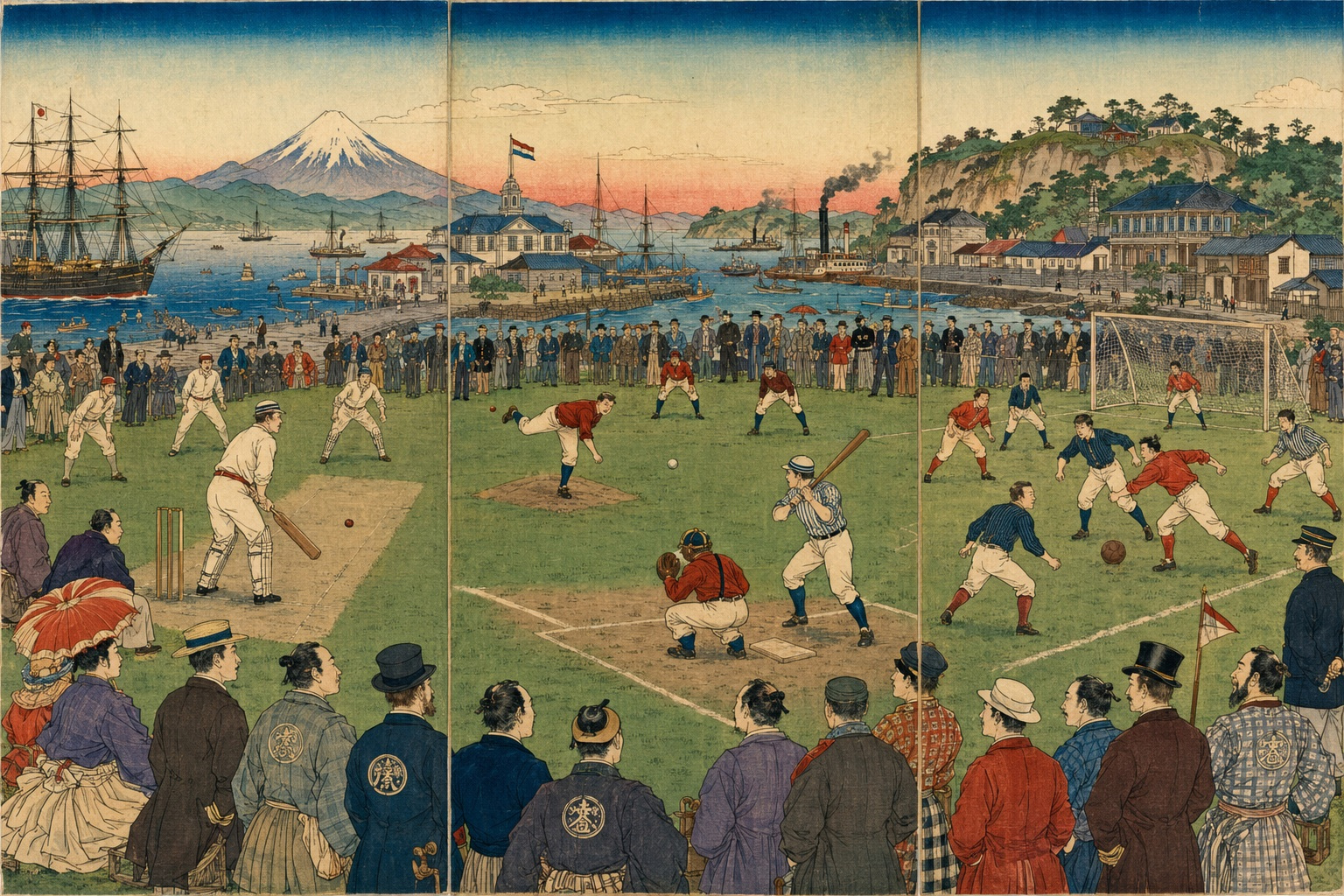
The old club is most revealing when it loses
The most consequential afternoon in YC&AC history may be the one its predecessor team would rather have forgotten. On May 23, 1896, students of the First Higher School—Ichiko—defeated Yokohama’s foreign baseball side 29–4. The Baseball Hall of Fame and Museum says that victory over the “Yokohama foreign team” helped raise baseball’s popularity across Japan. The result reversed the expected hierarchy of the treaty-port age: the imported game no longer belonged to the importers.
That reversal is the key to understanding the Yokohama Country & Athletic Club. The institution preserved foreign-resident sporting traditions, but the larger national histories of cricket, football, athletics and baseball were made when those traditions crossed a boundary. Sailors played merchants; Yokohama met Kobe; foreign residents met Japanese students; children and families now meet coaches from local professional teams. Sport became a contact language.
In June 2026, the Club made that point explicit. Its Field of Dreams 2026 reunited YC&AC with University of Tokyo alumni, successors to Ichiko, and alumni of Yokohama Commercial High School. The event marked 130 years since the 1896 games and 150 years since the Yokohama Base Ball Club predecessor. It was not only commemoration. It was an institutional acknowledgment that defeat, imitation and rematch were engines of Japanese sporting modernity.
There are three honest founding dates
YC&AC’s homepage says “Established in 1868.” That is a legitimate lineage date, because the Yokohama Cricket Club founded that year became a principal predecessor. It is not the date on which today’s multi-sport organization first existed.
The Yokohama Cricket & Athletic Club was formed on April 7, 1884, by merging four bodies: the Yokohama Foot Ball Club, founded in 1866; Yokohama Cricket Club, 1868; Amateur Athletic Association of Yokohama, 1872; and Yokohama Base Ball Club, 1876. In 1912, after the organization moved from Yokohama Park to its present Yamate-area grounds at Yaguchidai, “Cricket” in the name became “Country.”
So three dates answer three different questions. The oldest constituent lineage begins in 1866 with football. The institutional lineage the Club publicly emphasizes begins in 1868 with cricket. The combined club dates to 1884, and the present name and hilltop home date to 1912. Treating one as the only founding date flattens a history whose importance lies precisely in aggregation.
From treaty port to sporting laboratory
Yokohama opened to foreign trade in 1859 under the unequal-treaty system. Its foreign settlement was physically and legally distinct, populated by merchants, diplomats, missionaries, sailors and military personnel. Imported sport initially served familiar purposes: exercise, ritual, sociability and competition inside a community far from home.
It also needed public space, opponents and spectators. The ground that became Yokohama Park was a place where the settlement’s clubs could organize recurring play. Ships in the harbor supplied teams. Kobe supplied interport rivals. Japanese onlookers, students and teachers supplied the decisive next stage. The boundary around the settlement was real, but a ball repeatedly crossed it.
This is why “the birthplace of modern sport in Japan” must be used carefully. Yokohama was one major gateway, not the sole route. Foreign residents established clubs, while Japanese students learned games through naval and engineering schools, foreign teachers, returning students and later Japanese associations. YC&AC is exceptional because a single living institution connects so many of those early strands.
Cricket: first the match, then the club
The first documented cricket match in Japan was played in Yokohama in 1863, five years before Yokohama Cricket Club was founded. The International Cricket Council identifies a Yokohama side and a Royal Navy team; a later historical reconstruction places the match on June 25 amid fears of an attack on the foreign settlement. Armed naval protection and even pistols near the wicket turn an afternoon game into a vivid image of the insecurity surrounding the treaty port.
Scottish merchant James Pender Mollison founded Yokohama Cricket Club in 1868. The present Club keeps his name in Mollison’s restaurant and gallery. That sequence matters: 1863 is the first documented game; 1868 is the first club. The institution made play repeatable—fixtures, membership, equipment, grounds and a social life around the contest.
Cricket remained largely within expatriate circles for more than a century. The ICC notes that a Japanese club movement developed much later and that the Japan Cricket Association was formed in 1984. Baseball, introduced in the same broad era, followed a radically different adoption curve. YC&AC therefore preserves two possible histories of cultural transfer: one game stayed relatively niche; another became national.
Football before “soccer” had one Japanese meaning
The Japan Football Association says British residents formed the Yokohama Foot Ball Club in January 1866, Japan’s first football club. “Football” did not yet mark the clean code boundaries modern readers expect; the predecessor’s lineage is also claimed by the present rugby section. What matters is that organized football activity existed in the settlement before the first confirmed Japanese participants.
JFA’s historical FAQ places those Japanese participants at the Naval Academy in Tsukiji and the Engineering College in Toranomon. A British advisory mission led by Archibald Lucius Douglas began teaching 125 Japanese students football, cricket and other sports in August 1873; JFA judges the first football play likely occurred in the winter of 1873–74.
The distinction avoids a colonial cliché. Foreign residents created the 1866 club. Japanese students did not simply appear inside it. They learned through a separate state-education route, formed their own practices and eventually built national institutions. YC&AC later met those institutions as opponent and partner.
JFA’s centenary chronology also identifies the interport match between YC&AC and Kobe Regatta & Athletic Club as Japan’s oldest interclub fixture. In 2018, according to the Yokohama Archives of History, Sheffield FC’s Club of Pioneers recognized YC&AC as Japan’s oldest football club after evidence was found in an 1887 issue of the Japan Weekly Mail. The honor recognizes continuity; it does not mean the present team has an unchanged code, roster or organization from 1866.
Athletics supplied the multi-sport idea
The Amateur Athletic Association of Yokohama, dated by the Club to 1872, is the least famous of the four merger partners and perhaps the most conceptually important. “Athletic” activity made the future organization more than a cricket club with occasional guests. It created space for running, field events and a general sporting calendar.
The surviving public record is thinner than for the dramatic first cricket match or the famous baseball upset. The responsible claim is therefore limited: YC&AC documents the 1872 association as a direct predecessor, and the 1884 merger formally embedded athletics in the combined club. It should not be turned, without stronger evidence, into a sweeping claim that all Japanese track and field began there.
That restraint improves the history. Modern sport did not arrive as a single parcel. Different codes moved through different ports, schools, militaries and associations. The value of the Yokohama club is not that it owns every beginning, but that its merger anticipated the multi-sport club as a durable social institution.
Baseball: the foreign club was a catalyst, not the whole origin
YC&AC dates the Yokohama Base Ball Club predecessor to 1876 and calls its present team the oldest surviving baseball team in Asia. That is the Club’s continuity claim. Independent national baseball history adds necessary context.
The Baseball Hall of Fame and Museum says American teacher Horace Wilson taught baseball to students in Tokyo in 1872. It calls the Shimbashi Athletic Club, founded by Hiraoka Hiroshi in 1878, Japan’s first full-fledged Japanese baseball team. These facts do not diminish the 1876 Yokohama lineage; they show that foreign-resident baseball and Japanese baseball developed along parallel, intersecting paths.
The intersection exploded in 1896. YC&AC’s 2026 history records three games between May 23 and July 4. Ichiko won the first 29–4. The national museum treats the victory as a turning point in the spread of baseball. The Club’s own anniversary program goes further, calling the series Japan’s first international baseball matches. That phrase is best understood as a match between a Japanese institution and the foreign-settlement side, not a modern national-team fixture.
Yokohama Commercial High School’s connection illustrates the afterlife. The 2026 organizers say supporters watched the Ichiko games, received bats and balls, founded their baseball club that year and were coached by Ichiko pitcher Aoi Etsuo. A foreign club, a Tokyo school and a Yokohama school became linked through competition and the transfer of equipment and knowledge.
1884 made one club; 1912 gave it a lasting home
The April 1884 merger pooled fragmented clubs into the Yokohama Cricket & Athletic Club. In an expatriate population too small to sustain endless separate organizations, consolidation was practical. It also allowed one clubhouse and ground to carry cricket, football, athletics and baseball through changing seasons.
The move in 1912 from Yokohama Park to 11-1 Yaguchidai shifted the Club from the old settlement’s urban sports ground to a hilltop campus. Yokohama Archives of History says the organization continued there to the present except during the Asia-Pacific War and a period after it. Prewar interport photographs, including fixtures with Kobe, survive in the archive.
The move also changed the name from “Cricket” to “Country,” signaling a broader recreational identity. Yet the original codes never vanished. The same lineage appears today in baseball Saturdays, cricket activity, over-35 football, rugby, field hockey and interclub travel.
The 2026 Club is a public-interest body behind a membership gate
YC&AC now operates as a koeki shadan hojin, a public-interest incorporated association. Its homepage frames the mission as interaction through sport and public benefit, and its governance page publishes articles, bylaws, membership and fee regulations, and a balance sheet. As checked July 18, it listed Guenter Spiess as president, Kenneth Bergenthal as vice president, Neil Lyons as treasurer and Yoichi Inakage as honorary secretary.
Public-interest status does not make the grounds freely public. Membership applications are reviewed by management and include an interview. Guests normally pay a visit fee, must be accompanied by a member and are registered under that member’s responsibility. Some festivals, camps and academies create wider entry points, but access depends on the specific program.
The Club’s current membership campaign runs from June 1 through September 30, 2026, offering a one-week trial and two months free with Full or Term membership. Because categories, fees and conditions can change, applicants should use the live membership page and the February 11, 2026 fee regulations rather than a copied price table.
A living campus, not a museum
The physical program shows how far the multi-sport idea has expanded. The official facilities page lists a full-size FIFA-certified all-weather main pitch configured for rugby, football, cricket, baseball and hockey; four clay tennis courts; three US Open-standard hard courts; a lawn-bowls green; and an outdoor pool open from May through September.
Indoors are a gymnasium, fitness center, studio, two international-standard squash courts, four bowling lanes, billiards, library, meeting and event rooms, roof deck and Mollison’s restaurant. The mixture is part athletic campus, part social club and part community venue.
Weekly life keeps the historical codes visible. The Club advertises adult baseball doubleheaders at 10 a.m. Saturdays from mid-March to mid-September, with more than 20 players on the roster. Over-35 football normally plays on Saturday afternoons or evenings and enters 12 to 15 Kanagawa Over-40 league matches each year. The website’s cricket frequency still contains a reference to a possible increase in 2022, so it is not reliable enough to present as a current 2026 schedule; prospective players should ask the sports office directly.
Newer programs widen the age range. A soccer academy for ages six to 18 runs three Wednesdays a month, while a middle- and high-school basketball academy meets on Mondays and Wednesdays. The 2026 summer camp combines English and sport for children aged six to 12, with support advertised from the Yokohama B-Corsairs, Yokohama Canon Eagles, Real Madrid Foundation Football School, Yokohama DeNA BayStars Baseball School and Pickleball One. The old conduit between an international club and local sport now runs in both directions.
Verified address, telephone numbers and direct websites
YC&AC is about a 15-minute walk from JR Yamate Station on the Keihin-Tohoku/Negishi and Yokohama lines. Confirm event eligibility before travelling; the grounds are not an unrestricted public park. The current contact page and 2026 Bon Odori invitation agree on 045-623-8121. A Field of Dreams media block prints 045-823-8121; this appears to be a typographical error and is not used below.
| Service | Verified contact | Direct website |
|---|---|---|
| YC&AC main office / concierge | 11-1 Yaguchidai, Naka-ku Yokohama 231-0831, Japan Tel: 045-623-8121 Fax: 045-623-1233 concierge@ycac.jp Daily, 09:00–18:00 | ycac.jp official contact page |
| Membership | Tel: 045-623-8121 concierge@ycac.jp Applications are reviewed and include an interview | membership, current campaign and regulations |
| Events | events@ycac.jp Tel: 045-623-8121 | Club calendar |
| Sports and academies | sports@ycac.jp Program-specific registration may be open to nonmembers | fitness and sports soccer academy basketball academy |
| Access | JR Yamate Station, approximately 15 minutes on foot Paid upper and lower parking; event restrictions can override normal parking | walking route and current parking fees |
| Facilities and governance | Public documents include current officers, articles, bylaws, membership and fee rules, and balance sheet | facilities governance and documents |
Upcoming events and current programs found
Details were checked July 18, 2026. “At YC&AC” does not always mean “organized by YC&AC,” and a listing does not guarantee public admission. Registration status can change; confirm with the linked organizer. Times are Japan Standard Time.
| Date and time | Event or program | Access status |
|---|---|---|
| Jul 20–Aug 14 Mon–Fri, 09:00–15:00 | YC&AC Summer Camp 2026 Week 2: Jul 27–31 Week 3: Aug 3–7 Week 4: Aug 10–14 | Ages 6–12. The Club page marks Weeks 1–3 full. Its booking form was still offering Week 4 when checked. Published weekly fee: ¥61,000; member fee ¥40,000; optional after-care 15:00–17:00, ¥12,000. |
| Sun, Jul 26 17:00–21:00 | Swiss National Day Celebration | Organized by Swiss Club Tokyo at YC&AC. SCCIJ publishes member/SCCIJ-member admission at ¥5,000 adults and ¥2,000 children; nonmembers ¥7,500 and ¥3,000. Registration through the organizer. |
| Sat, Aug 1 Pool 09:00–18:00 Festival 17:30–21:00 | 47th Annual International Bon Odori Festival | YC&AC invitation circulated through reciprocal club FCCJ; pool places limited and no parking. The FCCJ registration listing was marked closed when checked. Event inquiries: events@ycac.jp / 045-623-8121. |
| Saturdays to mid-September from 10:00 | Adult baseball doubleheaders | Recurring Club sports activity, not a public spectator event. Age 18+, some playing experience preferred. Ask the Club about membership, guest and player arrangements. |
| Through Sep 30 | 2026 Membership Campaign | Applications submitted June 1–September 30 are advertised with a one-week trial and two months free for Full or Term membership. Review, interview and current fee rules apply. |
What survived—and what changed
The Yokohama Archives of History calls YC&AC the foreign community’s most traditional social club and records its continuity except during wartime and the immediate postwar period. Continuity, however, is not sameness. Codes separated and standardized. Japanese governing bodies became authoritative. A club once centered on Western male merchants became a mixed community of Japanese and international residents, families, juniors and older athletes.
The strongest historical claims survive scrutiny when narrowly stated. Japan’s first documented cricket match was in Yokohama in 1863; its first cricket club followed in 1868. JFA recognizes the 1866 Yokohama football club and distinguishes it from the first confirmed Japanese play in 1873–74. The baseball predecessor dates to 1876, while the national museum locates the first full-fledged Japanese team in 1878. The 1896 Ichiko victory over the Yokohama foreign team was a national turning point. Athletics entered the combined institution through the documented 1872 predecessor.
The larger claim is interpretive: YC&AC is one of the rare places where Japan’s treaty-port past remains physically connected to weekly sport. A Saturday baseball game on the all-weather field is not a reenactment. Children at summer camp are not preserving an expatriate enclave. They are doing what made the institution historically important in the first place—taking a game across a social boundary and making a new routine from it.
The next root system must reach farther into Yokohama
YC&AC’s future will not be secured by age alone. “Oldest” claims draw attention, but they can turn a living club into a cabinet of trophies. The public-interest mission asks a harder question: how can private facilities, member knowledge and international networks deliver a wider benefit without pretending the membership gate does not exist?
The 2026 evidence points to an answer. Field of Dreams treated Japanese opponents as co-owners of the story. The summer camp brought in Yokohama professional teams and international coaching partners. The Bon Odori turns an imported-club campus into a setting for Japanese communal dance. Soccer and basketball academies give younger players a recurring point of entry.
That is a better legacy than an uncontested birthplace plaque. YC&AC matters because it shows that cultural transfer is reciprocal, competitive and unfinished. Foreign residents organized games; Japanese athletes mastered and transformed them; the old club survived by changing its relationship to the city around it. On the Yaguchidai hill, international sport did not merely arrive in Japan. It took root because other people claimed it.
Sources and further reading
- YC&AC: Field of Dreams 2026, including the four-club merger, 1912 move, 1896 games and current continuity claims; YC&AC homepage and 2026 notices.
- Yokohama Archives of History: YC&AC sports scenes; 2021 exhibition account of the Club’s football history and 2018 Club of Pioneers recognition.
- International Cricket Council: cricket in Japan; YC&AC historical reconstruction of the 1863 cricket match.
- Japan Football Association historical FAQ; JFA centenary chronology.
- Baseball Hall of Fame and Museum: history of baseball in Japan.
- YC&AC facilities; governance and current documents; membership and 2026 campaign; contact and service hours; access.
- 2026 summer camp; Swiss National Day organizer listing; 2026 Bon Odori reciprocal-club invitation.
Editor’s note: Research was checked through July 18, 2026 against YC&AC, Yokohama Archives of History, Japan Football Association, International Cricket Council, Baseball Hall of Fame and Museum, and event-organizer pages. “Oldest surviving baseball team in Asia” is YC&AC’s own continuity claim; the national baseball museum’s chronology is used to distinguish the 1876 foreign-settlement predecessor from the first full-fledged Japanese team in 1878. The Field of Dreams page contains a telephone number that conflicts with the current official contact page and the 2026 Bon Odori invitation; this article uses the corroborated 045-623-8121. Event availability can change. The exchange-rate display supplied for this edition is reproduced exactly—“1 US Dollar = 162.39 Japanese Yen”—with its UTC update converted to July 19, 2026 at 4:07 AM JST. The hero is a contemporary digital editorial illustration, not a historical print, photograph or record of any match.