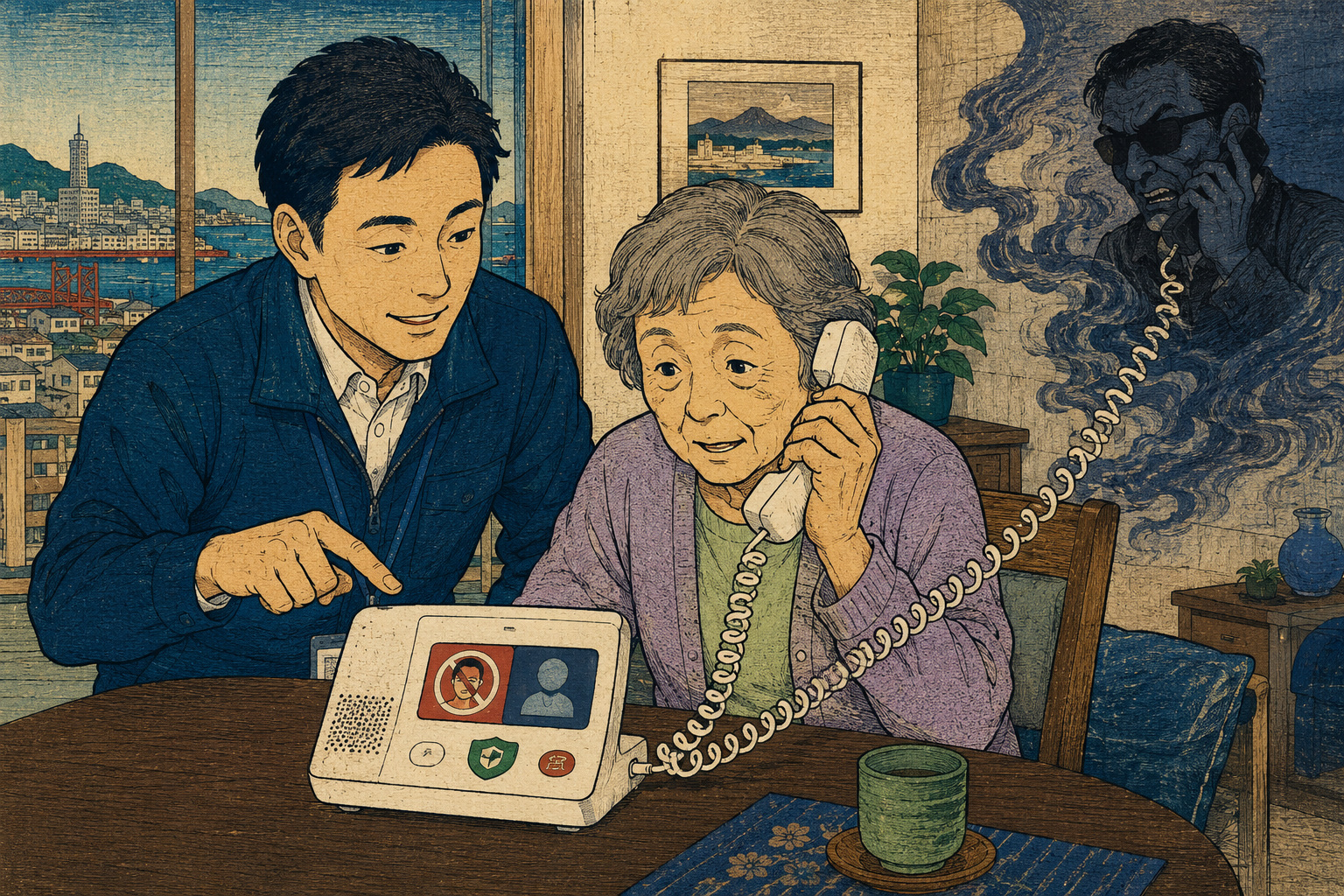
Before the resident hears the ring, the caller meets the machine. A recorded message says the conversation will be preserved. Only then does the call proceed. For a relative arranging lunch, the announcement is a minor delay. For a criminal whose method depends on an unrecorded performance, it can be a reason to disappear.
That moment is the policy behind Kitakyushu’s fiscal 2026 subsidy for what the city calls a nise denwa sagi higai bōshi kinō-tsuki denwaki—a telephone equipped with functions to prevent fraud by deceptive calls. An eligible resident buys a qualifying fixed-line phone, files evidence of the purchase and, after review, receives part of the cost in a bank account.
The city’s headline ceiling is ¥10,000, about $62.83 at the exchange rate shown on this page. The practical benefit may be smaller, and it is not a discount at the register. Kitakyushu pays three-quarters of eligible cost, rounds the result down to the nearest ¥1,000 and stops at ¥10,000. Tax, delivery, installation and value covered by points or coupons do not count.
There is a more consequential condition: an applicant must telephone the city before buying anything. The reservation preserves a place in a program expected to cover about 200 households. The city then checks the intended make and model. A resident who buys first, even in good faith, may have purchased the right device in the wrong order.
The feature that matters happens automatically
A telephone is not eligible merely because it has a “record” button. Kitakyushu requires both parts of a sequence: when a call arrives, the device must automatically tell the caller that the conversation will be recorded; after the resident answers, it must automatically record. A system that depends on the user recognizing danger and pressing a button does not qualify.
The distinction is more than technical. Telephone fraud often works by denying the target time to step back. The caller constructs an urgent fiction—a family emergency, an overdue charge, a bank problem, a police investigation—and keeps the target inside it. Automatic intervention moves the first decision away from the person under pressure. The caller must decide whether to continue after learning there will be a record.
Japan’s National Police Agency promotes the same general design. It says criminals tend to dislike having their voices recorded and presents advance-warning, automatic-recording telephones as a useful defense. Some commercial phones also reject withheld numbers or flag unfamiliar callers. Those can be valuable features, but they are not the two functions that define eligibility in Kitakyushu. Prospective buyers must confirm the exact model with the city.
Nor does the word “prevention” amount to a guarantee. A caller can ignore the warning, use a compromised account or move the target to another channel. A recording cannot decide whether someone claiming to be a police officer is genuine. Kitakyushu’s own guidance says residents must remain cautious even when they use a qualifying phone. This is a filter, not an oracle.
Why a ¥10,000 phone produces a ¥7,000 subsidy
The reimbursement formula rewards careful reading. Suppose the qualifying base price is ¥10,000 before tax. Three-quarters is ¥7,500. Because the city drops any amount below a ¥1,000 unit, the award is ¥7,000. Kitakyushu’s FAQ gives two more examples: a ¥13,000 eligible price produces ¥9,000, while a ¥20,000 price reaches the ¥10,000 ceiling.
Only the telephone’s purchase price enters the base. Consumption tax, delivery charges, installation and other fees are excluded. So are portions paid with retailer points, coupons or gift cards. Internet purchases can qualify if the transaction record identifies the applicant and address, purchase date, product and model, quantity, price and separated tax, and seller. Auction sites, flea markets and apps, used devices, and purchases priced far above the market are excluded.
| Question | Fiscal 2026 rule | Consequence |
|---|---|---|
| Who? | A registered Kitakyushu resident who actually lives in the city and is 65 or older, including anyone turning 65 by March 31, 2027 | Past recipients and anyone in their household are ineligible; organized-crime exclusions apply |
| What phone? | A fixed-line unit that automatically warns the caller and automatically records after answer | Manual recording alone is insufficient; city verification before purchase is essential |
| How much? | Three-quarters of eligible cost, rounded down to a ¥1,000 unit, up to ¥10,000 | Tax, delivery, installation, points, coupons and gift cards are removed first |
| When? | Purchase and apply between July 15, 2026 and Feb. 26, 2027 | First-come; normally file within one month of reserving |
| Where to buy? | Retail stores and document-compliant online merchants | No auctions, flea markets or apps, used goods, or purchases substantially above market price |
The application packet demands precision of its own. It includes an original residence record covering the entire household, an original receipt, proof of an account in the applicant’s name, and a written pledge. The receipt must carry the applicant’s full name and enough product and price detail to establish eligibility; an ordinary till slip will not do. The city does not return the original, so applicants are advised to make a copy.
Applicants may bring the packet to the Safety and Security Promotion Division on the second floor of Kitakyushu City Hall’s main building, or send it by simplified registered mail to 1-1 Jōnai, Kokurakita Ward, Kitakyushu 803-8501. The city says payment normally takes about two to three months after filing. The application deadline is a postmark deadline, but the budget can run out earlier.
- Call 093-582-2946 and reserve a subsidy place.
- Give the city the manufacturer and model number for confirmation.
- Only after confirmation, purchase the phone and obtain a compliant receipt.
- Within about one month, submit the application and original supporting documents.
- After review and approval, receive reimbursement in the applicant’s bank account.
This administrative sequence guards a small public budget and makes model eligibility auditable. It can also become a barrier for the people the program seeks to protect. A customer may accept a sales recommendation and buy immediately. An online receipt may omit the full name. A household may assume the ceiling is a flat payment. A reservation may expire while documents are assembled. In fraud prevention, a technically sound device cannot help the resident who never clears the paperwork.
A defense shaped by two decades of adaptation
Japan’s modern history of mass telephone fraud is often dated to the surge of ore ore sagi in 2003. The name—literally “It’s me” fraud—came from callers pretending to be a child or grandchild in trouble. In 2004, the broader category then called remittance fraud reached 25,667 recorded cases and approximately ¥28.38 billion in losses, according to the National Police Agency.
Regulation and intervention changed the environment. Banks limited ATM transfers, employees questioned unusual transactions, authorities froze criminal accounts, and police intensified enforcement. By 2009, case counts and losses had fallen to roughly one-third of the 2004 level. The decline was real; extinction was not. Offenders diversified into refund fraud, unpaid-bill demands, bank-card theft and elaborate impersonation of police and prosecutors.
They also learned to use an initial call as reconnaissance. An apo-den, short for “appointment call,” can extract information about savings, family members and whether anyone else is home before a later fraud or robbery. Kitakyushu’s 2023 municipal newsletter warned residents about that preparatory tactic. The danger is not confined to the request at the end of a call; sometimes the seemingly casual questions are the valuable part.
Fukuoka Prefecture and Fukuoka Prefectural Police created the Nise Denwa Kizukasetai—roughly, a corps helping people recognize deceptive calls—on June 15, 2015. Companies, associations and individuals could join public education and watchfulness efforts. In Kitakyushu’s Moji Ward, police, firefighters, city officials, neighborhood organizations, and medical, welfare and legal groups built a local collaboration around the same goal.
The current telephone subsidy belongs to that longer institutional response. Kitakyushu’s July 2026 press release describes it as a continuation, and city records show a similar offer in fiscal 2021: residents aged 65 and older, three-quarters of purchase cost, a ¥10,000 cap, one phone per household and reservation before purchase. What looks like a short consumer rebate is a mature layer in a strategy that has combined enforcement, finance, public education and household technology.
2003 “It’s me” fraud surges into national awareness.
2004 Remittance fraud reaches 25,667 cases and about ¥28.38 billion in losses nationwide.
June 2015 Fukuoka launches the Nise Denwa Kizukasetai awareness network.
Fiscal 2021 Kitakyushu is already offering a substantially similar anti-fraud phone subsidy.
2025 Losses from deceptive-call fraud in the wider Kitakyushu area reach a record of about ¥4.4 billion.
July 15, 2026 Reservations and applications open for the current program.
¥4.4 billion—and a boundary that matters
Kitakyushu introduces this year’s program with a startling figure: approximately ¥4.4 billion in losses from nise denwa sagi during 2025, a record. There is an important geographic qualifier in the city’s notice. The “Kitakyushu area” used for that total includes not only Kitakyushu City but also Nakama and Onga District. The figure cannot be reported accurately as the city’s loss alone.
National data explain why the program is age-targeted. The National Police Agency recorded 14,273 recognized special-fraud cases involving victims aged 65 or older in 2025, up 3.9% from the prior year. Their reported losses were approximately ¥84.11 billion. Excluding corporate victims, older people accounted for 51.3% of recognized cases and 59.2% of value.
The acceleration continued into 2026. Across the wider “special fraud and related fraud” scope used in the agency’s first-half report, police recorded 9,230 recognized cases involving victims 65 or older, 14.7% above the same period a year earlier. Losses in those cases reached about ¥81.78 billion, up 51.1%. Those percentages do not mean that older people are the only targets. They show why a city would concentrate a fixed-line intervention where exposure is especially severe.
The distinction between the national category tokushu sagi, or special fraud, and Kitakyushu’s preferred term nise denwa sagi also matters. Special fraud covers a family of schemes in which offenders generally obtain money without meeting the victim, often through telephone deception. The city’s phrase makes the instrument unmistakable: a fraudulent approach delivered by a deceptive phone call. We use “deceptive-call fraud” here as a descriptive English rendering, not an official national translation.
A fixed-line shield in a mobile and international era
The phone subsidy addresses one exposed channel, not the whole communications system. National Police Agency analysis says fixed-line contact features more heavily among victims in their 60s and older, while mobile-phone contact is more common among victims from their 20s through 50s. Kitakyushu’s 2026 warning says roughly 60% of fraudulent calls are believed to use international numbers and notes an increase in suspicious calls to mobile phones.
For households that do not use international calls, authorities offer a separate defense: free suspension of international outgoing and incoming service on eligible fixed lines and fiber-optic telephone services. On mobile phones, the relevant tools are different—carrier blocking, smartphone settings, filtering applications, platform controls and skepticism toward a number that appears official. Caller ID can be spoofed, and a foreign country code is a warning signal, not a complete test.
Simple social practices remain essential. Let unknown numbers go to voicemail. Never provide a PIN, password or cash-card information during an unsolicited call. Hang up and dial an independently verified number for the bank, agency or relative being impersonated. Japan’s police consultation line is #9110; the Consumer Affairs hotline is 188. In an immediate emergency, call 110.
The subsidized phone is designed to interrupt the first performance. It cannot replace the family, retailer, bank clerk, police officer or neighbor who helps challenge the story afterward.
What the city should learn from 200 telephones
Public money places obligations on the device after reimbursement. Kitakyushu’s guidelines restrict use contrary to the program’s purpose and prohibit sale, transfer, exchange, lending or pledging during a six-year useful-life period. Recipients must cooperate with surveys about use. The rules turn an ordinary appliance into a small piece of publicly supported safety infrastructure.
Those surveys could answer questions that a purchase count cannot. How many suspicious callers hang up during the warning? Do residents retrieve and share recordings? Does the announcement reduce ordinary nuisance sales calls? Can people operate the phone months later? How many eligible applicants drop out after reservation because of receipt, residence-record or mailing requirements?
Kitakyushu has published a survey report covering fiscal 2022 recipients. Self-reported experience can show whether residents find a device usable or reassuring, but it is not a controlled measure of crimes prevented. A suspicious call that ended before becoming a police report is inherently difficult to count; a resident’s assessment cannot by itself establish causation.
The limited scale makes good evaluation more important. About 200 household purchases will not transform every fixed line in a major city. The program can still generate a working network around each one: relatives who know how to listen to a recording, retailers who understand the eligibility rule, community volunteers who help with settings, banks that interrupt an unusual withdrawal, and police who can identify a changing script.
A fraudulent caller’s advantage is momentum. Startle, isolate, hurry, extract. Kitakyushu’s device reverses that sequence by announcing evidence before the first lie. The subsidy, at its best, buys more than hardware. It buys a pause—and gives everyone around the resident a better chance to enter it.
- Kitakyushu City — fiscal 2026 subsidy for telephones with deceptive-call fraud prevention functions, updated Aug. 25
- Kitakyushu City — fiscal 2026 subsidy guidelines
- Kitakyushu City — subsidy questions and answers
- Kitakyushu Crisis Management Office — July 9, 2026 program announcement
- Kitakyushu City — 2026 deceptive-call fraud warning, including international and mobile calls
- Kitakyushu municipal newsletter, July 15, 2021 — earlier anti-fraud telephone subsidy
- Kitakyushu municipal newsletter, March 15, 2023 — deceptive calls and apo-den reconnaissance
- Kitakyushu City — Nise Denwa Kizukasetai public-awareness network
- Kitakyushu Moji Ward — local collaboration to prevent deceptive-call fraud
- Kitakyushu City — survey report on the fiscal 2022 telephone subsidy
- National Police Agency — 2014 Police White Paper history of remittance-fraud countermeasures
- National Police Agency — final 2025 special-fraud statistics
- National Police Agency — 2025 special-fraud victim and contact-channel briefing
- National Police Agency — special-fraud statistics for the first half of 2026
- National Police Agency SOS47 — using telephones with crime-prevention functions
Editorial note: The official program name, ages, device functions, reimbursement formula, purchase window, application order, documents, excluded purchase channels, contact number and planned reach were checked against Kitakyushu’s fiscal 2026 page, guidelines, FAQ and press release. The ¥4.4 billion figure is described as a wider-area total because the city includes Nakama and Onga District in that geography. National and historical figures come from National Police Agency publications. Recipient survey comments are treated as self-reported experience, not causal proof. The illustration is conceptual. The supplied exchange-rate timestamp of Aug. 25 at 7:48 p.m. UTC converts to Aug. 26 at 4:48 a.m. JST.