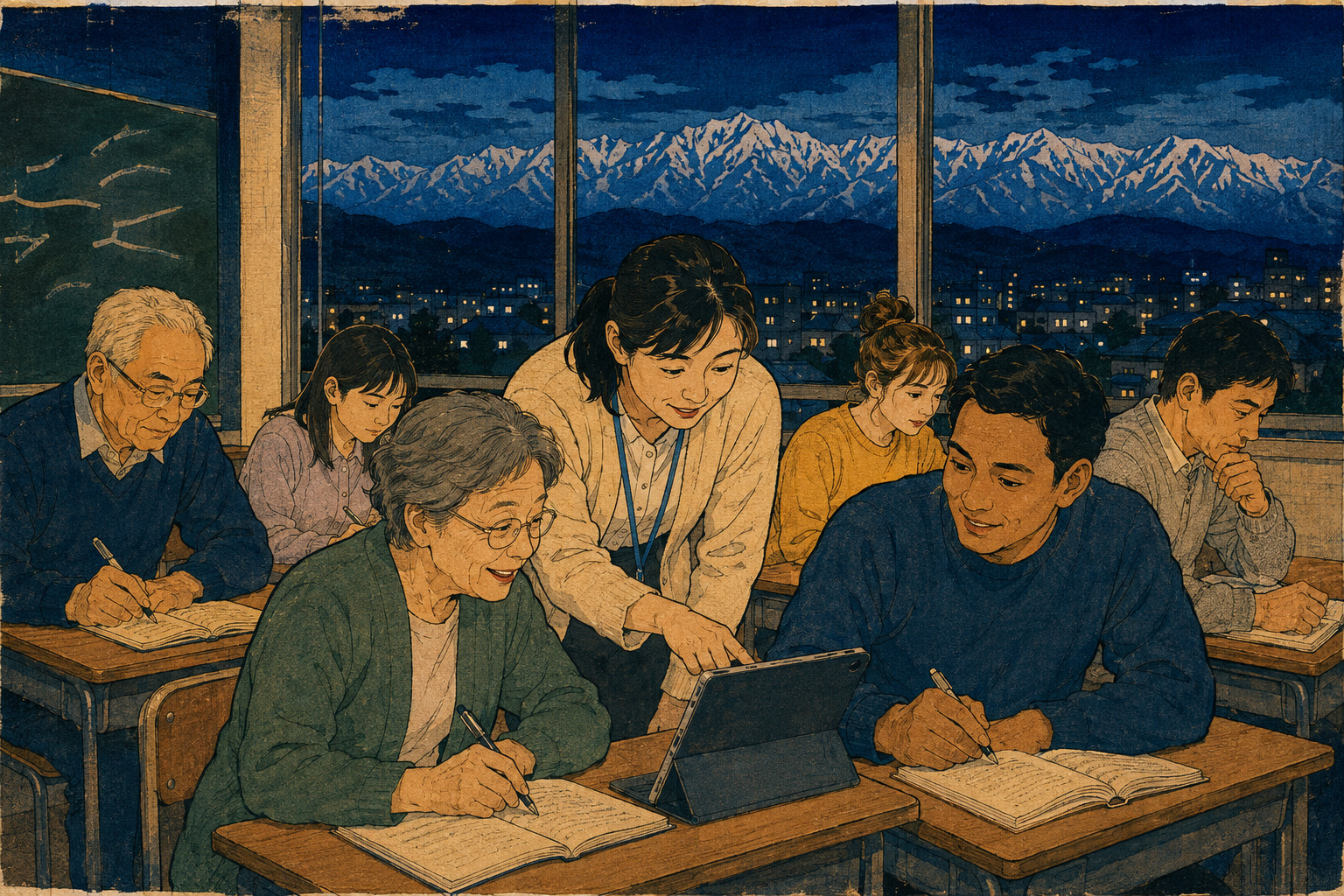
At 6 p.m. tonight, a classroom about a 10-minute walk from Toyama Station is scheduled to become a small rehearsal for a school that has not yet opened. One 20-minute lesson will be science, another English. A briefing and individual consultations will follow. People may attend without advance registration.
The venue is the Toyama District Center of the Prefectural Lifelong Learning College, inside Toyama Prefectural Yūhō High School. It is also where 富山県立高志のあかり中学校—officially read Toyama Kenritsu Koshi no Akari Chūgakkō—is due to open in April. “Toyama Prefectural Koshi no Akari Junior High School” is a descriptive English rendering; the prefecture’s official Japanese name and reading are definitive.
Tonight’s class is the fourth in a series of 12 trial sessions planned twice monthly from July through December. Social studies and technology were offered yesterday; Japanese-language instruction and science are scheduled for Sept. 14, followed by mathematics and Japanese on Sept. 16. Details after September remain to be announced. Participants may return more than once, attend only a lesson, or skip the lesson and join the explanation.
The short classes are a low-stakes way to ask a high-stakes question: can I sit in a schoolroom again? For a person who spent years avoiding school after bullying, who left education to work, or who cannot yet follow rapid Japanese, the door can be harder than the textbook. The trials allow prospective students to test the journey, the room, the pace and the social mixture before committing to a formal application.
A real junior high, not an evening course
Japan’s public night junior highs are easily mistaken for adult-education programs, language schools or evening tutoring. Legally and institutionally, they are junior high schools. Licensed teachers teach the curriculum. Students who complete it receive a recognized junior high diploma. Tuition and textbooks are free.
Koshi no Akari is intended, in principle, for Toyama residents who are past compulsory-school age and at least 15. Applicants must also fall into one of three broad groups: people who did not complete compulsory education; people who formally graduated but received too little education because of illness, non-attendance or other circumstances; and foreign nationals who did not finish compulsory education in Japan or their home country. There is no upper age limit.
The second group is central to the modern meaning of a night school. In Japan, a student can receive a diploma after long-term absence and still have missed much of the learning that diploma appears to certify. In 2015, the education ministry issued guidance making clear that such graduates—officially termed nyūgaku kibō kisotsusha, or graduates seeking readmission—could be accepted by night junior highs under appropriate conditions. Until then, prior graduation itself had often barred them.
Toyama’s guidance likewise asks people with complicated histories to consult the prefecture rather than decide for themselves that they are ineligible. Disability is not an exclusion; prospective students will be interviewed about support needs. A person in or beyond high school may still have a case for junior-high-level study. But Koshi no Akari will not be an à-la-carte service. Its leaflet explicitly says students cannot enroll only for Japanese or a single preferred subject.
Compressing a school day without shrinking the education
The newest school leaflet gives a sample day from 5:40 to 8:50 p.m. Four 40-minute periods are divided by short breaks and a 20-minute homeroom and meal interval. There will be classes Monday through Friday, three terms, and summer and winter vacations. The school will not serve meals; students who need dinner must bring it. Materials, activities, transport and stationery can still cost money even though tuition and textbooks do not.
The planned curriculum totals roughly 700 hours a year, using a national exception that permits fewer hours for people educated at a night school after compulsory-school age. That flexibility does not turn the school into a basic-literacy course. Students will cover Japanese, social studies, mathematics, science, foreign language, music, art, health and physical education, and technology and home economics, as well as moral education, integrated studies and special activities. Toyama plans to preserve more time for the five academic subjects because many prospective students want foundational study or progression to high school.
Students who need Japanese support are to receive lessons in plain Japanese, intensive introductory instruction when necessary, and language teaching integrated into subject time according to individual need. Every student is due to receive a learning device free of charge. Face-to-face teaching remains the rule. Online delivery is planned as a support when heavy snow, health, work or another unavoidable circumstance makes attendance impossible.
That distinction matters. The school’s purpose is not merely content delivery. A mixed-age class can provide conversation, routine, friendships and a public identity as a student—things a video lesson cannot reproduce. The device is meant to prevent interruption, not erase the classroom.
| Question | Toyama’s plan | Practical meaning |
|---|---|---|
| Who can enter? | Generally Toyama residents past school age; no upper age limit | Incomplete education matters more than age, nationality or the mere existence of an old diploma |
| How long? | Normally three years; entry in Grade 2 or 3 possible; generally up to six years | Placement and pace can reflect prior learning and the student’s wishes |
| What is taught? | All nine subjects plus the other required junior-high domains | Completion produces a recognized diploma, not a course certificate |
| What language help? | Plain Japanese, introductory instruction and individual device use | Students learn Japanese in order to participate in subjects, not instead of them |
| What is free? | Tuition and textbooks | Transport, food, supplies and activity costs can remain barriers |
A postwar institution with a new student body
Night junior highs emerged from the disorder and poverty that followed Japan’s defeat in 1945. The postwar school system introduced the new junior high in 1947, but compulsory education on paper did not put every child behind a desk. Some worked during the day or performed household labor because their families could not manage without them. Public junior highs began adding night classes in the early Shōwa 20s—the late 1940s—to give those students access to compulsory education.
The institution survived because exclusion changed form rather than disappearing. Older Japanese who missed school during war and reconstruction were joined by returnees, migrants, foreign residents and, increasingly, younger people who had graduated after prolonged non-attendance. Community-run voluntary night schools and literacy groups filled gaps where no public school existed, but they could not award a formal junior high diploma.
Policy changed decisively over the last decade. The 2015 ministry notice opened the door to readmission for graduates who had not meaningfully received an education. In December 2016, the Diet enacted the Act on Securing Educational Opportunities Equivalent to General Education at the Compulsory Education Stage. Its Article 14 requires local governments to take necessary measures to provide opportunities at schools operating at night or other special times.
Late 1940s Public junior highs create night classes for young people forced to work or perform household labor by day.
July 2015 The education ministry clarifies that insufficiently educated graduates may be readmitted under set conditions.
December 2016 The Educational Opportunity Securing Act gives night-school access a national statutory foundation.
June 2018 Japan’s third Basic Plan for the Promotion of Education seeks at least one night junior high in every prefecture.
June 2023 The fourth plan expands the goal to every prefecture and designated city.
April 2026 The national total reaches 69; Toyama continues preparations for its first school.
The expansion has accelerated: 33 schools in fiscal 2020, 53 in fiscal 2024, 62 in April 2025 and 69 one year later, according to the education ministry. Yet coverage remains uneven. The ministry counted schools in 44 prefectural and designated-city jurisdictions in April 2026. A national policy goal is not the same thing as a seat reachable after work.
The people hidden inside Toyama’s statistics
Toyama’s basic plan cites two census measures. In 2020, 738 prefectural residents were classified as never having attended school, while 12,632 reported elementary school as their highest completed level. Those counts include different ages and circumstances and do not measure willingness or eligibility to enroll. Treating all 13,370 as prospective students would be misleading. The figures do establish that lack of compulsory education is not a purely historical condition elsewhere in Japan.
Another 1,518 Toyama junior high students were classified as non-attending in fiscal 2024. The number was 13 lower than the previous year but remained high. A night school is not a reason to wait until current students graduate, and it does not replace support offered by regular schools, municipalities, free schools or other services. Its role is different: it keeps a public route back open for people whose education remains incomplete years later.
A targeted prefectural survey in 2025 drew 121 responses from potentially eligible people and their relatives or acquaintances. Thirty-eight respondents identified themselves as eligible. Of those, 16 said they definitely wanted to enroll, 13 were considering it and nine said enrollment would be difficult. The survey was voluntary and not a random sample, so it cannot establish a prefecture-wide demand rate. It does show that the category is populated by actual people making actual decisions.
National data dismantle two common stereotypes at once. As of May 2024, the 53 schools then operating enrolled 1,969 students: 1,256 without Japanese nationality and 713 with it. There were 484 students aged 16 to 19, but also 227 aged 70 or older. Among Japanese-national students, 559—78.4 percent—were graduates seeking readmission, not people who lacked a diploma.
The school is not only repairing a missing credential. It is repairing the gap between having “graduated” and having had a real chance to learn.
One centrally located school, a prefecture of long journeys
Koshi no Akari will occupy classrooms and specialist rooms inside Yūhō High School at 2-12-20 Jinzūmachi, near Toyama Station. Locating a prefectural school at a rail hub and reusing an education complex are sensible choices. Prefectural status also avoids limiting admission to residents of a single municipality.
But access is measured at the end of the night, not on a map at noon. When Toyama’s 2025 survey asked where a school would be commutable, allowing multiple answers, 65 respondents selected Toyama City, 44 Takaoka, 28 Imizu, 24 Uozu, 22 Kurobe and 20 Tonami. The geography of need did not collapse around one station.
Students must consider the last train or bus after an 8:50 p.m. finish, heavy winter snow, rotating shifts, elder care and family responsibilities. The school will not make its parking lot available and asks students to use public transport, although people who must drive can consult the prefecture. Online delivery may keep an enrolled student connected during a snowstorm; it does not solve an unsustainable five-day commute.
Other boundaries are explicit. Child care for children who are not themselves eligible students is not planned. Meals will not be served. Clubs are not currently contemplated. Tuition-free therefore does not mean cost-free: fares, food, materials, events and reduced working hours can decide whether a person remains enrolled.
Toyama plans to appoint a principal, vice principal, teachers, a school nurse and administrative staff under prefectural staffing standards, and says it will add a school counselor and school social worker. The quality of the school will depend on how that team connects language support, disability accommodation, welfare, employment, residence-status questions and progression to high school. A small school serving highly varied lives needs more coordination, not less.
- Attend a trial lesson, briefing or individual consultation between July and December 2026.
- Prospective students take part in an individual interview in autumn or winter about their goals, prior education and Japanese ability.
- Submit the application and residence documents; foreign nationals may be asked for a copy of their residence card.
- Discuss grade placement and pace. Three years is standard, but later-grade entry and longer study are possible.
- Begin in April 2027. April is the norm, although the prefecture says people seeking midyear entry should consult it.
When “light” becomes an institution
Koshi no Akari’s stated philosophy is “a night junior high where I and you can both be happy and learn equally together.” Safety, inclusion and equity are the three organizing terms. The school promises a place where students can feel accepted as they are and widen their possible futures.
Those ideals will be tested in mundane details. Can a lesson use plain Japanese without becoming intellectually thin? Can a 17-year-old and a 70-year-old both participate without one being treated as the default? Will students who miss class for work receive support without being allowed to drift away? Can staff reach the eligible resident who never sees a prefectural web page? Does completing the school lead to a high school, a job or simply greater control over daily life?
The trial lessons cannot answer those questions. They can reveal the friction points before opening day. Tonight’s science and English classes are scheduled events, not evidence of outcomes; at the publication time of this article, they have not yet happened. No attendance total, participant quotation or account of the lesson can honestly be reported in advance.
What can be said is that Toyama has moved beyond discussing whether such a school is needed. It has chosen a name, building, curriculum, admissions framework and opening date. The next step is to turn those decisions into a routine sturdy enough for lives that have rarely fit a standard timetable.
An evening light is an inviting metaphor. A functioning public school is harder: it needs teachers, trains, translation, counseling, time and persistence. If Koshi no Akari succeeds, its most important lesson may be the one implied by its existence—that compulsory education is not a one-time chance that expires at 15.
- Toyama Prefectural Board of Education — official Koshi no Akari night junior high information
- Toyama Prefecture — 2026 trial-class and school-briefing schedule
- Toyama Prefectural Board of Education — Basic Policy for Establishing a Prefectural Night Junior High (February 2026, Japanese PDF)
- Toyama Prefectural Board of Education — Koshi no Akari school guide (July 2026, Japanese PDF)
- Toyama Prefectural Board of Education — official questions and answers
- Toyama Prefectural Board of Education — 2025 night-junior-high needs survey
- Ministry of Education, Culture, Sports, Science and Technology — night junior high policy portal
- MEXT — school locations and establishment status as of April 2026
- MEXT — FY2024 Survey of Night Junior High Schools, summary
- MEXT — July 30, 2015 notice on readmission of junior high graduates
- MEXT — notice on promulgation of the Educational Opportunity Securing Act
Editorial note: The official Japanese school name, reading, location, eligibility, fees, curriculum, class size, study period and trial schedule were checked against Toyama Board of Education pages, its February 2026 basic policy and July school guide. The national school count comes from MEXT’s April 2026 list; enrollment characteristics are from the May 1, 2024 national survey. Toyama’s 2025 needs survey was voluntary and targeted, so its responses are not presented as a population estimate. The Aug. 27 class was still in the future at publication; no outcome, attendance figure or quotation is attributed to it. The image is conceptual. The supplied exchange-rate timestamp of Aug. 25 at 7:48 p.m. UTC converts to Aug. 26 at 4:48 a.m. JST.