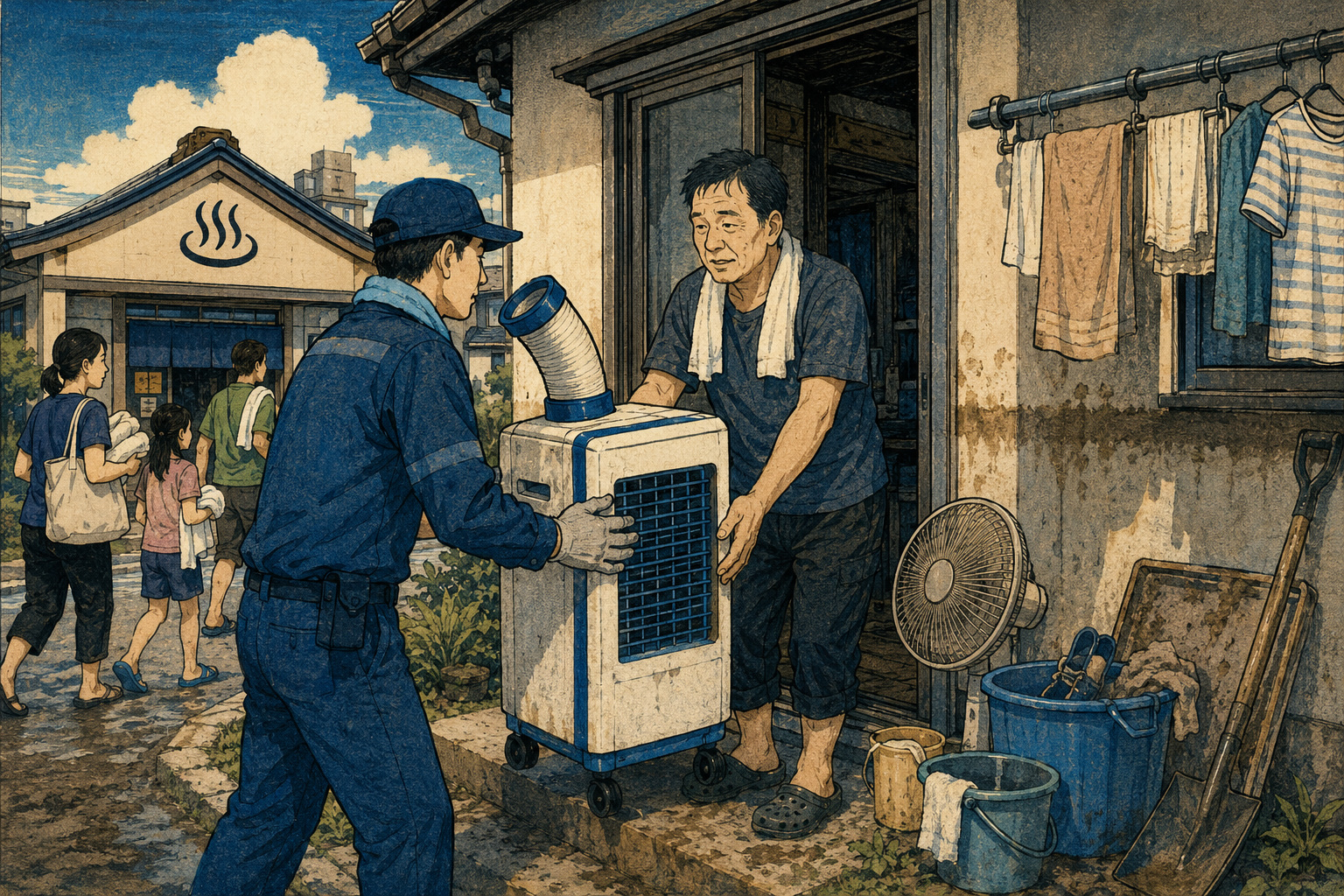
The waterline on a wall is easy to photograph. The missing functions of the room are harder to see. A flooded house may have power, a front door that closes and a roof still overhead, yet no safe bath and no working air conditioner. Its occupants are neither fully displaced nor fully at home. They are living in the administrative space between shelter and recovery.
Kashiwa City’s response to the Aug. 13 rain disaster reaches into that space. Residents unable to bathe at home because of flood damage can use bathing facilities at two senior welfare centers and Refresh Plaza Kashiwa free of charge. Households whose air-conditioning equipment was damaged can be offered a portable cooler at no cost, normally for two weeks.
Neither measure repairs a boiler, bathroom wall, compressor or outdoor condenser. That is precisely the point. They are bridge services: the bath is delivered through existing public buildings, while a movable cooling unit temporarily brings one essential function back into the house. Their value lies in the days before a contractor, insurer, damage certificate or longer-term housing solution catches up.
The hour the city’s risk map became an emergency
Rain intensified rapidly on Aug. 13. Japan’s National Research Institute for Earth Science and Disaster Resilience reported rainfall of roughly 100 millimeters or more in the hour to about 5:20 p.m. around Kashiwa and neighboring Abiko. Kashiwa had received a heavy-rain warning at 2:10 p.m. By 5:02, heightened heavy-rain and landslide warnings were in force; the city ordered people in landslide-risk zones to evacuate at 5:30. It expanded the order to communities around the Ōhori River at 6:45.
At 7:30 p.m., a Level 5 emergency heavy-rain warning covered Kashiwa. The city activated its disaster headquarters, then issued “Emergency Safety Securing”—the highest municipal alert—to the entire city at 7:40. Japan’s meteorological agency warned that disasters might already be occurring even in places not normally considered dangerous. At that stage, the instruction is not a promise that roads remain passable; it is a demand to take whatever action offers the best immediate chance of survival.
Kashiwa’s first report that night listed a six-person preliminary “human damage” total, 40 cases of residential damage, 106 reports involving roads or bridges, and 25 river or other flood incidents. Sixteen shelters held 25 people. A Cabinet Office status report dated Aug. 18 recorded one death in Kashiwa, while the city’s public damage index still described the Aug. 13 totals as under examination on Aug. 25. The figures cannot responsibly be merged or treated as a final ledger.
The Japan Meteorological Agency named the event the “August 2026 Chiba Heavy Rain” (Reiwa 8-nen 8-gatsu Chiba Gōu) on Aug. 14. Official naming is reserved for phenomena that cause marked damage; it is intended to coordinate recovery and preserve the event’s lessons. The Disaster Relief Act was applied to Kashiwa effective Aug. 13, eventually covering 21 cities and four towns in Chiba Prefecture.
Bathing first, paperwork second
The bath program has a deliberately low threshold. It covers people whose home bathroom became unusable because of the heavy rain. At the facility, a user fills out a form and presents something confirming address, name and date of birth. Anyone unable to bring identification because of the disaster is told to speak to reception. Kashiwa’s instructions do not require a completed disaster-victim certificate.
Two sites began accepting users on Aug. 25. The Nanbu Senior Welfare Center (南部老人福祉センター), known as Katakuri no Sato, is at 293-1 Fujigokoro. The Shōnan Senior Welfare Center (沼南老人福祉センター), Ikoi-sō, is at 1356 Tsukazaki. Baths are available from 10 a.m. to 3 p.m. for the time being. The facilities normally serve residents aged 60 and older, but the disaster arrangement removes that age limit for bathing.
The emergency opening does not erase every facility rule. Users need to bring towels and soap. A person requiring assistance is asked to come with a caregiver of the same sex. Children of elementary-school age or younger require an accompanying adult of the same sex, age 18 or older. The city also lists health-related restrictions, including some skin conditions. Other parts of the senior centers remain limited to people at least 60.
Refresh Plaza Kashiwa, at 58-3 Minamimasuo, joined the program on Aug. 26. Its bathing area is free to affected residents for the time being; other amenities remain chargeable. Shampoo and body soap are available, and towels must be brought or purchased. The complex is normally closed on Tuesdays. Users must still complete the identity and eligibility declaration at reception.
| Site | Disaster arrangement | What to know |
|---|---|---|
| Katakuri no Sato | Free bathing from Aug. 25; 10 a.m.–3 p.m.; no age restriction for eligible flood victims | Bring a towel and soap; identification requested but reception can assist if documents were inaccessible |
| Ikoi-sō | Same opening date and bathing hours; arrangement continues “for the time being” | Caregiver, child-accompaniment and health rules apply; non-bath use remains restricted by age |
| Refresh Plaza Kashiwa | Free bathing from Aug. 26; generally closed Tuesdays; only the bathing facility is free | Body soap and shampoo supplied; bring or buy a towel; other facilities cost extra |
The senior centers embody a longer institutional history. They exist under Japan’s Elderly Welfare Act as places for health support, preventive activities, recreation and social connection. Kashiwa says its three centers are 30 to 50 years old. Ordinarily, that age creates maintenance pressure. In this emergency, it created reserve capacity: working baths, established staff and an intake process could be turned outward to the whole affected community.
Disaster infrastructure is not only what a city buys after the alarm. It is also what the city kept functioning before the alarm—and whom it decides to admit when ordinary rules no longer fit.
Why the cooler has a tighter gate
Portable coolers are scarcer and more easily exhausted than time in a communal bathing facility, so access is more controlled. A household must meet all three published conditions: a member must be registered as a Kashiwa resident; the household must have applied for a risai shōmeisho disaster-victim certificate or filed a hisai todokede shōmeisho damage notification; and the filing must state that the home’s air conditioner, cooler or outdoor unit was damaged.
This is not an open counter where residents line up for equipment. The city checks its records and contacts apparently eligible households individually to ask whether they want a unit. There is no fee. A loan normally lasts two weeks, and the limit is one cooler per household, on one occasion. Kashiwa’s Commerce and Tourism Division handles program questions; its Property Tax Division handles the two damage-document procedures.
The certificate distinction matters. A disaster-victim certificate assesses the degree of damage to a residence and feeds into many major forms of relief. A damage-notification certificate records that a report was made about other property or movable possessions. By accepting either filing for the cooler program, Kashiwa does not require every case to fit a completed housing-damage classification. It does require an administrative trail linking the household to an air-conditioning loss.
- Be registered as a Kashiwa resident.
- Apply for a disaster-victim certificate or file a damage-notification certificate.
- Include damage to the air conditioner, cooler or outdoor condenser in the filing.
- Wait for the city to verify the record and make individual contact.
- If a unit is available and wanted, borrow one free for normally two weeks.
The arrangement is a rationing design as much as a welfare benefit. A bath can serve a succession of users; a cooler disappears from inventory for the duration of its loan. Record matching helps direct limited units to households with documented equipment damage. Yet the published notice does not state how many machines exist, whether medical vulnerability affects priority, or what happens when repair cannot be completed within two weeks.
A portable unit is also not central air. Its usefulness depends on room size, ventilation and safe management of exhaust heat and drainage. Electricity remains a household cost. Still, cooling one sleeping room can be the difference between a house that is technically standing and one that is tolerable through the night. The intervention is intentionally partial: it buys time.
The second disaster can be heat
The Cabinet Office’s Aug. 18 disaster report forecast highs around 30 degrees Celsius in Chiba over the following days and specifically urged heat-illness prevention. Recovery work makes the exposure worse. Residents shovel mud, carry soaked furniture, wait outdoors for assessors, and move between offices and damaged homes. If the house’s air conditioner failed, there may be no cool place to recover from that labor.
Environment Ministry guidance for disasters tells people without air conditioning to block direct sun, create airflow when outside temperatures permit, hydrate and replace salt, use body-cooling measures, and move to a cooler public or private place when needed. Older people, young children, people with chronic illness and people with disabilities can face elevated risk. A borrowed cooler should therefore be understood as one layer of protection, not proof that a house is safe for everyone in it.
The bath program addresses a different but connected chain of harm. Flood cleanup can expose skin and clothing to contaminated mud, dust and mold. Washing does not substitute for wound care, infection precautions or medical attention, but the ability to clean the body and change clothes is part of restoring hygiene. It also restores privacy and routine at a moment when disaster has made both scarce.
These are the details that damage categories flatten. “Residential damage” says nothing about whether the water heater operates. “Power restored” says nothing about whether the condenser was submerged. “Shelter population” excludes the resident sleeping in a hot upstairs room because the rest of the house is wet. Kashiwa’s two measures treat habitability as a bundle of functions, not a binary label.
An old relief law, adapted to a hot urban flood
Japan enacted the Disaster Relief Act in October 1947, amid the physical and social disruption of the early postwar period. Its purpose is immediate rescue and protection through cooperation among national and local government, the Japanese Red Cross and others. The modern framework lists shelters, food, drinking water, essential goods, medical care, rescue, emergency housing repairs, school supplies and other forms of short-term assistance.
Chiba applied the law to Kashiwa under an emergency criterion covering situations in which many people face harm or the threat of harm and require continuing relief. For qualifying relief carried out by the prefecture, costs enter a national-prefectural sharing arrangement. That legal step expands capacity and aligns a wide area under a common emergency framework.
It does not answer every household-level question. Kashiwa explicitly connects some assistance—such as school supplies for affected children—to the Act. Its public notice does not say how the bathing and cooler programs themselves are financed or classify them under a particular statutory category. It would therefore be inaccurate to call either program a direct national entitlement merely because the Act applies to the city.
The distinction reveals how disaster policy actually develops. National law supplies authority, categories and cost sharing. Local government observes the season, its building stock and the condition of its residents, then adds operational detail. A law written in 1947 did not name a wheeled room cooler. Its purpose—keeping people alive and protecting minimum daily life—can nevertheless be expressed through one in a flooded home in August.
October 1947 Japan enacts the Disaster Relief Act for emergency assistance after disasters.
Sept. 20, 2023 Kashiwa records 80 building-damage reports and 29 flooded-road incidents after heavy rain.
October 2024 map The city’s inland-flood model uses a maximum scenario of 153 mm in one hour.
Aug. 13, 2026 Torrential rain brings the highest emergency alert, severe damage and application of the Disaster Relief Act.
Aug. 25–26 Municipal baths begin opening to affected residents as the cooler-loan program joins the relief package.
The measure of a bridge is where it leads
Kashiwa’s own hazard materials provide two views of water risk. Its river-flood map models inundation from the Tone River system and related waterways. A separate inland-flood map examines rain overwhelming drainage, using a maximum scenario of 153 millimeters in one hour. The city also publishes a neighborhood-level history of reported water damage, while warning that an address absent from the list is not proof it has never flooded.
That record matters because the August disaster is not Kashiwa’s first encounter with water inside the urban fabric. The city recorded 80 building-damage cases and 29 flooded-road incidents after heavy rain on Sept. 20, 2023. It reported 29 road-flooding cases and five homes flooded below floor level as recently as July 17, 2026. Past incidents do not make the Aug. 13 event predictable at the household level, but they show why recovery capacity must be maintained alongside hazard maps.
The immediate test is reach. Can a person without a car get to a bath during its opening hours? Does someone working all day on cleanup arrive before 3 p.m. at a senior center? Can older residents, foreign nationals and people whose documents were soaked find the right office? Will the city’s record-based outreach identify everyone who lost cooling equipment? A service that exists on a webpage is not yet a service received.
Kashiwa has tried to reduce that fragmentation through a disaster call center, health consultations, volunteer referrals and a consolidated aid page covering housing, waste, school, tax, insurance and utility relief. The bathing and cooling measures work best when they become entry points into that larger system. A resident who says the bathroom is unusable may also need floor disinfection, debris removal, an emergency repair or temporary housing.
The programs are temporary by design. “For the time being” is not a reconstruction timetable. A two-week loan is not an air-conditioner repair. Their success will depend on whether the handoff occurs: from municipal bath to repaired bathroom, from portable machine to working home cooling, from preliminary damage report to the assistance a household actually qualifies to receive.
Disaster recovery is often narrated through the largest numbers—rainfall, fatalities, destroyed buildings, public expenditure. Kashiwa’s response asks for another unit of measurement: an ordinary evening restored. A clean body. A room cool enough to sleep in. The ability to remain in one’s own neighborhood while the slow machinery of repair advances. Those are not side benefits of recovery. For a household standing in the damp heat, they are what recovery first means.
- Kashiwa City — consolidated support for people affected by the August 2026 Chiba heavy rain, updated Aug. 24
- Kashiwa City — senior welfare centers and emergency bathing access
- Kashiwa City — Refresh Plaza Kashiwa and emergency bathing access
- Kashiwa City — disaster-victim and damage-notification certificates
- Kashiwa City — first Aug. 13 heavy-rain damage and response report
- Kashiwa City — official damage index
- Japan Meteorological Agency — Level 5 emergency heavy-rain warning for Chiba
- Japan Meteorological Agency — official naming of the August 2026 Chiba Heavy Rain
- Chiba Prefecture — Disaster Relief Act application, third report
- Cabinet Office — Aug. 18 status report on the August 2026 Chiba Heavy Rain
- National Research Institute for Earth Science and Disaster Resilience — Aug. 13 Chiba rain analysis
- Kashiwa City — web disaster and hazard map
- Kashiwa City — historical water-damage records
- Cabinet Office — overview of the Disaster Relief Act
- Ministry of the Environment — disaster heat guidance, including when air conditioning is unavailable
Editorial note: Program names, eligibility, site names, addresses, opening dates, hours, fees, required items, loan rules and responsible divisions were checked against Kashiwa’s Aug. 24 support hub and facility pages. The rainfall sequence, warnings, event name and Disaster Relief Act application were cross-checked against NIED, JMA, Chiba Prefecture and Cabinet Office materials. Damage counts are dated and attributed because the city’s first report and later national compilation use different reporting times and categories. The illustration is conceptual. The supplied foreign-exchange timestamp of Aug. 25 at 7:48 p.m. UTC converts to Aug. 26 at 4:48 a.m. JST.