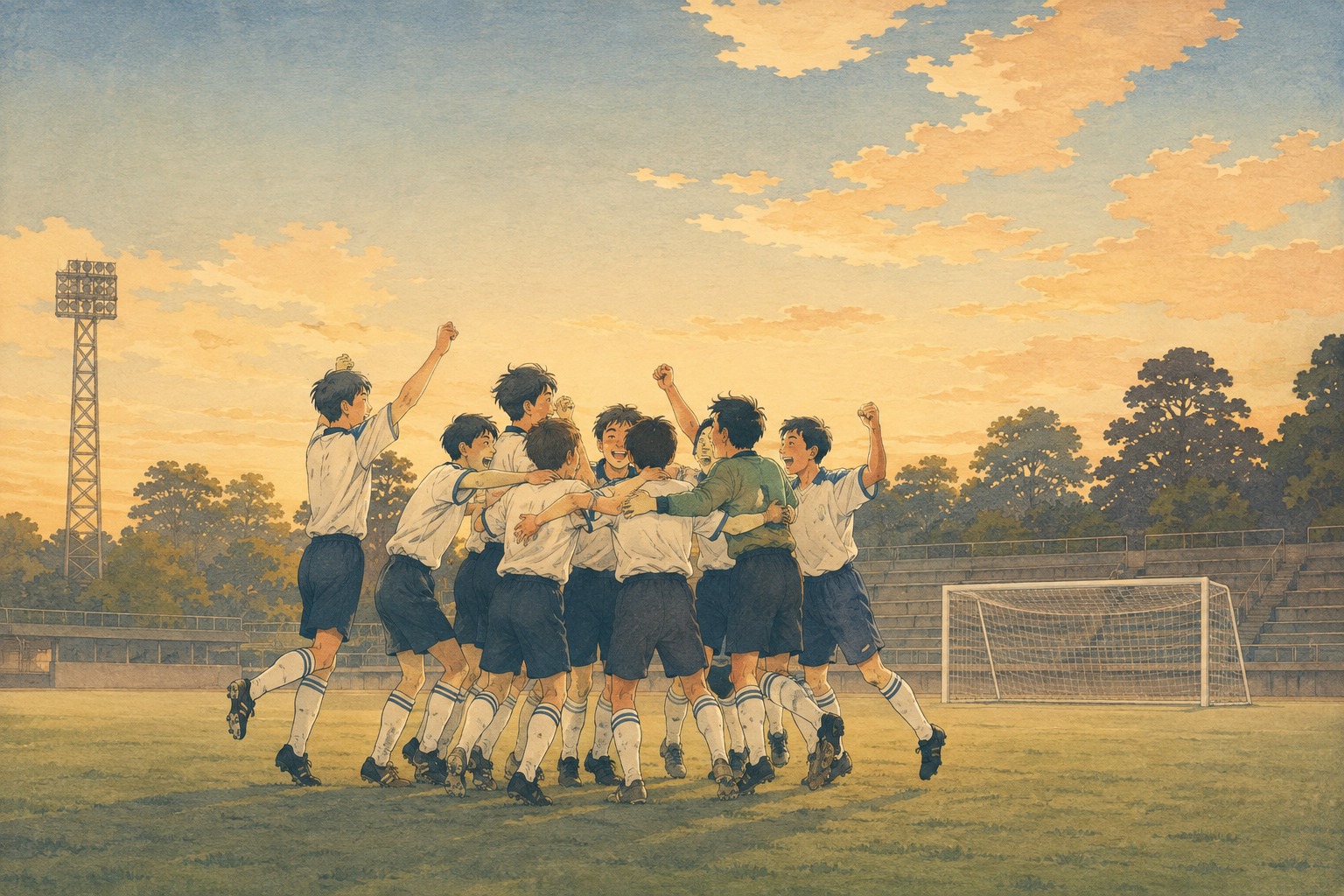
The most important number on the final record is written as an addition. “60+8” means the 60 minutes allotted to a junior-high match had elapsed and eight more had been accumulated through second-half stoppages. A penalty shootout was near. Then Kamimura Gakuen’s No. 12—the player listed in the Japanese record as 渡部翔介—scored the only goal against Shizuoka Gakuen.
The final whistle made Kamimura the champion of the 57th National Junior High School Football Tournament, the football competition within Japan’s fiscal 2026 National Junior High School Athletic Meet. It was the Kagoshima school’s fourth title, after victories in 2021, 2023 and 2024, and its first in two years.
That is what the primary record establishes. The final sheet provides shot totals and describes the goal in compressed field-zone and action codes, including a cut, an opposing field player and a right-footed shot. It does not contain a conventional narrative, a formally named assist, possession or running data. This article does not turn shorthand into an invented sequence. The verified structure is spare: 0–0 at halftime, Kamimura’s goal at 60+8, a 1–0 result, and a trophy won at Edion Peace Wing Hiroshima on the morning of August 23.
The 60-minute match that occupied nearly 89 minutes
Kickoff was at 9:30 a.m. on natural grass. The match sheet lists 600 spectators and weak wind. The first half occupied 38 minutes 5 seconds on the match timeline; the second, 39 minutes 39 seconds. Total recorded duration was 1 hour 28 minutes 31 seconds. Cooling breaks and other stoppages are why a goal in “60+8” is neither a contradiction nor an extra-time goal.
Under the tournament rules, each match consisted of two 30-minute halves. A tie after regulation did not lead to extra time, even in the final; it went directly to kicks from the penalty mark. Had the 0–0 survived the added minutes, the national title would have been decided there.
The late goal can be called dramatic because of the clock. The official shorthand does not support adding a cross, a counterattack, a defensive error or a named assist. Nor does the score prove that one side dominated possession. Precision matters most when the subjects are minors whose performances can be magnified into reputations before they have had time to develop.
Fifteen goals, then two games with no margin
Kamimura’s route changed character halfway through the bracket. It beat KAMI F.C. 5–0 in the first round, 浜松開誠館中学校 5–2 in the second, and 岡山学芸館清秀中学校 5–0 in the quarterfinal. Three games, 15 goals.
The semifinal against 京都精華学園中学校 ended 1–0. So did the final. The last two opponents allowed Kamimura no numerical cushion, yet neither scored. Across all five games, Kamimura conceded only the two goals in the second round and kept four clean sheets.
The arithmetic is strong evidence of output and results, not a complete tactical profile. The final PDF includes a shot count, but the five public match pages do not provide a common possession or territorial-control series. “Attacking team,” “deep block,” “pressing side” and similar labels would require match observation or richer data. What the bracket proves is more useful than a guess: a team that won three five-goal matches also found a way through two one-goal matches.
| Round | Opponent | Result | What the record shows |
|---|---|---|---|
| First round | KAMI F.C. | 5–0 | Five goals and a clean sheet. |
| Second round | 浜松開誠館中学校 | 5–2 | Kamimura’s only concessions of the tournament. |
| Quarterfinal | 岡山学芸館清秀中学校 | 5–0 | A third consecutive five-goal performance. |
| Semifinal | 京都精華学園中学校 | 1–0 | The margin narrows; the clean sheet remains. |
| Final | Shizuoka Gakuen Junior High School | 1–0 | The winning goal arrives at 60+8. |
A 17–2 aggregate can look like a story about abundance. The championship was decided by scarcity: one goal in the semifinal, one in the final, none conceded in either.
A one-goal loss returned as a one-goal win
The opponent and score carried a recent memory. In the 2025 semifinal—not the quarterfinal—Shizuoka Gakuen beat Kamimura 1–0. Shizuoka then won the title. One year later, the schools met in the final and the score was reversed.
It is tempting to write a perfect revenge story. Junior-high football resists that neatness. Graduation and promotion change a roster quickly; bodies, roles and relationships shift over twelve months. The player who scored the 2026 final winner appears in Kamimura’s 2025 semifinal roster, but neither match belonged to one individual. A school can carry institutional memory while the children living the experience change.
Shizuoka Gakuen’s place in the history also exceeds this loss. It first won the tournament in 2009 and claimed its second championship in 2025. Two schools with national titles produced consecutive 1–0 meetings, each winning one. That symmetry is enough. It does not need fictional quotations or a reconstructed locker-room vow.
From 1970 to the 57th tournament
The national tournament began in 1970. JFA’s historical table lists 西益津 of Shizuoka as the first champion and 似島 of Hiroshima as runner-up; this edition preserves the primary-source spelling. The record contains exceptions that explain why an edition number is more informative than a simple count of summers: there were co-champions in 1972 and 2000, and the 2020 tournament was canceled during the COVID-19 pandemic.
Kamimura’s ascent is recent. Its 2021 victory over 青森山田中学校 brought the first championship. It won again in 2023 against 日章学園中学校 and in 2024 against 青森山田中学校, completing a repeat. The 2025 semifinal loss ended that run; the 2026 final restored the title. Four wins in six editions is an accurate calculation, though one of those editions followed the canceled 2020 summer and the players changed throughout.
1970 The inaugural national junior-high football tournament is held.
2020 The 51st edition is canceled.
2021 Kamimura Gakuen wins its first championship.
2023 Kamimura wins a second title.
2024 A repeat makes it three.
2025 Shizuoka Gakuen beats Kamimura 1–0 in the semifinal and wins the tournament.
2026 Kamimura beats Shizuoka Gakuen 1–0 in the final for title No. 4.
What exactly did Kamimura win?
The official Japanese title is 「令和8年度 全国中学校体育大会 第57回全国中学校サッカー大会」: the 57th National Junior High School Football Tournament within the fiscal 2026 National Junior High School Athletic Meet. It ran from August 18 through 23 at venues in Hiroshima Prefecture and was organized by bodies including 日本中学校体育連盟, Japan’s junior-high school sports federation, and the Japan Football Association.
Thirty-two regional and host representatives entered a single-elimination bracket. There was no third-place match. The regional allocation was two from Hokkaido, three from Tohoku, seven from Kanto, two from Hokushinetsu, three from Tokai, five from Kinki, two from Chugoku, two from Shikoku, five from Kyushu and one host-place team.
Teams could register up to 18 players in a 21-person party that also included leadership and coaching roles. Re-entry was permitted: a substituted player could later return. These are youth-specific competition choices, designed around a 60-minute match and broader participation rather than copied intact from senior professional football.
The title has a precise scope. JFA categorizes middle-school-age football as “Category 3,” which also includes the Prince Takamado Trophy JFA All-Japan U-15 Championship, regional U15 leagues and the Japan Club Youth U-15 Championship. Different competitions draw different populations and use different formats. Winning the school tournament makes Kamimura the national junior-high tournament champion. It does not, on its own, prove a scientific ranking above every U15 academy or club in Japan.
A school tournament no longer means only single-school teams
The word “school” in the title can conceal a changing boundary. The 2026 regulations allow eligible community club activities to enter if they satisfy junior-high federation requirements. Joint-school teams and hub-school activities may also qualify under the relevant provisions. Kamimura entered as the junior-high division of an educational institution, but the competition around it is adapting to depopulation, falling enrollment and Japan’s wider reform of school club activity.
This is not a contest in which school teams must defeat clubs ideologically. It is an access question. A child in a small district may not have enough classmates for a team; a school may not have a specialized coach; a regional club may be the only viable place to continue. Eligibility reform opens doors, but it does not by itself pay travel costs, standardize safeguarding, protect study time or remove geographic inequality.
The field itself displays the hybrid system. Kamimura competes not only in short school knockouts but in the 2026 Prince Takamado Trophy U-15 Kyushu League. JFA match records place it opposite J.League academies and community clubs, including Oita Trinita U-15, V-Varen Nagasaki U-15 and アリーバFC. The final’s scorer also appears in those official league records. A modern Japanese school team can therefore develop through the same year-round competitive network as club academies.
The institution behind four championships
Kamimura Gakuen’s junior-high division is in Ichikikushikino City, Kagoshima Prefecture. Its official Japanese motto is 「健康・勤労・誠実・礼儀・責任」—health, diligence, sincerity, courtesy and responsibility. Its specialized-talent course explicitly aims for national championships in activities including boys’ football while describing individualized education and a balance between study and club work.
That explicit ambition matters. Four national trophies are not produced by a final alone. They imply recruitment, coaching, facilities, scheduling, medical judgment, schooling and family commitments that operate before the public bracket begins. They also make it necessary to ask who receives playing time and educational support, not only who appears in a winning photograph.
The wider school program has had an exceptional calendar. Kamimura’s senior-high boys won the 2025 Inter-High tournament and the 104th All Japan High School Soccer Tournament, completing the summer-winter double in January 2026. The junior-high title followed in August. That continuity can create an advanced pathway, but no institutional result guarantees that every 13-, 14- or 15-year-old will become a senior-high starter, university player or professional.
Youth development is not a factory output. A responsible pathway gives a player room to progress, change schools, join a club, emphasize study, switch sports or stop. The measure of a strong institution includes injuries avoided, education completed, agency preserved and affection for the game after the medals have been stored.
WBGT 32.7 belongs in the main story
The heat entry on the final sheet is not background decoration. JFA issued its first football heat countermeasures guidebook in 1997 and established a formal heatstroke countermeasures guideline in 2016 to protect players, staff, referees and spectators. In an August 12, 2026 explanation, the association described WBGT measurement and the preparation of medical response as organizational duties of the event operator.
JFA also emphasized that a hydration break is not ceremonial. It is a planned chance to slow dehydration and rising body temperature, observe expression and movement, consider substitution or a restriction on play, and make it easier for a player to report a change in condition. The final record’s cooling-break note therefore documents part of a safety system, not merely interruptions to momentum.
The controlling guideline classifies an in-match WBGT reading of 31 or above as “exercise in principle canceled” and calls for the match to be canceled, interrupted or postponed. It contains a narrow route to play: an organizer may proceed only if all of Steps 1, 2 and 3—covering body cooling, shade, ice and medical preparation, qualified emergency personnel, air-conditioned rooms and other measures—plus cooling breaks are implemented.
The final record states 「前後半・クーリングブレークを2回実施」 and records WBGT 32.7. It does not document the entire checklist, explain why kickoff was set for 9:30 or state whether anyone developed heat illness. The number alone proves neither a breach nor complete compliance: the guideline has an exception, while the match sheet does not show every condition behind it. It does put heat management at the center of a national championship for minors.
Admiring composure is compatible with refusing a toughness myth. Players should not have to prove commitment by concealing dizziness or nausea. Coaches and organizers need a shared authority to pause, substitute, postpone or stop; medical personnel need an unobstructed route to act; competition design must account for successive matches, travel and recovery. A trophy cannot retroactively make environmental exposure acceptable.
- How were minutes and re-entry opportunities distributed across the 18-player tournament roster?
- How were match load, training load, recovery, injuries and heat acclimatization managed before and after five knockout games?
- What academic and career options were available to players who did not move into the senior-high first team?
- How did the school support travel, family costs, residential life and study time?
- Did players leave the program able to report discomfort, make choices and retain a healthy relationship with football?
Do not make a 15-year-old carry the institution’s mythology
Kamimura’s official announcement thanked families, the community and other supporters and said the program would continue working to grow. That final verb is more appropriate to this age than the language of arrival. A national title is a major achievement; it is not a declaration that a child has become a finished footballer.
The score sheet assigns the goal to one name. The title also required four earlier wins, 16 other goals, four clean sheets, substitutes, teammates who did not enter, opponents who tested the champions, coaches, families, medical personnel and tournament staff. Elevating the scorer into a forecast of stardom would be less accurate than recognizing the collective adaptation visible in the results.
In 2025, Shizuoka stood on the one-goal side of this rivalry. In 2026, Kamimura did. Next summer will bring another roster and another bracket. That is why the fourth title should be attached to a date and a body of verified work: five wins in Hiroshima, 17 goals scored, two allowed, and one goal after the regulation clock had run out.
Kamimura’s achievement was not simply that it overwhelmed opponents. It was that the team survived when goals became scarce. It paused in severe heat, returned to play, approached the edge of a penalty shootout and found one final score. The next victory would be quieter: turning that success into safe training, meaningful playing opportunities, education and enough freedom for every player to choose what football becomes next.
- Japan Football Association — 2026 final, Shizuoka Gakuen vs. Kamimura Gakuen
- JFA — official final record: goal, lineups, conditions and cooling breaks
- JFA — 57th National Junior High School Football Tournament regulations
- JFA — historical champions
- JFA — first round, Kamimura Gakuen vs. KAMI F.C.
- JFA — second round, Kamimura Gakuen vs. Hamamatsu Kaiseikan
- JFA — quarterfinal, Kamimura Gakuen vs. Okayama Gakugeikan Seishu
- JFA — semifinal, Kamimura Gakuen vs. Kyoto Seika Gakuen
- JFA — 2025 semifinal, Kamimura Gakuen vs. Shizuoka Gakuen
- Kamimura Gakuen junior-high division — official 2026 championship announcement
- Kamimura Gakuen junior-high division — official account of the 2021 first title
- Kamimura Gakuen junior-high division — school, course and motto
- Kamimura Gakuen senior-high division — official account of the 2025 summer-winter double
- JFA — 2026 U-15 Kyushu League, Kamimura Gakuen vs. Oita Trinita U-15
- JFA — 2026 U-15 Kyushu League, Kamimura Gakuen vs. アリーバFC
- JFA — 2026 U-15 Kyushu League, Kamimura Gakuen vs. V-Varen Nagasaki U-15
- JFA — Heatstroke Countermeasures Guideline, revised May 21, 2024
- JFA — Heatstroke Countermeasures: The Importance of Hydration Breaks, August 12, 2026
Editor’s note: Official Japanese names, competition titles, venues, rules and specialist terms were checked against Japanese primary sources. The scorer’s name is reproduced as 渡部翔介, exactly as it appears in the JFA record. The 17 goals, two conceded and four clean sheets are Japan.co.jp calculations from the five official results. The hero is editorial art, not documentary evidence. The exchange-rate source time of August 24, 2026 at 7:47 p.m. UTC was converted to August 25 at 4:47 a.m. Japan Time. The rate was not used to convert any figure in the story.