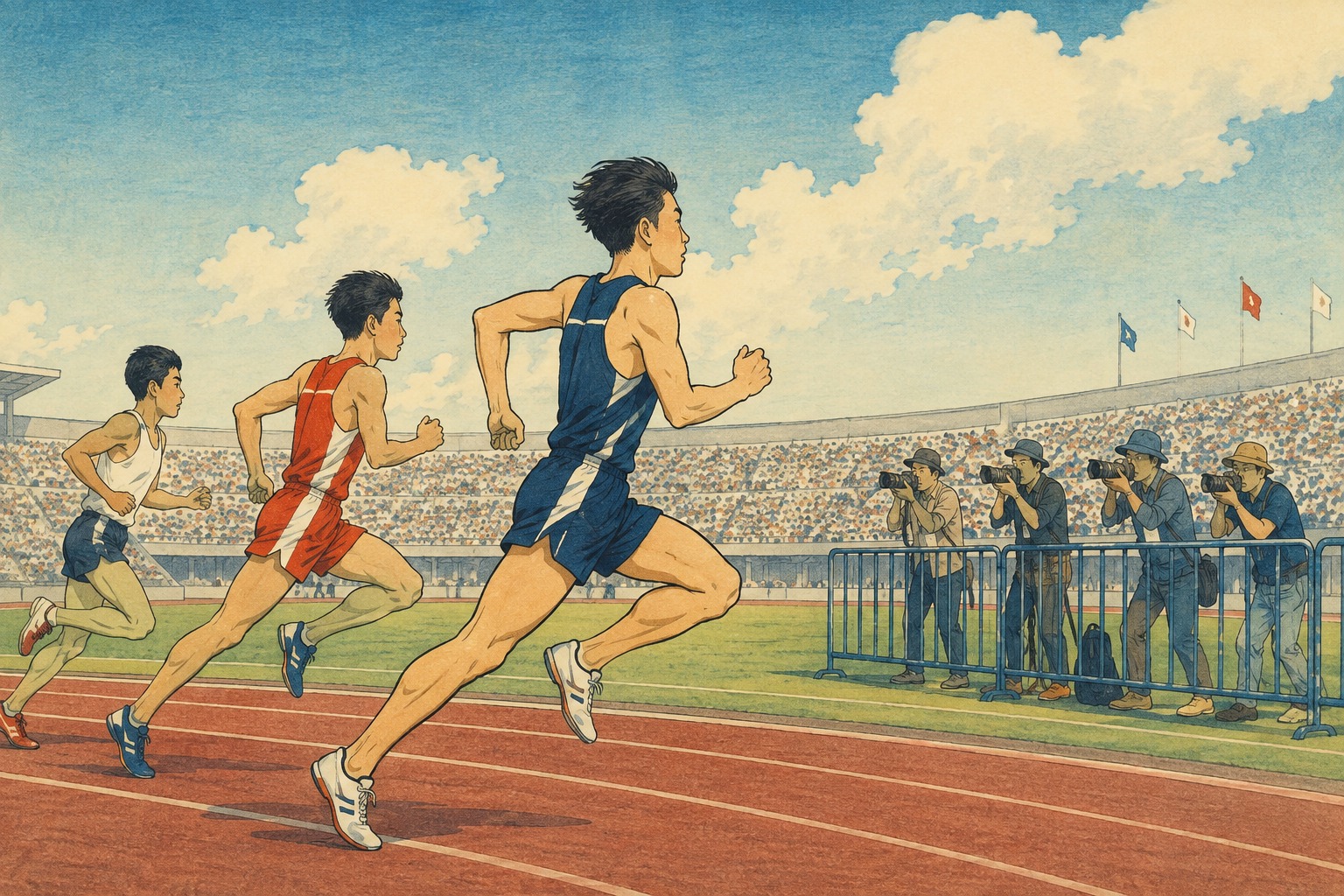
A track photographer waits for the fraction of a second when muscle, effort and consequence align. The same shutter can also begin a very different transaction: a body part isolated from the performance, enlarged, paired with sexual commentary and reposted or sold where the athlete never agreed to appear.
On August 24, the Japan Association of Athletics Federations—JAAF, or Nihon Rikujō Kyōgi Renmei—announced photography restrictions for two age-group championships. The 42nd Japan U20 Athletics Championships will be held October 3 and 4 at Kusanagi Sports Complex Athletics Stadium in Shizuoka. The 20th U18 and 57th U16 Athletics Competition will follow October 23–25 at Mie Kotsu Group Sports no Mori Ise Athletics Stadium.
At both meets, athletes, coaches, event personnel, parents and spectators may use only smartphones and tablets for ordinary photography. DSLR cameras, video cameras and similar equipment are prohibited unless the user is wearing a bib issued to someone authorized by the organizer, such as accredited media or JAAF’s Scientific Committee. Attaching a telephoto lens to a phone or tablet is also prohibited. Phones and tablets cannot be used in designated no-shoot areas, including locations behind the 100-meter start.
The distinctions matter. This is not a national ban on all photography at every Japanese track meet. It is not even a complete photography ban at the two named championships. The same general camera restriction operated at those youth events in 2025; the 2026 notice continues that approach and adds the federation’s current package of patrols, reporting and public warnings.
The rule reaches the family camera
The official notice defines the general public broadly enough to include the people who usually stand closest to a young athlete: competitors, coaches, officials and parents, as well as spectators. A father documenting his child and a coach filming technique may have legitimate purposes. Neither relationship, however, can be authenticated quickly from the opposite side of a stadium. A device rule avoids asking security workers to infer intent from appearance, age, gender or family status.
Accreditation changes the accountability chain. A bib tells athletes and staff that the organizer knows why a long-lens camera is present and who is using it. It can help distinguish news coverage, official documentation and scientific analysis from unknown collection. It should not create immunity. An accredited photograph can still be exploitative, poorly cropped, overidentified or misused later. Media standards and a complaint path must apply on both sides of the barrier.
| Person or equipment | Default rule | Important limit |
|---|---|---|
| Athletes, coaches, personnel, parents and spectators | Photography with a phone or tablet only. | No use in designated no-shoot zones; no attached telephoto lens. |
| DSLR, video and similar cameras | Not permitted without an organizer-issued authorization bib. | The announcement regulates use at the meet; it does not describe a general ban on ownership. |
| Accredited media and authorized scientific staff | May be exempt while wearing the designated bib. | Authorization does not erase image-use and safeguarding duties. |
| Any other meet | Read that organizer’s specific conditions. | The two-meet rule is not a universal code for all Japanese athletics. |
Why regulate a device when the harm is an intention?
Intent is the least visible thing at the gate. A sequence that looks like ordinary race coverage may later be cropped around an athlete’s body, stripped of competitive context, combined with obscene language and redistributed. A stranger may behave politely. A known adult may misuse an image. Profiling a photographer is both unreliable and unfair.
Long-lens and high-capacity cameras are therefore being used as an administrable proxy. They support prolonged, high-resolution capture from a distance and are easy for roaming personnel to identify. Device, location and bib status can be explained in a sentence and applied without a debate over motive.
The rule does not establish that expensive cameras cause abuse. It gives stadium staff a visible boundary when a future use cannot be proven at the point of capture.
That convenience brings a predictable blind spot. A current phone can record detailed video and distribute it before a steward arrives. A television image can be screen-captured. A legitimate parent photograph can be copied from a public account. Counting prohibited cameras may demonstrate compliance with the entrance rule, but it cannot demonstrate that athletes are safe.
Thirteen-point-five percent is not an athlete prevalence rate
JAAF’s most useful national evidence is also easy to overstate. In March 2024 it invited roughly 6,300 holders of federation-certified coaching qualifications to take part in a hearing survey; 555 responded. Of those respondents, 75—13.5 percent—said their team had experienced victimization or harm from intrusive photography at competitions. Eighteen, or 3.2 percent, identified an experience at training or club activity.
The denominator is responding coaches, not athletes. A team may have had one incident or several. A coach may know about conduct that affected more than one person, or know nothing about an incident that an athlete never disclosed. The response rate was about 8.8 percent, leaving room for both concern-driven participation and substantial underrecognition.
The responsible conclusion is neither “13.5 percent of athletes were victims” nor “only 75 cases.” The survey establishes that the issue was known across multiple coaching settings and that coaches reported recurrent patterns. It does not estimate national athlete prevalence. Future measurement should combine anonymous athlete-centered surveys with consistent event logs, while suppressing small cells that could identify a minor.
From warning athletes to redesigning the venue
In a 2023 federation interview, former London 2012 Olympic sprinter Kana Ichikawa—Ichikawa Kana in Japanese order—described vulnerable moments after a race, when an exhausted athlete bends over or lowers guard. Her practical warning was that athletes should remain conscious that they do not know where or how they are being photographed.
That advice reflects what athletes had available: vigilance. It should not become a demand that runners modify uniforms, posture, celebration or recovery to manage other people’s conduct. JAAF’s Athlete Commission made the institutional responsibility clearer in a June 2026 statement. It said intrusive photography can damage personality and dignity, produce psychological stress, disrupt concentration and even drive athletes away from the sport.
Beginning in fiscal 2024, JAAF prohibited ordinary spectators from using DSLR and similar cameras in first-tier stands at flagship events such as the Japan Championships and Golden Grand Prix. The 2025 U20 and joint U18/U16 meets adopted the broader device restriction now being continued. Late that year, the federation published a separate child-image-misuse policy for organizer-run events involving elementary-age participants.
July 2023 The principal provisions of Japan’s new sexual-image photography law take effect.
March 2024 JAAF surveys certified coaches about intrusive photography; 555 respond.
Fiscal 2024 Flagship-meet first tiers restrict ordinary DSLR and similar camera use.
2025 The U20 and joint U18/U16 meets bar unauthorized DSLR and video cameras.
October 2025 JAAF issues a policy against misuse of children’s images at events it organizes.
June 2026 The Athlete Commission publishes a statement centered on dignity and the sporting environment.
August 24, 2026 JAAF confirms the current rules for the two October youth meets.
A new criminal law did not make venue policy obsolete
Japan enacted the Act on Punishment of Acts of Photographing Sexual Appearance and related matters in June 2023. Its principal provisions took effect on July 13. The Ministry of Justice uses the short Japanese name seiteki shitai satsuei-tō shobatsuhō. It created nationwide offenses covering specified conduct such as secretly or nonconsensually recording defined sexual appearances.
It did not make every unauthorized sports image a crime. The subject, method, circumstances and later publication matter. Depending on the facts, prefectural nuisance-prevention ordinances, defamation, privacy, portrait or other civil claims may also be relevant. Only police, lawyers, prosecutors and courts can resolve an individual case.
A venue condition can be deliberately wider than the criminal threshold. An organizer does not need to prove a crime before designating a no-shoot zone, limiting equipment, approaching a photographer or, under stated entry conditions, requiring someone to leave. That preventive power also needs limits. Searching a private device, demanding deletion or preserving evidence engages privacy, due process and possible police procedure. The federation’s August 24 youth notice describes reporting, patrols, signage, big-screen messaging and police presence; it does not publish a complete sanction ladder or a detailed protocol for inspecting devices at the two meets.
A parent’s consent is not the end of a child’s image rights
For a minor, a sports photograph can also be a location file. Face, full name, school or club, bib, certificate, schedule and geotag may allow a viewer to map the child’s routines. A parent who approves a team photograph has not authorized a sexual crop, a commercial database or indefinite redistribution.
JAAF’s child-image-misuse policy takes a graduated approach at organizer-run meets involving elementary-age athletes. Outside spectator stands, unauthorized photography with any device is barred. From the stands, ordinary users are limited to phones and tablets. The publication guidance warns against images that emphasize a face or body part and against combinations that identify a child, such as a face and name shown together on a certificate. It calls for anonymization where needed and individual parental consent.
Good consent should be granular. Event operations, editorial news, team communications, advertising and public social media are different purposes. A young person should receive an age-appropriate explanation and a way to object without losing selection or participation. Organizers should display a correction, removal and complaint route that does not require the athlete to confront the photographer.
The harm can begin after the shutter
Stadium rules govern only one point in an image’s life. Misuse may begin with an official broadcast, a newspaper gallery, a school record or a public family account. The original publication may be legitimate while the crop, caption, repost or sale is not.
That is why incident reporting must accept URLs, timestamps and screenshots as well as a description of a person in the stands. It must minimize personal data and warn reporters not to circulate harmful material more widely in the name of evidence. Organizers need relationships with police, lawyers and online platforms, and a way to support the athlete while a takedown or investigation proceeds.
Publishers have a separate duty. A frame should retain enough athletic context to show an action, not isolate anatomy for attention. Captions and galleries should avoid binding a minor’s face, name, school, next competition and location into a searchable dossier. Download settings, embeds and contact details deserve editorial review. Good sports photography does not erase the body; it makes skill, force, expression and competitive meaning visible without reducing the athlete to a body part.
Success is not the number of cameras turned away
A better reporting system may produce more incident reports at first. That can mean behavior is worsening, but it can also mean athletes and spectators know where to speak and believe someone will respond. Zero reports can describe a safe meet or a silent one.
- Reports, verified incidents and responses relative to attendance and the event’s photography environment.
- Time from report to staff arrival, athlete support and any necessary police referral.
- Anonymous pre- and post-meet athlete measures of safety, concentration and knowledge of reporting routes.
- Warnings, relocations, removal requests and police consultations, with a proportionate appeal or complaint process.
- Wrongful interventions affecting legitimate family photography, media or accessibility needs, and the remedy provided.
- Online reports, takedown support, recurrence and time to resolution.
- Staffing levels, safeguarding training and consistency across venues and regions.
Public JAAF material does not provide a federation-wide annual total for warnings, image checks, removals, police referrals or verified online misuse. Nor does it publish an evaluation showing how much the 2025 youth-meet camera rule changed incident levels or athletes’ sense of safety. Those gaps do not prove that the measures failed. They prevent the public from knowing what worked, what moved online and where enforcement burden fell.
Transparency must protect the same people it is meant to serve. A table that cross-references a rare event, age, gender and discipline may identify a young athlete. Aggregate reporting should suppress small numbers while allowing an independent safeguarding specialist and athlete representatives to review the underlying anonymized records.
Keep the photograph; put the athlete back at its center
Athletics has been preserved through images: the torso at the tape, a pole bending above the box, a foot suspended before the sand, two relay hands reaching for the same baton. Family photographs hold years of training. Journalism gives a public record to performances outside the biggest broadcasts. Treating all photography as hostile would diminish the sport and could make safety theater out of an unmeasured ban.
The answer is a precise system: visible zones, accountable accreditation, trained stewards, support-first reporting, proportionate interventions, privacy-aware evidence handling and a route from online discovery to removal. Rules should be reviewed against evidence and tightened or relaxed according to age, risk and outcome rather than allowed to expand by habit.
The most important result from the two October meets will not be how many large cameras stayed outside. It will be whether young competitors could bend over after a race, celebrate, grieve, adjust a shoe and walk through the mixed zone without calculating how each ordinary movement might be sexualized. Once that result is measured and published, a camera restriction becomes more than a prohibition. It becomes safeguarding.
- Japan Association of Athletics Federations — 2026 photography restrictions for the U20 and U18/U16 meets
- JAAF — 42nd Japan U20 Athletics Championships event page
- JAAF — 20th U18 / 57th U16 Athletics Competition event page
- JAAF — 2025 U18/U16 and U20 photography restrictions
- JAAF Athlete Commission — statement on preventing intrusive photography, June 5, 2026
- JAAF — report of the 2024 hearing survey on intrusive photography in athletics
- JAAF — interview with former Olympian Kana Ichikawa on protecting athletes
- JAAF — policy to prevent misuse of children’s images at federation-organized competitions
- JAAF — sexual harassment of athletes through photographs and video
- JAAF — Safety Navi reporting and consultation portal
- Ministry of Justice — enactment and commencement of the sexual-image photography law
Editor’s note: Official Japanese names, readings, titles, event dates, venues and specialist terms were checked against Japanese primary sources. Kana Ichikawa’s reading is Ichikawa Kana. The 13.5 percent figure describes responding coaches who recognized competition-related harm to their team; it is not an athlete victimization rate. This article does not provide legal advice on any individual image or incident. The hero is editorial art, not documentary evidence. The exchange-rate source time of August 24, 2026 at 7:47 p.m. UTC was converted to August 25 at 4:47 a.m. Japan Time. The rate was not used to convert any figure in the story.