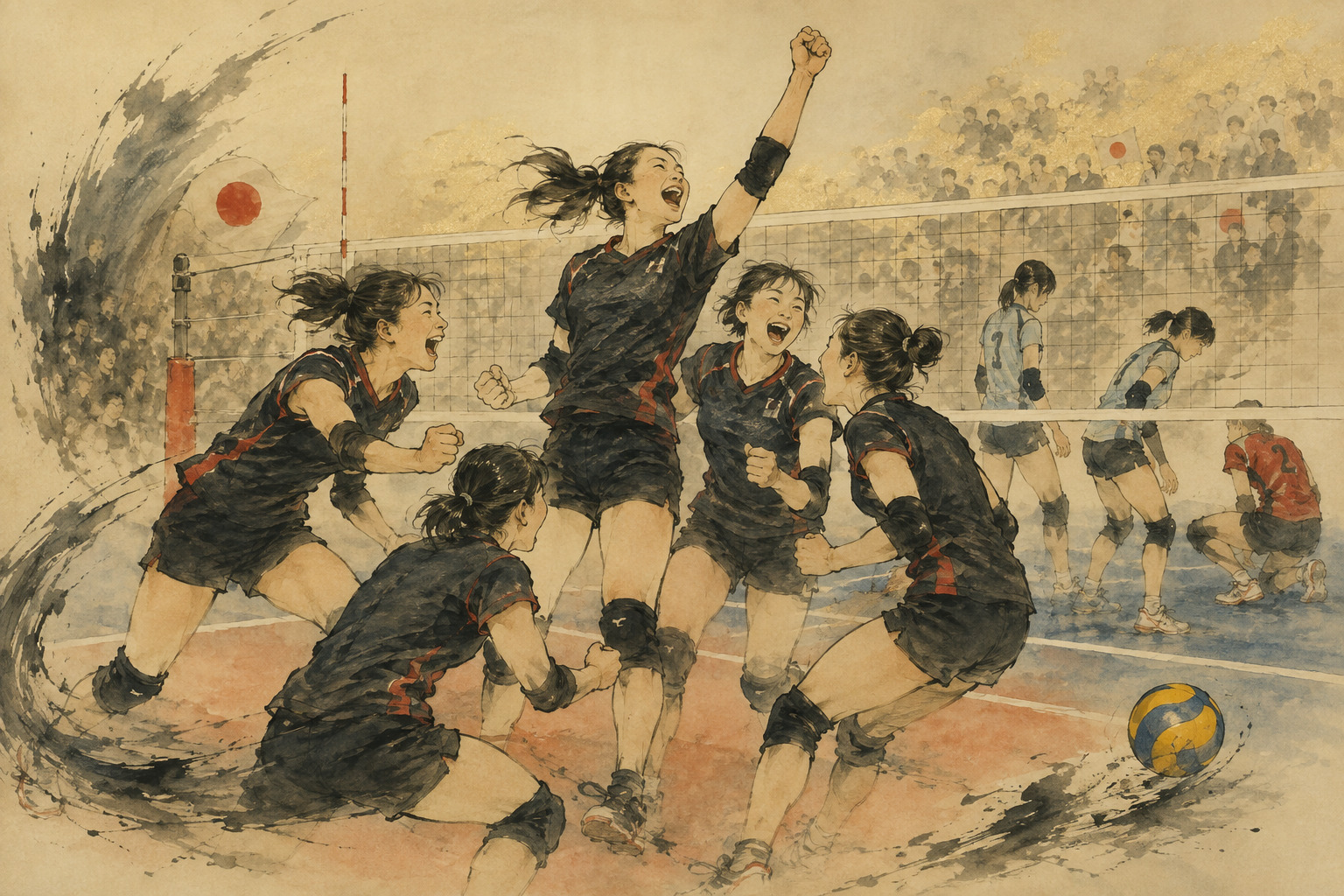
At 31-all, the first set had already consumed 14 points after the score reached 24–24. There is no cap to stop a regulation volleyball set at 30 or 32. Under FIVB Rule 6.2, one team must reach at least 25 and lead by two. Both had passed 25. Neither could keep the required two-point margin.
Hinata Shigihara finally changed that from the left side. Her attack completed a 33–31 first set for Japan on Sunday night in Tianjin. Japan then won 25–19 and 25–20, finishing a 3–0 preliminary-round victory at the 2026 AVC Women’s Volleyball Continental Championship and securing a place in the quarterfinals.
A sweep is an accurate result and an incomplete account. The Japan Volleyball Association’s match report describes Korea’s hard serving disrupting Japan’s reception at the beginning of both the first and second sets. Korea reached set point first in the opener. Japan recovered, then improved the pressure of its own serve and used its bench to create separation. The straight-sets score contains both evidence of competitive control and a warning about the part of Japan’s game opponents will keep testing.
The set Korea almost took
Japan entered the match sixth and Korea 26th in the FIVB World Ranking, according to the JVA’s time-stamped pre-match figures. Rankings offered no immunity from the first contact. Korea’s serve pushed Japan behind 5–3 before the defense helped reverse the score to 10–9.
Yukiko Wada attacked from the back row for 14–12. Korea answered through a quick attack, a block and a tip, regaining a 17–16 lead. Captain Mayu Ishikawa ended a rally at 20-all. Yoshino Sato’s attack put Japan in front 23–22.
Then Korea turned a defensive play into an attack and reached set point at 26–25. The official JVA sequence next identifies a Korean tip error that gave Japan a set point at 30–29. Sideouts continued. Shigihara’s left-side finish eventually supplied the two-point margin that the rules required.
The arithmetic matters because “deuce” can sound like a single dramatic moment. It was a sequence of repeated tests. A serve shaped the quality of the pass; the pass narrowed or preserved the setter’s choices; those choices changed the blockers’ timing and the backcourt’s defensive map. Under rally scoring, every failure changed the score and the next server. Japan did not merely survive nerves. It had to reconstruct an attack, point after point, while Korea kept applying the same pressure.
What changed after 33–31
Korea opened the second set by disrupting reception again and took a 5–2 lead. Wada’s ace and Ishikawa’s direct attack brought Japan level at five. At 13-all, substitute Ayane Kitamado used her serve to damage Korea’s first contact. Sato converted for 16–14; Airi Miyabe’s quick and Sato’s tip extended the break to 19–14. Seki ended the set with a block.
The third set followed a different route. Sato scored twice at the start, Korea tied it at four with help from an ace, and Wada served Japan to a 7–4 advantage. Japan’s defense helped build a 17–11 lead. Korea still compressed it to 22–20. Wada blocked for match point and then attacked for 25–20.
That progression shows a team correcting the match without pretending the original problem had disappeared. Japan’s own serve began to constrain Korea. A bench player changed the quality of a rotation. The block and backcourt defense produced enough usable balls to return Japan to its preferred speed.
Kitamado told the JVA that Japan’s serve had not been sufficiently effective in the first set and that she entered determined to change the flow with hers. That is a player’s account of her intention, not proof that one substitution alone caused the result. The score sequence nevertheless supports the narrower conclusion: her service turn arrived at 13-all, disrupted Korea and preceded Japan’s decisive second-set separation.
The winner’s harshest review came from inside the team
Middle blocker Haruyo Shimamura did not treat 3–0 as a clean bill of health. In the JVA’s Japanese transcript, she said reception, serving, the relationship between the block and defense, and other defensive details had not been fully corrected. Her summary was that the match taught Japan what it still lacked.
That diagnosis connects the phases of play that a box score tends to separate. If Korea’s serve moves Japan’s passer away from target, the setter has fewer credible attackers. The block can load toward a predictable high ball. If Japan’s serve allows a perfect Korean pass, Korea can keep its quick attack and both pins available. The block and floor defense then face more uncertainty.
Shimamura also discussed the middle blockers’ responsibility to call for the ball and occupy opposing blockers, even on plays when the middle is not the final hitter. The value of a middle attack is not exhausted by the point it scores. Its threat can hold one blocker long enough to give an outside hitter a cleaner matchup.
The JVA match story does not publish a complete individual box score or attack-efficiency table. This article therefore does not assign point totals or infer hitting percentages from incomplete reports. The more reliable evidence is the official point sequence and the players’ own description of the technical problem.
“Could have changed” is analysis, not a result
The headline requires a boundary. No source can verify what would have happened had Korea won the first set. Japan might have recovered to win in four or five. Korea might have grown into the match. A counterfactual cannot be replayed, and Japan.co.jp is not reporting that one set predetermined the next two.
The defensible claim is narrower. Korea’s serve-receive strategy produced a lead late enough to reach set point at 26–25. Winning there would have put Korea ahead 1–0 with evidence that its primary pressure tactic worked. Japan would have entered the second set chasing the match while still addressing the same first-contact failure. Instead, Japan left the long set ahead and could use Kitamado’s service turn at 13-all in the second to create a new pattern.
Score does not manufacture technique. It changes the decisions made around it: how much risk a server accepts, when a coach substitutes, which attacker a setter trusts on a poor pass, and whether an opponent can continue a plan with confirmation or must revise it. That is why the 33–31 opener could have changed the match without being described as the set that inevitably decided it.
A mirror from Tokyo
Japan and Korea have a recent memory built around the same two-point requirement. At the Tokyo 2020 Olympics, played in 2021, they met at Ariake Arena in a five-set preliminary match. Japan reached match point at 14–12 in the fifth. Korea scored the next four points, won 16–14 and clinched a quarterfinal place.
Ishikawa was on the floor in that Tokyo match. No verified comment from her or the current team links that defeat psychologically to Tianjin, so this article does not invent one. The documented parallel is enough: in Tokyo, Japan stood two points from closing and did not; in Tianjin, Korea reached the first set point before Japan found the final two-point margin.
The rivalry’s tournament history offers another comparison. In the 2019 Asian Championship semifinal in Seoul, a young Japanese selection lost the first set to host Korea 25–22, then won 25–23, 26–24 and 28–26. Japan defeated Thailand in the final for its second consecutive and fifth continental title. Ishikawa was named the tournament’s most valuable player.
The 2026 team is pursuing Japan’s first Asian title since that run. The details differ—rosters, coaches and qualification stakes have changed—but the 2019 semifinal makes one fact especially clear: losing a first set does not settle a Japan–Korea match. That is another reason to keep the headline’s counterfactual modest.
| Tournament | Result | Why it matters here |
|---|---|---|
| Tokyo 1964 Olympics | Japan 3–0 Korea; Japan won gold. | An early Olympic entry in the JVA’s long record of the matchup. |
| Munich 1972 Olympics | Japan 3–0 Korea in the semifinal. | Both programs were competing near the top of the Olympic field. |
| Montreal 1976 Olympics | Japan 3–0 Korea in the semifinal; Japan won gold. | Another medal-stage meeting between the Asian powers. |
| 2019 Asian Championship | Japan 3–1 Korea in the semifinal; Japan won its fifth title. | Ishikawa was tournament MVP in Japan’s most recent Asian championship. |
| Tokyo 2020 Olympics (played 2021) | Korea 3–2 Japan; fifth set 16–14. | Japan led 14–12 before Korea scored four straight. |
| 2026 Asian Championship | Japan 3–0 Korea; first set 33–31. | Japan escaped Korea’s set point and secured a quarterfinal place. |
The stakes are larger than the rivalry
The 12-team championship runs August 21–30 at Tianjin Olympic Center Gymnasium. Japan, Korea, Vietnam and Hong Kong China form Pool C. Japan opened with a 3–0 win over Hong Kong China and moved to 2–0, six sets won and none lost, after beating Korea.
The continental champion earns a direct quota place for the Los Angeles 2028 Olympics. The three highest finishers also qualify for the 2027 FIVB Volleyball World Cup. In FIVB’s redesigned cycle, the continental championships are the first direct Olympic path rather than a title detached from the qualification calendar.
Failure to win in Tianjin would not end every Olympic route. The LA28 system also awards places to the three highest eligible teams not already qualified at the 2027 global championship, then to the three highest eligible teams in the world ranking after the preliminary phase of the 2028 Volleyball Nations League. The United States holds the host place. Tianjin offers the earliest certainty, not the only possible future.
- Secured: A quarterfinal place after two straight-set wins.
- Still at stake: The Asian title and its direct LA28 quota.
- Next: Vietnam at 7:30 p.m. JST on August 25. The match had not begun when this article was published.
- Technical test: Can Japan stabilize reception and connect serve, block and floor defense before a set reaches crisis?
The bench intervention must become a system
Kitamado’s service turn is the sort of intervention tournament teams need. It cannot be the only model. Sustainable depth means every substitute knows which passer to target, which attack the serve is meant to remove, how the front-row block will respond and where the backcourt should wait. “Change the flow” becomes useful when it is attached to a shared tactical sequence.
Japan’s rescue skill is real. It defended long enough to create another swing and remained functional through a first set that extended 16 rallies past 24-all. But resilience should not be confused with a preference for disorder. Against stronger serving and blocking teams, a predictable high ball after a poor pass will eventually narrow the court beyond rescue.
Vietnam is not a ceremonial final pool match. The JVA listed it 35th in the world immediately before Japan’s next match, but rankings move and cannot guarantee the contest. FIVB’s tournament preview notes Vietnam’s fourth-place finish at the 2023 Asian Championship and bronze medal at the 2026 AVC Women’s Cup. Japan had already qualified for the quarterfinals; it had not finished the work of building the game it would need there.
What the scorebook cannot keep
Thirty-three to thirty-one deserves to be remembered because Japan finished it. It deserves to be studied because Korea nearly shaped the whole match through the serve. Both statements can be true without turning the opener into mythology.
The 3–0 line compresses the Korean set point at 26–25, Japan’s 2–5 deficit at the beginning of the second and Korea’s third-set recovery from 17–11 to 22–20. It also compresses the corrections: Wada’s service pressure, Kitamado’s bench entry, Seki’s closing block in the second, and the block-and-spike combination that Wada used to end the third.
Japan left Tianjin on Sunday with the result it needed and a technical critique delivered by its own players. The former advances a team through a tournament. The latter may determine how far it goes.
At 33–31, the scoreboard stopped. Japan’s repair work could not.
- Japan Volleyball Association — Official Korea match report, point sequence and Japanese player comments
- Japan Volleyball Association — Official opening-match result against Hong Kong China
- Japan Volleyball Association — Japan’s 14-player Asian Championship roster and Olympic quota note
- Japan Volleyball Association — 2026 national-team names, romanization and registered positions
- Volleyball World — Official Japan–Korea match result
- FIVB — Official Volleyball Rules 2025–2028, Rule 6.2
- FIVB — Tournament field, pools, venue and qualification stakes
- Volleyball World — Ishikawa’s 2026 captain designation
- FIVB — LA28 volleyball qualification system
- FIVB — 2027 World Cup format and LA28 qualification role
- Japan Volleyball Association archive — Japan’s Olympic women’s match record
- Volleyball World — Official Tokyo 2020 Japan–Korea result
- Yonhap News Agency — Tokyo 2020 fifth-set finish and Korea’s quarterfinal qualification
- Olympics.com — Japan’s 2019 Asian Championship semifinal win over Korea
- Monthly Volleyball — Japan’s 2019 title and Ishikawa’s MVP award
Attribution note: The 2026 match sequence, player comments, time-specific rankings and next-match time come from the JVA; the result and scoring rule were checked against Volleyball World and FIVB. Earlier rivalry results come from the named tournament and federation records. The claim that the first set could have changed the match, the tactical interpretation and the questions for Vietnam are Japan.co.jp analysis—not statements attributed to a player or coach.