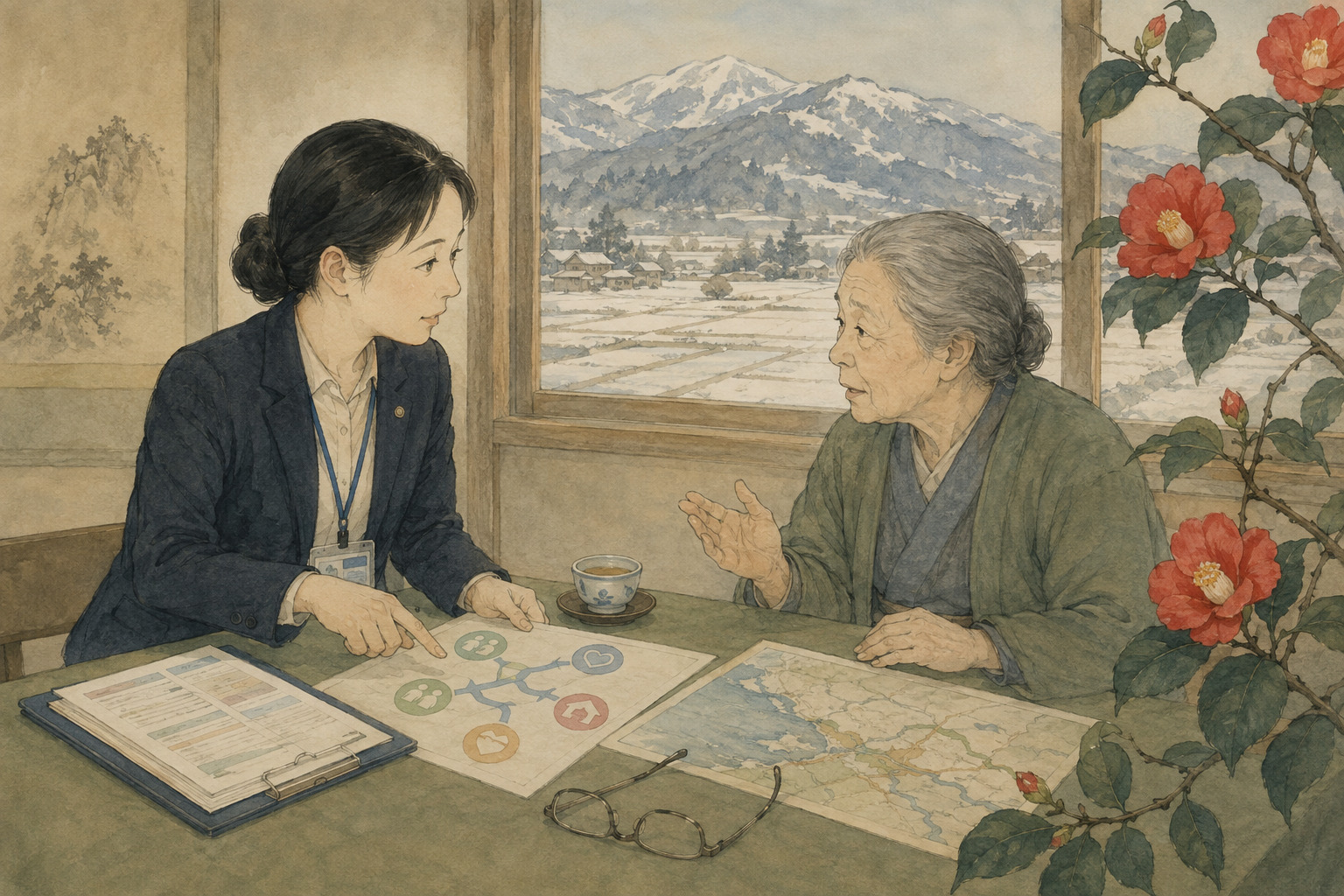
The hardest later-life problem may arrive as a sentence fragment: “The bills are getting confusing.” “My husband has been a little different.” “The hospital asked for someone to call.” None of those statements names a benefit, a profession or a government counter. Each may contain several problems at once, and the person saying it may not yet think of herself as needing help.
Niigata Nippo, the prefecture’s long-established newspaper company, and a Tokyo startup called Omohibito plan to build a front door for that ambiguous stage. Their proposed service, Nippo Kurashi Anshin Navi—a working Japanese name that roughly means “Nippo Daily-Life Reassurance Navigator”—is scheduled for a trial across Niigata Prefecture from October through December 2026.
As of this article’s August 25 publication, the trial has not begun. There are no published results, no demonstrated reduction in crises and no decision to make it a continuing business. The companies say commercialization will be judged after the test.
The headline’s “human concierge” needs one more correction: the model is hybrid. An automated questionnaire and AI chat are supposed to generate a personalized risk-and-referral report. Professionals, including certified social workers, then answer questions and help turn recommendations into an order of action. The central question is not whether a personable adviser feels reassuring. It is whether a machine-assisted intake can lead to accountable human judgment and a successful transfer to existing services.
What the companies actually propose
The trial has three layers. First, a resident describes his or her circumstances and receives a free, automatically generated report organizing possible risks, responses and places to seek help. That layer includes AI chat and is based on Omohibito’s existing Care Guide. The company says the current guide takes about three minutes, asks 10 questions and requires no registration.
The guide is unusually broad. It groups needs under six fields: long-term care, health care, property, welfare, legal matters and funeral or post-death arrangements. Breadth is the point. A family deciding whether a parent can remain at home may need a care assessment, a clinic, a housing change, access to a bank account and a conversation about future decisions. No single benefit application captures that sequence.
Second, professionals described in the announcement as certified social workers and others will answer questions through individual consultations and seminars. Third, the service will help produce what the companies call a “daily-life reassurance blueprint”: who should do what, in what order, including how tasks might be divided within a family.
Niigata Nippo is assigned promotion to readers and the role of a trusted regional contact. Omohibito is assigned system development and consultation operations. The newspaper’s open-innovation program accepted applications from May 15 to June 15, held a pitch event on August 4 and offered ¥1 million to each advancing company for test marketing, prototypes and planning. A final business decision is expected by year-end.
The unlicensed job families have always done
Japan’s later-life systems are divided for defensible reasons. Municipalities determine public benefits. Insurers administer long-term care. Doctors make medical judgments. Lawyers and judicial scriveners perform defined legal work. Banks control accounts. Funeral and after-death arrangements belong to still other contracts. Division creates expertise and authority; it also creates seams.
A nearby relative often becomes the unpaid systems integrator. She notices the unopened envelope, calls the ward office, accompanies a parent to a clinic, finds the insurance card, asks a care manager to explain a change, then tells siblings what happened. Families rarely call the work “navigation.” They simply absorb it.
Having children does not guarantee that this work is available. Distance, employment, childcare, illness, estrangement and the older person’s own preferences all matter. Nor does living alone prove that a person is lonely or incapable. A useful navigator must map actual relationships and capacity, not substitute household status for need.
Omohibito founder Moe Kaneko says the business grew from caring for her father at home from age 17. In the company’s release, she identifies the experience of not knowing whom to ask for what as the venture’s starting point. That history explains motivation. It does not validate the product, and the trial should not be evaluated by the founder’s story.
Why Niigata is a revealing test
Niigata is not simply “old.” It is losing population while household structure is changing. In the 2020 census, 32.8 percent of the prefecture’s population was 65 or older. The number of people in that age group living alone was 98,746—19.9 percent higher than in 2015 and 13.7 percent of the prefecture’s older population, or roughly one in eight.
General households reached a record 862,796 under the comparable series, while their average size fell to 2.48 people, also a record low. Between the 2015 and 2020 censuses, population fell in 29 of Niigata’s 30 municipalities; only Seiro Town recorded an increase. These are 2020 census facts, not current 2026 counts, and they should be labeled that way.
The combination matters more than a ranking. Smaller households can generate more addresses to reach and fewer co-residents to notice change. Population loss can widen physical distance to services and make professional recruitment harder. A digital tool might compress some distance, but only for people who can use it and trust it.
Japan’s National Institute of Population and Social Security Research projects further growth in one-person households through 2050, including higher rates of older people living alone. The projection begins from the 2020 census and applies national assumptions; it is not a forecast specific to any Niigata town. Its relevance is structural: a welfare system cannot assume that every resident will bring a relative who can translate a vague concern into an application.
There is already a public front door
Japan created chiiki hōkatsu shien sentā, community comprehensive support centers, for precisely the problem of fragmented support. A 2005 revision of the Long-Term Care Insurance Act introduced the centers from fiscal 2006, alongside community-based services, to support older people—including those living alone and people with dementia—close to home.
Niigata City operates 30 centers, one for each designated daily-life area of roughly 20,000 to 30,000 residents. The centers are staffed by professionals such as certified social workers, public-health nurses and senior care managers and receive consultations involving care, welfare, health and medicine. The city’s 30-center network should not be misreported as a prefecture-wide count, but it proves that an established public gateway exists within the area to be tested.
Omohibito’s announcement explicitly says the new service will not replace government or comprehensive support centers. It will emphasize connection to appropriate institutions. That boundary is more than a disclaimer. It defines the business case: the concierge must reach people before or outside the existing gateway, then improve—not duplicate—the passage through it.
- Guidance is not a benefit decision. A private report cannot determine eligibility or bind a municipality.
- A referral is not legal authority. It does not create power to manage assets, guarantee admission, consent to care or act after death.
- AI output is not professional judgment. Local rules, urgent risk and conflicting evidence require accountable review.
- A family assignment is not consent. A blueprint cannot presume a relative is willing or able to perform a task.
From social insurance to the space around it
The proposed concierge belongs to a longer Japanese argument about what families, markets and the state should each carry. The Elderly Welfare Act of 1963, health reforms of the 1980s and the Gold Plan era of the 1990s expanded the public architecture. In April 2000, Long-Term Care Insurance shifted elder care toward a social-insurance model in which users could select contracted services rather than rely solely on administrative placement.
The 2006 comprehensive-support centers tried to coordinate that architecture locally. Yet long-term care insurance begins mainly with assessed care needs. It does not, by itself, solve who will help with hospital paperwork, bills, housing, property, future legal planning or tasks after death. These are often the matters that make a family describe “care” as overwhelming even before hands-on care becomes intensive.
In fiscal 2024 and 2025, the Ministry of Health, Labour and Welfare tested municipal responses for older people without dependable relatives. One model built a comprehensive consultation and coordination desk combining public resources with private services and monitoring how support contracts were performed. Another offered an integrated package of daily-life assistance, hospital or facility procedures and post-death administration for people lacking money or local resources, while preserving supported decision-making.
The Niigata project is not one of those national model programs and is not a statutory service. It shares one design insight: coordination is a function in its own right. A list of phone numbers is not coordination. Someone must establish the order, define each provider’s responsibility and notice when a transfer fails.
| Period | Public development | Relevance to the Niigata test |
|---|---|---|
| 2000 | Long-Term Care Insurance begins. | Builds a social-insurance market for assessed care services and user choice. |
| 2006 | Community comprehensive support centers begin. | Creates a local public gateway across care, welfare, health and medicine. |
| FY2024–25 | National ministry tests municipal models for people without dependable relatives. | Separates consultation/coordination from direct daily-life and after-death support. |
| 2026 | Law No. 51 revises social-welfare and related laws. | Formally recognizes assistance accessing health and other services for defined low-income people with daily-life barriers. |
| Fall 2026 | Newspaper-startup trial planned in Niigata. | Tests an earlier, hybrid contact point outside but linked to existing public services. |
A new law recognizes the gap—but does not certify this service
On June 19, Japan’s Diet passed a package called the Act Partially Amending the Social Welfare Act and Related Acts. It was promulgated June 25 as Law No. 51 of 2026. Among its provisions is recognition as a category-two social-welfare business of assistance in using health and other services for low-income people whose daily lives are impeded because, for example, they have no family living nearby.
In an April policy-council explanation, the health ministry said the revised framework would include older people without dependable relatives and contemplate daily-life assistance, hospital and care-facility procedures, and post-death administration. The law takes effect in stages, with implementation details to be developed through subordinate rules and notices.
That legislation does not approve Omohibito, certify its AI or make “regional concierge” a protected title. The Niigata announcement says consultations will involve certified social workers “and others.” Shakai fukushi-shi, certified social worker, is a national qualification. The word “others” leaves the trial’s precise staffing unknown. Advice touching legal, financial, medical or agency functions remains subject to the authority, professional rules and consent required in each field.
A newspaper can lend trust; it can also spend it
Niigata Nippo’s role makes this trial different from a normal care-tech launch. The company traces its predecessor newspaper to 1877. A publication delivered repeatedly into homes can reach people who would never search for a care-navigation startup and who might resist approaching a government office. The newspaper can normalize preparation before a crisis and present the service through print, events and familiar local channels.
Trust, however, is not a transferable logo. If a news organization introduces readers to a commercial service, readers need to know where journalism ends and business development begins. Referral criteria, commissions, provider relationships and complaint channels should be disclosed. Coverage of the trial should not be controlled by the team trying to commercialize it.
Niigata Nippo says its 2025 open-innovation program received 45 applications, selected three and is advancing them toward business development. That is the publisher’s own performance account, not independent evidence that this year’s project is viable. Audience reach can improve recruitment. It cannot establish welfare quality.
The six-field promise creates six-field risk
Including property, legal planning and funeral arrangements makes the intake more realistic. It also brings the service close to markets where consumers can be vulnerable and contracts can be large. A navigator might identify a real need for a will, a guarantor, asset management or post-death work. If the navigator earns from one recommended provider, the resident may not be able to distinguish the best referral from the most profitable one.
Japan’s Consumer Affairs Agency warns about contracts sold under the broad label of lifetime support for older people, which can combine identity guarantees, daily-life assistance and post-death arrangements. In 2024, the government issued provider guidelines and a consumer checklist because the work crosses civil law and social-security rules. The agency has separately warned older consumers not to rush into home-sale, asset-management or costly guarantee contracts they do not fully understand.
The planned Niigata service is not described as a lifetime-support contract. That distinction should remain explicit. Still, its referral design should disclose whether money changes hands, how providers are vetted, who handles a complaint, how conflicts are recorded and how a person can obtain a second opinion.
What an AI intake cannot hear
A short structured intake can be useful. It can cover categories consistently, surface options a user does not know and give professionals a starting map. It can also encode a false sense of completeness. Abuse, coercion, fraud, cognitive change, suicidal thinking and family conflict may not appear in a selected answer. Silence and hesitation can be evidence; a chatbot cannot safely interpret them on its own.
Local accuracy is another risk. Benefits vary by municipality, eligibility rules change and community resources close or stop taking clients. Every automated report should identify the date and source of its information, distinguish a possibility from confirmed eligibility, show emergency contacts and flag cases requiring rapid human review. Error logs should be part of the trial’s evidence, not treated as embarrassing exceptions.
Access is also a test of the word “regional.” If the path begins and ends on a smartphone, it can miss people with limited vision, dexterity, literacy, Japanese fluency, connectivity or confidence. Telephone, paper and face-to-face routes are not optional extras when the target includes people least able to navigate systems.
Finally, a personalized report may require sensitive information about health, family, housing and assets. Trial participants should receive plain-language answers about consent, retention, deletion, AI vendors, secondary use and family sharing before entering data. A person’s decision not to disclose must not become another barrier to human consultation.
Counting consultations would be the easy evaluation
A three-month pilot can readily publish registrations, completed questionnaires, seminars and satisfaction scores. Those measures show activity. They do not show whether the right people were reached or whether anyone obtained help.
- Reach: Did the trial include people who had not used existing services, people without family help and people unable to complete a digital intake alone?
- Accuracy: How many outdated, wrong or incomplete recommendations appeared, and how quickly were they corrected?
- Completed handoffs: Did residents merely receive a phone number, or did they reach an appointment, assessment or application?
- Autonomy: Could residents change the blueprint, decline a referral and control what was shared with family?
- Equity: Were outcomes different by municipality, income, disability, language or device access?
- Cost and burden: What professional time was required per case, and did the service reduce or add work for public centers?
The people who stop midway may teach more than the people who finish. A useful evaluation should learn whether they were overwhelmed, distrustful, already served elsewhere, unable to use the interface or simply uninterested. Declining a service can be an informed choice, not a failure to convert.
Independent review would strengthen the result. The same partners that recruit, operate and hope to commercialize the trial should not be the only parties deciding whether referrals were correct. Public centers receiving handoffs, participating professionals and residents themselves should be able to report friction and harm.
The product is an order of operations
Aging policy often talks in nouns: care, housing, health, money. A resident experiences verbs: remember, pay, travel, decide, ask, wait. The concierge’s potential value lies in converting the nouns back into an order of action that one person can follow.
The proposal divides that work among three kinds of infrastructure. Software creates consistency and speed. A professional interprets uncertainty and risk. A newspaper supplies recognition and local reach. None can substitute for the others, and none should claim the authority of the public institutions to which the resident may be sent.
If the trial begins in October, its best result will not be a large number of generated reports. It will be evidence that a resident who could only say “something is becoming difficult” reached the correct next person, understood why, retained the right to say no and did not disappear between the two doors.
That is a modest promise compared with solving loneliness or redesigning elder care. It is also difficult. Japan already has many services. The missing piece is often the connective sentence between them. Niigata is about to test whether a regional concierge can write that sentence without pretending to be the whole story.
- Omohibito — selection by Niigata Nippo and the announced trial design
- Niigata Nippo — 2026 open-innovation program schedule and funding
- Omohibito — Care Guide functions and six-field scope
- Niigata Prefecture — final basic results of the 2020 census
- National Institute of Population and Social Security Research — 2024 national household projections
- Niigata City Medical and Long-Term Care Coordination Center — community comprehensive support centers
- Ministry of Health, Labour and Welfare — history and introduction of Long-Term Care Insurance
- Ministry of Health, Labour and Welfare — 2005 reform and comprehensive-support centers
- Ministry of Health, Labour and Welfare — municipal models for older people without dependable relatives
- House of Councillors — legislative history and summary of the 2026 social-welfare amendment
- Ministry of Health, Labour and Welfare — April 23, 2026 Social Security Council Welfare Subcommittee record
- Consumer Affairs Agency — lifetime-support services for older people and provider guidelines
- Consumer Affairs Agency — warning on home-sale and asset-management contracts
Attribution note: The working service name, proposed dates, components, roles and Kaneko’s personal account come from Omohibito’s August 20 announcement. Program dates and development funding come from Niigata Nippo. The 32.8 percent and 98,746 figures are 2020 census results, not 2026 estimates. Omohibito’s description of its Care Guide is a company claim and has not been independently performance-tested here. The risk analysis and proposed scorecard are Japan.co.jp analysis informed by the cited public records and consumer guidance.