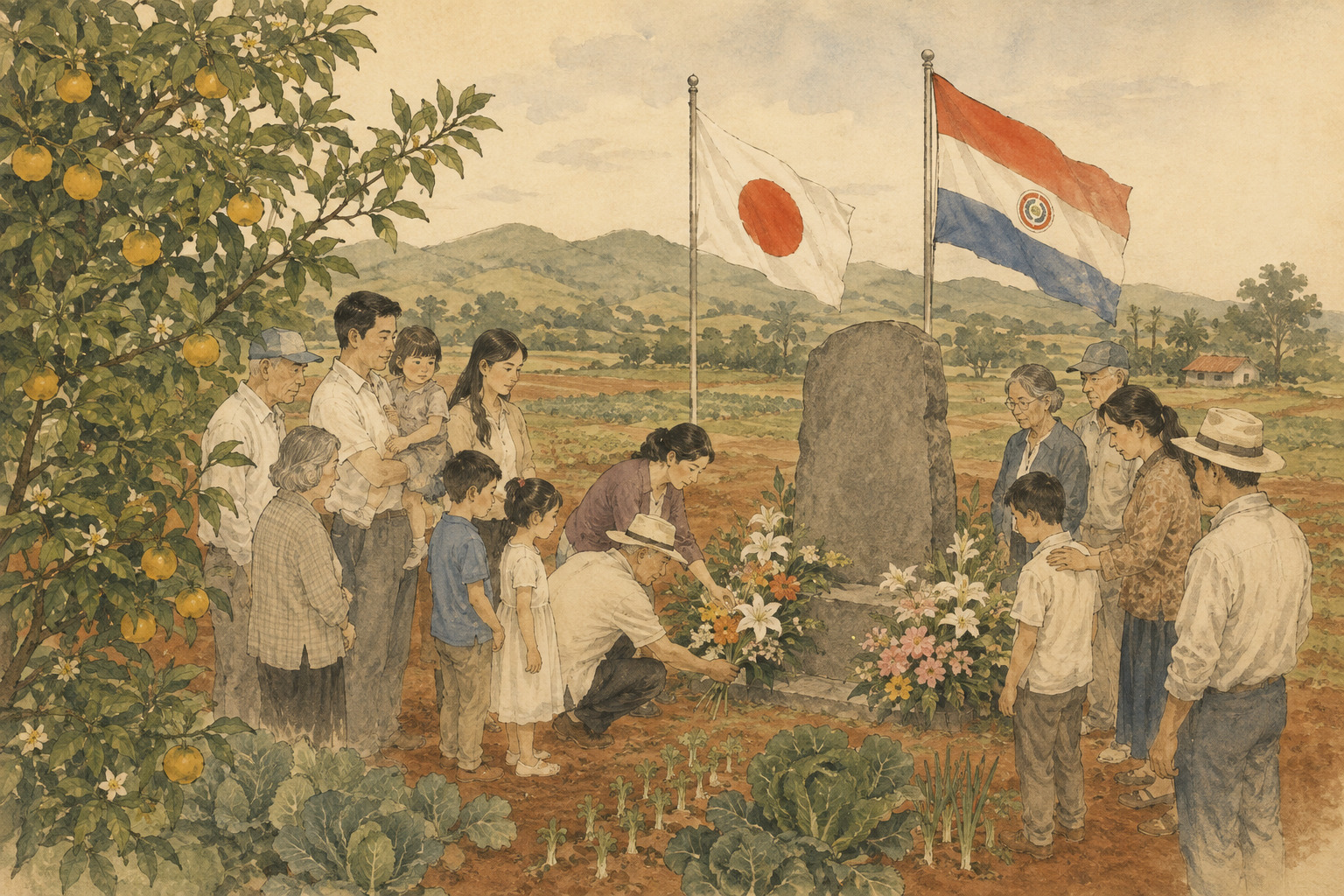
Crown Prince and Crown Princess Akishino placed separate floral tributes before La Colmena’s immigration memorial on August 22, then bowed to the dead. The act lasted minutes. The history gathered behind it stretches across 90 years of state policy, cleared forest, failed crops, closed schools, forced confinement, locusts, roads, wine and fruit.
La Colmena, about 130 kilometers southeast of Asunción in Paraguarí Department, was the first organized Japanese agricultural settlement in Paraguay. The Imperial Household Agency says the Paraguayan government invited the couple for the 90th anniversary of Japanese immigration. Their itinerary placed them in Asunción from August 19, La Colmena on the 22nd and Yguazú on the 23rd.
The title’s “Japan returns” is deliberately symbolic, not literal. A country did not arrive in a town. Crown Prince Akishino returned 20 years after attending the 70th-anniversary observances in 2006; Crown Princess Akishino was making her first official visit to Paraguay. More important, the visit brought the Japanese state into a place whose history cannot be reduced to state friendship.
After the memorial, the couple met residents, including first-generation immigrants who had arrived more than 80 years earlier. Japanese television footage captured Crown Prince Akishino asking a woman identified by FNN as Kanazawa about her age when she migrated in 1941. She said she turned three aboard ship and that the voyage took 70 days. A diplomatic anniversary became, for a moment, the remembered length of one child’s crossing.
What “first” means
Calling La Colmena Paraguay’s first Japanese settlement requires a boundary. Japanese individuals were in the country before 1936. Community histories record, among others, Shōtarō Fukuoka in Asunción in the 1910s, where he taught judo and worked in therapeutic practice and floristry. La Colmena was first as a planned agricultural colony authorized by the state, purchased as a block of land and populated through an organized family-migration program.
That distinction matters because “the first Japanese arrived in 1936” erases earlier lives. It also turns a long formation into a single landing. May 15 is the settlement’s official commemorative date. A 2026 history published by Discover Nikkei identifies an initial party of 11 families, 81 people, on that date. The Japanese-Paraguayan federation’s local history, however, separates the stages: instructional migrants came from Brazil in June, and the first migrants from Japan arrived in August.
A door narrowed in Brazil
The route to Paraguay began with a restriction elsewhere. In 1934, Brazil introduced a nationality-based quota often described in Japanese as the “two-percent immigration restriction.” It sharply reduced the number of Japanese newcomers who could enter the country. The Brazil Colonization Cooperative—known in Japanese as Burataku—began looking for an alternative.
Kunito Miyasaka, the cooperative’s executive director, helped investigate Paraguay and negotiate an experimental authorization. The timing was unsettled. Paraguay had just emerged from the Chaco War with Bolivia, and a change of government interrupted the initial arrangement. On April 30, 1936, Presidential Decree No. 1026 authorized a trial intake of 100 Japanese families. The migration organization acquired about 11,000 hectares.
Commemorative narratives understandably emphasize Paraguay’s welcome. The fuller setting includes racialized migration controls across the Americas, Paraguay’s desire for agricultural development and a private colonization organization seeking a viable destination. The settlement was born from friendship and opportunity, but also from exclusion and economic calculation.
Southwest of the selected land rose Cerro Apuragua, a hill of roughly 300 meters. The federation’s history says settlers saw a resemblance to Mount Fuji and later called it “Colmena Fuji”; the familiar landscape may have influenced selection. This is a community tradition, not an independently measured reason for the land decision. It shows how migrants made an unfamiliar geography emotionally legible.
The people who left belong in the history
Preparation had been short. The settlers found little vegetable food and heavy clearing work. Cotton was intended as a principal export crop, but methods expected to work from Brazilian experience did not transfer cleanly. Drought hit in 1936, severe hail around harvest in the next year, and flooding followed. Yields and household finances suffered.
The federation’s history says withdrawals began in 1938. By the outbreak of the Pacific War, 24 families and three single settlers had abandoned their holdings. That is not a footnote to the success story; it is one of its measurements. A colony’s outcome includes the people who could not make the original plan work, not only descendants of those who stayed.
Local Paraguayan households also lived in the rural and town areas around the colony. The labor of turning the district into a functioning community cannot credibly be assigned to Japanese settlers alone. Later agricultural gains emerged through land, markets, institutions and exchange with the surrounding society.
Cotton did not remain the only answer. Settlers tried rice, corn, cassava and tobacco, then onions, potatoes, beans, peanuts and grapes. The shift was not a finished package of “Japanese farming” transplanted overseas. It was an extended exercise in adapting seed, soil, labor and marketing to Paraguay.
Wartime friendship did not prevent wartime confinement
The Pacific War reached this inland settlement through policy. After Paraguay broke relations with the Axis powers, new Japanese immigration stopped. The Japanese-language school closed in 1942. Its land and buildings were confiscated in 1945. When Paraguay declared war on Japan and the other Axis countries, La Colmena became a confinement site for Japanese residents from around the country, and movement outside the colony was restricted, according to the federation’s history.
Paraguayan newspaper ABC Color reported that Crown Prince Akishino’s August 22 address remembered Agustina Miranda González, a local woman said to have supported Japanese immigrants and protected them during the war. Japan.co.jp does not reproduce the address as a Japanese quotation because an official Japanese transcript was not available at publication; the account is attributed to the Paraguayan report. The episode resists a simple national frame: government restrictions and local protection existed at the same time.
Peace did not restore security overnight. Huge locust swarms struck in 1946 and 1947, consuming crops and even trees, the community history says. More residents left for Argentina and Brazil. The decision to remain on the land had to be made again after war, and again after ecological disaster.
| Year | Event | Why it mattered |
|---|---|---|
| 1934 | Brazil adopts a nationality-based immigration quota. | The restriction pushed Japanese migration organizers to investigate Paraguay. |
| 1936 | Decree No. 1026; settlement begins at La Colmena. | Paraguay’s first organized Japanese agricultural colony takes shape. |
| 1942–45 | School closure and confiscation; wartime movement restrictions. | La Colmena becomes a confinement location for Japanese residents in Paraguay. |
| 1946–47 | Large locust infestations. | Crop and tree damage drive another round of departures. |
| 1951 | The cooperative begins winemaking. | Grapes and wine symbolize movement away from dependence on cotton. |
| 1965 | Road connection toward Acahay improves. | Vegetables and fruit can reach the Asunción market more efficiently. |
| 2026 | 90th anniversary: museum, stamp, local events and imperial visit. | Preserving evidence becomes as important as celebrating achievement. |
From cotton to wine to the “Capital of Fruit”
The durable breakthrough was diversification. Cotton monoculture depleted soil and exposed families to one harvest and one market. Farmers combined onions and potatoes with grapes, tung trees, yerba mate, beans and peanuts. In 1951, the cooperative began producing wines under the names La Colmenita and La Japonesita. The winery closed in 1995, but its history marks an important change in local agricultural logic.
Road access mattered as much as agronomy. A 1965 route toward Acahay made it easier to carry tomatoes, peppers, cabbages, watermelons, melons and other produce to consumers in Asunción. Orchards and intensive vegetable farming helped La Colmena earn the Spanish title Capital de las Frutas—the Capital of Fruit.
La colmena means “the beehive.” The federation says the name was chosen as an apt image for industrious Japanese settlers. That explanation is local institutional tradition, not a neutral linguistic finding about motive. The district itself was elevated to city status in 1978.
Japan’s Foreign Ministry credits Japanese immigrants with major contributions to the development of Paraguay’s soybeans and sesame. That is an official government assessment. It should not be collapsed into a claim that La Colmena single-handedly built Paraguay’s modern soybean economy. Community historians describe early collective soybean cultivation there, but later settlements—including Yguazú and Pirapó—belong to the larger history of mechanized grain. La Colmena’s clearest local trajectory runs through fruit, vegetables, grapes and access to the capital’s market.
The return was personal before it was national
On August 22, the imperial couple visited the La Colmena Paraguayan-Japanese Cultural Association and the memorial in the park named for Kunito Miyasaka. Contemporary reporting says they also learned about food enterprises run by local women and visited the private Tanaka Photographic Museum, where images preserve the first families’ work and daily life.
Crown Prince Akishino delivered an address in Japanese. EFE and ABC Color, relying on local reporting and a Japanese Embassy translation, said he expressed respect for immigrants and descendants, gratitude to Paraguayan society, and hope that younger generations would pass on language, culture and migration history. Those are attributed summaries, not direct quotations; this article does not translate the Spanish rendering back into Japanese.
The restraint matters. Anniversary speeches often turn hardship into a seamless bridge of friendship. Japan and Paraguay established diplomatic relations on November 17, 1919, but wartime rupture and confinement sit inside those 107 years. A relationship can be durable without being uninterrupted or innocent.
The imperial presence also risks making migrants supporting characters in a state ceremony. The most revealing moment was not a grand declaration. It was the exchange with Kanazawa about how long the ship took. Twenty years after the Crown Prince’s previous visit, the first generation could still answer. That opportunity is disappearing.
A year for building memory infrastructure
The 90th anniversary is larger than the August itinerary. On March 27, a new Museum of Japanese Immigration to Paraguay opened inside the headquarters of the Federation of Japanese and Nikkei Associations. Japan’s embassy says it displays 310 items: photographs, records, agricultural implements, tools and objects of daily life. They turn migration from ceremonial language into evidence that can be handled, catalogued and questioned.
In June, Paraguay’s legislature presented resolutions declaring the anniversary a matter of national interest, and a commemorative stamp was issued. Designer Yuki Hayashi wrapped an origami crane in ñandutí, Paraguay’s radiating lacework. According to the Japanese Embassy’s account, Hayashi connected the image to the Japanese folktale of a crane repaying kindness and intended it to express Nikkei gratitude to Paraguayan society. That is the artist’s explanation of the design, not an authoritative interpretation of every migrant’s experience.
Paraguay’s Foreign Ministry announced a yearlong program spanning colony anniversaries, a Nikkei symposium, museum activity, ikebana, calligraphy, music, sport, food and publishing. The government presents Japanese immigration as a contribution to economic development, agricultural modernization and national culture. That is an official commemorative claim. The record beneath it contains cooperation, but also departure, coercion, environmental loss and uneven opportunity.
From pioneering land to sustaining a rural economy
Memory alone will not keep a rural town viable. For about nine years beginning in 2016, a Japan International Cooperation Agency partnership involving Yokohama National University worked with women in La Colmena and Coronel Oviedo on food processing, sales, community resources and agritourism. A 2026 JICA project report says more than 10,000 female beneficiaries, counted cumulatively across two phases, acquired knowledge and skills and that participants built small enterprises.
Those figures are the project’s own evaluation, not a census of lasting income gains across La Colmena. The distinction is important. Development agencies measure activity and reported change; a municipal economy is affected by many forces beyond one program. Still, the project reframes Japanese heritage as more than preservation. Food, hospitality, mapping and local stories can become income-generating assets controlled by rural women.
The comparison with 1965 is instructive. A physical road once connected produce to Asunción. Today, visitor information, branding, food processing and sales channels perform a related task. Each tries to shorten the distance between what the community can make and the market that will support it.
- First Japanese people vs. first Japanese colony: individual residents came earlier; La Colmena was the first organized agricultural settlement.
- Commemorative date vs. arrival sequence: May 15 is the founding marker, while migrants from Brazil and Japan arrived in stages.
- La Colmena vs. Nikkei agriculture nationwide: its fruit-and-vegetable history is not interchangeable with the later soybean story of several colonies.
- Fact vs. commemorative interpretation: government claims of contribution, the “Colmena Fuji” tradition and the stamp designer’s symbolism each need a named source.
Passing 70 days into the next 90 years
Japan’s Foreign Ministry estimates that Paraguay is home to about 10,000 Japanese immigrants and people of Japanese descent. It lists 3,837 Japanese nationals residing in the country as of October 2025. Those numbers describe presence, not continuity. A community can remain statistically visible while the language, names and context attached to family photographs fade.
That is why the museum’s 310 objects and Kanazawa’s 70-day memory perform the same public work. Implements show what people tried to grow. A remembered voyage says who crossed, at what age and at what cost in time. Without the objects, migration becomes nostalgia. Without the voices, it becomes agricultural policy.
La Colmena did not advance in a straight line. It began under an experimental permit, lost families to poor harvests, confined people during war, suffered locusts, changed crops, found a road and became known for fruit. On August 22, a prince who had visited 20 years before returned with a princess seeing Paraguay for the first time, and together they placed flowers.
A memorial is not only for those who fulfilled the plan. It can hold the people who died before doing so, those who left, the Paraguayan neighbors who helped, and the descendants now deciding what to retain. La Colmena’s 90th anniversary will matter less for how neatly it polishes the past than for whether it passes that complicated past—whole—into the next generation.
- Imperial Household Agency — official schedule for the 2026 Paraguay visit
- Embassy of Japan in Paraguay — La Colmena memorial and 90th-anniversary ceremony, May 15
- FNN Prime Online — video report from the August 22 visit
- Federation of Japanese and Nikkei Associations in Paraguay — history of La Colmena
- Federation of Japanese and Nikkei Associations — history of Japanese immigration to Paraguay
- Discover Nikkei — 90 years of Japanese immigration to Paraguay, Part 1
- Discover Nikkei — 90 years of Japanese immigration to Paraguay, Part 2
- Embassy of Japan — opening of the Museum of Japanese Immigration to Paraguay
- Embassy of Japan — national-interest resolutions and commemorative stamp
- Paraguay Ministry of Foreign Affairs — official 90th-anniversary program
- Ministry of Foreign Affairs of Japan — Paraguay country and bilateral-relations data
- JICA Yokohama — report on the rural women and agritourism partnership
- ABC Color — local reporting on the August 22 visit
- EFE via Infobae — itinerary and local context
Attribution note: The Imperial Household Agency supports the visitors’ official titles and schedule. Japanese diplomatic and foreign-ministry sources support the May ceremony, museum, stamp, bilateral dates and population estimates. The federation’s institutional history is the principal source for local agriculture and wartime confinement. Accounts of Crown Prince Akishino’s August 22 address are attributed to Paraguayan and agency reporting; this article does not reconstruct Japanese quotations from Spanish translations. JICA’s beneficiary and outcome figures are the project’s own reporting, and the stamp symbolism is the designer’s explanation.