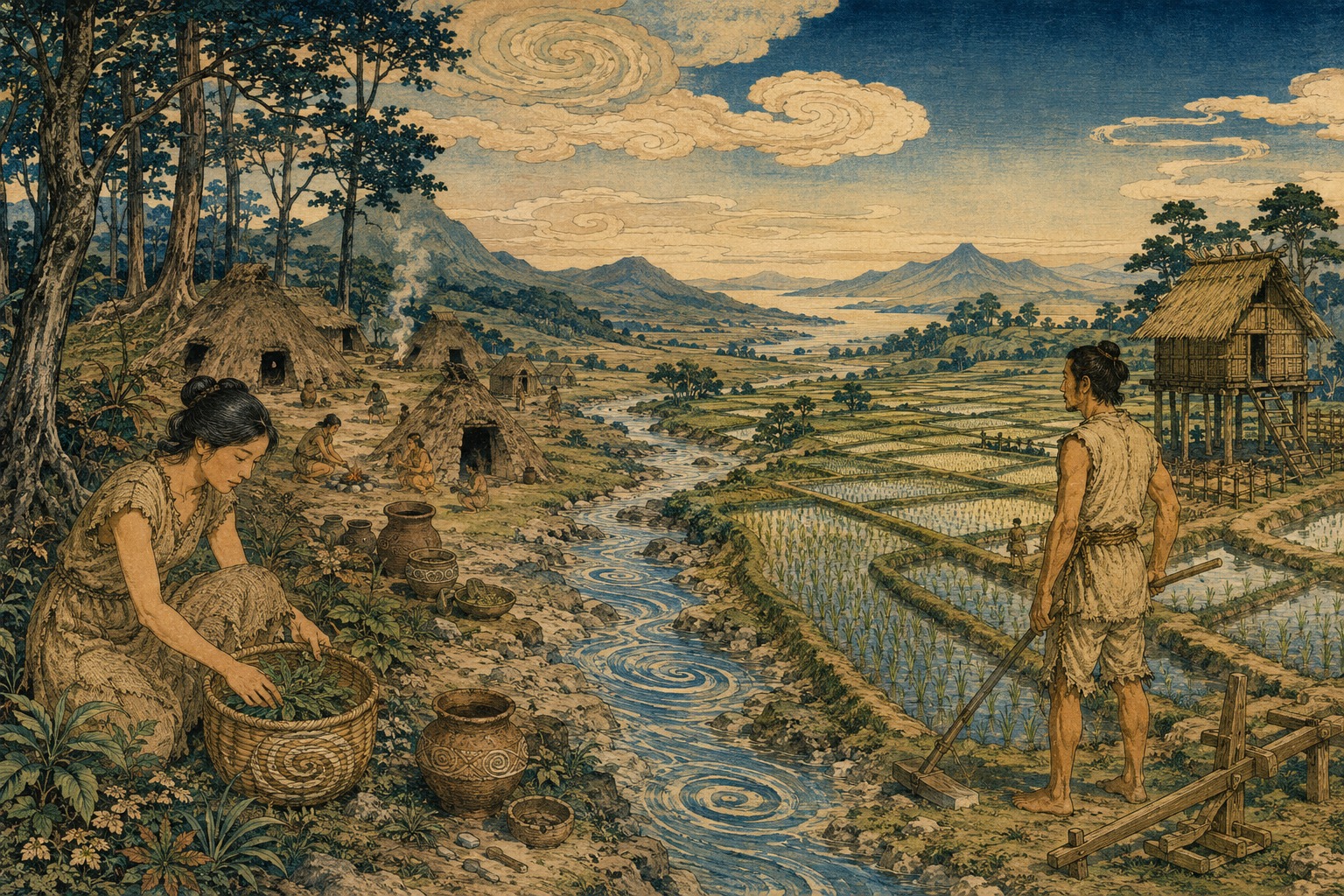
At the Iyai rock shelter in Naganohara, Gunma Prefecture, a shallow space beneath stone accumulated human time. People made fires, ate, worked and buried their dead there. Layers of ash, pottery, charred seeds and human bone show repeated use over roughly four millennia, with the oldest substantial evidence of activity reaching back about 10,000 years.
One of the people buried there was IY1. Two radiocarbon measurements place her approximately 8,300 to 8,200 years ago. A 2018 osteological study described a woman who died at roughly 20 to 40 years of age and stood an estimated 146 centimeters tall. Her teeth were heavily worn but showed no caries. Her flexed burial was unusual: the upper and lower portions of the body had been separated at the waist and arranged one above the other. We do not know the meaning of that treatment. We do know that she did not simply become bone by accident. Other people placed her in the ground with intention.
Six thousand years later and far to the west, people used a gentle coastal dune at Doigahama in Shimonoseki, Yamaguchi Prefecture, as a cemetery. The nationally designated historic site faces the Hibiki Sea and has yielded the remains of about 300 people. The male individual called DO lived approximately 2,306 to 2,238 years ago, broadly in the fourth to third centuries BCE. A mountain shelter and a seaside dune became connected not merely because bone survived, but because enough endogenous DNA remained to read each person's genome dozens of times.
What does reading a genome 67 times change?
A human genome does not emerge from ancient bone as a continuous book. After death, DNA breaks into short fragments, accumulates characteristic chemical damage and becomes surrounded by microbial DNA from the burial environment. Japan's warm, humid climate and often acidic volcanic soils are especially severe. A 2021 study of ancient mitochondrial genomes noted that although more than 10,000 Paleolithic and Neolithic sites have been found across Japan, human skeletons are scarce and DNA preservation is poor.
Coverage describes how many sequence reads overlap each position in a genome on average. At less than onefold coverage, researchers may see only one of the two DNA copies inherited from a person's parents at many positions. At 67-fold coverage, the same position is checked about 67 times on average. Repetition makes it easier to distinguish genuine sequence from error or contamination, identify places where the two chromosome copies differ, and estimate how many copies of a gene are present.
The team assembled low-contamination whole genomes at greater than 67-fold coverage for IY1 and greater than 46-fold for DO, exceptional quality for ancient people from mainland Japan. The depth supported principal component analysis and ancestry modeling, but it also enabled diploid genotyping and inference from the changing pattern of variation along each person's two chromosome copies. If many ancient genomes resemble scattered words, these two approach sustained passages in which syntax becomes visible.
- Diploid genotypes: whether the two inherited DNA copies carry different bases at the same position.
- Demographic history: long-term patterns in ancestral effective population size inferred from how the two genome copies coalesce backward in time.
- Structural variation: changes in how many copies of genes such as AMY1 are arranged in the genome.
- Quality control: characteristic postmortem damage, fragment length and possible modern contamination can be tested through multiple signals.
Depth does not turn two samples into a population survey. It raises the resolution of each individual, but it cannot replace geographic, chronological, familial and sex-based breadth. That distinction is the first protection against turning a remarkable technical achievement into a story the data cannot support.
IY1's genome: long separation without a great expansion
In principal component and model-based clustering analyses, IY1 sat close to previously studied Jomon individuals and carried a Jomon-characteristic ancestry component that is uncommon in other East Asian populations. Population-tree analyses reinforced earlier evidence that the Jomon lineage split early from other East Asian lineages and later contributed ancestry to people in present-day Japan.
The researchers also examined how differences between the two chromosome copies change along the genome to infer ancestral effective population size over time. Both the lineage leading to IY1 and the lineage represented by DO experienced contraction around the Last Glacial Maximum. After that shared cold-period decline, their trajectories diverged. IY1's ancestral lineage showed no discernible postglacial expansion and instead maintained a comparatively stable size.
“Effective population size” is not a count of how many people lived in the archipelago in a given year. It reflects the scale of the breeding population that generated observed genetic diversity, and it can also be affected by population subdivision and changes in connectivity. The curve cannot be translated directly into a Jomon head count. It is nevertheless consistent with a lineage shaped by long isolation, limited large-scale growth and strong genetic drift.
DO's genome: continental mixture before arrival
DO occupied a different genetic position. He was closer than IY1 to East Asian populations including present-day Japanese, and he carried an ancestry component common in ancient Northeast Asia. In admixture modeling, multiple combinations using Neolithic populations from Shandong, Inner Mongolia and the Amur River region could fit aspects of his ancestry. The result suggests that the continental population behind DO had already been shaped by interactions among more than one ancestral stream before people carrying that background reached Japan.
The place names in a statistical model should not be converted into an exact itinerary. Ancient reference samples are proxies: they are the closest available representatives in an incomplete record. If the direct source population has not been discovered, preserved, excavated or sequenced, a genetically related sample from Shandong or the Amur basin may become the best stand-in. The research release explicitly cautions that a supported candidate does not prove direct descent from that population.
The ancestral population represented by DO also followed a different demographic path after the Last Glacial Maximum. It underwent gradual and sustained growth, probably beginning on the Eurasian continent before migration to the archipelago. A world of expanding populations, settlements, agriculture and mobility offers a context in which people, wet-rice technology, metalworking and other practices could cross water over generations rather than arrive in one synchronized event.
DO also showed distinct genetic continuity with present-day mainland Japanese. That does not mean all mainland Japanese descend from this one man. It means that the combined background found in a Middle Yayoi individual such as DO lies on a population-level trajectory that continued into later people of the main islands.
| What the study supports | What it does not establish |
|---|---|
| IY1 clusters near other Jomon individuals and carries Jomon-characteristic ancestry | All Jomon people in every period and region were genetically uniform |
| DO reflects complex continental interaction before migration to Japan | Each modeled reference population was a direct ancestral community |
| The two lineages followed divergent postglacial demographic histories | Estimated effective population size equals an actual census |
| DO shows genetic continuity with present-day mainland Japanese | Culture, language or nationality passed unchanged through DNA |
| IY1 carried a comparatively high AMY1 copy number | Her individual meals or the average Jomon diet have been reconstructed |
Jomon to Yayoi was not a single border in time
Archaeological periods are necessary tools, but history did not change as cleanly as a page heading. The National Museum of Japanese History places the beginning of wet-rice cultivation in northern Kyushu around the tenth century BCE. It then spread gradually, and some 600 years later the archipelago still included regions that accepted paddy agriculture and regions that did not. Jomon subsistence traditions, Yayoi technologies, migrants and longstanding local communities overlapped in different combinations.
Models of Japanese population formation have changed with the evidence. Did material culture travel without many people, did immigrants replace established populations, or did populations mix? The dual-structure model, developed from skeletal evidence, made admixture between Jomon-related people and continental migrants the basic framework. A 2021 ancient-genome study proposed a tripartite origin in which Jomon, Northeast Asian and East Asian ancestry were all visible by the Kofun period.
New samples then added regional complexity. A different woman from Doigahama, published in 2024 at about twofold genome coverage, was modeled with Jomon-related and Korean-related ancestry; the authors argued that this two-way framework could account for Yayoi, Kofun and modern mainland Japanese formation. In January 2026, genomes from four Yayoi individuals in northwestern Kyushu found two people with nearly full Jomon ancestry living alongside two admixed people, evidence that admixture there began gradually rather than through one population replacement at the opening of the Yayoi period.
Treating “two or three?” as a contest between colored bars misses the central point. Ancestry components are not naturally labeled substances. They are statistical summaries shaped by the reference samples and models researchers choose. If a Korean Peninsula population already combined backgrounds related to East and Northeast Asia, a two-source migration model and the observation of three deeper components can both capture parts of the same history. The durable conclusion is a sequence of isolation, multiple movements, regional coexistence and long admixture.
About 16,000 years ago The Incipient Jomon period begins a long pottery-bearing cultural history.
About 8,300–8,200 years ago IY1 is buried at the Iyai rock shelter.
Around the tenth century BCE Wet-rice farming begins in northern Kyushu and spreads unevenly.
About 2,306–2,238 years ago DO is buried in the seaside cemetery at Doigahama.
1953 The first complete skeleton is excavated at Doigahama; the eventual total reaches about 300.
2018 IY1's age, skeleton, burial and isotopic evidence are published.
2021 Ancient genomes support a tripartite model of Japanese population origins.
2026 The two high-coverage whole genomes are published in PNAS.
A world of starch before rice
The most familiar—and most easily exaggerated—result concerns AMY1. This gene produces salivary amylase, an enzyme that begins breaking starch into simpler sugars in the mouth. People vary in the number of AMY1 copies in their genomes. A landmark 2007 study found that populations with traditionally starch-rich diets tended to have more copies on average and that copy number correlated positively with salivary amylase protein level.
An increased AMY1 copy number in DO is consistent with the use of starch-rich plant foods including rice. The surprise was that IY1 also carried a comparatively high number of copies. She lived thousands of years before paddy rice became widespread in the archipelago. Starch-related genetic diversity therefore did not appear suddenly with immigrant farmers; it was already present.
The soil at Iyai gives that possibility a list of actual foods. A 2026 archaeobotanical study found abundant charred fragments of chestnut and oak-group nuts as well as walnuts in Initial Jomon deposits. Chestnuts and acorns were likely major carbohydrate resources, while Japanese walnuts offered fat. The researchers also recovered seeds from wild relatives of millet, azuki and soybean—plants that could provide carbohydrates, protein and lipids. Stable isotopes from IY1 placed her among inland Initial Jomon people whose protein came principally from C3 plants and terrestrial animals.
None of that proves that a particular charred nut was eaten by IY1. Nor can her AMY1 copy number alone reconstruct digestive performance, health or meals. Copy number varies among people, and one woman cannot supply a Jomon population average. The importance lies in independent kinds of evidence beginning to converge: genome, charred plants, dental wear and stable isotopes all make intensive plant use before rice agriculture biologically and archaeologically plausible.
Recent work has also replaced the simple idea of an “agriculture gene.” A 2024 Science study concluded that the first duplication underlying common AMY1 structures may date back about 800,000 years and that hunter-gatherers already displayed substantial copy-number variation 45,000 years ago. A separate 2024 Nature analysis found higher amylase copy numbers in agricultural populations and a rapid rise of duplication-bearing forms among West Eurasians over the past 12,000 years. Agriculture did not invent the variation. Different food systems could act on variation that already existed.
Do not confuse two lives with two population curves
Ancient genomics moves continually between the individual and the population. IY1's stature, teeth, burial and isotopes approach one body's history. Principal components and admixture models place that person among many ancient and modern samples. Demographic curves reach farther backward into patterns of diversity inherited from remote ancestors. These scales are related, but they are not interchangeable.
The most dangerous shortcut is turning an archaeological culture into a biological box. “Jomon” and “Yayoi” organize pottery, subsistence, chronology and region; they are not races or nationalities determined by DNA. People living within Jomon traditions moved and differed regionally. Yayoi societies included people with substantial Jomon-related ancestry, admixed people and people with more continental-related ancestry. The northwestern Kyushu genomes published in 2026 show that contrasting ancestry histories could coexist in the same broad time and place.
Another shortcut converts a modeled source into a settled migration map. Ancient DNA databases contain immense absences: places where DNA did not preserve, graves not yet found, remains not approved for sampling and periods not yet sequenced. A model chooses the best-fitting combination among what is available. One new high-quality genome can change the arrows.
| Evidence | Questions it answers well | Principal limitation |
|---|---|---|
| Whole-genome DNA | Genetic affinity, admixture, demographic history and inherited variation | Cannot directly read culture, language or identity |
| Skeleton and teeth | Age, sex, body form, health and traces of activity | Morphology alone cannot establish ancestry or migration |
| Stable isotopes | Long-term protein sources and ecological setting | Cannot identify individual dishes and may underrepresent low-protein plants |
| Plant and animal remains | Foods and environments used at a site | Do not necessarily belong to one individual and preserve unevenly |
| Pottery, paddies and metal | Technology, chronology, exchange and social change | Movement of objects is not identical to movement of people |
Keeping ancient people from becoming only “data”
Before they became useful sample codes, IY1 and DO were human beings buried by families or communities. Ancient DNA extraction often irreversibly removes part of a bone or tooth. The greater the value of a high-coverage genome, the greater the responsibility to decide which remains are sampled, how much material is consumed, who is consulted and how the resulting information is stored.
Five globally applicable guidelines for DNA research on human remains, developed in 2021 by researchers representing 31 countries, call for compliance with local regulations, a detailed plan before research begins, minimization of damage, data availability after publication for critical re-examination, and engagement with stakeholders from the beginning. In Japan, the long preservation and responsible reanalysis of human remains depend on cooperation among museums, excavators, local communities and site managers.
A single excellent sequence can reduce the need for future destructive sampling. Public genomic data, however, can also be misused to flatten modern communities or turn ancient people into political certificates of ancestry. Reporting must resist language about “pure Japanese” or one “first Japanese” population. Uncertainty and regional variation belong in the main story, not in fine print.
From two deep genomes to a deep map
These two individuals are both a technical summit and a demonstration of scarcity. The next requirement is a set of comparably high-quality genomes across Hokkaido, Tohoku, Kanto, Chubu, Kansai, Chugoku, Shikoku, Kyushu and the Ryukyu Islands, sampled at multiple points in time. Continuous sequences before and after wet-rice farming reached each region could reveal when migration and admixture occurred, and at what speed.
At the amylase locus, short-read copy-number estimates can be tested with long-read or orthogonal methods, then integrated with dental calculus, stable isotopes and plant remains from the same individuals and sites. Determining when high-copy forms became common in different parts of Japan will require many genomes from the six millennia between IY1 and DO. Two points invite a line; they are not the line.
The same caution applies to demographic curves. Inferences from one diploid genome should be compared with multiple individuals, settlement size, house counts, food production, climate history and explicit models of population connectivity. Only then can effective population size move closer to a history of how people actually lived, moved and formed families.
What two people left across six thousand years
IY1's genome preserved the deep position of the Jomon lineage and a population history without the large postglacial expansion seen elsewhere. DO's genome captured ancestry shaped by several continental interactions, a growing ancestral population, migration into the archipelago and continuity toward present-day mainland Japanese. Together, the two reject a false choice between isolation and migration. Both made Japan's population history.
IY1's AMY1 result also unsettles the notion that the time before agriculture was nutritionally empty. People selected, processed and digested plants without rice paddies. Yayoi wet-rice farming was a profound transformation, but it was not the beginning of relationships between humans and starchy plants. New subsistence systems arrived upon existing knowledge and inherited diversity.
The ash beneath a mountain shelter and the sand of a seaside cemetery were both places where people left their dead. Reading DNA 8,300 or 2,300 years later does not give the present ownership of their past. It gives us fragments that can be joined cautiously to bone, seeds, pottery, sea routes and demographic models—and an obligation to leave what remains uncertain genuinely unresolved.
Principal sources and research basis
- Ishiya et al., “High-coverage ancient genomes reveal divergent population histories and prehistoric starch-related genetic variation in Japan” (PNAS, published online July 23, 2026).
- SOKENDAI and partner institutions: research release, figures, methods, results and definitions (July 28, 2026).
- Kondo, Yoneda and Taniguchi, “A female human skeleton from the Initial Jomon period found in the Iyai rock shelter” (Anthropological Science, 2018).
- Kudo and Yoneda, chronology of the Iyai rock shelter (The Quaternary Research, 2025).
- Nasu, Initial Jomon plant use at the Iyai rock shelter (The Quaternary Research, 2026).
- Iyai Rock-Shelter Research Project: human burials and radiocarbon chronology.
- Doigahama Site Anthropological Museum: the nationally designated cemetery, approximately 300 skeletons and evidence of exchange.
- National Museum of Japanese History: the Last Glacial period, Jomon chronology and the regional spread of wet-rice farming.
- Cooke et al., “Ancient genomics reveals tripartite origins of Japanese populations” (Science Advances, 2021).
- Kim et al., “Genetic analysis of a Yayoi individual from the Doigahama site” (Journal of Human Genetics, 2024).
- Kim et al., “Ancient genomes reveal early-stage admixture and genetic diversity in the Northwestern Kyushu Yayoi” (Scientific Reports, 2026).
- Mizuno et al., mitochondrial genomes and population dynamics in the Japanese Archipelago (Scientific Reports, 2021).
- Perry et al., diet and the evolution of human AMY1 copy-number variation (Nature Genetics, 2007).
- Yilmaz et al., ancient duplications and modern variation at the human amylase locus (Science, 2024).
- Bolognini et al., recurrent evolution and selection at the amylase locus (Nature, 2024).
- Li and Durbin, inference of population history from individual diploid genomes (Nature, 2011).
- Alpaslan-Roodenberg et al., five ethical guidelines for DNA research on human remains (Nature, 2021).
Editor's note: Dates expressed as years ago follow the calibrated ranges reported by the cited research; the beginning of the Yayoi period varies by region and remains an area of chronological debate. IY1 and DO are two individuals, and their traits cannot be generalized to every Jomon or Yayoi community. Modeled ancestry components describe statistical affinity and are not fixed biological categories for culture, language, ethnicity or nationality. A “comparatively high” AMY1 copy number may be relevant to starch use, but it does not independently prove IY1's diet or adaptation. Integrative interpretation and proposals for future work are Japan.co.jp analysis based on public sources. Research current through August 15, 2026 at 3:14 AM JST.