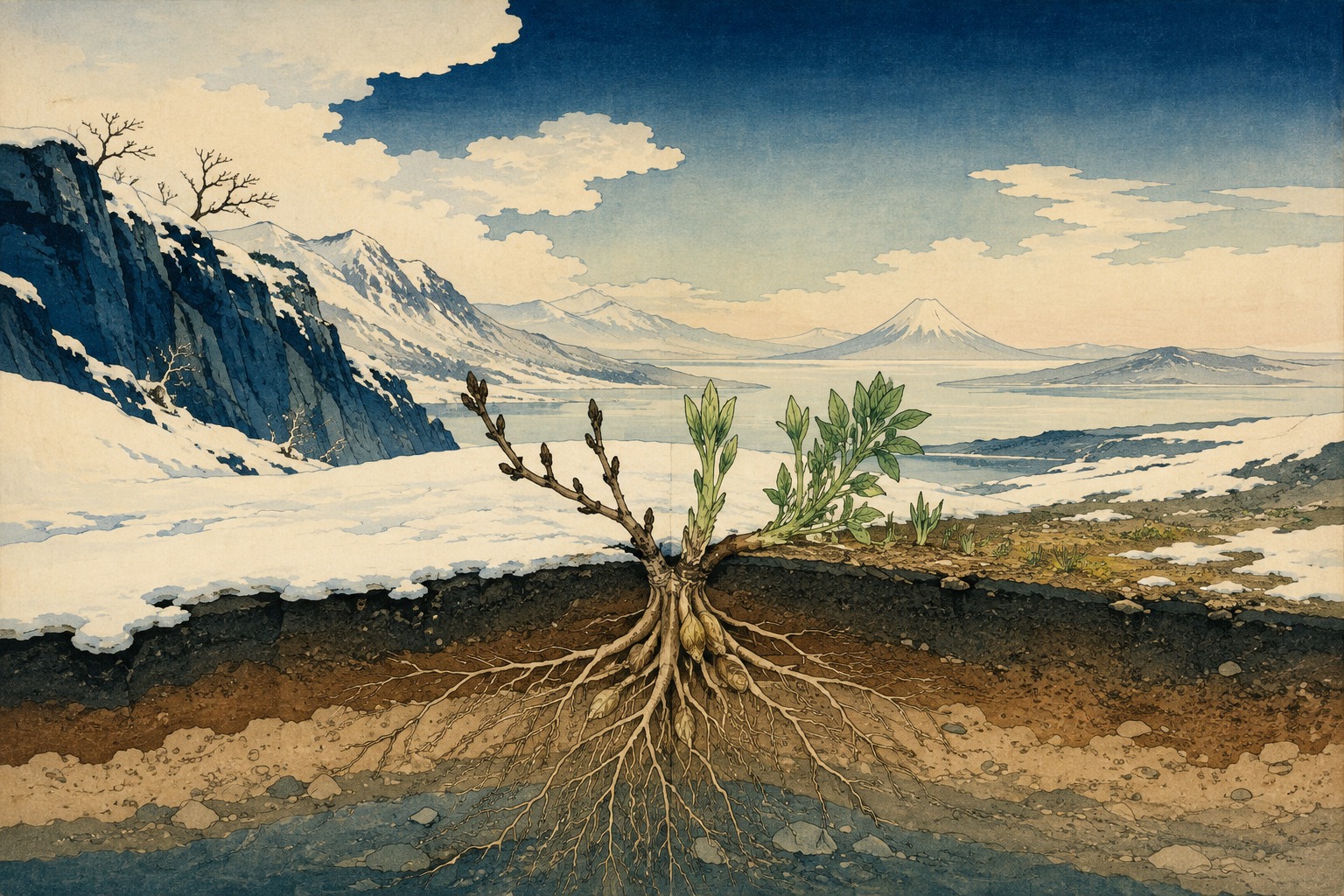
Orchardists have never chosen a grafting day by the calendar alone. They wait for the branch to rest, sap to slow and winter to bend toward spring. In that narrow season, two cut surfaces can build soft tissue across a wound and eventually join the vessels that carry water and sugar.
Cuttings also keep seasonal time. The same stem can root differently depending on the month it was collected, the age of its wood and whether it passed through winter. Growers have long known that cold can do more than damage a plant: it can release dormancy, prepare buds and alter the readiness to make roots. What remained missing was a molecular answer to a deceptively simple question. Why should tissue that has experienced winter be better able to rebuild itself after injury?
A team led by Keiko Sugimoto and Fu-Yu Hung at the RIKEN Center for Sustainable Resource Science now proposes one route. Cold-induced transcription factors CBF1, CBF2 and CBF3 recruit the histone acetyltransferase HAG1 to regeneration genes. HAG1 adds chemical marks to proteins around which DNA is wrapped, making genes including WOX5 easier to activate. Cold was not an order to grow a new organ. It prepared the cells to answer a later order.
Building six weeks of winter in a laboratory
The experiment began with Arabidopsis seedlings grown for 14 days at 22°C. One group was transferred to 4°C for six weeks; another remained the control. After the cold treatment, the researchers wounded leaf stalks, hypocotyls—the embryonic stem below the seed leaves—and leaf blades. Tissue that had experienced cold produced more callus at all three kinds of wounds. When hypocotyls were severed from roots, they also made more adventitious roots. On a cytokinin-rich shoot-inducing medium, cut hypocotyls regenerated new shoots sooner.
Callus is often described as an unorganized mass of undifferentiated cells, but current plant biology gives it more structure. In Arabidopsis, cells associated with vascular tissue and the pericycle can change identity after injury and enter a regenerative state resembling aspects of a lateral-root meristem. Signals from hormones, light and the wound then reorganize that tissue toward a root or shoot.
One cold night was not enough. The team varied exposure from one day to eight weeks. There was no clear improvement through three weeks. Regenerative capacity rose progressively from four to six weeks, then showed no significant additional gain at eight weeks. The plant was not merely sensing temperature. It was integrating the duration of cold.
| Stage | What the team measured | What it means |
|---|---|---|
| Cold pretreatment | Four degrees Celsius for six weeks, with a one-day-to-eight-week duration series | The effect emerged after about four weeks and plateaued near six |
| Wounding | Callus on petioles, hypocotyls and leaf blades ten days after cutting | Cold strengthened the response across several organs |
| Rooting | Adventitious roots formed by hypocotyls severed from their original roots | The benefit was not limited to callus and shoots |
| Shoot regeneration | Hypocotyl explants placed on cytokinin-rich shoot-inducing medium | Wild-type tissue produced shoots about two days sooner |
| Genotype | Columbia, Wassilewskija and Landsberg erecta accessions | All improved despite different baseline regenerative ability |
Winter had more than one memory
To a plant scientist, prolonged cold first suggests vernalization. Winter wheat and many biennials do not flower until they have experienced weeks of cold. The delay prevents an autumn warm spell from being mistaken for spring. In winter-annual Arabidopsis, FRIGIDA helps keep the floral repressor FLC highly active. Cold progressively establishes a repressive chromatin state at FLC; that silence persists through later cell divisions when warmth returns. It is the canonical epigenetic “memory of winter.”
The regeneration pathway was different. The common laboratory Columbia accession carries a nonfunctional FRI allele, so the researchers compared it with a Columbia line restored with functional FRI. Callus and shoot regeneration did not differ significantly. The celebrated FRI–FLC flowering pathway was not responsible for the new effect.
CBF reads the address; HAG1 opens the door
DNA does not float naked inside a nucleus. It is wrapped around histone proteins and assembled into chromatin. Chemical marks on histones influence whether a stretch of DNA is tightly packed or accessible to the machinery that transcribes a gene. Histone acetylation is often associated with a more open, transcription-friendly state.
RNA sequencing before and after cold showed that 102 of a manually compiled set of 431 regeneration genes were significantly upregulated. A regulatory-network analysis highlighted CBF1, CBF2 and CBF3, members of an AP2/ERF family best known for cold response. Their expression was negligible in the control, moderate after three weeks and pronounced after six. Existing DNA-binding data suggested that they recognized upstream regions of the newly active regeneration genes.
The CBF proteins provide an address-reading function. HAG1—also called GCN5—is an enzyme that acetylates histones. Two protein-interaction methods, bimolecular fluorescence complementation and co-immunoprecipitation, indicated that the CBFs and HAG1 associate inside plant cells. Chromatin immunoprecipitation then showed CBF3 and HAG1 accumulating at common target loci after prolonged cold, alongside increased histone H3 acetylation.
Genetics supplied a harder test. Two independent triple mutants lacking CBF1, CBF2 and CBF3 failed to gain the normal cold-induced increase in callus and shoot regeneration. A hag1 mutant already made little callus and regenerated no shoots under either condition. Reintroducing functional HAG1 rescued those defects. A quadruple mutant combining hag1 with the three CBF losses resembled hag1 alone, supporting a model in which the proteins act along the same genetic pathway.
- 1. Prolonged cold: the plant integrates weeks, not a brief chill.
- 2. CBF1/2/3: cold-responsive transcription factors accumulate and recognize selected DNA regions.
- 3. HAG1/GCN5: the CBFs recruit a histone acetyltransferase to regeneration genes.
- 4. H3 acetylation: chromatin becomes more permissive to later gene activation.
- 5. Wound and hormones: cutting and culture signals still trigger actual proliferation and organ formation.
A guardian of the root appears in stem tissue
Among the targets, the team investigated WOX5 most closely. WOX5 normally operates in a tiny organizing region at the root tip known as the quiescent center. It helps keep neighboring stem cells from using up their developmental potential. It is, in effect, one guardian of the root’s ability to keep making cells.
After six weeks of cold, a fluorescent reporter controlled by the WOX5 promoter appeared not only in its normal root territory but in the nuclei of differentiated hypocotyl cells. The expression domains of CBF3 and HAG1 also expanded. Artificially inducing WOX5 increased wound callus and subsequent shoot regeneration; a wox5 mutant showed a weaker response after cold.
Lineage tracing suggested that at least part of the callus descended from cells that expressed WOX5. There was a technical qualification: the recombination system used to record cell history did not work efficiently at 4°C, so marking had to be performed after transfer to warmer culture. WOX5 is therefore an important mediator, not a solitary master switch. Other targets—including WOX1, LOG1, HAM1, miR156c and PCS1—also showed CBF–HAG1-dependent expression and acetylation.
Cold does not regenerate. It makes regeneration possible.
Across the transcriptome, 4,607 genes rose and 2,846 fell after prolonged cold. Yet core cell-cycle and meristem gene groups did not switch on together, and seedlings did not spontaneously erupt with new organs while sitting at 4°C. Instead, genes normally induced by wounding were broadly shifted in the same direction before the wound arrived.
Cold had not fired the starter pistol. It had moved the cells toward the starting line. Injury was still required. Cytokinin-rich medium was still required for the shoot assay. The new pathway does not replace the hormones on which tissue culture depends; it may lower the barrier to responding to them.
The canonical auxin-response program changed little, and plants lacking the auxin-response factors ARF7 and ARF19 did not show an obvious defect in cold-enhanced regeneration. Several LOG genes that activate cytokinin did increase, however, and a mutant lacking six LOG family members regenerated poorly after cold. The classical auxin–cytokinin map still matters, but winter’s chromatin preparation now sits one step before it.
From cut branches to chromatin: a history of regeneration
Antiquity Cuttings and grafts spread valuable fruit and ornamental plants without relying on seed.
1902 Gottlieb Haberlandt proposes that plant somatic cells may retain the potential to produce an entire organism—later called totipotency.
1957 Folke Skoog and Carlos Miller show that changing the auxin-to-cytokinin balance can direct tobacco tissue toward roots, callus or shoots.
1958 Frederick Steward and colleagues regenerate embryos and plants from isolated carrot cells, demonstrating somatic-cell totipotency.
1988 Efficient regeneration and Agrobacterium transformation from Arabidopsis root explants creates a foundation for modern plant genetics.
2004 Studies in Nature connect prolonged cold, histone modifications and stable silencing of the flowering repressor FLC.
2018–2022 HAG1 is shown to be necessary for acquiring regenerative competence; warm culture promotes shoot regeneration through H2A.Z-linked chromatin change.
2026 The RIKEN-led preprint links cold pretreatment to a CBF–HAG1–WOX5 pathway that primes later wound regeneration.
Skoog and Miller’s famous map was simple: relatively more auxin favored roots, more cytokinin favored shoots, and an intermediate balance favored callus. Later work revealed endogenous hormones, cell origin, light, sugar, temperature and chromatin layered beneath that map. Still, the basic procedure—prepare an explant on callus-inducing medium, then transfer it to shoot- and root-inducing conditions—remains central to clonal propagation and genetic transformation.
Does this contradict evidence that warmth improves regeneration?
In 2022, Sugimoto’s group and collaborators compared Arabidopsis tissue culture at 17°C, 22°C and 27°C. Warmer culture accelerated callus and shoot production. At 27°C, the histone variant H2A.Z was depleted from regeneration genes, accompanying stronger expression of CUC1 and auxin-biosynthesis genes. That can sound like the opposite of a 2026 claim that cold improves regeneration.
The temperature acts at a different stage. The new work gave an intact plant a long winter-like pretreatment, then returned tissue to 22°C for wounding and regeneration. The 2022 work altered temperature while the explant was actively forming callus and shoots. A cold winter can prepare; a warm spring can execute. Different chromatin systems may support the two parts of the sequence.
What could change in grafting, cloning and breeding?
Regeneration is more than a botanical curiosity. It determines whether an excellent fruit tree can be multiplied by grafting, whether a cutting will root, whether virus-clean plants can be produced from meristems, whether rare germplasm can be conserved, and whether a gene-edited cell can be returned to a fertile plant.
| Use | How cold priming might help | What must be tested first |
|---|---|---|
| Grafting | Improve wound callus and vascular reconnection, shortening the route to a stable union | Rootstock–scion combinations, dormancy stage, disease and actual graft survival |
| Cuttings | Increase adventitious rooting in genotypes that propagate poorly | Species-specific duration, root quality and growth after transplanting |
| Micropropagation | Precondition explants for faster or more reliable callus and shoot production | Contamination, cooling energy, hormone dose and clonal stability |
| Transformation and editing | Lower the regeneration barrier between an edited cell and a complete plant | Reproducibility across crops and cultivars, unintended expression changes and fertility |
| Germplasm conservation | Improve recovery from rare, old or stored tissue | Long-term health, somaclonal variation and cold injury in each species |
The practical endpoint need not be six weeks of refrigeration for every seedling. Researchers could search for a temporary treatment that stimulates the CBF–HAG1 module, breed lines that respond to shorter cold, time explant collection to natural seasonal priming or pair a shorter temperature pulse with existing media. If the pathway is conserved in recalcitrant crops, one bottleneck in gene editing might be attacked not at the DNA-cutting stage, but at the harder step of rebuilding a plant from the edited cell.
“Epigenetic” does not mean inherited magic
Because histone modification is involved, the effect can properly be described as epigenetic priming. That does not mean the DNA sequence changed. Nor does the study show that greater regenerative capacity passes through seed into later generations. Even the well-known FLC memory of vernalization is generally reset for the next generation.
The work does not yet establish how long the primed regenerative state lasts after warmth returns, how rapidly it fades, or whether any part can cross generations. Histone acetylation is reversible—well suited to rapid environmental response, but also a possible source of variable duration and effectiveness.
What remains unanswered
- Peer review: independent specialists have not yet completed formal review of the analyses and interpretation.
- Species: the central evidence is from Arabidopsis, not rice, wheat, soybean, fruit trees or forest species.
- Time: six weeks at 4°C would add energy cost and production delay in a greenhouse or culture facility.
- Quality: regenerated roots and shoots must be followed through normal form, transplantation, yield, fertility and genetic stability.
- Optimum: cold can release dormancy in one species and cause injury in another; longer treatment may become harmful.
- Climate: warmer winters may alter propagation calendars, but this experiment cannot by itself attribute orchard failures or graft losses to climate change.
The measurements also average across many cells. Bulk RNA-seq and ChIP-seq can dilute a decisive change confined to the few cells that will become a wound callus. The authors found genes that lost the repressive mark H3K27me3 and explicitly did not exclude chromatin mechanisms beyond acetylation. Many cold-induced genes were not dependent on CBF–HAG1.
At the same time, the evidentiary chain is substantial for a preprint: phenotype, duration response, multiple Arabidopsis accessions, RNA profiling, protein interaction, chromatin occupancy, independent mutants, genetic rescue, WOX5 gain and loss, and public sequencing data all address the model from different directions. The caveat is important, but this is not a claim resting on one correlation plot.
Spring is not winter’s opposite, but its continuation
A winter branch appears to be doing nothing. Division slows, buds close and roots extend little. Beneath the stillness, however, a plant measures cold and changes how genes can be read. The cell returning to warmth is not quite the cell that entered winter.
The most revealing part of the RIKEN-led work is that cold did not “cause” regeneration in the everyday sense. Six weeks of chilling did not make callus swell without a wound or a shoot rise without the culture signal. The environment did something subtler: it enlarged the set of futures available after the next event.
Old horticultural hands may have felt that readiness in winter wood. Sequencing and microscopy translate it into CBF, HAG1, histone H3 and WOX5. The next work is to discover whether those words carry across an apple graft, a grape cutting or a rice culture.
If they do, winter will look less like an empty interval in cultivation. It will be the season in which a plant leaves the chromatin door slightly open, ready to become whole after it is cut.
Sources and reporting basis
- Hung et al., “Prolonged cold exposure enhances regeneration potential in Arabidopsis,” bioRxiv (posted April 22, 2026; not peer reviewed)
- GEO GSE297467: RNA-seq data for the cold-regeneration study
- GEO GSE297486: ChIP-seq data for the study
- KAKEN research report, “Epigenetic regulation of cell cycle in plant meristem development”
- Feng et al., “Plant grafting: Molecular mechanisms and applications,” Molecular Plant (2024)
- Ikeuchi et al., “Plant regeneration: cellular origins and molecular mechanisms,” Development (2016)
- Ikeuchi et al., “Molecular Mechanisms of Plant Regeneration,” Annual Review of Plant Biology (2019)
- Kim et al., “Epigenetic reprogramming by histone acetyltransferase HAG1/AtGCN5 is required for pluripotency acquisition in Arabidopsis,” EMBO Journal (2018)
- Rymen et al., “Histone acetylation orchestrates wound-induced transcriptional activation and cellular reprogramming in Arabidopsis,” Communications Biology (2019)
- Lambolez et al., “Warm Temperature Promotes Shoot Regeneration in Arabidopsis thaliana,” Plant and Cell Physiology (2022)
- Perez-Garcia et al., “The cold-induced factor CBF3 mediates root stem cell activity, regeneration, and developmental responses to cold,” Plant Communications (2023)
- Bastow et al., “Vernalization requires epigenetic silencing of FLC by histone methylation,” Nature (2004)
- Amasino, “Vernalization, Competence, and the Epigenetic Memory of Winter,” The Plant Cell (2004)
- Angel et al., “A Polycomb-based switch underlying quantitative epigenetic memory,” Nature (2011)
- Mishra et al., “Adventitious rooting in response to long-term cold,” Frontiers in Plant Science (2024)
- Melnyk, “Quantitative regeneration: Skoog and Miller revisited,” Quantitative Plant Biology (2023)
- Valvekens et al., “Agrobacterium tumefaciens-mediated transformation of Arabidopsis thaliana root explants,” PNAS (1988)
- RIKEN, “How wounding induces plant regeneration” (April 27, 2026)
- RIKEN, “Elucidation of control principles for a plant regeneration switch” (March 24, 2026)
Editor’s note: This report checked the preprint, supplement and public data against peer-reviewed background research. Root regeneration was reported in a supplementary experiment, while shoot regeneration occurred on cytokinin-containing medium; cold alone did not generate the organs. This article is based on material available by 3:14 a.m. Japan Standard Time on August 15, 2026.