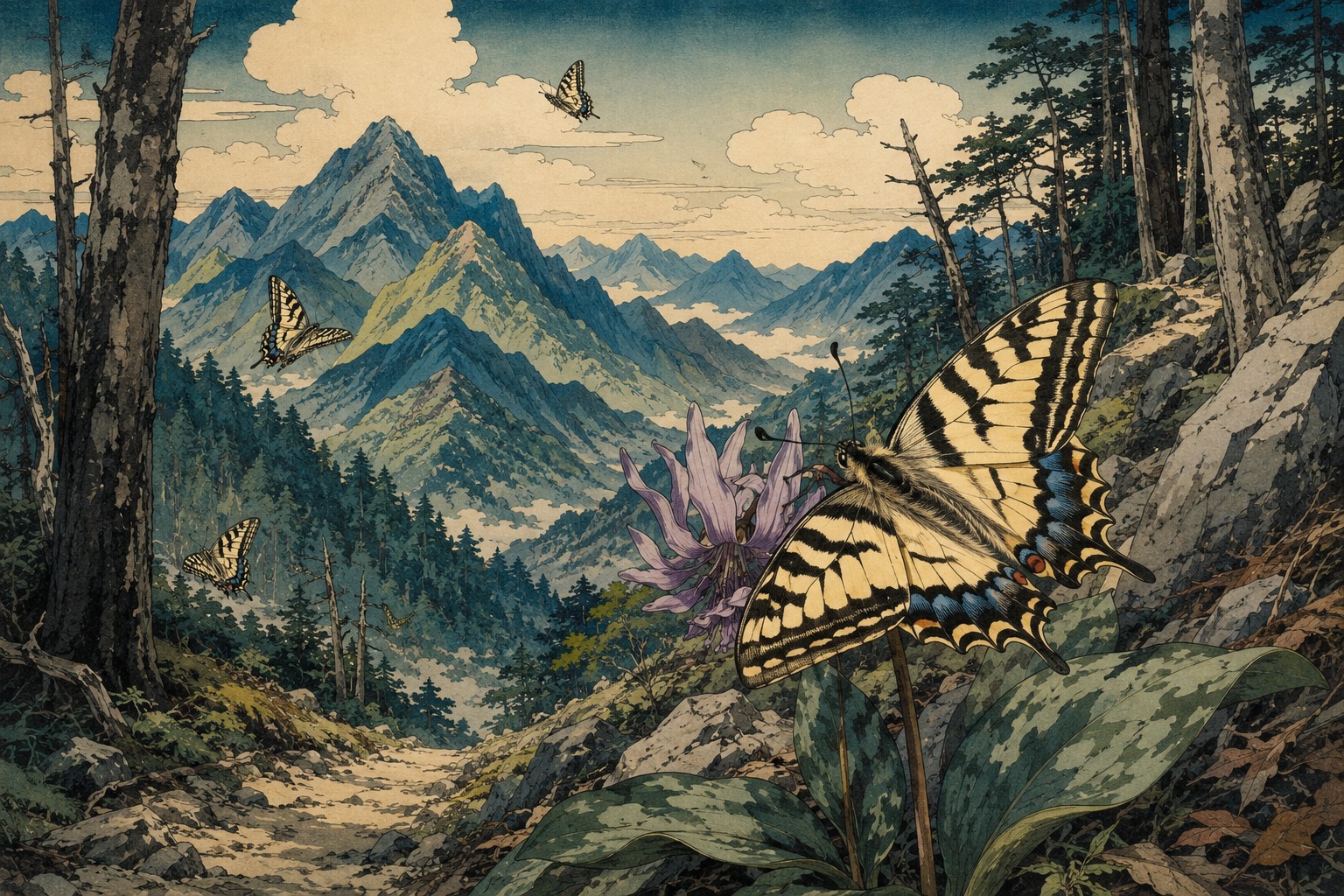
In early spring, before deciduous branches close the sky, sunlight reaches the woodland floor. Katakuri lilies and violets open. Across them moves a small swallowtail patterned in black and yellow, with red, orange and blue spots at the hindwing. Luehdorfia japonica is called the “goddess of spring” not only for its beauty but for its brevity. It spends most of the year hidden as a pupa and appears as an adult for a short season around March and April.
At Mt. Ishizare, the edge of that wing became the edge of a scientific argument. Kanagawa butterflies normally carry alternating black and yellow fringe. Some individuals, however, displayed a continuous yellow fringe—the “yellow band” associated with northern Nagano populations. Had butterflies transported by people survived, reproduced and begun rewriting the evolutionary history of the Kanto region's final population? Visible yellow had opened a question that could not be settled by sight.
“Mixed” does not mean “lost”
Researchers from Osaka Metropolitan University, the Kanagawa Prefectural Museum of Natural History, the University of Toyama, the Research Institute of Environment, Agriculture and Fisheries in Osaka, and the University Museum of the University of Tokyo used a method called MIG-seq to read variation scattered across the genome. They examined 67 butterflies in all. The 45 Ishizare samples spanned 2005–2024. Comparisons included a southern Toyama population geographically close to the reported northern Nagano release source, and a northern Osaka population.
Cluster analysis grouped individuals by genetic similarity under models with two, three and four groups. Across those settings, only 1.6%–2.4% of the ancestry assigned to Ishizare matched nonlocal genetic clusters. Six of the 45 butterflies carried at least 5% nonlocal assignment, the threshold the authors used for clear genetic disturbance. Introgression was not zero, but most individuals retained the dominant Ishizare background.
That distinction changes the conservation decision. If any trace of human movement made a population worthless, managers might abandon the last habitat after detecting a few introduced variants. The study supports the opposite conclusion: a small human signature can coexist with a substantially intact regional lineage. Conservation is not a contest to identify genetically “pure” individuals. It is the work of retaining a population's accumulated evolutionary history, its relationship with place, and its capacity to persist.
Reading the outline of a population from 581 markers
A SNP is a position at which one DNA letter varies among individuals or populations. One SNP is rarely a label of origin. Hundreds distributed through the genome can, together, form a statistical pattern left by populations that have bred separately over many generations.
MIG-seq stands for multiplexed inter-simple sequence repeat genotyping by sequencing. Introduced by Tohoku University researchers in 2015, it uses PCR to amplify many regions adjacent to simple repeated sequences, then reads them with next-generation sequencing. It can discover many SNPs without a complete reference genome and can work with small amounts or lower-quality DNA—qualities that make it useful in conservation genetics and with archived biological material.
The new butterfly study did not read every base in every genome. It used 581 markers to infer population structure. Because the investigators tested different numbers of genetic clusters, the estimate is a range rather than one supposedly exact value. “Two percent” is not a physical measurement saying exactly two out of every hundred DNA letters came from somewhere else. It is a model's estimate of how much of the observed pattern resembles the comparison groups.
| What the study showed | What it did not show by itself |
|---|---|
| The genetic component resembling comparison populations was low across Ishizare | That every release failed or that another release would have no effect |
| Most of the 45 sampled butterflies retained the main Ishizare background | A census of every butterfly, location and generation in the habitat |
| Six individuals exceeded the authors' 5% disturbance threshold | That those six had lower survival, fertility or local adaptation |
| Genome-wide markers could detect ancestry related to a northern source | An estimate of releases from genetically similar southern Yamanashi |
| The population's conservation value remains substantially intact | A recommendation to release more butterflies, breed selectively or remove admixed individuals |
The largest blind spot: Yamanashi ancestry looks too similar
Historical records report releases not only from northern Nagano but from southern Yamanashi. Earlier work found very little genetic differentiation between southern Yamanashi and Kanagawa butterflies. The new analysis could not distinguish them and did not perform that comparison.
This is not a disposable caveat. It is why 1.6%–2.4% cannot be called the total legacy of all historical releases. Movement from a genetically close source may blend into the background under the markers and reference samples used here. Nor does genetic similarity prove that two populations are ecologically identical. Denser genomic sampling, suitable source specimens and measures of survival and reproduction might provide another level of resolution.
Many of the 581 SNPs are useful as relatively neutral signs of ancestry, but they need not be the genes responsible for local adaptation. The study did not directly compare egg production, larval survival, pupation, spring emergence or mating success between ancestry groups. A low ancestry share is not the same as a demonstrated absence of biological effect.
The butterfly stage is the shortest part of its year
Luehdorfia japonica is endemic to Honshu and small for a swallowtail. Females place clusters of eggs on wild gingers. Young larvae feed together, later becoming pupae. The insect then passes summer, autumn and winter in the pupal stage. Experimental work has shown a complex seasonal control involving summer and winter diapause: shortening autumn days and a sustained winter chill help synchronize emergence the following spring.
The adult seen on a flower is therefore the brief visible ending of a year-long story. Conserving it requires more than protecting a summit on a sunny April day. There must be leaves for eggs and larvae, a connected woodland floor, litter in which pupae escape desiccation and disturbance, nectar flowers, and deciduous forest open enough for early-spring light.
Its habitat often overlaps satoyama—woodland historically cut for fuel, cleared beneath the canopy and used for leaf litter. When that management ends, evergreen growth and dense understory can shade spring plants. Too much cutting can dry the ground and remove host plants. Development, collecting and deer pressure on host and nectar plants add further threats. Conservation does not simply mean leaving everything untouched. It means learning what degree of continuing human care allows the ecological cycle to persist.
A butterfly found in Gifu in 1883
In 1883, Japanese entomologist Yasushi Nawa collected the butterfly at Soshino, now in Gero's Kanayama district in Gifu Prefecture. Its scientific authority is Luehdorfia japonica Leech, 1889, and its Japanese name, Gifu-chō, preserves the place of discovery. The dramatic bands, colored hindwing spots and brief spring flight fascinated collectors and scientists. Nawa established his insect research institute in 1896; an insect museum opened in Gifu in 1919. The butterfly became a symbol of Japanese entomology and public affection for insects.
Popularity can generate protection and pressure at once. Observations and specimens preserve invaluable records of range and regional form. Collecting, breeding and the pursuit of unusual color forms also remove animals from small habitats. A wish to “help” a diminished population—or simply to see a beautiful butterfly fly in a new place—can motivate releases without a scientific plan.
Kanagawa designated “Gifu-chō and its habitat” a prefectural natural monument on December 28, 1982. Mt. Ishizare lies south of Lake Sagami in Sagamihara's Midori Ward, at the Pacific-side eastern limit of the species' range. It is now described by the research team as the sole remaining habitat in the Kanto region. Protecting a natural monument in this sense means protecting more than individual insects: it means protecting the regional history and habitat that produced them.
1883 Yasushi Nawa collects the butterfly at Soshino in Gifu.
1889 The year attached to the scientific description Luehdorfia japonica.
1982 Kanagawa designates the Mt. Ishizare butterfly and habitat a natural monument.
2007 A feeding experiment warns that butterflies from other regions can develop on Ishizare's local host plant.
2011 Japan's Environment Ministry issues principles requiring advance assessment and planning for returns to the wild.
2015 MIG-seq is published as a way to infer population structure from limited DNA.
2005–2024 The Ishizare samples used in the new study accumulate.
2026 Analysis of 67 butterflies finds the detectable disturbance to be slight.
A warning in 2007, an answer in 2026
Nearly two decades before the genomic result, researchers asked a different question: could butterflies from outside the Tanzawa–Ishizare population survive on the local host at all? A 2007 rearing experiment tested lineages associated with the Fujigawa and Niigata regions. Females laid eggs on Asarum nipponicum, the wild ginger used by the native population, and most larvae developed into normally sized pupae on it.
The ecological barrier was therefore incomplete. Managers could not assume that outsiders would fail because their original host plants differed. Establishment, competition and crossing were possible. The 2007 study tested whether the risk had a plausible biological route; the 2026 study measured how much trace could be found in the population. The two results do not conflict. The event was possible, but extensive introgression appears not to have followed.
The new public materials do not establish why the signal stayed low. Perhaps few individuals were released. Perhaps adults failed to find mates or good oviposition sites. Repeated backcrossing may have diluted introduced ancestry. Local conditions may have reduced descendant survival. Sampling years and places, reference populations and statistical detection all shape the result. These are hypotheses to test, not findings that the paper proved.
Butterflies and their host plants changed together, place by place
Regional difference in this butterfly is deeper than the yellow fringe. A 2023 biogeographic study combined mitochondrial DNA, SNPs and cross-host feeding experiments. It found multiple genetic groups across Japan and inferred at least four expansion routes. Some host plants reduced pupation when fed to butterflies from another population, evidence that adaptation to local plants helped shape population structure along with geographic distance.
“The same species” therefore does not mean “interchangeable from anywhere.” Separated populations pass generations under different temperatures, snow, emergence seasons, host plants, predators and pathogens. They can look similar while their relationship with habitat differs. A person can carry a butterfly in hours across a boundary that natural gene flow may not have crossed for a very long time.
That does not justify talking about wildlife in moralized terms of “purity.” Genes move, mix and undergo selection naturally. In a very small isolated population, inbreeding and lost variation can themselves increase extinction risk. Carefully designed genetic rescue can be beneficial. The conservation question is not whether mixing is always good or always bad. It is whether managers have evaluated the goal, source, local adaptation, disease, expected crosses, alternatives and monitoring before intervening.
- Purpose: Is there a defined conservation outcome, rather than private enjoyment or an untested wish to increase numbers?
- Provenance: Has regional genetic structure been studied, and can managers explain the selected source?
- Habitat: Have the causes of decline been addressed, with enough host plants, nectar and woodland floor?
- Health: Have risks from pathogens, parasites and accompanying organisms been assessed?
- Authority: Is there a plan and permission involving landowners, government, scientists and residents?
- Follow-up: Will survival, reproduction and genetic effects be measured across generations?
In 2011, Japan's Environment Ministry set out national principles for returning threatened wildlife to nature. They call for scientific assessment of necessity and feasibility, a written implementation plan, and close connection with in-situ conservation. The ministry identified disregard for regional genetic characteristics, introduction outside natural habitat, and movement of pathogens or parasites as risks. IUCN's 2013 guidelines similarly treat conservation translocation as an intervention requiring purpose, alternatives, risk assessment and long-term monitoring. Releasing an animal takes seconds; the science and responsibility should extend for years.
Look at the disappearing forest before chasing a small ancestry signal
The new finding is not a reason to make “removing nonlocal genes” the conservation priority. Five percent was an analytical threshold, not an instruction to remove six butterflies. A yellow wing fringe is not a complete ancestry test. Selection or removal in a small population could shrink it further and discard valuable native variation by mistake.
The immediate work is habitat. Map wild gingers and nectar plants. Manage woodland gradually so early-spring light reaches the floor. Where deer browse important plants, connect plant protection with deer management. Continue patrols and communication against collecting and unauthorized release. Design observation access without trampling host patches. Protect the pupal environment through the rest of the year, not only the adult flight season.
Genetic monitoring should also become a time series rather than a one-time verdict. The 2005–2024 samples can serve as a baseline. Standardized sampling at the same places and seasons every few years could track nonlocal ancestry, diversity and relatedness. If neighboring colonies have recently become established, analysis can ask whether movement is outward from Ishizare or inward from another source. Museums should preserve dates, places and provenance with specimens: an archive allows tomorrow's technology to interrogate yesterday's landscape.
| Conservation pillar | What to measure next | The shortcut to avoid |
|---|---|---|
| Habitat | Wild ginger, nectar flowers, floor light, moisture and deer browsing | Counting released adults as habitat recovery |
| Population | Eggs, larvae, pupae and adults across years | Calling one good observation day a long-term trend |
| Genetics | Regional background, nonlocal assignment, diversity and relatedness over time | Using wing pattern alone to decide origin or removal |
| Human behavior | Collecting, unauthorized release, trail pressure and stewardship capacity | Assuming good intent means low ecological risk |
| Decisions | Goal, authority, source, health screening and post-release monitoring | Filling a damaged habitat with outsiders before repairing it |
Conservation value is not all or nothing
The idea that nature touched by people is no longer authentic fits satoyama poorly. Mt. Ishizare's woodland carries histories of human use and abandonment, protection and observation, collecting and research. Its value does not depend on an impossible absence of human influence. It lies in a living relationship between local organisms and place that has not yet disappeared.
The 1.6%–2.4% result asks for optimism and caution at the same time. Optimism, because the main genetic outline of the Ishizare population remains. Caution, because at least some released butterflies reproduced, leaving a signal readable decades later. Southern Yamanashi influence remains unresolved. A human-assisted movement can outlast the memory of the person who made it.
What must survive until next spring
The researchers did not issue a contamination sentence or a license to release more butterflies. Mt. Ishizare's population experienced slight human-caused genetic disturbance, yet it has not lost its identity as a regional lineage. That is why it deserves protection. And because introgression really did occur, there is reason to prevent further unplanned movement.
One butterfly opens its wings in the early-spring woodland. Whether the fringe is striped or yellow cannot reveal its whole history. Even 581 markers cannot fully answer the southern Yamanashi question or measure every effect on fitness. Science has not supplied a neat ending. It has drawn the boundary of responsibility more accurately.
For the goddess of spring to return, the mountain does not need another box of butterflies. It needs light on the woodland floor, wild ginger, flowers, leaf litter, records, local stewards—and the restraint to leave the butterfly within the time and place that made it.
Sources and reporting basis
- Nakahama et al.: human-caused genetic disturbance in Mt. Ishizare's Luehdorfia japonica (Entomological Science, June 14, 2026)
- Osaka Metropolitan University: historical releases had only a slight detected genetic effect (June 18, 2026)
- University Museum, University of Tokyo: study design, limitations and researcher comment
- Tanikawa & Ishii: establishment potential of lineages introduced to Mt. Ishizare (Lepidoptera Science, 2007)
- Expansion, population structure and local host adaptation in Japan's Luehdorfia butterflies (Journal of Biogeography, 2023)
- Microsatellite markers for conservation studies of Luehdorfia japonica (Entomological Science, 2024)
- Suyama & Matsuki: the original MIG-seq method (Scientific Reports, 2015)
- Ishii & Hidaka: two-stage pupal diapause in Luehdorfia japonica (1983)
- Matsumoto: adult population dynamics of Luehdorfia japonica (Population Ecology, 1984)
- Gifu Prefecture: ecology, distribution, threats and habitat management
- Gifu City: the 1883 discovery and “goddess of spring”
- Cultural Heritage Online: Gifu-chō and its habitat (Kanagawa designation, December 28, 1982)
- Ministry of the Environment: Japan Red List 2020
- Ministry of the Environment: principles for returning threatened wildlife to the wild (2011)
- IUCN: Guidelines for Reintroductions and Other Conservation Translocations (2013)
- Weeks et al.: genetic benefits and risks of conservation translocations (Evolutionary Applications, 2011)
- Kanagawa Prefecture: deer and vegetation-impact monitoring in the Tanzawa Mountains
Editor's note: The 1.6%–2.4% range is a model-based assignment to nonlocal genetic clusters under the study's comparison populations and cluster settings. It is not a physical “contamination rate” for the entire genome. Releases from southern Yamanashi could not be distinguished from Kanagawa ancestry in this analysis. The 5% research threshold is not an instruction to remove, restrict or devalue individual butterflies. Recommendations about future habitat management, genetic monitoring and translocation governance are Japan.co.jp analysis based on public sources, not decisions announced by the researchers or government. Research was current to 3:14 a.m. Japan Standard Time on August 15, 2026.