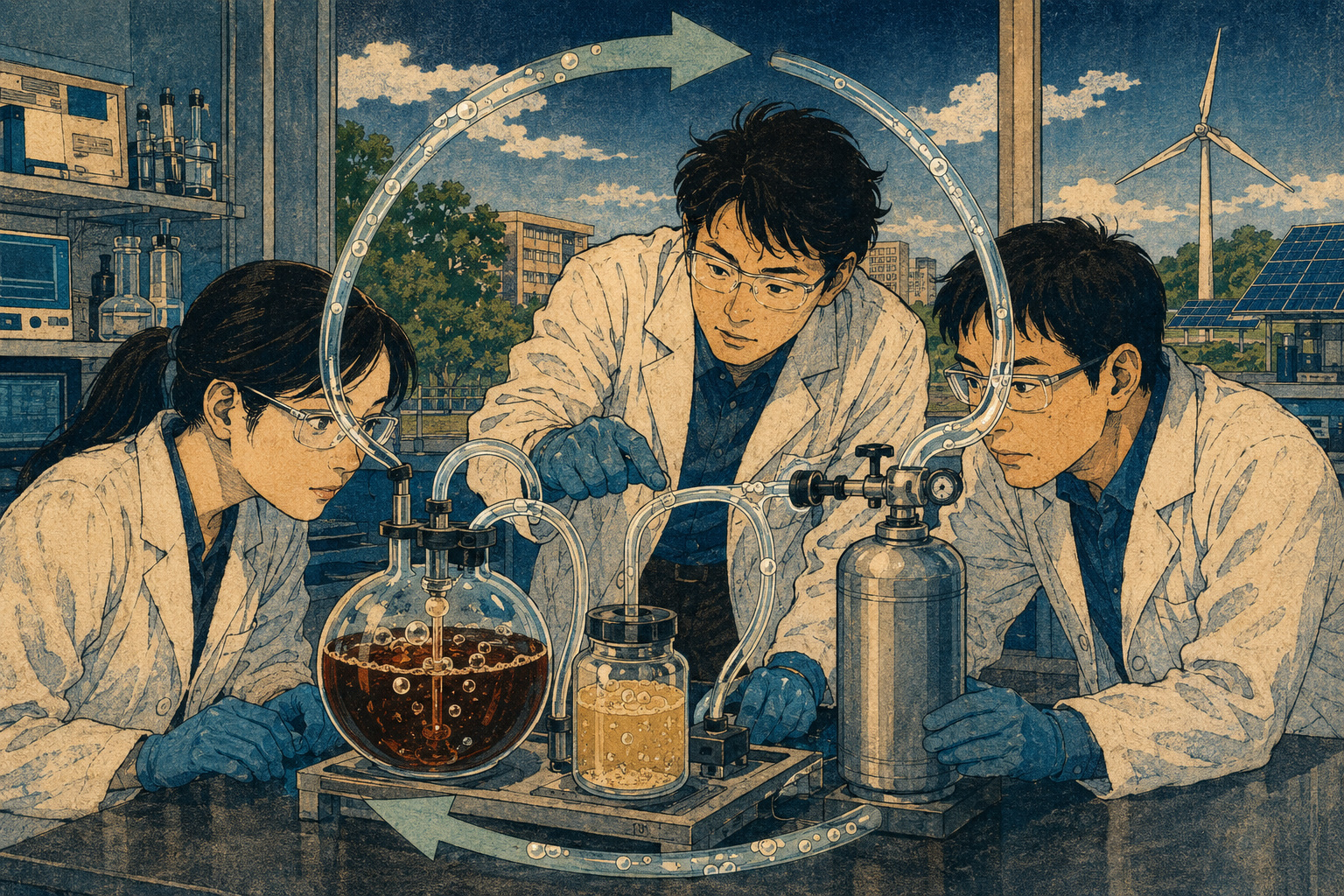
Hydrogen’s cleanest moment is its last one. Feed it to a fuel cell and the immediate product is water, not carbon dioxide. Everything before that can be much messier: making the gas, purifying it, compressing or liquefying it, moving it and then converting it again. The International Energy Agency says low-emissions hydrogen production approached one million tonnes in 2025 but still supplied less than 1% of the world total. Unabated fossil fuels continued to dominate.
A paper published Aug. 24 in the Journal of Materials Chemistry A asks whether several of those steps can be collapsed into a change in a liquid molecule. The work comes from Tohoku University, Hokkaido University and Kyushu University. Its ingredients sound almost domestic—water, sugar, baker’s yeast, iron and light—but the chemistry is precise. Yeast supplies reducing power that converts a molecule with two ketone groups into one with two alcohol groups. Iron ions and light then help reverse that conversion, yielding molecular hydrogen and recovering the starting diketone.
The group includes associate professor Kouki Oka and professor Hitoshi Kasai of Tohoku University’s Institute of Multidisciplinary Research for Advanced Materials; Tohoku doctoral student Takumi Ichimura; Takuro Tsutsumi, then an assistant professor at Hokkaido University; Hokkaido specially appointed professor Kazuki Sada; and Kyushu University associate professor Takahiro Matsumoto. Oka is the corresponding author.
A rechargeable bond, not a miniature gas cylinder
The broader technology is known as a liquid organic hydrogen carrier, or LOHC. A carrier is hydrogenated at one end of a supply chain and dehydrogenated at the other. Hydrogen travels in covalent bonds rather than as a compressed gas. If both the hydrogen-rich and hydrogen-lean forms are manageable liquids, they may use some of the tanks, pipes, ships and handling practices already built for liquid fuels.
Japan has already demonstrated that principle at supply-chain scale with a different pair. In 2020, a NEDO-backed consortium combined hydrogen with toluene in Brunei to make methylcyclohexane, shipped the MCH to Kawasaki, removed hydrogen for a power plant, and returned the toluene. NEDO said the conversion reduced hydrogen’s volume to one five-hundredth that of the gas and allowed transport at ordinary temperature and pressure. But hydrogenation, dehydrogenation, catalyst management, heat and the return trip remain part of the energy and cost balance.
The new work examines polyhydric alcohols and their polyketone counterparts. Here “polyketone” describes a molecule carrying multiple ketone groups, not necessarily a long-chain engineering polymer. Oxidizing an alcohol group to a carbonyl group removes hydrogen; reducing the carbonyl restores it. Give one molecule two or more such sites and, in principle, it can carry more hydrogen than a comparable monohydric alcohol.
That matters because the familiar isopropyl-alcohol/acetone pair stores only 3.3% hydrogen by mass, according to the universities’ release. Alcohol carriers are attractive because their dehydrogenation enthalpy can allow release below 200°C, milder than several established organic-hydride systems. The design problem is to retain that thermodynamic advantage while adding storage sites without creating an unstable, viscous, toxic or difficult-to-separate liquid.
How bread chemistry “charges” the liquid
The model pair is 2,5-hexanedione and 2,5-hexanediol. The first molecule has two carbonyl groups. The second has two alcohol groups and four additional hydrogen atoms. Written as a release reaction, C6H14O2 becomes C6H10O2 plus two H2 molecules. The carrier has not trapped intact gas in a pore; its elemental composition and oxidation state have changed.
In the biological charging route, the diketone is stirred with baker’s yeast in water under ambient temperature and pressure. Yeast metabolizes sugar. In that network, the cofactor NAD+ accepts electrons and hydrogen to become NADH; enzymes can then use NADH to reduce carbonyl groups. The published study reports that optimized conditions completely hydrogenated 2,5-hexanedione within nine hours, fixing four hydrogen-atom equivalents as 2,5-hexanediol.
“Complete” is important but narrow. It describes conversion of the target substrate under a laboratory condition. It does not mean that every joule in the sugar became recoverable hydrogen, that the separation was lossless, or that the overall plant would be 100% efficient. A process balance would also count yeast cultivation, sugar production, mixing, temperature control, water, downstream purification and the carbon-containing fermentation products.
The paper also demonstrates electrochemical hydrogenation using water as a hydrogen source. That alternative makes the platform more than a fermentation curiosity: the same diketone/alcohol chemistry can accept reducing power from biology or electricity. The yeast route, however, makes the most provocative systems claim. Conventional LOHC charging commonly begins with H2 that has already been produced, purified and sometimes compressed before catalytic hydrogenation. Fermentation places reducing equivalents directly into the carrier without isolating H2 first.
It is less a bottle of hydrogen than a rechargeable chemical bond. The energy carrier is the molecule’s oxidation state; H2 appears only when the discharge reaction asks for it.
How iron and photons discharge it
The return half must do two jobs together: oxidize the diol back into the diketone and couple the removed hydrogen atoms into H2. The researchers report that iron ions serve as a photocatalyst for this alcohol-oxidation/hydrogen-evolution step. Light triggers hydrogen release while the hydrogen-accepting diketone is regenerated. The article describes the use of nonprecious, earth-abundant Fe(II) ions as a proof of concept.
That result has a direct precursor. In April, Matsumoto and colleagues at Kyushu and Osaka universities reported that iron ions alone—without a purpose-built organic ligand—could catalyze hydrogen evolution from methanol under light. Their open-access Communications Chemistry paper used continuous ultraviolet irradiation and, under its most active conditions, sodium hydroxide. Visible or simulated solar light produced much less hydrogen. Water-rich mixtures sharply reduced the rate, and the authors said the mechanism remained unresolved.
The August paper applies iron-ion photochemistry to the multi-alcohol carrier concept. That may remove the iridium or other precious-metal complexes used in several earlier alcohol-carrier demonstrations. But “iron instead of precious metal” cannot be translated directly into “cheap hydrogen.” The light source, photon utilization, base or other additives, iron recovery, gas separation and reactor surface area all become part of the bill. A common catalyst can still sit inside an expensive process.
| Stage | Inputs | Transformation | Output | Engineering questions |
|---|---|---|---|---|
| Fermentation storage | Diketone, water, sugar, yeast | NADH-linked enzymatic reduction | Hydrogen-rich diol | Sugar efficiency, selectivity, yeast lifetime, product recovery |
| Electrochemical storage | Diketone, water, electricity | Electrode-driven reduction | Hydrogen-rich diol | Voltage, current efficiency, electrode durability, renewable intermittency |
| Photochemical release | Diol, iron ions, light | Alcohol oxidation and H2 evolution | H2 and regenerated diketone | Quantum yield, gas purity, side products, iron recovery, light delivery |
| Carrier return | Spent carrier and logistics | Separation, transport, recharge | Next cycle | Toxicity, leaks, corrosion, retention, cost and usable storage density |
A decade of Japanese work closes the loop
The combination looks whimsical only if its lineage is omitted. Japanese groups have spent a decade developing ways to fix hydrogen from water or fermentation directly into carbonyl-containing molecules, then release it under relatively mild conditions. The stubborn part was often the precious-metal catalyst on discharge.
2016 Ryo Kato, Kenichi Oyaizu, Hiroyuki Nishide and colleagues at Waseda University electrochemically reduced a fluorenone polymer in water at room temperature, then released H2 at 80°C with an aqueous iridium catalyst.
2020 The NEDO-backed Brunei–Japan demonstration completed a round-trip MCH/toluene supply chain, showing what LOHC logistics could look like beyond a laboratory vial.
2024 Oka’s group used baker’s yeast to reduce cellulose-derived Cyrene to Cyrene-OH, fixing hydrogen equivalents in the molecule, and paired the biological step with catalytic release.
March 2026 The group completely reduced benzaldehyde with baker’s yeast at 25°C and linked it to hydrogen release from benzyl alcohol using an iridium complex.
April 2026 Matsumoto’s group disclosed the ligand-free iron-ion/light reaction for hydrogen evolution from methanol.
August 2026 The new paper brings multi-site alcohol carriers, direct biological or electrochemical storage, and nonprecious iron-ion release into one design.
Seen in sequence, each project removes a constraint left by the last. The 2016 polymer avoided pre-made gas during charging but needed iridium during release. The Cyrene and benzyl-alcohol work brought ordinary yeast into charging, but discharge still depended on a metal complex. The April iron result suggested a simpler outlet. The August study connects that outlet to a denser, multi-site carrier architecture.
“Green” is a system result, not an ingredient list
Tohoku University calls the work a green-hydrogen production-and-storage cycle. Its release defines green hydrogen as H2 made from sustainable resources without CO2 emissions during production. The aspiration is coherent: biomass-derived carrier molecules, renewable electricity or fermentation, common iron and reusable liquids could reduce dependence on fossil-derived carriers and scarce catalysts.
But yeast, iron and biomass do not certify a lifecycle. Sugar has a farm or factory behind it. Light may come from an ultraviolet lamp powered by the grid. Stirring, separation, drying and purification consume energy. Iron salts, base, water and solvent have supply chains. The carrier must be manufactured, contained, returned and replaced as it degrades. A carbon atom that remains in a closed carrier loop is very different from one lost as an emission or waste stream.
The specific model compounds also carry a safety warning. The U.S. National Institute for Occupational Safety and Health identifies 2,5-hexanedione as the metabolite probably responsible for n-hexane’s distinctive peripheral neurotoxicity. That does not invalidate a molecular proof of concept; screening chemistry often begins with a tractable model. It does mean the demonstrated pair should not be mistaken for a selected commercial shipping fluid.
The team says it will investigate more suitable alcohols, including ethylene glycol. Suitability will have to combine theoretical hydrogen density, reaction rate, volatility, melting point, viscosity, separability, biodegradability and exposure risk. Ethylene glycol itself is toxic if ingested. There is no single “biomass-derived” label that resolves process safety.
The university release also projects a large reduction in hydrogen supply costs and distributed production and storage. Those are attributed expectations, not measured outcomes. The public material does not report a delivered cost per kilogram, round-trip energy efficiency, integrated light-to-hydrogen efficiency, plant capital estimate or lifecycle carbon intensity. The honest achievement is narrower and still substantial: the team found a reaction path that may eliminate several expensive operations and precious-metal catalysts.
- Whether sugar and carrier feedstocks come from waste, sustainably managed biomass or fossil carbon.
- The carbon intensity of electricity for electrochemistry, mixing, irradiation and separation.
- How often yeast, iron, water, base and carrier can be reused—and at what recovery rate.
- Purification needed to reach fuel-cell-grade H2 and the fate of fermentation by-products.
- Carrier toxicity, volatilization, leaks, degradation, wastewater and end-of-life treatment.
- Greenhouse-gas emissions, water and land use from raw material to point of hydrogen use.
The hard experiment begins after the elegant one
A circular arrow on a reaction scheme is not yet a circulating plant. A fermenter contains yeast cells, unused sugar, salts and metabolites. The photoreactor needs controlled contact among carrier, iron and photons while separating an explosive gas. Conditions favorable to living or resting yeast may not suit iron photochemistry, so the two vessels may require an intervening purification train. Every separation can erase part of the energy advantage that direct storage was meant to create.
The paper establishes reversible molecular logic, including complete yeast-assisted conversion of the model diketone and iron-ion-enabled hydrogen evolution from the corresponding alcohol class. It does not report an integrated continuous pilot, distribution trial, direct fuel-cell feed, multiyear cycling campaign, independent replication, full techno-economic analysis or lifecycle assessment. Those are not omissions from a basic-science paper so much as the next hierarchy of evidence.
Durability will be particularly unforgiving. A carrier that loses only a fraction of a percent per cycle can accumulate a large replacement burden over hundreds of trips. Minor by-products may poison enzymes, absorb light, foul a membrane or contaminate H2. Iron is abundant, but iron discharged into wastewater is lost material and a treatment problem. Yeast is cheap, but a living catalyst is sensitive to substrate concentration, inhibitors and temperature.
There is nevertheless a genuine systems idea here. The usual hydrogen diagram is a procession of machines: electrolyser, purifier, compressor, storage tank, truck or ship, and fuel cell. This project inserts two other kinds of machinery—yeast metabolism and a photoexcited iron ion—into the same chain. In a future distributed version, a region might use local water, renewable electricity or biomass-derived sugar to charge a transportable molecule, then use light at the destination to release gas on demand.
Distributed does not automatically mean economical. Small photoreactors may expose more liquid to light, but small installations also repeat controls, separation hardware and maintenance. The next comparisons must therefore use common denominators: joules in per joule of usable H2 out; yen per delivered kilogram; grams of CO2-equivalent per megajoule; grams of carrier lost per cycle; hours of stable operation; and impurity levels at the outlet.
Baker’s yeast has not baked a hydrogen economy. It has demonstrated something more specific: an old fermentation toolkit can move reducing power directly into a candidate transport molecule. Iron and photons offer a way back out. Joining those halves without a precious-metal catalyst makes the loop scientifically compelling. Making the loop tight, safe, fast and honestly green will require a much larger experiment.
- Ichimura et al. — Hydrogen Gas Production and Storage Cycle of Polyhydric Alcohols/Polyketones, Journal of Materials Chemistry A (2026)
- Tohoku University — official Japanese research announcement (Aug. 24, 2026)
- Tohoku, Hokkaido and Kyushu universities — full joint release, glossary and funding (Japanese PDF)
- Tohoku University — official English research release
- Hokkaido University — paper record and institutional affiliation
- Sakurai et al. — Iron Ion Enables Photocatalytic Hydrogen Evolution from Methanol, Communications Chemistry (2026)
- Kyushu University — official announcement of the iron-ion/light reaction (April 17, 2026, Japanese)
- Kato et al. — A Ketone/Alcohol Polymer for Cycle of Electrolytic Hydrogen-Fixing with Water and Releasing under Mild Conditions, Nature Communications (2016)
- Ichimura et al. — Cyrene, baker’s yeast and hydrogen fixing/release, International Journal of Hydrogen Energy (2024)
- Ito et al. — Hydrogen Gas Production and Storage Cycle with Benzyl Alcohol/Benzaldehyde, Sustainable Energy & Fuels (2026)
- NEDO — Brunei–Japan MCH international hydrogen-transport demonstration (2020)
- International Energy Agency — Global Hydrogen Review 2026: Production
- U.S. NIOSH — n-hexane assessment and the role of 2,5-hexanedione in peripheral neurotoxicity
- Tohoku University Kasai Laboratory — official member names and romanization
- Hokkaido University — official profile of Kazuki Sada
- Kyushu University Center for Future Chemistry — official profile and reading of Takahiro Matsumoto
Editorial note: The title, author order, affiliations, DOI, complete nine-hour conversion of 2,5-hexanedione, four hydrogen-atom equivalents, electrochemical and fermentation storage routes, and proof-of-concept use of Fe(II) ions were checked against the paper’s public record, indexed text and the universities’ joint release. Japanese names, romanization, readings and titles were checked against official university pages. “Green,” “large cost reduction” and “distributed production” are institutional definitions or projections, not completed lifecycle or price findings. Global context uses the IEA’s current 2026 review rather than the 96% fossil-derived figure in the university release. The work was supported by Japan’s Environment Research and Technology Development Fund, JPMEERF20241RA4, and JSPS fellowship grant JP25KJ0623; Tohoku University’s FY2026 APC program supported open access. The illustration is conceptual. The supplied exchange-rate timestamp of Aug. 25, 7:48 p.m. UTC converts to Aug. 26, 4:48 a.m. JST.