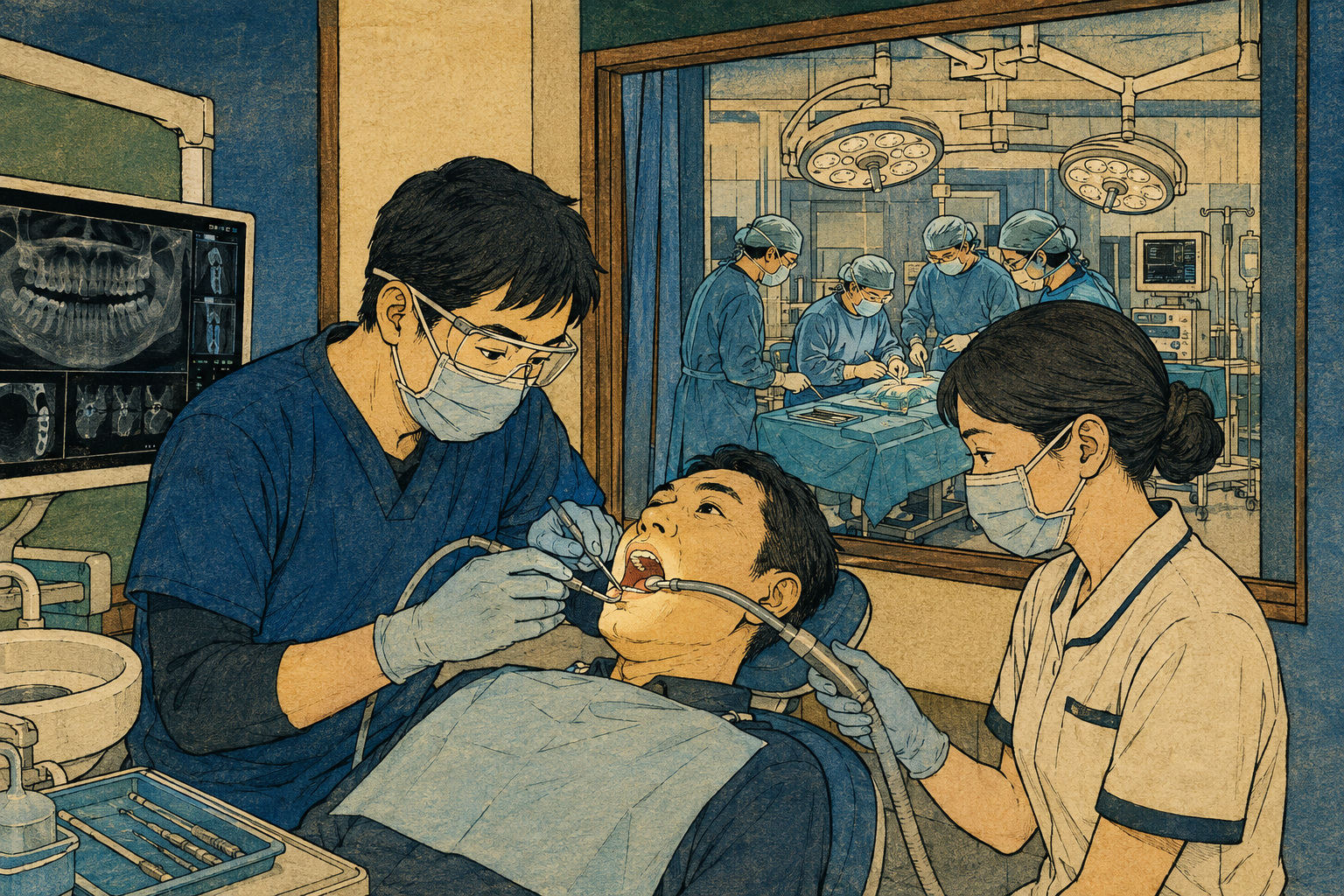
A hospital can sterilize an instrument, filter operating-room air and time an antibiotic to the minute. It cannot make the human mouth sterile. Nor should it try. The practical question is narrower: can treating obvious dental infection, removing accumulated plaque and helping a patient manage oral hygiene before anesthesia lower the chance that microbes carried in oral and pharyngeal secretions contribute to pneumonia after surgery?
Tokushima University Hospital has a long real-world experiment with that question. The hospital began professional perioperative oral care in 2012 and progressively extended it to more surgical departments and patients. Its Oral Management Center has now reviewed approximately 60,000 operations under general anesthesia from 2009 through 2024. According to an August 25 university release, pneumonia incidence trended downward as oral-care coverage rose. When the team examined timing, preoperative care—not simply care at any point around the operation—was associated with lower postoperative pneumonia.
Keiko Aota, director of the hospital’s Oral Management Center and an associate professor who also holds the title of hospital professor, presented the work as a poster in Matsumoto on May 16–17. Its Japanese title translates as “Impact of expanding perioperative oral-function management on pneumonia after general anesthesia: an examination of longitudinal change and comparisons by clinical department.” The venue was the 23rd annual meeting of the Japanese Society of Oral Care, held with the sixth annual meeting of the International Society of Oral Care.
A large cohort with a missing effect size
Sixty thousand operations give the investigators reach. They can examine relatively uncommon events, compare departments and watch an institution change over time. The three years before the 2012 program began provide a valuable baseline. Few randomized trials could reproduce 16 years of hospital-wide implementation.
Size does not repair information that has not been published. The release gives no exact denominator and no number receiving preoperative care. It does not state how pneumonia was diagnosed, how long after surgery cases were counted, or whether the outcome came from clinical adjudication, medical records or billing codes. There are no annual coverage rates, event counts, unadjusted rates, odds ratios, risk ratios, risk differences or 95% confidence intervals.
Most importantly, the announcement does not list the variables in the factor analysis. Age, smoking, chronic lung disease, neurologic disease, nutritional status, emergency surgery, operation site and duration, ventilation, and postoperative swallowing difficulty can all influence pneumonia risk. Without the model, a reader cannot tell what “associated” means after case-mix differences are considered.
The distinction between relative and absolute benefit is not pedantic. Cutting a 10% event rate to 5% prevents five cases per 100 patients. Cutting 0.2% to 0.1% prevents one per 1,000. Both are a 50% relative reduction. Only the absolute figures allow a number needed to treat, a staffing model or a credible cost-effectiveness estimate.
“Sixty thousand” describes the database. “How many out of how many” describes the finding.
Oral management is more than an instruction to brush
The Japanese clinical term is shūjutsuki-tō kōkū kinō kanri—perioperative and related oral-function management. Tokushima’s official description begins when a disease is diagnosed and extends through admission, treatment, discharge and, where needed, referral back to a community dentist.
Before general anesthesia, chemotherapy or head-and-neck radiotherapy, dentists and dental hygienists inspect the mouth for sources of infection and improve oral hygiene. Patients may be referred for caries treatment or denture adjustment. The hospital also considers mouth protectors for some anesthesia patients to reduce dental injury during intubation. This is risk assessment, professional cleaning, treatment planning and continuity—not a standardized mouthwash handed to everyone.
The proposed respiratory pathway is biologically credible. Oral and pharyngeal secretions can be aspirated. Intubation passes through the mouth. Pain, sedation, immobility, dry mouth and impaired swallowing or cough can make airway clearance harder after surgery. Lowering the microbial burden and identifying unstable teeth or infection before those stresses arise could reduce risk.
But the new Tokushima analysis, as released, does not prove that sequence. It reports no oral-hygiene score, bacterial measurement or swallowing data that would demonstrate mediation. Patients seen early by a dental team may also be the ones with planned rather than emergency surgery, better organized care pathways or different baseline health. The mechanism explains why the result makes sense; it does not substitute for the missing analysis.
- assessment of oral hygiene, infection, loose teeth, mucosa, dentures and oral function;
- professional plaque removal and individualized self-care instruction;
- coordination of necessary dental treatment or denture adjustment;
- planning to protect teeth during intubation; and
- postoperative maintenance and handoff to a community dentist.
The actual plan depends on the operation, medical condition and time available. It is not a patient-directed reason to stop medication or arrange an extraction independently.
Japan built dentistry into the surgical payment system
The institutional story starts in 2012. In that year’s national fee revision, the Ministry of Health, Labour and Welfare identified dental participation in team medicine as a priority and explicitly linked medical–dental cooperation to reducing postoperative complications such as aspiration pneumonia. New fees recognized planning and delivery of perioperative oral-function management.
Tokushima’s program began the same year. A 2014 fee revision recognized coordination between surgical and dental institutions, created a surgical add-on for patients who had qualifying oral management and raised the fees for preoperative management. Successive revisions broadened eligible circumstances; by 2026 the official Japanese term includes tō, “and related,” reflecting management around surgery as well as specified chemotherapy and radiotherapy.
Policy mattered because it changed the identity of the service. Dentistry was no longer merely an optional clearance task performed if a surgeon remembered to request it. It became a named, plan-based component of reimbursed multidisciplinary care. Tokushima studied its early operation in a project approved by the hospital’s clinical research ethics committee in December 2014; Aota and colleagues published a report on the program’s status and challenges in 2015.
The program remains unfinished. Tokushima’s current quality indicators say perioperative oral management among patients undergoing surgery for the five major cancers has generally been around 60%. The hospital itself identifies broader coverage as a challenge. That figure uses a billing-based numerator and a defined cancer-surgery denominator; it is not the coverage rate for all 60,000 operations in the new analysis.
2009 The new Tokushima analysis begins its observation period.
2012 Japan adds perioperative oral-function management to the fee schedule; Tokushima starts its program.
2014–15 Tokushima formally studies and publishes on early implementation.
2017 A seven-university esophageal-cancer study reports an association with lower pneumonia.
2018 A Japanese claims study analyzes 509,179 major cancer operations.
May 2026 Aota presents the 16-year Tokushima analysis as a poster.
Aug. 25, 2026 Tokushima University issues its public research announcement.
The evidence is supportive, but not interchangeable
Tokushima’s signal fits a body of Japanese and international evidence. A 2017 retrospective study included 539 esophageal-cancer patients at seven Japanese university hospitals. Pneumonia occurred in 103 patients, or 19.1%. Among 420 propensity-score-matched patients, longer surgery, postoperative dysphagia and the absence of oral-care intervention were significantly related to pneumonia.
A much larger 2018 study used Japan’s nationwide administrative database. It identified 509,179 patients who had major resections for head-and-neck, esophageal, gastric, colorectal, lung or liver cancer from May 2012 through December 2015. Only 81,632, or 16.0%, received preoperative care from a dentist. After inverse-probability weighting, pneumonia was 3.28% with dental care and 3.76% without it: an adjusted absolute difference of 0.48 percentage points, with a 95% confidence interval of 0.32 to 0.64 points lower. Thirty-day all-cause mortality was 0.30% versus 0.42%.
That national analysis supplies the kind of absolute estimate missing from Tokushima’s release. It cannot supply Tokushima’s estimate. It covers selected cancer resections, a different period, many hospitals and claims-defined exposures and outcomes. Unmeasured smoking, functional status and the exact content of oral care remained possible sources of bias.
A 2025 systematic review of thoracic surgery combined 25 studies—nine randomized trials and 16 observational studies—with 52,227 patients. Pneumonia occurred in 11.6% of oral-care patients and 12.6% of controls; the pooled risk ratio was 0.54. Heterogeneity was substantial at I²=72%, meaning the estimated effects varied beyond chance across procedures, intervention types and study designs.
| Evidence | Population | Reported result | Primary caution |
|---|---|---|---|
| Tokushima, released 2026 | About 60,000 general-anesthesia operations, 2009–24 | Expansion tracked falling pneumonia; preoperative timing associated with lower incidence | No absolute rates, effect estimate or full model yet |
| Seven universities, 2017 | 539 esophageal-cancer operations; 420 matched | No oral care associated with pneumonia | Retrospective and limited to a high-risk procedure |
| National cancer claims, 2018 | 509,179 major cancer operations | Adjusted 3.28% vs. 3.76%; difference −0.48 points | Administrative data and residual confounding |
| Thoracic meta-analysis, 2025 | 25 studies, 52,227 patients | Pooled RR 0.54; I²=72% | High heterogeneity; not all-surgery evidence |
Taken together, the literature makes oral care a serious preventive candidate, especially for thoracic and upper gastrointestinal surgery. It does not justify copying the largest relative effect into every operating list. A small absolute benefit may still be worthwhile if the intervention is safe and inexpensive; a resource-intensive program may need to prioritize patients at higher baseline risk. Department-specific Tokushima results could help answer that operational question if the full data are released.
Sixteen years contain more than one intervention
A time trend can be persuasive and treacherous. Between 2009 and 2024, surgery became more minimally invasive; anesthesia, antibiotic stewardship, early mobilization, respiratory rehabilitation, nutrition and swallowing assessment changed; and the patient mix may have shifted. Diagnostic coding and pneumonia surveillance can change measured incidence even when biology does not. The COVID-19 era introduced another major break in infection-control practice and surgical selection.
Referral is also selective. Departments that adopted dental management early may have stronger standardized pathways generally. Emergency patients have less time for dental intervention and may carry higher pulmonary risk. Conversely, a hospital may refer the sickest patients preferentially, which could make the oral-care group look worse. Statistical adjustment can reduce these biases only for variables that were measured accurately and placed in the model.
A complete paper should report exact inclusion and exclusion criteria; urgent versus elective status; age and comorbidities; smoking; nutritional and functional status; operation type and duration; ventilation; postoperative dysphagia; department and calendar year; missing-data methods; pneumonia definition; sensitivity analyses; and funding and conflicts of interest. Because the poster title promises department-specific comparisons, denominators and absolute event rates by department are essential.
Interrupted time-series methods could test whether the slope or level of pneumonia changed when the program expanded, rather than simply noting that one line rose while another fell. Patient-level exposure models should complement the hospital-level trend. Neither approach makes the design randomized, but together they would make the causal argument more credible.
Standard care starts with the booking workflow
Tokushima says it wants preoperative oral care to become a routine part of care. That cannot depend on every patient remembering to make a dental appointment. The pathway begins when surgery is planned: an automatic referral or screening trigger, risk-based triage, a deadline that leaves time for useful intervention, and a shared record connecting surgeon, anesthesiologist, dentist, hygienist and nurse.
Hospitals without an in-house dental service need a regional protocol: who accepts urgent referrals, which medical details travel with the patient, who decides whether a proposed dental procedure is compatible with the operation date, and how anticoagulants or antiresorptive drugs are handled. The answer is coordination, not unilateral cessation of medication.
Coverage alone is an inadequate performance measure. A program should report time from surgical decision to oral assessment; the proportion completed early enough to act; pneumonia per 1,000 operations by risk and department; dental adverse events; surgical delays; length of stay; readmission; patient cost; and successful handoff after discharge. A high billing rate achieved through cursory visits the day before surgery would satisfy a numerator without delivering the intended preventive pathway.
- Ask the surgical or anesthesia team early whether a preoperative dental assessment is indicated.
- Report loose or painful teeth, swelling, ulcers, dentures and swallowing difficulty.
- Give the dental team a complete medication list, including blood thinners and drugs affecting bone.
- Do not stop medication, arrange an extraction or delay urgent surgery on your own.
- Follow the hospital’s individual fasting, drinking, brushing and mouth-rinsing instructions.
These are general questions, not personal medical advice. The urgency and content of care must be decided by the treating teams.
From a plausible practice to a measurable standard
Tokushima’s work matters because it treats oral health as infrastructure for surgery. It asks whether an inexpensive, human-intensive service delivered before the operation can prevent a complication that prolongs recovery and can become life-threatening. Sixteen years of real practice provide a view that short trials rarely can.
The announcement should now be followed by the data that make the result usable. Patients need absolute risk in people like them. Clinicians need to know which procedures and which timing generated the benefit. Administrators need workload, cost and safety. Researchers need the model and its assumptions.
The mouth is not outside the surgical field merely because the incision is elsewhere. Tokushima has produced a strong reason to connect dentistry to the operating pathway earlier. It has not yet produced the complete numerical case. Publishing that case—clearly, by department and in absolute terms—is the next step from an encouraging association to a dependable standard.
- Tokushima University — research announcement on preoperative oral care and postoperative pneumonia (Aug. 25, 2026)
- Tokushima University — full one-page research release (PDF)
- Tokushima University Department of Oral Medicine — May 2026 conference record
- Tokushima University researcher directory — Keiko Aota’s official name reading and title
- Tokushima University Hospital — Oral Management Center services and staff
- Tokushima University Hospital — perioperative oral-management quality indicators
- Ministry of Health, Labour and Welfare — outline of the fiscal 2012 medical fee revision (PDF, Japanese)
- Ministry of Health, Labour and Welfare — fiscal 2014 dental fee revision (PDF, Japanese)
- Aota et al. — early status and challenges of perioperative oral-function management at Tokushima University Hospital (2015, Japanese)
- Soutome et al. — seven-university esophageal-cancer study (2017)
- Ishimaru et al. — 509,179 major cancer operations in Japan (2018)
- Duan et al. — systematic review and meta-analysis of thoracic surgery (2025)
Editorial note: Japan.co.jp uses “associated,” matching the university’s underlying wording, and does not treat the release’s causal headline as proof of causation. The public materials reviewed on Aug. 25, 2026, do not report the exact cohort size, exposed and unexposed counts, pneumonia definition, absolute event rates, effect estimate, confidence interval, covariate set, missing-data method, funding or conflicts of interest. No full peer-reviewed article was located. Keiko Aota’s reading and titles were checked against official Tokushima University records. Historical Japanese terminology is preserved: the program entered the fee schedule as shūjutsuki kōkū kinō kanri in 2012; the current term is shūjutsuki-tō kōkū kinō kanri. Results from other populations are presented as context, not substituted for Tokushima’s unpublished effect. The illustration is editorial and not documentary. The exchange-rate timestamp supplied as Aug. 25, 7:48 p.m. UTC was converted to Aug. 26, 4:48 a.m. JST.