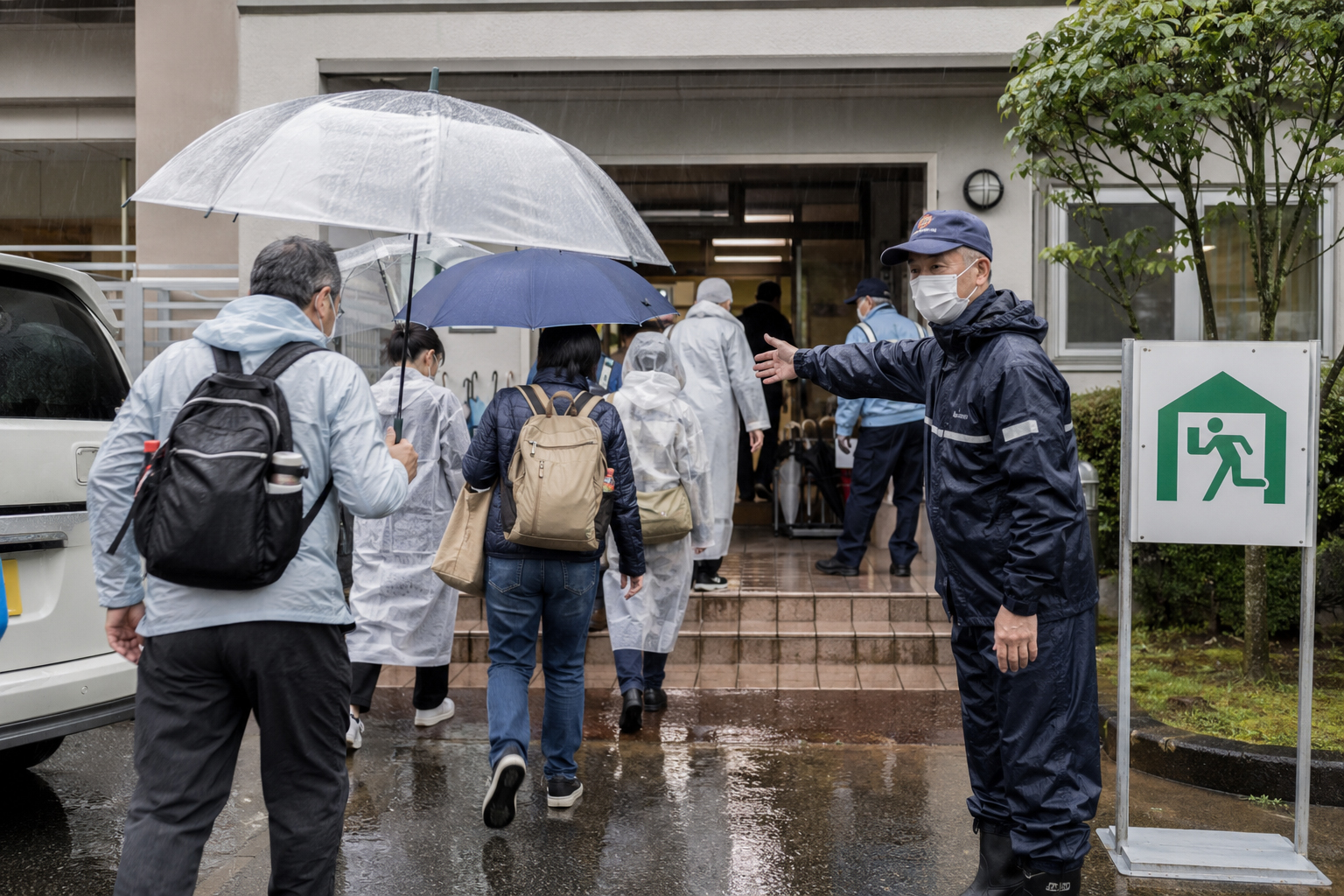
Evacuation warnings are not meant to scare people. They are meant to give people enough time.
The most important phrase in Japan’s evacuation system is not simply “early.” It is “where you are.” Heavy rain does not put every person in the same danger. A family beside a river, a hotel guest in a low coastal district, an older person below a steep slope, a commuter about to enter an underpass, and a tourist who does not know the local geography all face different risks. Japan’s alert levels are designed to translate complicated weather and disaster information into a question everyone can act on: what should I do now?
For the June 26 disaster-safety issue, the most useful message is clear. Alert Level 4 is not a time to keep watching the news and waiting. It is the stage when people in dangerous areas should evacuate. Alert Level 5 is not the best time to begin evacuation. It means a disaster may already be occurring or is about to occur, and ordinary movement may already be unsafe.
What Alert Level 4 means
Alert Level 4 corresponds to an Evacuation Instruction issued by a local municipality. The target is not every person in the country or even every person in the municipality. The target is people in dangerous places: flood-prone areas, landslide zones, storm-surge areas, river basins, lowlands, coastal districts, or neighborhoods listed in local hazard maps.
Evacuation does not always mean going to a public shelter. It means getting out of danger. That may mean going to a designated shelter, a safer relative’s home, a hotel on higher ground, an upper floor of a sturdy building, or a room away from a cliff or river. If roads are already flooded, if it is dark, if winds are severe, or if crossing a bridge would be dangerous, staying indoors and moving to the safest available place may be the better option.
Why Level 5 is too late to wait for
Alert Level 5 corresponds to Emergency Safety Measures. The phrase sounds strong, but that is exactly the point: it is not a normal evacuation stage. It is issued when a disaster is already occurring or imminent. Local authorities may not always be able to issue Level 5 before damage happens. Communications can fail. Flooding can move faster than reports. Landslides can occur suddenly. Night conditions can prevent officials from confirming what is happening.
That is why Japan’s system emphasizes evacuation by Level 4. With heavy rain, landslides, river flooding, and storm surge, the final minutes can change quickly. A small river becomes a dangerous current. A road dip becomes a pool. An underpass fills with water. A hillside begins to release water and mud. A car that seemed safe becomes trapped. Waiting for absolute certainty is often how people lose the time they needed.
The five levels in plain language
| Alert level | Meaning | What to do |
|---|---|---|
| Level 1 | Pay attention to future weather | Start watching forecasts, storm tracks, rain, and local government information. |
| Level 2 | Confirm evacuation actions | Check hazard maps, shelters, routes, family contacts, and supplies. |
| Level 3 | Evacuation of the Elderly, Etc. | Older adults, people with disabilities, infants and caregivers, and anyone needing extra time should begin evacuation. Others should prepare. |
| Level 4 | Evacuation Instruction | Everyone in dangerous areas should evacuate. If going outside is more dangerous, secure safety indoors. |
| Level 5 | Emergency Safety Measures | A disaster may already be occurring or imminent. Take the best possible action to protect your life where you are. |
A public shelter is not the only form of evacuation
Many people imagine evacuation as going to a school gymnasium or community center. Those places matter, but they are not the only answer. Evacuation means moving away from danger. For a flood risk, moving to a higher floor may save a life. For landslide risk, moving away from the slope side of a building may matter. For storm surge or tsunami risk, moving to higher ground or a tsunami evacuation building can be essential.
For travelers, the first safe move may be asking the hotel front desk which floor, exit, shelter, or local government page to use. For foreign residents, the best move is to learn the municipality name, download Safety tips, check NHK WORLD-JAPAN and JMA, and know whether the home, school, or workplace is near a river, coast, slope, or lowland.
Dangerous movement versus safe movement
One of the most dangerous habits in heavy rain is “just going to check.” Checking the river. Checking a boat. Checking a field. Checking a parked car. Checking a shop. Checking an underground garage. These actions feel responsible, but they can become deadly. In darkness or muddy water, the edge of a road, ditch, or canal may disappear. A manhole cover may be gone. A road may be undermined. A vehicle may stall in water that looked shallow.
Evacuation is safe because it happens before the most dangerous moment. Once rain is intense, roads are flooded, rivers are rising, or winds are strong, evacuation itself becomes risky. That is why the sequence matters: prepare at Level 3, act at Level 4, do not wait for Level 5.
- Do not go to rivers, canals, coasts, ports, cliffs, valleys, or drainage channels to “check.”
- Do not go out to secure boats, cars, fields, shops, or equipment once warnings are active.
- Do not enter flooded roads, underpasses, underground parking areas, or underground malls.
- Do not stay in a Level 4 target area because “it was fine last time.”
- Do not wait for Level 5 before deciding to protect yourself.
For tourists and foreign residents
Japan’s warning language can be difficult even for Japanese speakers. Municipality names, district names, river names, alert levels, shelter names, and hazard categories can arrive at the same time. Some local information may appear first in Japanese. That is why preparation matters before a storm or heavy rain event begins.
Download Safety tips. Learn the name of the city, ward, town, or village where you are staying. Ask your hotel where the nearest evacuation place is. Check whether you are near a river, sea, slope, or underground route. National news gives the big picture, but local governments issue evacuation instructions and shelter information. JMA tells you about weather, rain, landslide, flood, storm surge, earthquake, and tsunami risk. Municipalities tell you what to do in your specific place.
What families, schools, and companies should decide before Level 4
Level 4 is too late to begin a family meeting. Decide in advance who calls older relatives, who picks up children, whether school pickup is safer or school sheltering is safer, whether evacuation is by car or on foot, where medicine is kept, where flashlights are, and what to do with pets. These choices are simple in daylight and difficult during wind, rain, noise, and fear.
Companies should also plan by level. When heavy rain may stop trains, sending people home late can create danger. Stores, factories, offices, and construction sites should decide when to close, how to secure vehicles and equipment early, who monitors municipal alerts, and when staff should stop traveling. A good disaster plan prevents everyone from standing in the same room asking, “What do we do now?”
Japan’s alert system changed because past disasters taught hard lessons
Japan has revised evacuation information repeatedly after major rain, flood, landslide, and typhoon disasters. Officials and communities saw the same problem again and again: evacuation language was too complicated, people did not understand the difference between advisories and orders, and many waited until it felt obviously dangerous. By then, it was sometimes too late.
The five-level framework was designed to make action easier. Later revisions abolished the separate “evacuation advisory” category and unified Level 4 around Evacuation Instruction. The purpose was not to create more official wording. The purpose was to make the decision clearer: at Level 4, people in hazardous areas should evacuate.
The final rule: Level 4 is the deadline for action
You do not need to memorize every Japanese warning term. Remember this: Level 3 means people who need more time should move. Level 4 means people in dangerous places should evacuate. Level 5 means do not wait; protect your life with whatever option remains.
Disasters do not begin when an alert appears on a phone. The rain has already been falling. The ground may already be saturated. The river may already be rising. The sea may already be rough. The warning is not a prediction game. It is a tool to help people act while action is still possible.
When you think “it is probably still okay,” check the map. Call family. Put on shoes. Charge the phone. Confirm the route. If Level 4 applies to your area, leave danger. Living with disasters in Japan does not mean living in fear. It means knowing when to act.
- Level 3: people who need more time should begin evacuation.
- Level 4: everyone in dangerous areas should evacuate.
- Level 5: a disaster may already be happening. Do not wait for it.
- Evacuation means moving away from danger, not only going to a public shelter.
- Stay away from rivers, ports, cliffs, flooded roads, underpasses, and underground spaces.
Sources and references
This article is based on public information from the Cabinet Office, Japan Tourism Agency / JNTO Safety tips, the Japan Meteorological Agency, Tokyo disaster-prevention information, and local government evacuation guidance.