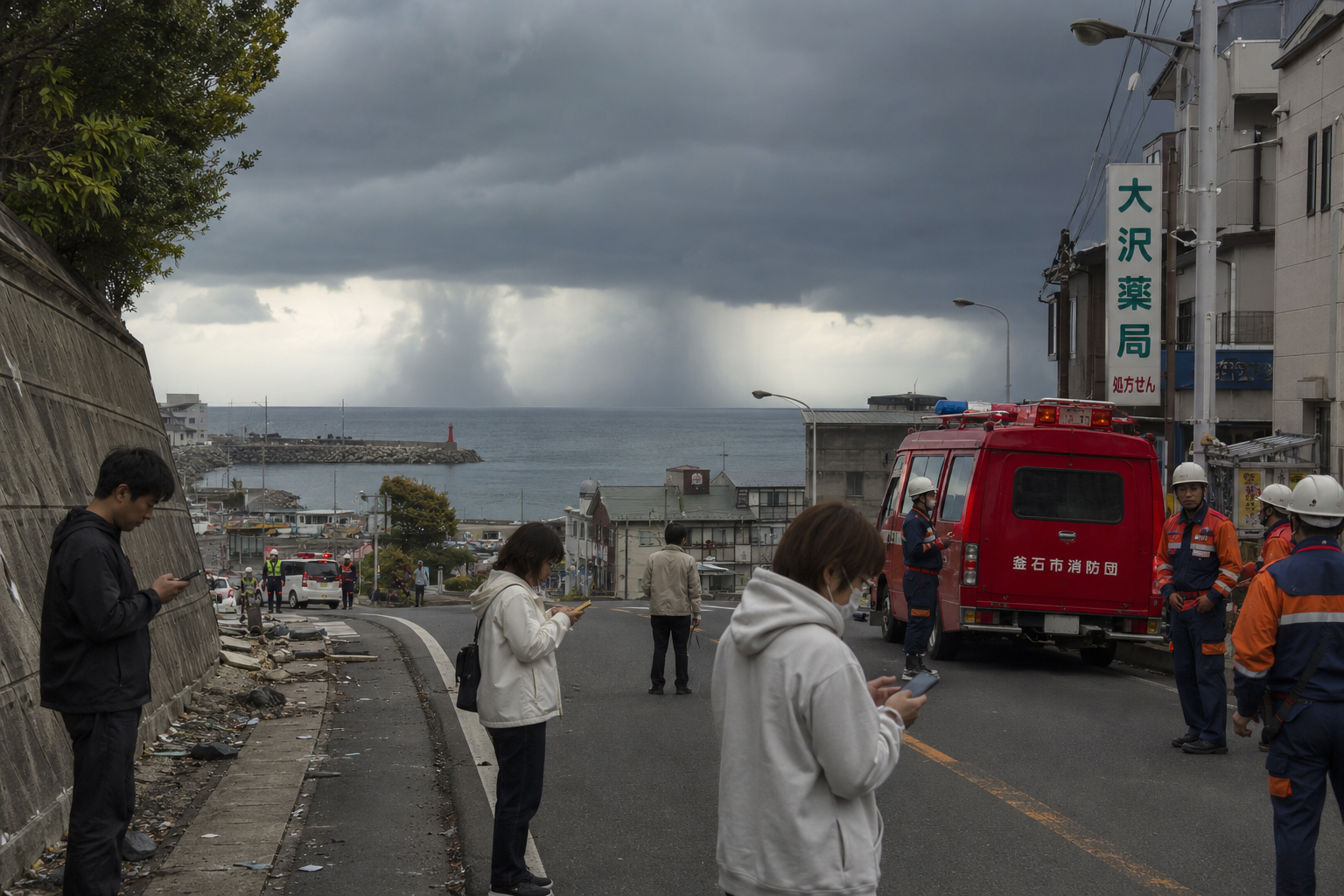
Japan woke on Thursday, June 25, to two different kinds of hazard: the sudden violence of the earth and the slower, forecastable threat of tropical weather. At about 7:30 a.m. Japan time, a powerful earthquake struck off Iwate Prefecture. Within hours, attention also turned south, where Typhoon Mekkhala and a second system, Higos, were adding wind, wave, and heavy-rain risk to the national disaster picture.
The earthquake: what happened first
The initial facts were clear enough to carry the morning’s lead. The Japan Meteorological Agency reported a preliminary magnitude of 6.9 for a quake off the eastern coast of Iwate, at a depth of roughly 50 kilometers. The Associated Press reported that the U.S. Geological Survey also placed the event at magnitude 6.9, and that no tsunami warning was issued. Weathernews Japan reported the same core values: Iwate offshore, M6.9, about 50 kilometers deep, with a maximum observed seismic intensity of Shindo 6+ in Aomori.
The tsunami language matters. A strong offshore earthquake understandably raises fear along the Sanriku coast, where memory of 2011 remains part of daily geography. But this event was not reported as a damaging-tsunami event. Weathernews said slight sea-level changes could occur along Japan’s coast, but there was no concern for damage. AP similarly reported that Japan’s meteorological agency said there was no tsunami danger.
That does not mean “nothing happened.” Shindo 6+ is violent shaking. It is strong enough to knock people off balance, topple unsecured furniture, break dishes and glass, damage weak walls, and turn ordinary objects into hazards. Even where buildings remain standing and life resumes quickly, a Shindo 6+ morning is a serious public-safety event.
Where shaking was felt
The strongest reported shaking was in Aomori, with strong motion also reported across Iwate and parts of Miyagi and the broader Tohoku region. AP noted that the quake lightly shook Tokyo and that East Japan Railway suspended some bullet-train and local-line services in northeastern Japan for safety checks. Those pauses can frustrate commuters, but they are exactly what a safety culture is designed to do: stop, inspect, and restart only when tracks, power, bridges, and signaling systems are confirmed safe.
Early reports also said there were no immediate reports of injuries or major damage. That sentence should always be read carefully. It does not mean there were no cracked walls, broken household items, frightened children, or later-discovered structural problems. It means that, in the first wave of official and media reporting, no major casualty or damage pattern had been confirmed.
What officials were watching next
The most important follow-up was not just aftershocks. TBS News DIG reported that the Japan Meteorological Agency began evaluating whether the earthquake met criteria for a Hokkaido–Sanriku offshore subsequent-earthquake advisory. This is a preparedness framework, not a prediction. It does not tell residents that a larger earthquake will happen. It tells them that, after a significant offshore event in a known hazard zone, government agencies are checking whether a heightened-readiness message is warranted.
Why Sanriku history changes the tone
Japan has many seismic regions, but Sanriku has a particular emotional and scientific weight. The Pacific plate subducts beneath northeastern Japan along the Japan Trench. That process has produced repeated offshore earthquakes, some destructive because of shaking, some catastrophic because of tsunami. The 1896 Meiji Sanriku tsunami, the 1933 Showa Sanriku tsunami, and the 2011 Great East Japan Earthquake are not just history-book entries. They shape seawalls, evacuation stairs, school drills, and the way local communities read a phone alert.
That is why the absence of a damaging tsunami in this event is reassuring but not a reason to ignore the sea. In Tohoku, preparedness culture often means moving early when official information says to move, even if the first visible wave is not dramatic. The lesson of the coast is that minutes matter, and clarity beats bravado.
The second layer: tropical weather from the south
While northeastern Japan was checking damage and aftershock information, the weather map remained active. Typhoon Mekkhala, the seventh typhoon of the season, had strengthened over the western Pacific and was forecast to approach Okinawa and Amami between Thursday and Friday before influencing western and eastern Japan around Saturday. Jiji Press, via Nippon.com, reported that Mekkhala had been a very powerful typhoon, with the agency warning of violent winds, high waves, and heavy rain.
The second system, Higos, added complexity. Hazard-monitoring reports described Higos as a tropical depression or tropical storm south of Japan, with forecasts discussing interaction or merger with Mekkhala south of Honshu around June 26. The practical public-safety message is simpler than the meteorology: two systems can expand the rain shield, roughen seas, complicate shipping and aviation, and raise landslide and river risks even if neither produces a classic direct-hit typhoon landfall.
Why weakening storms can still hurt people
People often hear “weakening” and relax. That can be a mistake. As tropical cyclones move north toward Japan, they can lose their tight tropical structure while still feeding moisture into fronts and mountain terrain. The Guardian’s weather tracker noted that a weakening Mekkhala near southern Japan could still bring strong winds and high seas, and that rainfall already in place could intensify if it interacted with the system’s remnants.
In Japan, rain is often the killer. Water rises in small rivers. Slopes that looked stable in the morning can fail by evening. Underpasses flood. Coastal rocks become deadly under swell. A storm does not need to keep a perfect eye on satellite imagery to be dangerous on the ground.
What residents should do now
For earthquake areas: check for gas smell, broken glass, damaged water pipes, shifted appliances, cracked walls, and unstable block walls. Do not re-enter a damaged building just because the shaking stopped.
For coastal areas: even when no damaging tsunami is expected, stay away from breakwaters and low waterfront areas if authorities warn of sea-level changes or rough weather.
For storm areas: move cars away from flood-prone underpasses, avoid rivers and drainage canals, prepare for power interruption, and evacuate early if your municipality issues an instruction.
A useful way to read this morning
The correct headline is not that Japan is helpless before nature. It is that Japan lives with layered risks and has built a layered response: alerts, shindo maps, tsunami evaluation, train inspections, school decisions, nuclear-facility checks, typhoon tracks, evacuation levels, municipal shelters, and neighborhood memory.
That system works best when the public treats warnings as instructions rather than background noise. A smartphone alert is not merely information. It is a prompt to act: drop, cover, check, charge, listen, and decide early.
What Japan.co.jp will watch next
Disaster readiness is not dramatic. It is practical. It is shoes by the bed, a charged battery, a family message plan, furniture that will not fall, and the humility to leave early when local officials say the hillside, river, or coast is no longer safe.
Japan had an earthquake morning. It also had a storm-warning morning. The wise response is calm attention.
Sources and references
This article draws on public reporting and agency-linked information from Associated Press, Weathernews Japan, TBS News DIG, Nippon.com / Jiji Press, The Watchers, and The Guardian weather tracker. Disaster information changes quickly; residents should follow the latest instructions from JMA, local governments, NHK, and emergency officials.