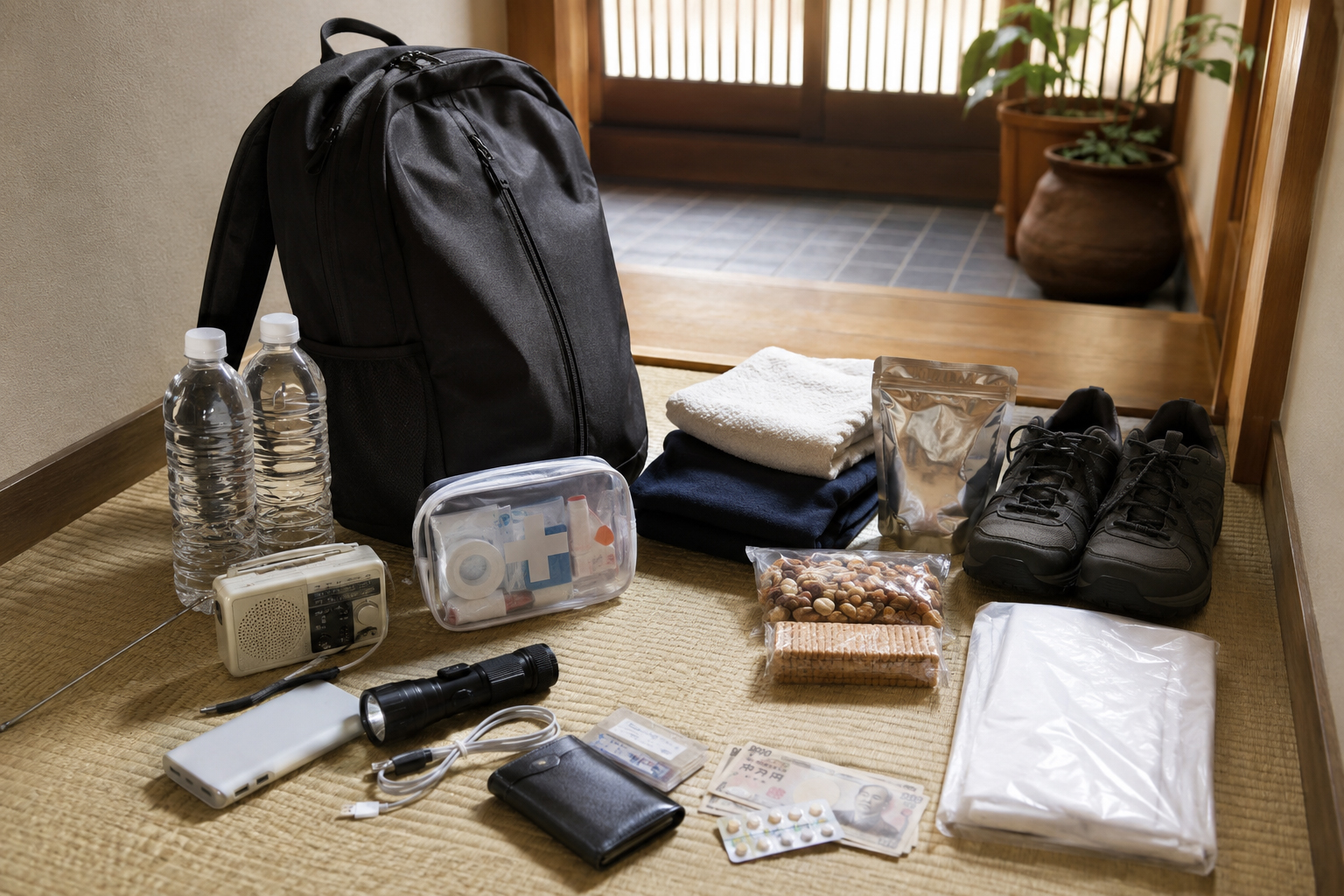
A good kit protects ordinary life
Emergency preparedness can sound bigger than it really is. People imagine military-looking backpacks, survival knives, expensive gadgets and food sealed for decades. Some specialized equipment can help, but most real disaster readiness in Japan is much more ordinary. Water. Shoes. Medication. Glasses. Phone charging. A flashlight. A towel. Rain gear. A paper list of phone numbers.
The offshore Iwate earthquake and the same-week storm risk in June 2026 are reminders of how Japanese disasters often feel in real life. They do not always arrive as cinematic destruction. They arrive as a strong morning shake, a television map, a rain warning, trains stopped, an elevator out of service, phone networks congested, a hotel lobby full of travelers, or a dark apartment where someone needs medication. The point of a 24-hour kit is not to make anyone a hero. It is to help people take the next safe step.
Separate the go-bag from the home stockpile
The first rule is simple: a go-bag and a home stockpile are not the same thing. A home stockpile is what helps you remain at home for several days if water, electricity, gas, transport or stores are disrupted. Tokyo disaster materials describe the idea of “daily stockpiles”: buying a little extra of the food and supplies you already use, consuming the older items first, and replacing them as part of normal life.
A go-bag is different. It is what you take if you must leave quickly: an evacuation center, a safer relative’s home, a hotel upper floor, a different neighborhood, or simply outside after a damaging earthquake. It should not be everything you own. If it is too heavy, it fails. The question is not “what could be useful someday?” The question is “what do I need to move, see, communicate, take medicine, stay dry, prove identity and get through one night?”
The first 24 hours: what belongs in the bag
| Category | What to pack | Why it matters |
|---|---|---|
| Water and food | Water, nutrition bars, canned food, retort pouch food, chocolate, candy | Stores may close, trains may stop, and shelters may take time to organize supplies. |
| Movement | Sturdy shoes, rain gear, towel, work gloves | Earthquakes break glass; storms soak clothing; floods leave mud and debris. |
| Light and information | Flashlight, portable radio, spare batteries, whistle | Power can fail; radio may work when phones are congested; a whistle can signal location. |
| Power | Battery bank, charging cable, adapters if needed | A phone is a map, alert receiver, translator, camera, wallet backup and contact tool. |
| Health | Medication, medication record, glasses, contacts, masks, small first-aid kit | Exact medicine or vision aids may not be available quickly after a disaster. |
| Money and documents | Cash, coins, ID copies, insurance information, passport details, emergency contacts | Electronic payments can fail when power or communications are disrupted. |
| Family needs | Paper contact list, meeting place, family photo, pet and baby supplies | A kit must fit the real household, not a generic checklist. |
Water: carry some, store more
Water is essential, but it is also heavy. The goal is not to put an entire household stockpile into a backpack. Carry enough for movement and immediate need. Keep more at home. Tokyo’s multilingual guidance lists drinking water at 3 liters per person per day and also recommends water for general use, such as stored water in bottles or a bathtub. That distinction matters: drinking water in the bag, larger supplies at home.
Storms add another lesson. The dangerous moment to buy water is often after the rain becomes heavy. A weakening typhoon can still flood roads, close stores, stop trains and make walking unsafe. A small daily habit—keeping extra bottled water or rotating pantry supplies—beats a last-minute run to a convenience store during a warning.
Shoes are disaster equipment
In many earthquakes, the first lifesaving tool is not food. It is footwear. Dishes fall. Windows crack. ceiling fixtures break. Small fragments cover floors. Bare feet or thin slippers can turn a survivable emergency into an injury. Keep sturdy shoes or hard-soled slippers near the bed, along with a flashlight.
This is one of the most practical ideas in Japanese preparedness guidance. Tokyo’s multilingual disaster page tells residents to keep an emergency backpack nearby and keep slippers or shoes close so they can flee quickly. The placement matters as much as the item. A perfect flashlight in a closet across a dark room is less useful than a modest one at your bedside.
Medication, glasses and contacts are not optional
Generic lists often understate personal medical needs. For many people, the most important emergency item is a medication, inhaler, insulin, blood-pressure drug, allergy medicine, prescription record, glasses, contact lenses, hearing-aid batteries, denture supplies, baby formula, or pet medicine. These are the things a shelter may not immediately provide.
For residents, keep a small reserve if possible and include a copy of the medication record. For travelers, carry medicine in the day bag, not only in checked luggage or a hotel suitcase. Write down the generic name of important medications, allergies and emergency contacts. A bilingual note can make medical care faster if stress, language or phone battery problems make speaking difficult.
Cash and paper still work when systems fail
Japan is increasingly cashless, but disasters are rude to payment systems. Power failures, internet outages and overloaded networks can make cards and smartphone payments unreliable. A small amount of cash and coins can still buy food, pay for a taxi if available, use some lockers or phones, or solve small problems when digital systems are down.
Paper information has the same old-fashioned strength. Write down family numbers, hotel address, embassy or consulate contact, insurance policy information, medical notes and the phone number chosen for 171/Web171 safety messages. Put one copy in the bag and one in a wallet. When a phone is wet, dead or broken, paper can still be handed to a shelter worker, police officer, hotel clerk or doctor.
Baby, pet and elder needs make every kit different
There is no single perfect kit because there is no single perfect household. A family with an infant needs formula, baby food, diapers, wipes, a bottle, spare clothes and maternal-health information. An older adult may need medication, dentures, hearing-aid batteries, soft food, a cane, compression items or care supplies. A pet owner needs food, water, leash, carrier, waste bags, medication, vaccination information and a photo.
This is where the “survivalist fantasy” fails. Real readiness is not about looking rugged. It is about knowing the person, child, animal or elder you are responsible for. A kit for a healthy single adult in Tokyo will not look like a kit for a coastal family with a toddler, a grandmother and a dog in Iwate.
- Water and easy food: bottle water, bars, retort food, candy or chocolate.
- Light and information: flashlight, portable radio, spare batteries, whistle.
- Power: battery bank, charging cable, adapter if needed.
- Movement: sturdy shoes, rain gear, towel, gloves, mask.
- Health: medication, medication record, glasses, contacts, first-aid items.
- Money and ID: cash, coins, ID copy, insurance information, passport details.
- Contacts: paper list of family numbers, meeting place, hotel address, 171/Web171 key number.
- Personal needs: baby supplies, pet supplies, elder-care items, disability-related equipment.
Travelers need a smaller version
Visitors to Japan do not need to carry a large emergency backpack through every museum and train station. A small “one-night pouch” is more realistic: water, snack, battery bank, cable, essential medicine, passport copy, hotel card, cash, rain shell, and the Safety tips app. That is enough to make a train shutdown, hotel evacuation, earthquake alert, or sudden rain warning easier to handle.
The most important traveler habit is knowing where you are. Japanese warnings are local. Keep a screenshot or paper card with the hotel name, address, phone number and municipality. Share your itinerary with someone overseas. Tell family that repeated calls can worsen congestion and agree on message apps, 171/Web171, or a single check-in method before a disaster happens.
Choose inspection days
A kit is not finished when it is packed. It is finished when it is easy to maintain. Check expiration dates, batteries, charging cables, seasonal clothes, medication, children’s sizes, pet food, contact lists and cash twice a year. Good days are March 11, Disaster Prevention Day, the start of typhoon season, or the first weekend of spring and autumn.
Location matters too. Tokyo disaster materials recommend placing emergency bags where they can be carried out even if a house is damaged, such as near the entrance, bedroom, car or shed. That advice is practical. A kit buried behind winter clothes is not a kit. It is storage.
The human point: less fear, less hesitation
The 24-hour kit is not about expecting the worst every day. It is about reducing hesitation when something happens. You do not need to wonder where the flashlight is. You do not need to cross broken glass barefoot. You do not need to search for a prescription in the dark. You do not need to remember a phone number under stress.
Start small. Put shoes near the bed. Charge a battery. Write down three phone numbers. Add medication information. Place a flashlight by the door. Buy one extra bottle of water and one extra packet of food you already eat. Preparedness is not a personality. It is a habit.
Sources and references
This article used public guidance from the Tokyo Metropolitan Government, Tokyo Intercultural Portal, JNTO Safety tips, Cabinet Office disaster information, NTT 171/Web171, and LION emergency-care materials.