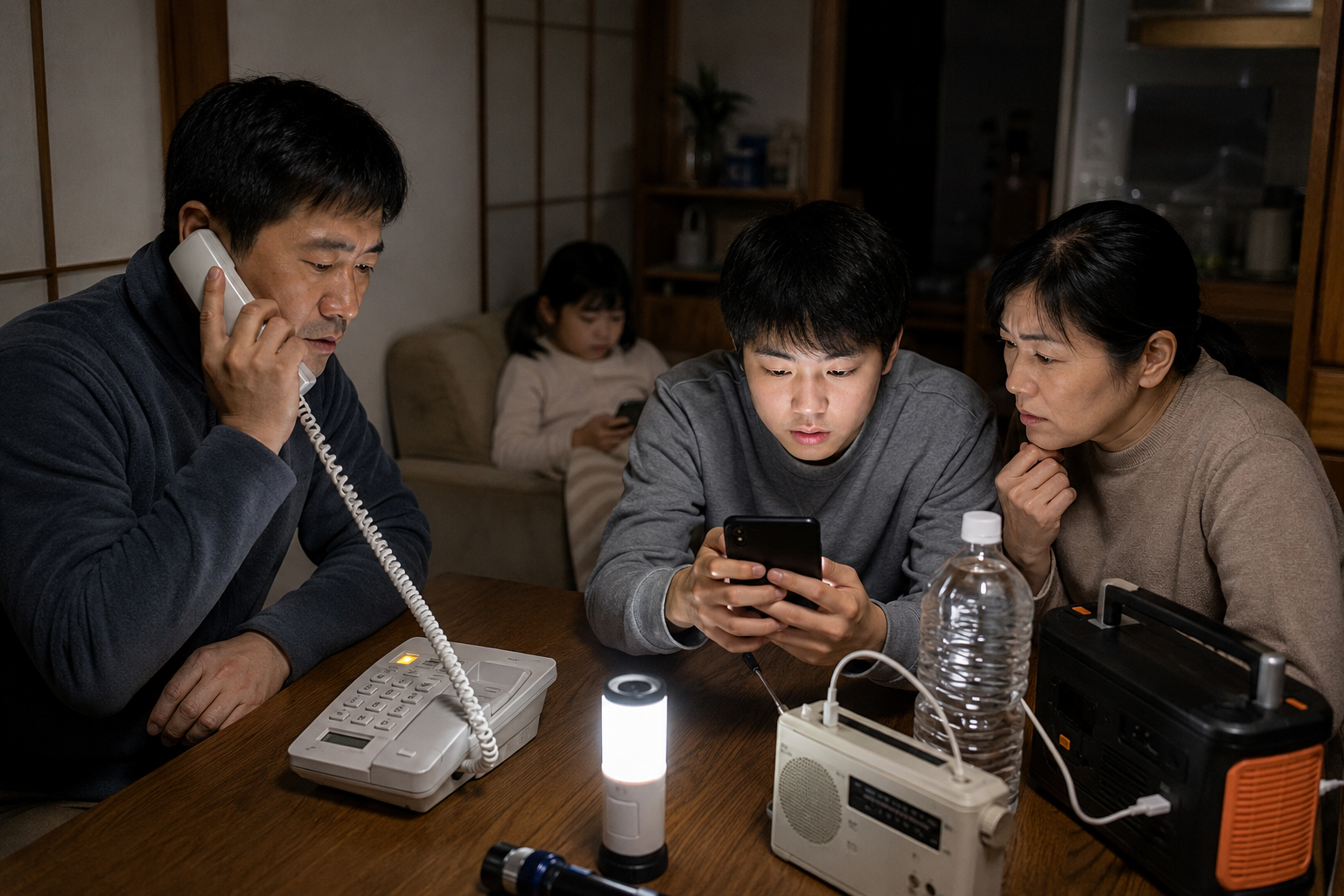
Disaster communication begins with one hard truth: calls may not go through
After a major earthquake, people instinctively do the same thing. They call their parents. They call their children. They call their spouse. They call friends, schools, offices and hotels. Everyone wants the same answer: are you safe? But if everyone calls at once, networks become congested. Calls may be restricted. Batteries drain. Anxiety grows. The failure of the phone call becomes its own emergency.
Japan’s disaster communication system is built around a different idea: instead of forcing one person to answer dozens of calls, leave one short message in a shared place, then let others check it. NTT’s 171 Disaster Emergency Message Dial and Web171 Disaster Message Board are two of the most important tools for that purpose.
171 is a voice message board. Web171 is an internet message board. Their core idea is the same: use the phone number of someone in the affected area as a key. The person in the disaster area leaves a safety message. Family and friends use the same number to check it. A phone number becomes a small emergency bulletin board.
What 171 does
NTT describes 171 Disaster Emergency Message Dial as a service that enables people to post and check safety status and other information by voice, using the phone number of a person in the disaster zone as the key. It is provided when disaster conditions make ordinary communication difficult, such as after a major earthquake or other severe event.
The concept is deliberately simple. The person leaving a message dials 171, chooses recording, enters the agreed phone number, and records a short voice message. The person checking the message dials 171, chooses playback, enters the same phone number, and listens. The most important preparation is deciding in advance which phone number the family will use as the key.
NTT’s guidance explains that the service can be used from lines such as fixed lines, public phones, Hikari Denwa optical-fiber telephones, special public phones registered with NTT East or NTT West, and NTT DOCOMO mobile phones. Actual availability can vary by disaster, region and carrier, so people should check current NTT and carrier guidance during a real event.
The basic pattern: record with 171 → 1 → phone number
The basic steps are easy to remember. To record a message, dial 171, follow the voice guidance, press 1, enter the phone number your family has chosen, and record a short message. To play back a message, dial 171, press 2, enter the same phone number, and listen.
| Goal | Basic action | What to say |
|---|---|---|
| Record a message | 171 → 1 → key phone number | “I am safe.” “I am at the evacuation center.” “I will update again at 6 p.m.” |
| Play a message | 171 → 2 → same phone number | Listen to the safety message left by family or friends. |
| Prepare before disaster | Choose a family key number | Use a number everyone knows: home, a parent, a school, a company contact or another agreed number. |
One crucial warning for foreign residents and visitors: NTT East’s FAQ says the 171 voice prompts are provided only in Japanese. That does not mean foreigners cannot use it. It means they should write down the simple number pattern in advance. Remember four points: 171; 1 means record; 2 means play; the phone number is the key.
What Web171 does
Web171 is the internet version of the disaster message board. In a disaster, people living in affected areas, including evacuation centers, can access Web171 online and post text messages using a phone number as the key. Those messages can then be checked from Japan or overseas by entering the same phone number.
If 171 is “listen by phone,” Web171 is “read online.” That matters. It can be useful when voice calls are congested but internet access or Wi-Fi remains available. It can be used quietly in evacuation centers. It can be easier for people who prefer to write a short message rather than speak. It can also be useful for families overseas because Web171 can be checked from outside Japan.
Web171 is not magic. It still requires internet access, battery power and the ability to reach the site. In major disasters, power outages, damaged base stations, congestion or device problems can interfere. That is why families should not choose between 171 and Web171. They should understand both.
Why this matters for foreigners and families overseas
When a major earthquake happens in Japan, relatives overseas often see frightening headlines before they understand the geography. They may not know whether Iwate is near Tokyo, whether a tsunami advisory is dangerous where their child is studying, or whether a typhoon warning affects a particular hotel. If calls fail, fear grows quickly.
171 and Web171 give foreign residents, travelers, students and workers a way to create a calm safety signal. Before a disaster, tell your overseas family: “If something happens in Japan and you cannot reach me, check 171 or Web171 using this phone number.” The number might be your Japanese mobile number, a home phone, a school or company contact number, or another agreed number.
A message in English does not need to be perfect. It needs to be short and useful: “I am safe. I am at the evacuation center near my school. I will update again at 18:00 Japan time.” That is enough to reduce panic. The message should answer three questions: are you safe, where are you, and when will you update again?
Why repeated calling can make the problem worse
Repeated calling feels natural. It is also part of the problem. If hundreds of thousands of people keep redialing at the same time, communication networks become more strained. Emergency services, hospitals, local governments, rescue teams and families with urgent needs all depend on communication capacity.
171 and Web171 help spread the load. One person leaves one message. Many people can check it. That reduces the need for every relative to call the same person repeatedly. Disaster communication is not only emotion. It is design.
The three-number family plan
To make 171 and Web171 useful, families need a pre-disaster plan. Choose the key phone number. Choose backup contacts. Choose update times. For example: “After a major earthquake, check our home number on 171 and Web171. If we evacuate, we will update at 6 p.m. and 9 a.m.”
- Choose one family key number for 171 and Web171.
- Save that number in every family phone.
- Write it on paper and keep it in wallets and emergency bags.
- Share the pattern: 171 → 1 to record, 171 → 2 to play.
- Tell overseas family members how to check Web171.
Practice before the disaster
NTT East provides practice opportunities for Disaster Emergency Message Dial 171. The purpose is simple: people should not learn this system for the first time while frightened, in the dark, with a low battery and after a major earthquake. Practice changes a strange number into a familiar action.
Schools, offices, apartment buildings, hotels, international centers and neighborhood associations should include 171 and Web171 in disaster drills. Food and water are not the only parts of preparedness. Telling family “I am safe” is also preparedness. For people with limited Japanese, practicing the number pattern is especially valuable.
Do not forget public phones
Smartphones dominate daily life, but public phones can matter after disasters. Mobile networks may be congested. Phones may run out of battery. Charging stations may have long lines. Evacuation centers may have special public phones. Public phones look old in ordinary life. In a disaster, they can become strong infrastructure.
Travelers should notice public phones in stations, hotels, community centers and evacuation shelters. Parents should teach children how to use one. The strongest disaster plan uses both old and new tools: smartphone, paper note, public phone, 171, Web171, radio, charger and an agreed meeting point.
Companies, schools and hotels need a representative contact plan
Families are not the only people who need a plan. Companies may have internal safety-confirmation systems, but those systems may not help family members outside the organization. Schools may have parent notification systems, but messages may not arrive if networks are overloaded. Hotels may know which guests are safe, but overseas relatives may not know how to ask.
Organizations should decide in advance what number or web page will serve as their representative disaster contact point. Hotels serving international visitors should include 171, Web171, Safety tips and NHK WORLD-JAPAN in check-in disaster information. A small multilingual handout can become very important in a real emergency.
What a good disaster message says
The best disaster messages are short, specific and calm. They say whether you are safe, where you are, and when you will update again. If needed, add injury status, medicine needs, travel plans and who is with you.
| Good message | Why it works |
|---|---|
| “I am safe. I am at the evacuation center at ○○ Elementary School. I will update again at 18:00.” | It gives safety status, location and next update time. |
| “I am with my mother. No injuries. My phone battery is low, so please check 171.” | It explains who is together, health status and communication limits. |
| “We are staying away from the coast and following local evacuation instructions.” | It tells relatives you are making safe choices. |
171 and Web171 do not eliminate disaster communication problems. They cannot restore every damaged network or calm every fear. But they can replace repeated failed calls with one shared safety message. For anyone living in Japan, traveling in Japan, or loving someone in Japan, 171 is a three-digit number worth remembering.
- 171 is the voice service; Web171 is the internet message board.
- Both use a phone number as the key.
- Choose the key number before a disaster.
- Tell overseas family how to check it.
- A good message says: safe or not, location, and next update time.
Sources and references
This article is based on public information from NTT Group, NTT East, NTT West, and the Telecommunications Carriers Association.
- NTT Group: 171 Disaster Emergency Message Dial
- NTT Group: Web171 Disaster Message Board
- NTT East: Disaster Emergency Message Dial 171
- NTT East: How to Use Disaster Emergency Message Dial
- NTT East: 171 Practice Guide
- NTT West: Disaster Emergency Message Dial 171
- NTT West: Web171 Disaster Message Board
- Telecommunications Carriers Association: Disaster message services