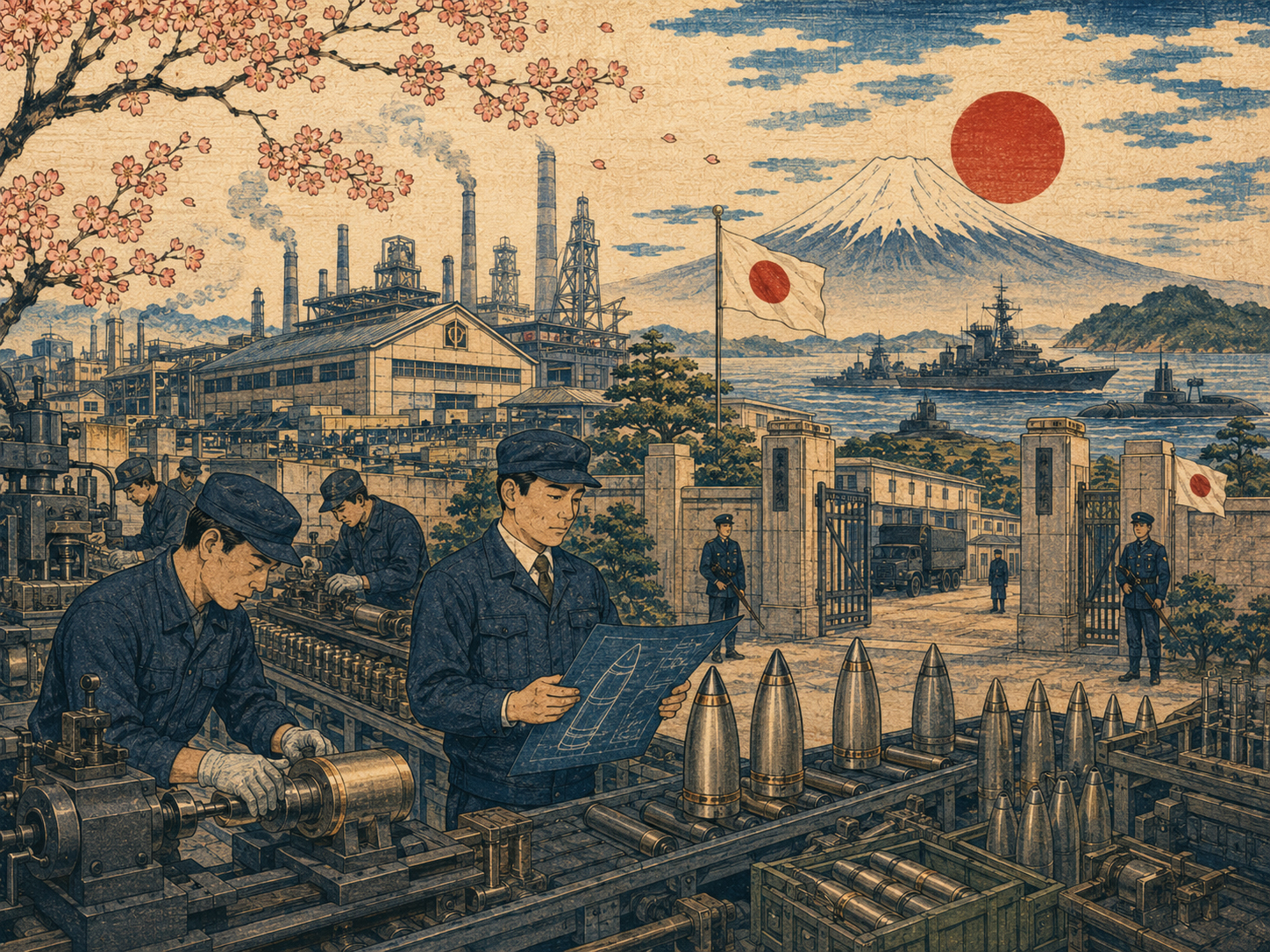
Ammunition factories are not glamorous. They do not appear on tourist posters or stock-market billboards. In peacetime, they sit in the background: machine tools, propellant, casings, fuzes, test equipment, safety rules and skilled workers. But when a war lasts longer than expected, national power moves into the warehouse and the production line. Japan’s debate over possible state ownership of some defense plants is a quiet story with enormous consequences.
According to recent reports, the government is considering revising rules so that the state could own certain defense production facilities in order to secure a stable domestic supply of ammunition and other critical equipment. One possible model would be government-owned, contractor-operated facilities: the state owns the plant or equipment, while a private company runs production. That is not just an ownership question. It is a question about whether Japan is preparing its industrial base for a long contingency.
For most of the postwar era, Japan kept weapons away from the center of its national story. The Self-Defense Forces existed. Defense contractors existed. Mitsubishi Heavy Industries, Kawasaki Heavy Industries, IHI, NEC, Mitsubishi Electric, SUBARU, Japan Steel Works, Daikin and many smaller suppliers supported the system. But defense manufacturing was not treated like a growth industry. It was low-margin, regulated, politically sensitive and largely confined to the domestic market.
Ukraine and the return of the ammunition problem
Russia’s invasion of Ukraine changed the mood. For years, analysts described future war in terms of cyber, AI, space, drones and precision strike. They were not wrong. But Ukraine also showed something older: wars consume shells, missiles, vehicles, replacement parts, explosives, engineers and time. A modern arsenal can be exhausted faster than a modern democracy can rebuild it.
High-end weapons are scarce. Missiles can be fired in minutes but take months or years to replace. Ammunition production depends on a chain of chemicals, metals, electronics, machining, testing, certification and skilled labor. If one part of the chain fails, output falls. Ukraine revealed that many advanced economies had allowed their defense production base to shrink during the post-Cold War peace.
For Japan, this is not a distant European lesson. Taiwan, the Korean Peninsula, the East China Sea and the southwestern island chain all sit inside Japan’s strategic horizon. If a crisis threatened sea lanes, bases, ports and airfields, Japan’s problem would not be only what it owns on day one. It would be what it can keep producing on day thirty, day one hundred and day three hundred.
The 2022 shift: the industrial base as defense capability itself
The conceptual shift was already written into Japan’s 2022 National Security Strategy. The strategy described the defense production and technology base as an indispensable foundation for stable domestic research, development, production and procurement. It went further: Japan would reinforce that base because it is a form of defense capability itself.
That sentence mattered. In older Japanese policy language, industry was often the back office of procurement. After 2022, factories, engineers, suppliers, materials, export controls, finance, research and cybersecurity began to be treated as part of the nation’s defensive power.
In 2023, Japan enacted legislation to strengthen defense production and technology bases. The framework allowed government support for manufacturing facilities, supply chains, cybersecurity, business succession and export promotion. The current discussion goes further. Subsidies and contracts may not be enough for facilities that are vital in a crisis but unattractive in ordinary market terms. In some cases, the state may need to own the capacity.
Why private markets are not enough
Defense production is structurally awkward for private companies. The buyer is usually the government. Volumes are small compared with civilian goods. Specifications are unusual and often change. Quality demands are severe. Export rules are political. Profit margins can be thin. In peacetime, demand may be low; in wartime, the state suddenly wants rapid expansion.
That makes defense work less attractive than it looks. A supplier can invest in a line, then wait years for volume. A small subcontractor can lose money maintaining a capability the state may need only in a crisis. If enough small firms exit, prime contractors cannot simply replace them overnight. A missile is not just a missile; it is a national network of parts, machines, materials and tacit knowledge.
Government-owned facilities are one answer to this market failure. The state preserves the building, machines and baseline capacity. Private industry operates the line. In normal times, the system keeps a minimum level of skill and readiness. In a crisis, it can expand. The point is not socialism. The point is preserving capabilities that the market alone will not carry, but the nation cannot afford to lose.
Japan’s defense-industrial shift in numbers
Nationalization or industrial policy?
The word “nationalization” has weight in Japan. It recalls wartime mobilization, military factories and the shadow of empire. Concern from China, South Korea and some domestic critics is not surprising. Japan’s security policy always carries the burden of history.
But reading the proposal only as a return to militarism misses the practical issue. The modern discussion is not about full state command of the economy. It is about limited ownership of facilities that are essential for national defense but difficult to sustain commercially. In that sense, defense production is beginning to resemble energy, semiconductors, medicine, ports, communications and food security: a strategic supply chain that government cannot simply outsource and forget.
The real question is governance. Which plants would qualify? Who would operate them? Would competition be preserved? How would costs be disclosed? Would the Diet be able to scrutinize decisions? How would export controls and end-use rules be maintained? The debate should not be decided by the word “nationalization” alone. It should be judged by design, transparency and accountability.
Exports and finance: from closed industry to strategic industry
Japan’s 2026 defense-industrial shift is broader than factory ownership. Tokyo has moved to overhaul defense export rules, opening the door to a wider range of overseas transfers of ships, missiles and other equipment under case-by-case screening. The purpose is not only diplomacy. It is industrial scale. A defense industry trapped in small domestic orders cannot easily maintain modern production capacity.
Finance is changing too. In May 2026, Reuters reported that the government-owned Development Bank of Japan had lifted restrictions on investments in companies that manufacture weapons, excluding arms banned under international treaties. The defense minister urged financial institutions to fund the sector. That marks a cultural change: defense is moving from an industry many investors avoided to one the state wants capital to support.
Yet this remains sensitive. Some ESG frameworks still exclude weapons manufacturers. Banks and pension funds worry about reputational risk. Export deals can trigger political criticism. If the government wants private companies to sustain defense production, it must define the public purpose, ethical boundaries, export review standards and accountability mechanisms more clearly than before.
Can car plants become drone plants?
Another 2026 debate shows why factory ownership alone is not enough. As Japan pushes into unmanned systems, some have suggested converting idle automotive plants into military drone production sites. Mitsubishi Heavy Industries’ chief executive has warned that this could be wasteful. Auto plants are optimized for high-volume production of standardized goods. Military drones may require low-volume, high-variation manufacturing with specifications that change rapidly.
That warning matters for the nationalization debate. What Japan needs is not simply empty buildings. It needs flexible equipment, secure supply chains, testing sites, classified handling, defense-grade quality control, cyber protection, explosives safety and people who know how to build military systems. A state-owned plant without the right ecosystem is just a warehouse.
Geography, islands and ammunition
Japan’s defense problem begins with geography. The country is a long island chain: Hokkaido, Honshu, Shikoku, Kyushu, Okinawa and the southwestern islands. Defending that geography requires transport, dispersion, stockpiles, ports, airfields, fuel, repair capacity and resilient communications. A crisis in the southwest would not be solved by having a factory somewhere in the abstract. The question is where ammunition is stored, how it moves, how it is protected, and how quickly it can be replaced.
That is why the factory issue connects to ports, roads, civilian logistics, fuel depots, cybersecurity, space surveillance and emergency management. Japan’s defense policy is no longer only an equipment catalogue. It is becoming a test of national endurance.
Japan.co.jp’s view
The heart of this story is not whether Japan buys a factory. The heart of the story is whether Japan accepts the industrial reality of deterrence. For decades, Japan built security on the U.S. alliance, domestic pacifism, economic power and advanced technology. Ukraine and the Indo-Pacific have complicated that formula.
State ownership carries risks. Costs can swell. Politics and contractors can become too close. Poor transparency can erode public trust. But doing nothing also carries risk: a country with expensive platforms but insufficient ammunition, spare parts and surge capacity is not truly ready.
Japan’s best path is quiet realism. It should remember history, avoid triumphalism, explain its choices and build the unglamorous capacity that makes deterrence credible. Ammunition plants do not look like peace. But in a dangerous region, the ability to sustain defense may be one of the things that keeps peace from breaking.
Reader guide
| Question | Answer |
|---|---|
| What is being considered? | Japan is considering legal changes that could allow state ownership of some defense production facilities, especially for ammunition and critical equipment. |
| Why does it matter? | In a prolonged conflict, ammunition, repairs, spare parts and surge production can matter as much as the number of platforms Japan owns on day one. |
| What is the background? | Ukraine, Taiwan contingencies, North Korean missiles, the 2022 National Security Strategy and the 2023 defense production base law. |
| What are the risks? | Cost overruns, weak transparency, political favoritism, export-control concerns and historical anxiety at home and abroad. |
| Japan.co.jp’s view | This is not simply militarization. It is a test of whether Japan can build an accountable industrial base for deterrence without forgetting its postwar lessons. |
Sources and references
This article draws on public information from The Japan Times, Jiji Press/Nippon.com, Reuters, Financial Times, Japan’s National Security Strategy, ATLA, CSIS and Hudson Institute analysis.
- The Japan Times: Japan weighs state ownership of defense plants
- Nippon.com / Jiji Press: Japan to consider nationalizing defense equipment plants
- Reuters: Japan urges banks to fund defense companies
- Reuters: Japan overhauls defense export rules
- National Security Strategy of Japan, 2022
- Acquisition, Technology & Logistics Agency: Missions of ATLA
- CSIS: Japan’s new defense buildup plan and defense industrial base