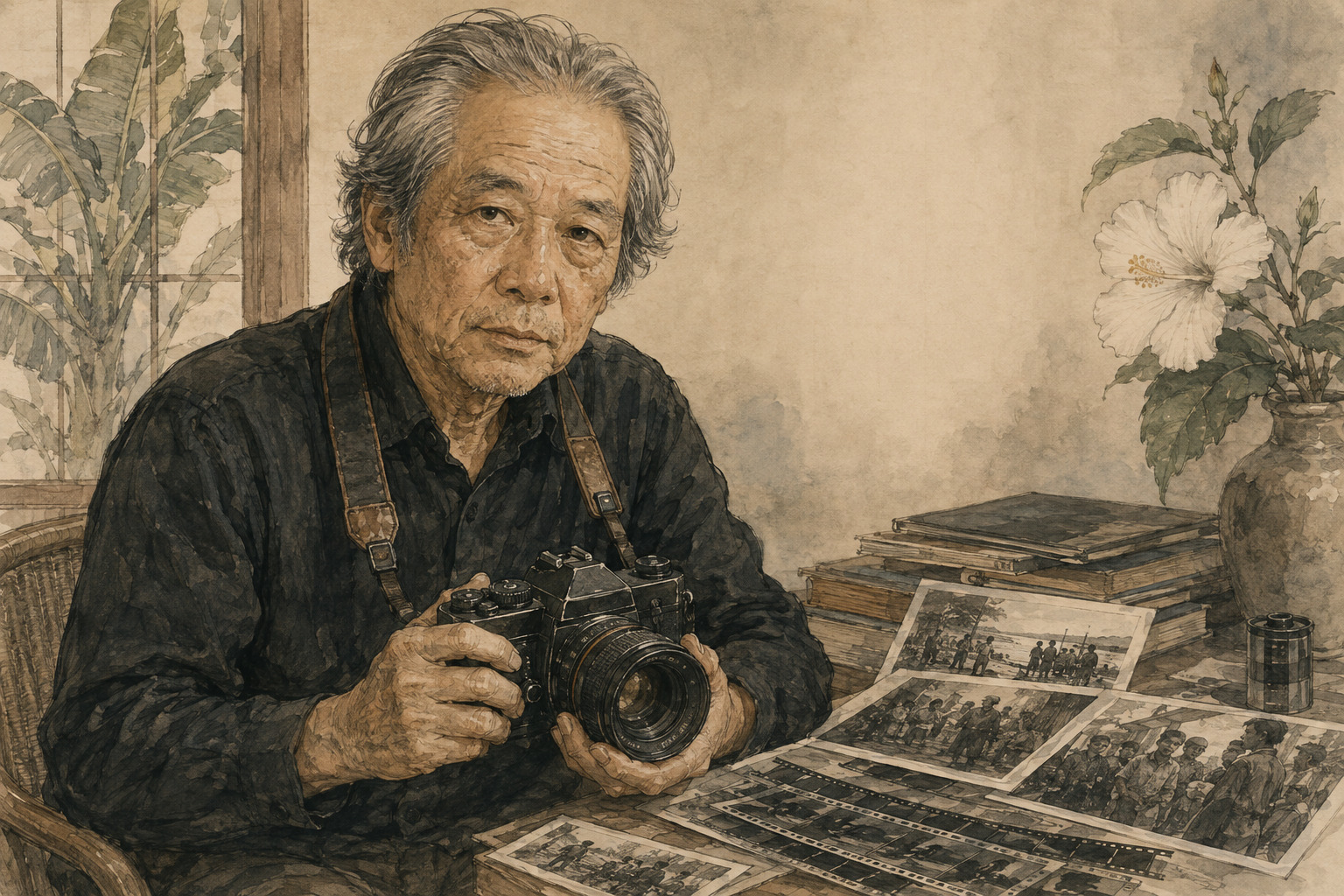
His given name was Bunyo, not Fumio. The Okinawa Prefectural Museum & Art Museum records him as 石川文洋, read Ishikawa Bunyo, and gives the official romanization “ISHIKAWA Bunyo.” The distinction matters in an obituary about evidence. A photojournalist who spent his career attaching places and consequences to war should not have his own name reconstructed from a guess.
Ishikawa died at 2:39 a.m. on August 23 at a hospital in Chino, Nagano Prefecture, according to Japanese reports based on an announcement from his family. The cause was malignant lymphoma. He was 88. A funeral was to be held privately by close relatives; no public memorial information had been announced by publication time.
He was born in the Torihori district of Shuri, Naha, in 1938. He would work from Saigon during the Vietnam War, photograph U.S. bases in Okinawa, report from Cambodia, Bosnia, Somalia and Afghanistan, and return repeatedly to places whose suffering had slipped out of the daily news. The range can sound like an itinerary of catastrophes. It was more coherent than that. Ishikawa kept asking what organized violence looked like to people who had not ordered it.
Three titles establish his field of view
A museum catalog can reveal more than a heroic anecdote. The Okinawa prefectural museum lists three of Ishikawa’s gelatin silver prints from Vietnam. Their Japanese titles, translated here by Japan.co.jp, are “Body Blown Apart” (1967), “There Are Still Children in the Village” (1966), and “The Eyes of a Girl Watching the Adults’ War” (1966).
The first title refuses to clean up bodily destruction. The second interrupts the idea that a village is only a tactical location. The third assigns responsibility through grammar: the war belongs to adults; the looking is imposed on a child. None of those titles proves that a photograph is ethically sufficient. Together, however, they show where Ishikawa positioned the human consequence of combat.
“From the ground” in this headline is Japan.co.jp analysis, not a quotation from Ishikawa. It means more than working at ground level. He photographed on the receiving end of policy and command—where a map coordinate became a village, a sortie became an explosion and a war continued after armed units moved on.
The access problem was part of the picture
The official synopsis for a new documentary about Ishikawa says he left Japan in 1964 with $27, traveled through Hong Kong and reached Saigon, now Ho Chi Minh City. The Okinawa museum and his Japanese publisher date his sustained freelance coverage in Saigon from 1965 through December 1968. The accounts can be reconciled without inventing precision: he arrived in 1964 and began the extended reporting period identified by the institutional biographies in 1965.
He accompanied U.S. and South Vietnamese government forces. That fact is essential, because war photography is never produced from an abstract place outside power. Accreditation opens a gate and closes others. Military transport determines which road a photographer takes. Briefings shape what can be anticipated. Commanders can restrict movement, and evacuation depends on the same machinery being documented.
Ishikawa’s achievement was not perfect detachment. No press card could provide that. It was the conversion of constrained access into evidence of civilian cost. The documentary’s official account says the Associated Press bought and distributed one of his negatives after a U.S. major was shot. That origin story belongs to the film producers’ synopsis and has not been independently reconstructed here. What the museum holdings establish directly is that his body of work did not end with the soldier or the firefight.
Vietnam’s rear base was his birthplace
When Ishikawa returned temporarily to Japan in 1968, the film’s official account says his U.S. military press card helped him gain access to American bases in Okinawa. The photographs created a geographical argument. Vietnam was not only the distant country at the front of the war. Okinawa—then still under U.S. administration—was bound to it by aircraft, supplies, maintenance and labor.
The Okinawa Prefectural Archives records that B-52 strategic bombers began arriving on the islands in 1965. Kadena Air Base served as a supply and sortie base, and B-52s were stationed there from February 5, 1968. On November 19 that year, a B-52 crashed during takeoff and exploded. Sixteen nearby residents were injured and 365 buildings, including Yara Elementary School, were damaged.
Okinawa City’s postwar history archive adds the labor behind the sortie. Local workers repaired vehicles, serviced medical equipment and managed supplies. A base could be feared as a target, opposed as an instrument of war and relied on as a source of wages—all at once. That complexity is why “Okinawa supported the war” is too blunt, and “Okinawa was merely nearby” is false.
Ishikawa could photograph both ends because one was the battlefield where he had learned the mechanics of access and the other was home. His Vietnam civilians and Okinawa residents do not appear in the same frame. His larger body of work places them on the same military line.
He outlived the age of the single iconic frame
Japanese photographers were central to the visual history of the Vietnam War. Kyoichi Sawada’s 1965 Vietnam portfolio won the 1966 Pulitzer Prize for Photography. Its most recognized image, known in Japanese as “Anzen e no Tohi” and in English as “Flee to Safety,” shows a family crossing a river to escape an attack. Taizo Ichinose photographed soldiers, civilians and children in Bangladesh, Vietnam and Cambodia before disappearing in Cambodia in 1973.
Sawada was killed in Cambodia in 1970; Ichinose was in his twenties when he died. Ishikawa survived long enough to face a different obligation: not only making images but captioning, arranging, donating and revisiting them. Photography’s history often condenses a war into one unforgettable frame. Ishikawa’s distinction was duration.
He presented “War, Soldiers and the People” in 1970 and published a book, “War and the People,” in 1971. He first reported from wartime North Vietnam in 1972, then mounted a North Vietnam exhibition and received the Photographic Society of Japan’s Annual Award in 1973. From 1969 until 1984 he worked for the Asahi Shimbun company, according to his publisher’s biography, then returned to freelance work.
In 1979 he entered Cambodia after the fall of the Khmer Rouge regime and published “Massacre.” Later assignments took him to South Yemen, Sarajevo, Somalia and Afghanistan. The Japan Congress of Journalists awarded him its 1990 special prize for his Vietnam reporting. Vietnam’s government honored him for contributions to culture and communications in 2005. Those awards identify the institutions doing the honoring; they do not settle every interpretation of his pictures.
1938 Born in Torihori, Shuri, Naha.
1964–65 Reached Saigon and began his sustained Vietnam War coverage.
1968 Ended his Saigon base and expanded his Okinawa base reporting.
1972–73 Reported from North Vietnam; received the PSJ Annual Award.
1979 Reported from Cambodia and published “Massacre.”
1998 A permanent room for his work opened in a Ho Chi Minh City war museum.
2018–19 Walked about 3,500 kilometers through Japan at age 80–81.
2025 Returned to Ho Chi Minh City in the 50th year since the war’s end.
2026 Died on August 23, age 88.
An archive is an argument made after the shutter
A battlefield negative is not self-explanatory. Remove its date, location and sequence and it can become generic horror. Separate an injured person from the events before and after the exposure and the image can turn suffering into spectacle. Preservation is therefore not a clerical afterlife of photojournalism. It is part of the reporting.
In 1998, a permanent room titled “Bunyo Ishikawa: 35 Years of Vietnam Reporting—War and Peace” opened at a war museum in Ho Chi Minh City, according to the Okinawa museum biography. Ishikawa donated Vietnam photographs accumulated across 35 years. The official Japanese biography confirms the room and donation but does not give a total. Later sources differ, so this article does not publish a donation count.
A separate number belongs to a later exhibition. VietnamPlus, part of the Vietnam News Agency, reported that a 2015 show at the War Remnants Museum presented 107 of his photographs under the English title “50 Years of Vietnam—War and Peace.” The 107 works on display in 2015 should not be mistaken for the size of the 1998 donation.
The distinction is small but revealing. Archives require exact units: negatives, prints, selected exhibition works and digitized images are not interchangeable. Ishikawa’s legacy depends not merely on keeping boxes dry but on preserving the information that lets a future viewer ask who is present, what happened and why the photographer was there.
At 80, he measured Japan with his feet
Late in life, Ishikawa moved even more slowly. From July 2018 to June 2019, he walked Japan from north to south over roughly 11 months, according to Newspark, the Japan Newspaper Museum. He was 80 when he began and 81 when he finished. The route covered about 3,500 kilometers, and he made approximately 35,000 images; a subsequent exhibition selected about 120.
His itinerary connected Fukushima, Kobe and Kumamoto disaster areas with Misawa and Iwakuni bases and the Okinawan sites of Henoko, Kadena and Futenma. He undertook the journey after a heart attack. The physical feat can obscure the editorial one: he placed military infrastructure and disaster recovery in a single longitudinal study of inhabited land.
War and natural disaster are not equivalent causes. Photographing them together did not make them equivalent. It emphasized a shared problem for journalism: public attention arrives fast, then departs while residents keep negotiating loss, displacement, rebuilding and contested official decisions. Obituaries also credit Ishikawa with work at Unzen-Fugendake, after the 2011 earthquake and tsunami, and following the 2024 Noto Peninsula earthquake.
| Geography | Documented work | Historical significance |
|---|---|---|
| Vietnam | South Vietnam from 1965–68, North Vietnam from 1972, and repeated postwar returns. | Built a long series around civilians and the social life surrounding combat. |
| Okinawa | U.S. bases, reversion, Henoko, Kadena and Futenma. | Connected the war’s front to the island infrastructure that supported it. |
| Conflict and disaster sites | Cambodia, Sarajevo, Somalia, Afghanistan and disaster-struck communities in Japan. | Returned the lens to people living after the immediate event had left the headlines. |
The final return joined two anniversaries
The year 2025 marked 50 years since the end of the Vietnam War and 80 years since the end of the Battle of Okinawa. From November 2025 through January 2026, the Okinawa Prefectural Museum & Art Museum organized “Vietnam: Landscapes of Memory,” an exhibition of about 120 works of contemporary Vietnamese art examining colonialism, war and postwar memory.
Ishikawa joined a related symposium remotely. Its Japanese title paired “50 years and 80 years” and brought Vietnam and Okinawa into a discussion of art and peace. His presence mattered precisely because the event was not a retrospective devoted to one celebrated photographer. It placed his witness beside later artists and scholars who inherit, revise and dispute the forms through which war is remembered.
The official site for “Senjo no Bohemian: Cameraman Bunyo Ishikawa” says the photographer returned to Ho Chi Minh City in 2025 after receiving an invitation to Vietnam’s anniversary events. Directed and shot by Atsunori Kawamura, the documentary is scheduled to begin a national theatrical rollout at Shinjuku K’s cinema on November 28, 2026. The posted schedule was current August 8 and remains subject to change.
The film was designed as a living photographer’s return. His death has altered, but not invalidated, that premise. It will now be encountered posthumously, where every use of first-person memory must also be weighed against the prints, captions and institutional records he left behind.
The danger of praising danger
An obituary for a war photographer can become a list of near-death experiences. The film’s publicity says Ishikawa came close to death nine times. That is a producers’ claim, not a count independently verified by Japan.co.jp. More important, a mythology of fearlessness can push the people inside the photographs back into the scenery.
Risk was real. It is not the only measure. A stronger accounting asks whose lives a photographer treated as historically specific, whether he returned after the gunfire, whether he preserved names and locations, and whether the archive gives later viewers enough context to resist consuming pain as decoration.
Ishikawa’s three museum titles keep that test visible. A body has been destroyed. Children are still in the village. A girl is made to watch an adults’ war. The titles cannot repair the harm, and they cannot answer every ethical question about looking. They do prevent the scene from becoming a clean emblem of adventure.
A shutter closes in a fraction of a second. The record begins afterward: protect the negative, verify the caption, keep the sequence, publish the book, build the exhibition, transfer the work, return to the place. Bunyo Ishikawa photographed war from the ground. What remains on that ground is now the responsibility of everyone who displays, studies and sees his photographs.
- Asahi Shimbun — obituary notice, time and cause of death, funeral status
- Kyodo via Nikkan Sports — Bunyo Ishikawa obituary
- Ryukyu Shimpo — obituary of the Okinawa-born photojournalist
- Jiji Press via Nippon.com — English obituary and official Bunyo rendering
- Okinawa Prefectural Museum & Art Museum — official name, biography and work titles
- Official documentary site — producer biography, 2025 return, director and 2026 schedule
- Shinnihon Publishing — author biography, Asahi tenure and books
- Okinawa Prefectural Archives — Kadena B-52 operations and November 1968 crash
- Okinawa City Histreet — “From Okinawa to Vietnam” exhibition and rear-base labor
- Photographic Society of Japan — 1973 Annual Award
- Japan Congress of Journalists — 1990 special award
- The Pulitzer Prizes — Kyoichi Sawada’s 1966 photography award
- Aomori Museum of Art — Kyoichi Sawada and “Flee to Safety”
- JCII Photo Salon — Taizo Ichinose exhibition biography
- Newspark — Ishikawa’s 3,500-kilometer walk and exhibition
- VietnamPlus / Vietnam News Agency — 2015 War Remnants Museum exhibition
- Okinawa Prefectural Museum & Art Museum — “Vietnam: Landscapes of Memory”
Attribution boundary: Time, place and cause of death and the private-funeral notice derive from Japanese reports citing the family. The Okinawa museum provides the authoritative Japanese reading, Romanization, work titles and career chronology. The $27 departure, AP negative, U.S. press-card access, near-death count and 2025 invitation are attributed to the documentary’s official materials. “From the ground,” the analysis of access and the discussion of archival ethics are Japan.co.jp analysis, not quotations from Ishikawa.