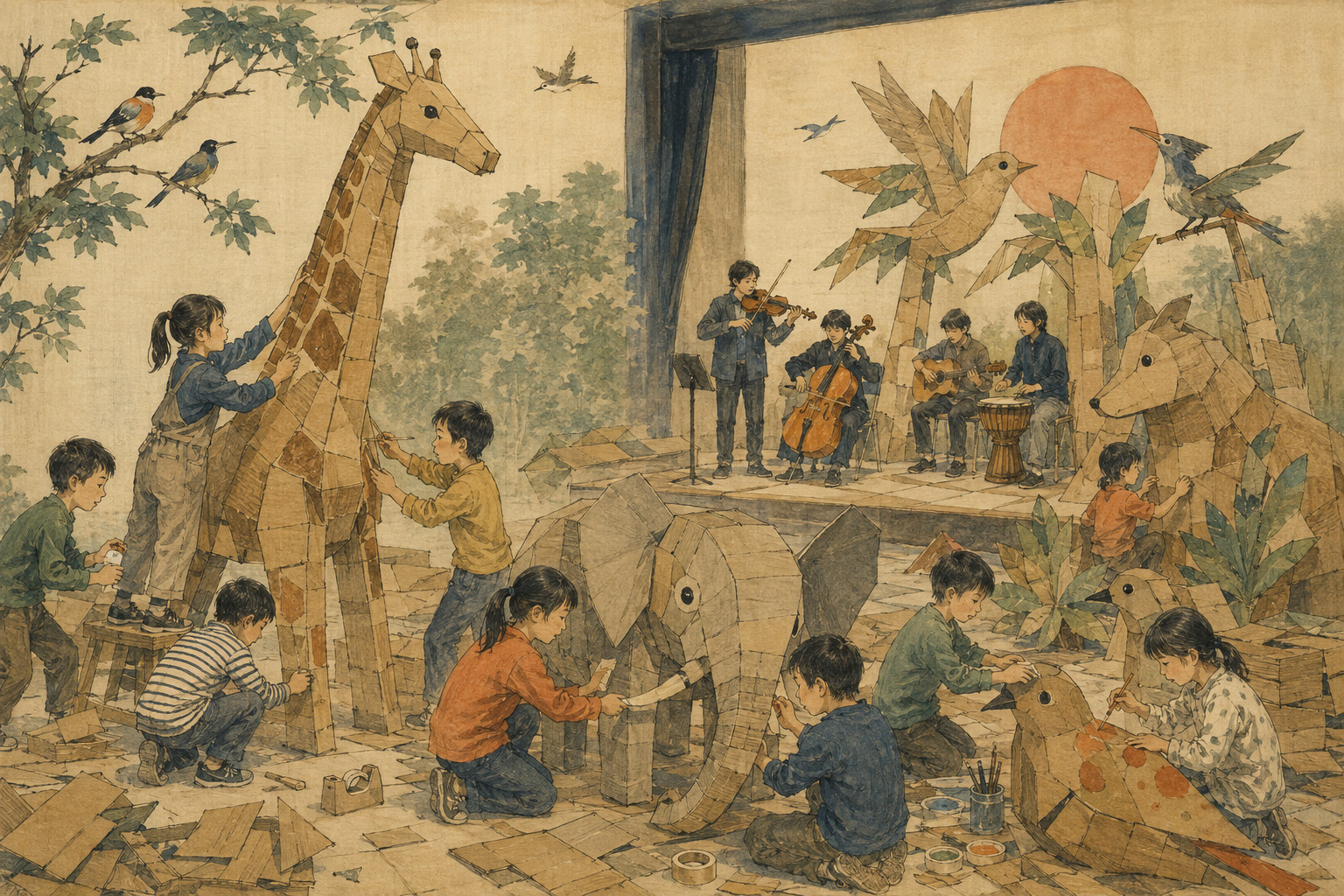
The program invited a child to enter the same public building twice and occupy two different places in its culture. Friday’s official schedule put the child in the lobby with paint and a brush. Saturday’s design put the child in the small hall, facing the surface painted the day before. The first visit would help make a set. The second would reveal what a set does.
That was the architecture of Stage Wakuwaku Operation, Japan.co.jp’s rendering of Stage Wakuwaku Daisakusen, a two-day program listed by Itabashi Culture Hall for August 21 and 22. Day one, formally titled Colorful Animal Gathering, placed giant cardboard animals in the first-floor lobby of the main hall. Day two, The Animals’ Music Carnival, moved the visual world into the 306-seat small hall for a brass concert.
One correction is necessary at the start. The children did not engineer and assemble the animals from raw sheets. According to the Itabashi Culture and International Exchange Foundation, the professional studio Atelier Yamada prepared lions, elephants and other cardboard forms approximately two meters high. Participants used brushes, larger brushes, paintbrushes and their hands to add color. “Build,” in the headline originally proposed for this story, assigns them more of the structural work than the sources support. We have changed it to “paint” and retained the requested file address.
That does not make the participation decorative. The professional contribution was to create a stable, manageable surface large enough for many children to alter. The children’s contribution was the one no fabrication plan could preselect: a skin made from separate gestures that had to coexist without becoming uniform.
The important object was the interval
The painting was divided into six 30-minute sessions between 11 a.m. and 3:30 p.m., each advertised for 15 participants. Children from age three through junior-high school could register. Those in third grade or younger needed an accompanying adult; preschool children needed an adult watching inside the area. Both participants and guardians were told to wear clothes that could be permanently stained.
Thirty minutes is not enough to design, cut and safely assemble a two-meter freestanding animal. It is enough to remove the fear of a blank surface. No child has to master the whole object. One can begin with a patch, a line, a handprint or a color that another participant must work around.
The organizer described the concept in Japanese as extending beyond making to the point where the work becomes active onstage. In many workshops, the object goes home and the institutional relationship ends. Here, the child had to let it go. Overnight, the work changed category—from something made in a lobby to something entrusted to a public stage.
That delay is more consequential than it first appears. When the child returns, the private question “Which part is mine?” meets a public one: “What did all of us make possible?” The artwork is no longer judged only as an object. It becomes an environment shared with musicians and an audience.
A workshop needs backstage engineering
The public description makes the front-of-house sequence vivid, but the hidden work matters. A form large enough to feel monumental to a three-year-old must still be light enough to move, stiff enough to stand, safe to approach from several sides and stable when children press against it. It must pass from a main-hall lobby to a smaller stage without blocking musicians, equipment or an exit route.
The organizer has not published the construction, anchoring, fire-safety or load specifications. It would therefore be inaccurate to say children installed the set. Participatory art does not erase expertise. It depends on adults designing boundaries within which an unusually large gesture becomes safe.
Atelier Yamada describes itself as a company centered on spatial form and experience design. Its official history says it began in April 2016 and incorporated in December 2022. Founder and spatial artist Ryuta Yamada was born in Osaka in 1988, grew up in Nishinomiya, Hyogo Prefecture, and studied mechanical design in Kindai University’s Faculty of Science and Engineering. The company works with cardboard, wood, iron and offcuts and says it can take a project from planning and fabrication through on-site operation.
Its slogan, “Give shape to excitement,” is a company claim, not an independently measured outcome for these children. But Yamada’s engineering background helps explain the division of labor. Before a surface can invite unplanned color, somebody has to calculate what lets the surface survive contact.
The music translated animals a second time
The next-day concert was advertised for Dōbutsuen Brass—literally “Zoo Brass”—a quintet assembled for the program. The final official listing named Ryo Noda and Yoshihiko Shigei on trumpet, the horn player listed in Japanese as 宮川尊伍, Ryo Matsunaga on trombone and Kosuke Shiba on tuba. On August 4, the hall announced that Matsunaga would replace the originally scheduled Jumpei Yamashita. The hall’s Japanese page gives no verified romanization for 宮川尊伍, so Japan.co.jp does not supply one.
The advertised program included selections from Camille Saint-Saëns’s Carnival of the Animals, music from My Neighbor Totoro, and the children’s song Yama no Ongakuka. The page warned that the contents could change. We therefore describe these as planned selections, not a verified final set list.
Saint-Saëns wrote Carnival of the Animals in 1886 as a sequence of 14 musical portraits and jokes. Lions, hens, tortoises, an elephant, kangaroos, an aquarium and an aviary appear through changes in register, speed and instrumental color. In “The Elephant,” a double bass makes a massive body seem to dance; in “Tortoises,” a racing tune is slowed to a deliberate crawl.
The Itabashi children performed the reverse translation. Saint-Saëns turned imagined bodies into sound. They returned the animal world to matter and color before musicians turned it back into breath and vibration. A brass quintet is not the original instrumentation of the 1886 suite. Two trumpets, horn, trombone and tuba instead offered their own ladder of pitches and weights, from a bright call to a heavy footfall.
| Stage | Verified public plan | Child’s role |
|---|---|---|
| August 21 | Paint professionally prepared cardboard animals in the main-hall lobby; six sessions, 15 places each. | Contributor to a shared surface. |
| Overnight | Transfer the forms to the small-hall stage; technical method not published. | Release the object into a public production. |
| August 22 | Brass quintet in a 306-seat hall, with an animal-themed advertised program. | Audience member inside a setting partly marked by the group. |
Cardboard is a structural idea before it is a box
Cardboard can look like the choice made when a “real” material is too expensive. Structurally, it is more interesting. A corrugated middle layer held between sheets resists bending far better than flat paper of comparable weight. It can be scored, folded, laminated and joined to create a large volume that remains light. Its surface accepts paint. Those properties answer two competing demands of a children’s set: appear enormous and remain manageable.
Rengo, a major Japanese packaging company, says in its corporate history that founder Teijiro Inoue started Japan’s first corrugated-board business in 1909 and coined the Japanese name danbōru. That is a company’s account of its own history and is attributed as such. For more than a century, corrugated board’s ordinary job has been to disappear around a more valuable object. In Itabashi, the protective structure itself became the visible body.
Nor should the material automatically turn the event into an environmental project. Atelier Yamada says it often explores offcuts, but the public materials do not say that every sheet in this program was reclaimed or recycled. They do not state what happened to the painted forms afterward. Paint, adhesive and mixed materials can complicate recovery. Japan.co.jp therefore does not label the program a recycling initiative.
A 1982 hall and a newer idea of public culture
Itabashi’s official chronology records the culture hall’s opening in October 1982. Its 1,263-seat main hall, 306-seat small hall, meeting rooms, Japanese rooms, tea rooms and rehearsal spaces embody a familiar generation of Japanese civic infrastructure: a municipality builds a place where ceremonies, touring performances and local groups can gather.
National policy has since asked more of such buildings. Japan’s theater and music-hall revitalization law took effect in 2012. Agency for Cultural Affairs guidance issued the following year described theaters as places for creating and transmitting performing arts, developing people, widening participation and supporting the creation and renewal of local communities. The national Basic Plan for the Promotion of Culture and the Arts, second phase, calls not only for children to watch and experience serious art but also for conditions in which they can participate and create.
No source reviewed by Japan.co.jp identifies the Itabashi event as a grant-funded implementation of those national policies. The connection is analytic, not administrative. Its structure nonetheless illustrates the institutional shift: the hall does not merely rent a room or discount a seat. It composes a path through making, technical transformation and performance.
Itabashi has spent 45 years joining paper to place
Paper already carries unusual civic weight in Itabashi. In 1981, the Itabashi Art Museum held its first Bologna Illustrators Exhibition. Beginning in 1993, books donated through the Bologna Children’s Book Fair began arriving. The Itabashi Bologna Children’s Book Hall opened in 2004 and later moved into the Central Library. The library now reports a collection of 33,000 books in 80 languages from roughly 110 countries and regions.
The ward links that international picture-book network to its concentration of printing and bookbinding businesses under the policy identity “Itabashi, City of Picture Books.” On January 28, 2026, it issued the Minna ni Kakehashi Itabashi Creative City Declaration, describing a creative city as one that connects art, culture and design to local value, problem-solving and exchange. It also announced that it would seek membership in the UNESCO Creative Cities Network in design.
The cardboard program is not identified in public documents as part of that application. It would be careless to attach every arts event to the ward’s new branding. But the program does provide a small, concrete example of the verb “connect”: packaging structure becomes animal sculpture; a lobby becomes a studio; children’s marks become set design; a public hall connects visual work to live music. That is Japan.co.jp analysis, not the organizer’s stated policy lineage.
1909 Rengo says Teijiro Inoue begins Japan’s first corrugated-board business and names danbōru.
1981 First Bologna Illustrators Exhibition at Itabashi Art Museum.
1982 Itabashi Culture Hall opens in October.
2004 Itabashi Bologna Children’s Book Hall opens.
2012 Japan’s Act on Revitalization of Theaters and Music Halls takes effect.
2016 Atelier Yamada begins operations; it incorporates in 2022.
January 2026 Itabashi issues its Creative City Declaration.
August 21–22, 2026 Official dates for Stage Wakuwaku Operation.
Participation is not proved by a photograph of participation
Programs like this are easily summarized with a finished object and smiling faces. The public record available here contains no final attendance, age distribution, share of first-time visitors, number who returned on day two, accommodation data for disabled children, or account of what happened to the animals after the concert. Without those measures, it would be irresponsible to claim that the program raised creativity, confidence or cultural participation.
The more useful evaluation begins at the seam between days. What percentage of workshop participants returned for the concert? Did children who came only for the music want to make something afterward? Could a child with limited reach, sensory sensitivities or an accompanying carer take part? How much technical labor did moving and securing the forms require? Could the hall repeat the model without exhausting staff or pricing out families?
- Actual attendance and age bands in each workshop session.
- Use of the combined ticket and the return rate on day two.
- First-time hall visitors and the accommodations requested and provided.
- Staff hours for fabrication, transfer, anchoring and removal.
- Whether the finished animals were displayed, reused, stored or separated for recovery.
The advertised prices did lower one threshold: ¥800 for the standalone workshop or child concert ticket, ¥1,000 for the combined child ticket, and ¥1,500 for an adult concert ticket; children age two and younger could sit on a guardian’s lap without a separate charge. Price, however, is only one form of access. Time, transport, language, disability and a guardian’s availability still determine who can enter.
The strongest insight in the Itabashi design is not a claim about educational outcomes. It is a rearrangement of authorship. Professionals made the structure. Children made the surface unpredictable. Technicians moved the shared work into performance space. Musicians filled that space with another kind of animal. Each group inherited a condition made by the last.
The concert did not begin only when a trumpeter took a breath. One day earlier, paint met corrugated board in the lobby. A public hall can give a child more than a good seat. It can let the child discover that yesterday’s mark has become part of what everybody sees today.
- Itabashi Culture Hall — Giant Cardboard Form Painting: Colorful Animal Gathering (Japanese)
- Itabashi Culture Hall — The Animals’ Music Carnival: schedule, final performer notice and advertised program (Japanese)
- Itabashi Culture and International Exchange Foundation — Stage Wakuwaku Operation press release (Japanese)
- Itabashi Ward — Koho Itabashi, June 27, 2026 (Japanese)
- Itabashi Culture Hall — Facility capacities (Japanese)
- Itabashi Ward — Official chronology (Japanese)
- Atelier Yamada — Company and founder profile (Japanese)
- Agency for Cultural Affairs — Guidance under the theater and music-hall revitalization law (Japanese)
- Agency for Cultural Affairs — Second Basic Plan for the Promotion of Culture and the Arts materials (Japanese)
- Itabashi Ward — Creative City Declaration, January 2026 (Japanese)
- Itabashi City Library — Itabashi Bologna Children’s Book Hall (Japanese)
- Rengo Co. — Corporate chronology of corrugated board in Japan (Japanese)
- Yamaha — The double bass and “The Elephant” from Carnival of the Animals (Japanese)
- St. Louis Symphony Orchestra — Carnival of the Animals program notes
Attribution note: Dates, capacity, size, ages, prices, advertised repertoire and the performer substitution come from the organizer and ward. Atelier history, its slogan and Rengo’s account of corrugated board are identified as company statements. Public-theater policy and Itabashi history come from Japanese government and ward sources. The passage from maker to audience, the connection to creative-city thinking and the proposed evaluation measures are Japan.co.jp analysis, not measured outcomes claimed by the organizer.