A personal note after a week of reading Japan’s drone builders
There are days when publishing a site about Japan feels like looking through a window into a workshop. You see careful hands. You see stubborn engineering. You see people trying to solve problems that are not glamorous enough for a movie trailer but are important enough for a country: a bridge that must be inspected, a village that still needs medicine, a rice field without enough workers, a mountain fire at night, a factory space too dangerous for a person to enter.
This drone issue of Japan.co.jp gave me that feeling again. I started with curiosity. I finished with respect. Japan’s drone market is not one story. It is a whole set of answers to a whole set of national problems. Some drones are small enough to fly inside pipes and dark industrial voids. Some are built for agriculture. Some are being shaped for rural logistics. Some are moving toward disaster response and defense. Some are chasing endurance, payload, hydrogen, heavy lift, autonomy, and command systems.
That range is humbling. It is also encouraging. Because as I read about these companies, I kept returning to a problem that has haunted me for years in California: windborne embers.
The fire does not always arrive as flame
When most people imagine a wildfire, they imagine a wall of flame. But in many disasters, the next ignition arrives first as a tiny burning traveler. An ember crosses a road, a fence line, a canyon, a freeway, a driveway, a palm crown, a roof edge, a utility corridor, or a hillside. It lands where firefighters are not yet standing. Then it becomes another fire. Then that fire throws more embers. In high wind, the map changes faster than the human response can move.
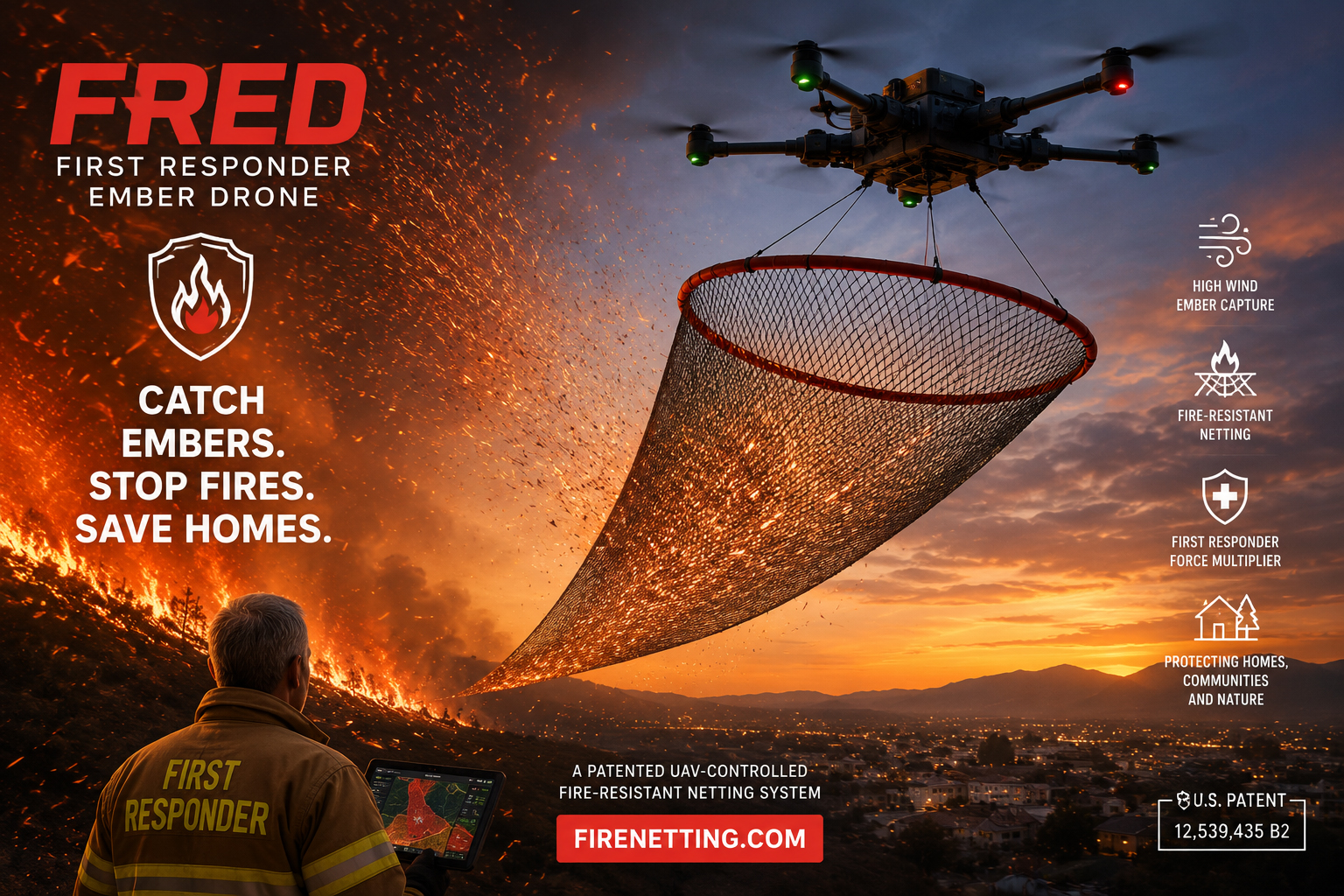
That is the gap FRED tries to think about. FRED stands for First Responder Ember Drone. The concept is simple to say and brutally difficult to engineer: use UAV-controlled fire-resistant netting to intercept windborne embers before they ignite the next structure, hillside, freeway edge, utility corridor, or fire line. FireNetting.com describes FRED as a patented UAV-controlled fire-resistant netting system designed for ember interception. The patent materials describe mesh netting with fire-resistant properties coupled to a UAV, with the aircraft maintaining the netting aloft and adjusting its position relative to flying embers.
I do not pretend that this is easy. In fact, the opposite is true. The more I read about Japan’s drone engineers, the more respectful I become of the engineering mountain. Wind is not a polite customer. Fire is not a lab demo. Embers are chaotic. Batteries are limited. Payloads matter. Netting has drag. Command systems need trust. Fire agencies need evidence, not enthusiasm. Public-safety technology has to survive reality.
Why Japan’s drone companies made me hopeful
Japan’s drone industry seems unusually suited to hard, practical, mission-specific problems. ACSL’s domestic-drone work speaks to economic security and trusted public-sector equipment. Terra Drone shows how Japanese drone companies can build global inspection and defense-adjacent relationships. Aeronext and NEXT DELIVERY show how airframes and logistics systems must be designed around real routes, not slogans. Blue Innovation shows the importance of command platforms, disaster imaging, and robotics integration. Liberaware shows that the most important drone in the room may be a palm-sized machine going where humans should not. NTT e-Drone and Sumitomo show how agriculture drones are not a novelty when farmers are aging. PRODRONE shows the value of building mission-specific aircraft for harsh work. Hydrogen and heavy-lift developers remind us that endurance and payload are often the real story.
Those are not abstract lessons. They are the exact categories FRED must learn from. A viable ember-interception system would need airframe discipline, high-wind thinking, sensor integration, fire-resistant materials, autonomy, communications, deployment logistics, field testing, training, maintenance, insurance thinking, and agency trust. No single inventor should pretend to carry that alone.
That is why this letter is not a victory lap. It is a respectful invitation. Japan has drone builders who understand precision. Japan has disaster-response culture. Japan has forests, mountains, typhoons, earthquakes, rural depopulation, aging infrastructure, and public agencies that understand preparedness. Japan also has a manufacturing culture that takes materials, repeatability, testing, and field reliability seriously. That combination deserves attention.
FRED is not asking Japan to applaud. FRED is asking Japan to test.
The wrong way to introduce FRED would be to say, “Here is the answer.” The right way is to say, “Here is a patented concept. Here is the public-safety problem. Who has the drone technology, fire science, test range, simulation tools, materials expertise, insurance perspective, and emergency-management discipline to see whether this can become useful?”
That is the spirit of this publisher’s letter. I am proud of FRED, but I am also humbled by the companies in this Japan drone issue. Their work reminds me how many pieces are required before an idea becomes a tool. A website can explain a concept. A patent can protect an architecture. A simulation can teach instinct. But field technology needs partners. It needs pilots. It needs engineers who say no. It needs firefighters who know where the fantasy ends. It needs materials people who understand heat and drag. It needs drone manufacturers who understand high-wind operations, payload stability, redundancy, batteries, tethers, and failure modes.
In that sense, FRED is less a product announcement than a question placed on the table: can the drone industry help create a new layer of ember defense?
The Japanese opportunity: not copying California, but improving the idea
Japan does not need to copy California’s wildfire experience. Japan has its own geography, climate risks, emergency systems, and land-use patterns. But Japan can study ember movement, firebreak protection, roadway edges, forest-village interfaces, utility corridors, evacuation routes, and mountainous terrain in its own way. The question is not whether every California idea belongs in Japan. The question is whether Japan’s drone and disaster-response ecosystem can help improve a difficult concept that may matter wherever wind turns fire into a traveling threat.
There may be multiple paths. One path is a test program with fire researchers and drone engineers. Another is simulation and training. Another is controlled ember and airflow work with fire-resistant net materials. Another is a tethered or assisted-lift system. Another is a drone swarm carrying a larger net. Another is a road-edge or utility-corridor defense use case where the geometry is easier than open wildfire airspace. Another is an emergency demonstration at a safe test range where the first goal is not heroism, but measurement.
The Japan drone issue made one thing clear: the best drone companies are not selling magic. They are narrowing problems until engineering can touch them. FRED has to do the same.
A note to Japanese drone companies, researchers, fire agencies, and investors
This letter is an invitation, not a demand. If you build drones in Japan, I admire what you are doing. If you work in disaster response, I respect the burden you carry. If you are a researcher, I would rather hear your hard questions than easy compliments. If you are an investor, please understand that FRED is not a quick gadget. It is a public-safety technology challenge with patent protection, field urgency, and a long road to serious deployment.
At FireNetting.com, there is more information about the concept, patent, simulation, and partnership interest. Firenetting is seeking serious conversations with fire agencies, emergency management leaders, insurers, utilities, drone manufacturers, wildfire researchers, and strategic partners. That is the right list because ember defense crosses industries. It is not only a drone problem. It is a fire problem, a wind problem, a materials problem, a command problem, a training problem, and a public-trust problem.
Why publish this on Japan.co.jp?
Because Japan.co.jp is my publication, and readers deserve to know when the publisher has a personal stake in a topic. That is why this page is labeled as a Publisher’s Letter. It is not hidden inside a news story. It is not pretending to be independent reporting. It is transparent opinion from the person who owns the site and invented the technology being discussed.
I believe that makes the piece stronger, not weaker. If I am proud of Japan’s drone companies, I should say so. If reading about them makes me hope for FRED partnerships in Japan, I should say that too. But I should say it plainly, with disclosure at the top, and with respect for the reader.
What I learned from Japan’s drone moment
| Lesson | Why it matters for FRED |
|---|---|
| Mission-specific drones matter | FRED cannot be a generic drone with a net. It needs aircraft, netting, sensors, and controls built around ember interception. |
| Disaster response needs systems | A drone alone is not enough. Command, training, data, deployment, safety, and agency trust are part of the product. |
| Payload and wind are unforgiving | Fire-resistant netting creates drag and stability challenges. Japanese heavy-lift, tethering, and endurance work may be relevant. |
| Small steps are better than slogans | The right first win may be controlled testing, simulation, road-edge defense, or utility-corridor trials — not dramatic wildfire heroics. |
| Humility is engineering fuel | The more serious the problem, the more important it is to invite criticism, testing, and better partners. |
My hope
My hope is simple. I hope Japan.co.jp’s drone issue helps readers appreciate the seriousness of Japan’s drone market. I hope Japanese companies see that the world is watching their work with respect. I hope FRED can be introduced honestly to people who may have the skills to challenge it, improve it, test it, or partner with it. And I hope the conversation stays focused on the public-safety problem: embers that move faster than the line of defense.
Maybe FRED becomes a Japanese partnership. Maybe it becomes a California test program with Japanese engineering advice. Maybe it becomes a better simulation. Maybe it becomes a research collaboration. Maybe the most valuable result is that a Japanese engineer tells me why one part of the idea is wrong, and how to make it less wrong. That would be progress too.
There is no shame in being humbled by excellent work. This week, Japan’s drone builders humbled me. They also encouraged me.
The fire will not wait for perfect technology. But public-safety technology should still be honest, tested, disclosed, and built with people who know what they are doing. That is the kind of partnership FRED needs. That is the kind of drone market Japan appears to be building.
Bradley Bartz
Publisher, Japan.co.jp
Inventor and patent holder, FRED — First Responder Ember Drone
www.FireNetting.com
- This is a Publisher’s Letter by Bradley Bartz.
- Bartz is the publisher of Japan.co.jp and the inventor/patent holder of FRED.
- FRED is a patented UAV-controlled fire-resistant netting concept intended to intercept wildfire embers.
- The Japanese drone companies covered in this issue did not sponsor this letter or review it before publication.
- The purpose is disclosure, appreciation, and an invitation for serious technical conversation.
Sources and references
This Publisher’s Letter draws on Japan.co.jp’s June 23 drone issue, public materials from FireNetting/FRED, and public patent references. It is opinion, clearly disclosed, and should be read separately from Japan.co.jp’s reported company profiles.