Japan’s drones are no longer just flying cameras
There was a time when drones in Japan felt slightly awkward. Fly one in a park and someone worried. Fly one in a city and someone called it dangerous. See one in the news and the story often became about restrictions, licenses, complaints, or common sense. Safety matters, of course. But in 2026, anyone who still treats drones mainly as toys or aerial cameras is missing one of the more important industrial stories in Japan.
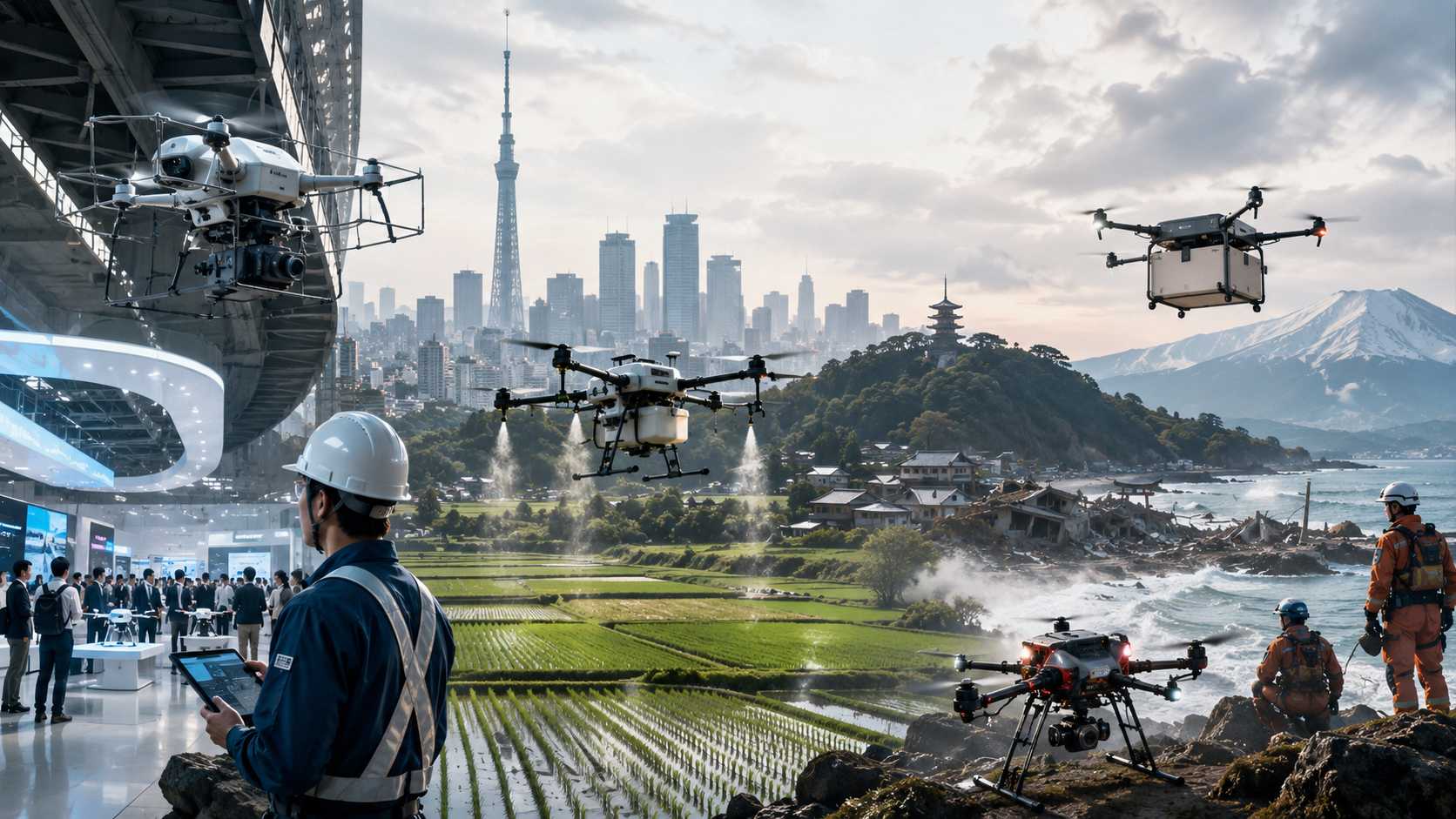
Drones are now pulling together several of Japan’s biggest problems: aging farmers, depopulated mountain villages, last-mile delivery, bridges and factories that need inspection, nighttime disasters, port resilience, coastal defense, and the security lessons of Ukraine. This looks like a story about small machines in the sky. It is really a story about a shrinking country trying to extend its hands, eyes, and reach.
Japan Drone 2026, held June 3 to 5 at Makuhari Messe, made that shift visible. The official show profile listed the 11th anniversary event with 300 planned exhibitors and 23,000 planned visitors. Those numbers alone sound like trade-show arithmetic. But the sectors tell the real story: agriculture, logistics, construction, infrastructure inspection, smart cities, advanced air mobility, and defense-adjacent systems. Drones are no longer one product category. They are becoming a layer across Japan’s infrastructure.
ACSL: the made-in-Japan drone becomes an economic-security tool
ACSL deserves a central place in the story. The company has become one of Japan’s most important domestic industrial drone makers, and in 2026 its position increasingly sits at the intersection of technology, procurement, and economic security. In June, ACSL said government officials and senior Japan Self-Defense Forces personnel visited its Japan Drone 2026 exhibit, accompanied by JUIDA. The company showed the latest features of SOTEN, which ACSL says is currently deployed by the JSDF, along with a next-generation small aerial photography drone under development.
That is not just a polite trade-show anecdote. It points to the question behind Japan’s domestic drone push: whose platforms should be used for public safety, infrastructure, emergency response, police, fire, and defense-related work? Chinese manufacturers built an enormous lead in global civil drones through performance, price, scale, and rapid iteration. But when the drone is used at a power plant, a port, a police scene, a disaster area, or a defense exercise, the supply-chain question becomes political.
ACSL also announced a large domestic project order in June worth about ¥1 billion for small aerial photography drones, with delivery scheduled for December 2026. It had announced other domestic large project orders earlier in the year. That matters because the domestic-drone argument is moving from speeches to purchase orders. A drone industry does not become real when a prototype flies at a show. It becomes real when agencies buy it, operators train on it, spare parts exist, and people trust it in ugly weather.
Terra Drone: from inspection company to geopolitical company
Terra Drone represents a different side of Japan’s drone story. The company built its reputation around surveying, industrial inspection, oil and gas infrastructure, overseas operations, and UTM. It was already one of Japan’s most globally ambitious drone companies. Then, in 2026, the company’s name appeared in a much sharper context: interceptor drones and Ukraine.
Terra Drone announced a strategic investment in Ukraine-based Amazing Drones and the launch of Terra A1, a low-cost interceptor drone. In April, Reuters reported that Russia summoned Japan’s ambassador over the Japanese company’s investment in Ukrainian interceptor-drone technology. That moment says something powerful about the industry. A drone-company investment became a diplomatic incident. The era of drones as mere inspection tools is over.
The Terra Drone story has two faces. One face is industrial: tank farms, plants, mapping, surveying, and infrastructure. The other is strategic: Ukraine, interceptor drones, low-cost air defense, and the economics of modern conflict. The two are not identical, but they share foundations: sensors, autonomy, communications, manufacturing, field support, and operational learning. Japan has long been cautious around dual-use technology. Drones make that caution harder to maintain because the same ecosystem can serve bridges, farms, ports, and security.
Ukraine comes to Tokyo
On June 19, Reuters reported that Ukrainian drone makers are targeting Asia, including Japan and Taiwan, as regional tensions increase. Ukrainian firms such as UFORCE, Skyeton, and General Cherry are seeking partnerships, production agreements, and defense-industry routes into Asian markets. Reuters also reported that Japan has allocated nearly $2 billion to drone systems in this year’s defense budget and aims to raise drone production dramatically by the end of the decade.
Japan faces a difficult choice. Its postwar habits, caution over weapons exports, and concern over corporate reputation do not vanish overnight. But Ukraine has taught the world that unmanned systems are no longer a sideshow. Cheap drones, interceptor drones, sea drones, swarm software, and battlefield iteration have changed the economics of conflict.
The real question for Japan is not whether it wants war. It is the opposite. What industrial base and deterrent capacity does a peaceful island nation need in a world where unmanned systems are now basic military grammar? Look at the map: Taiwan, China, Russia, North Korea, the Nansei Islands, long coastlines, ports, radar sites, and remote islands. Drones turn geography into a procurement question.
Aeronext and NEXT DELIVERY: the last house beyond the mountain
Defense is only one side of the drone story. Logistics may be the more quietly Japanese one. Aeronext announced that it would unveil a new Japanese-made logistics drone equipped with its ActiveWing technology at Japan Drone 2026. NEXT DELIVERY, Aeronext’s strategic subsidiary, works on drone-based logistics infrastructure through SkyHub.
This is not the silly future where a young urban consumer receives a latte by air because a venture capitalist needed a slide deck. The real Japanese logistics question is rural. A mountain village. An island. A depopulated town. An elderly resident waiting for medicine. A driver who retired last year and has not been replaced. A road closed by rain, snow, or landslide. In those places, drone delivery is not a stunt. It is a test of whether technology can keep ordinary life stitched together.
The hard part is not simply making a drone fly with a package. Payload changes energy consumption. Wind changes range. Landing areas are scarce. Residents must accept the system. Insurers, municipalities, operators, and regulators must agree on what is safe. Japan’s opportunity here is not just hardware. It is designing a community logistics system where drones, trucks, local depots, nurses, shops, and town halls work together.
Blue Innovation: when helicopters stop flying, drones keep seeing
Blue Innovation shows why disaster response may become one of Japan’s most natural drone markets. In March 2026, during a forest fire on Mount Ogi in Yamanashi Prefecture, Blue Innovation deployed drones for nighttime aerial imaging. DroneLife reported that the company responded through a request from the Japan Ground Self-Defense Force Eastern Army relayed by JUIDA, helping identify active fire points and map coordinates.
That use case is brutally practical. At night, helicopters may stop. Slopes may be too dangerous. Smoke hides the fire’s movement. Firefighters need to know where the fire is, where it is spreading, and where to send crews at first light. Drones do not need to be heroic to matter. They need to see when humans cannot.
Japan lives with earthquakes, typhoons, landslides, tsunamis, volcanic risks, floods, and fires. In the first hours of a disaster, information is often the most precious commodity. Which roads are passable? Which bridges are damaged? Which neighborhoods are cut off? Which buildings are dangerous? A drone sent before a human is not a cold replacement for people. It is a way to protect them.
Liberaware: the drone for narrow, dark, dirty places
Liberaware’s IBIS2 may be one of the most Japanese machines in this entire issue. It is not built to fly across the country or carry a heavy payload. It is a tiny inspection drone, about 20 centimeters in size and about 243 grams, designed for confined indoor spaces. Pipes, ducts, chimneys, attics, underground pits, boilers, tanks, sewers, culverts, and awkward industrial corners: these are not glamorous places, but they are where infrastructure ages.
Japan’s infrastructure problem is not abstract. Bridges, tunnels, plants, apartment blocks, factories, water systems, and power facilities built during the high-growth era are getting older. Inspection work is dangerous, dull, skilled, and hard to staff. Sending a human into a narrow, dark, dirty space should not be the default if a small flying robot can take the first look.
Drones are usually imagined against blue sky. Liberaware points in the opposite direction: inside. Behind walls. Under floors. Into ducts. Along pipes. The country’s most useful drone may not be the largest aircraft in the sky, but the tiny one carrying a light into a place nobody wants to enter.
NTT e-Drone and Sumitomo: rice fields become smart infrastructure
Agriculture drones are also more than convenience tools. In February 2026, Sumitomo Corporation and NTT e-Drone Technology launched a marketing collaboration to expand adoption of domestically produced agricultural drones. The companies said the collaboration follows the consolidation and transfer of development resources associated with Nileworks and is intended to support sustainable agriculture and food security.
Japanese agriculture shows the labor problem clearly. Farmers are aging. Fields are being abandoned. Summer heat is harsher. Work remains physical. Drones used for spraying, mapping, crop monitoring, and field management can reduce labor without pretending that farming is easy. They are not machines for laziness. They are machines for continuity.
Food security can sound like a cabinet-office phrase. In practice, it means someone has to check the field, spray at the right time, understand crop conditions, and keep production going. A domestic agricultural drone is not just a gadget over a rice paddy. It is a tool for keeping rural production viable.
PRODRONE: monozukuri for rough work
PRODRONE shows the industrial side of Japanese drone culture. The company highlights professional mission-specific machines, including sea-air hybrid drones for underwater inspection, rescue drones, high-speed models, and AI-powered control systems. JETRO’s profile emphasizes the company’s ability to design drones, control systems, and flight-management software, with durable aircraft that can operate in harsh natural environments such as disaster sites.
This is a different kind of Japanese craftsmanship. Not the tiny, elegant product in a showroom, but the tough tool used in rain, wind, sea spray, disaster debris, and industrial grime. Drones will not become infrastructure if they are only beautiful under trade-show lights. They must survive field work.
Heavy payloads, rescue equipment, coastal operations, underwater inspection, rough weather, and damaged sites all demand drones that are more tool than toy. PRODRONE’s role in the story is to remind us that the future of robotics is not only sleek. Sometimes it is wet, dirty, and carrying a red equipment case over a stormy shore.
The battery is the leash
Many drones share one invisible leash: the battery. Flight time limits everything. Carry a heavier payload and endurance drops. Fly over mountains and you need safety margin. Fly over water and you need confidence. Use drones in a disaster and charging time becomes operational friction.
That is why long-endurance, heavy-lift, VTOL, hydrogen, fuel-cell, and hybrid systems are attracting attention. Japan has industrial capabilities that fit this challenge: batteries, fuel cells, materials, precision controls, port logistics, disaster operations, and manufacturing discipline. The next race may not be the most beautiful drone. It may be the drone that can stay useful for long enough to complete the job.
This is where Japan may have room to compete. Not by trying to win every consumer drone market, but by building reliable systems for industrial and public-service missions where energy, payload, safety, maintenance, and operations all matter.
Regulation is not the enemy, unless it becomes a blanket
No serious Japan drone story can avoid regulation. Dense cities, airport zones, night flights, beyond-visual-line-of-sight operations, flights over third parties, aircraft certification, and pilot licensing all matter. Drones can fall. They can injure people. They can invade privacy. They can annoy neighborhoods. Regulation is necessary.
But Japan also has a bad habit of becoming comfortable inside meetings, guidelines, demonstration projects, and paperwork. Safety rules should stop dangerous uses. They should not quietly block necessary uses until the pilot project becomes the permanent state of the industry.
There is risk in flying drones. There is also risk in not flying them. A disaster area with no information. A bridge that cannot be inspected. A remote community with no delivery route. An agricultural sector without enough workers. A defense force behind the technology curve. Those are risks too.
Can Japan become a flying-robot country?
Yes, but probably not in the flashy consumer sense. Japan may not build the world’s dominant mass-market hobby-drone empire. That market has already been shaped by scale and price. Japan’s stronger path is more practical: trusted domestic drones for public agencies, disaster response, agriculture, infrastructure inspection, rural logistics, ports, heavy industrial use, and defense-related unmanned systems.
Drones reflect Japan’s weaknesses: not enough workers, aging farmers, many mountains, many islands, many disasters, old infrastructure, and a tense neighborhood. They also reflect Japan’s strengths: precision manufacturing, sensors, materials, logistics, local-government discipline, disaster experience, and a culture of operational improvement.
That is why the 2026 drone industry should not be laughed off. It is still imperfect. It may be too expensive. Deployment may be slower than exhibition-booth enthusiasm. Regulation will be heavy. China’s scale will remain formidable. But Japan needs this industry. Not because drones are fashionable. Because they answer problems Japan can no longer solve with human labor alone.
The Japanese sky will not be filled only with futuristic dreams. It may be filled with machines that protect rice, inspect bridges, fly at night above fires, carry medicine to mountain towns, patrol ports, and help a peaceful country prepare for an unmanned age.
Until recently, a drone was a machine that asked, “May I fly here?” The next question will be different: “Where will Japan be in trouble if it does not?”
- Japan Drone 2026 showed that drones now cut across agriculture, logistics, construction, inspection, cities, and security.
- ACSL is becoming a central name in domestic-drone procurement and economic security.
- Terra Drone shows how an industrial inspection company can suddenly become part of a geopolitical story.
- Aeronext, NEXT DELIVERY, NTT e-Drone, Liberaware, Blue Innovation, and PRODRONE each address practical Japanese problems: rural delivery, farming, confined-space inspection, disaster response, and rugged field operations.
- The story is not about cool aerial photos. It is about how Japan handles labor shortage, aging infrastructure, disaster risk, and defense anxiety.
Sources and references
This article is based on the Japan Drone 2026 official profile, public releases from ACSL, Terra Drone, Aeronext, Blue Innovation, Liberaware, Sumitomo/NTT e-Drone, PRODRONE/JETRO, and Reuters reporting. Dollar conversions use the Japan.co.jp market strip rate of 1 US dollar = 161.58 Japanese yen.
- Japan Drone 2026 official show profile
- ACSL: Government and defense officials visit ACSL exhibit during Japan Drone 2026
- ACSL: Notice concerning large project order
- Terra Drone: investment in Amazing Drones and Terra A1
- Reuters: Russia summons Japanese ambassador over Ukrainian drone investment
- Reuters: Ukrainian drone makers target Asia
- Aeronext: ActiveWing logistics drone at Japan Drone 2026
- DroneLife: Blue Innovation wildfire imaging in Japan
- Liberaware: IBIS2 ultra-narrow space inspection drone
- Sumitomo / NTT e-Drone: domestically produced agricultural drones
- PRODRONE official site
- JETRO: PRODRONE company profile