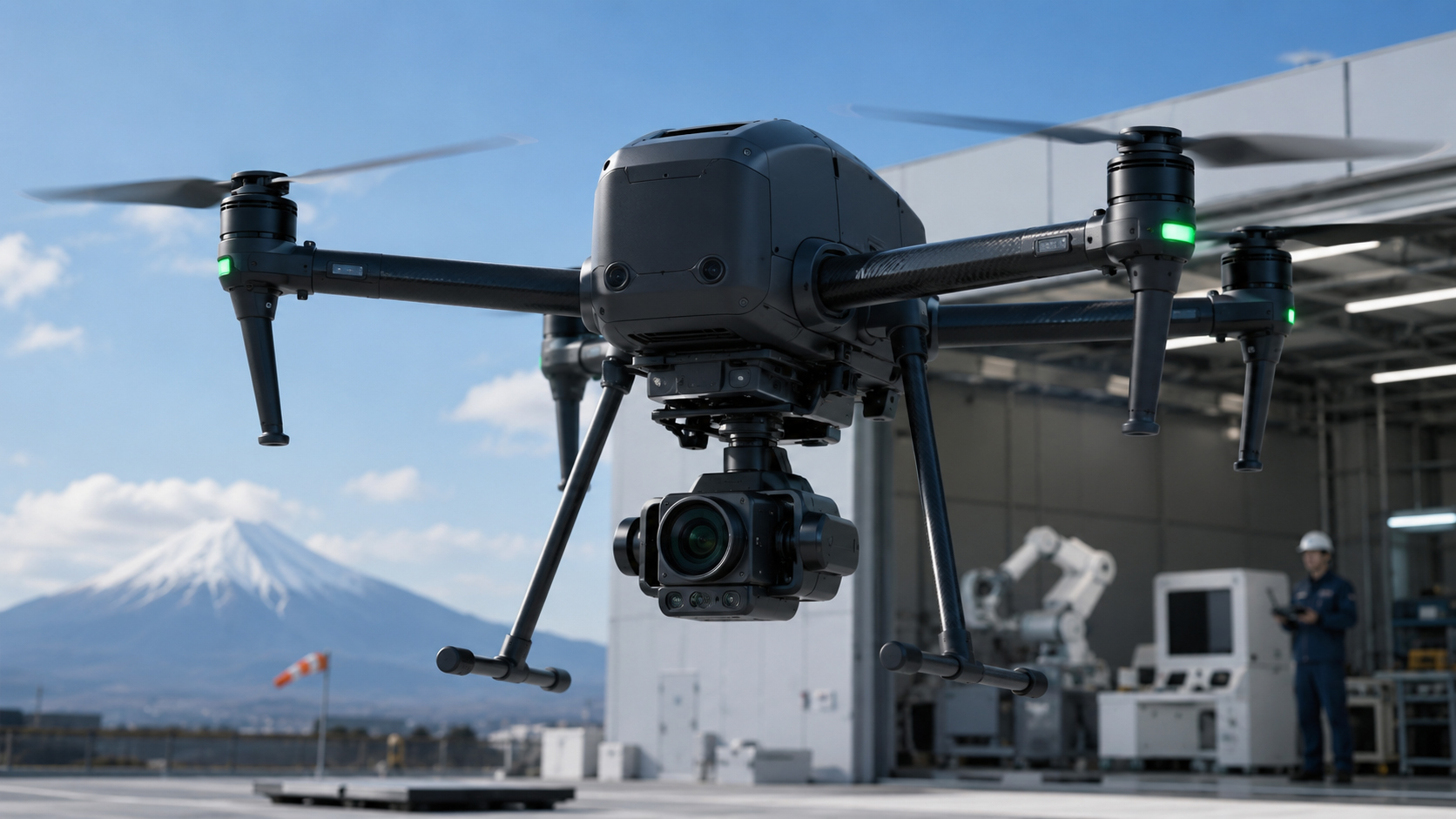
Drones have stopped being flying cameras. They are becoming national sensors.
If you still think of drones as toys with cameras, ACSL’s recent news can look almost boring. A small drone. A trade show. A defense procurement order. A government visit. Secure data. Domestic production. None of that sounds like science fiction. But in 2026 Japan, those plain words have become heavy.
Look at where drones fly. After typhoons and earthquakes. Under bridges. Above transmission lines. Around port facilities. Along mountain fire lines. Over islands. Across factory roofs. Near radar sites. At construction sites, riverbanks, farms, and police cordons. The camera may be small, but the information can be sensitive. A drone can reveal damage, routes, weak points, live operations, movement, terrain, and infrastructure status.
That means the drone is no longer merely a convenience tool. It is a sensor in the nervous system of society. And once a sensor becomes important, the deeper questions arrive. Who built it? Where does the data go? What communications path does it use? Who updates the software? Who can repair it during an emergency? What happens if imports stop? What happens if a vendor becomes politically unusable?
Why ACSL matters now
ACSL describes itself as a company that develops and implements industrial drones for logistics, infrastructure inspection, disaster prevention, and emerging use cases. But in 2026, the company’s story has moved more clearly into the language of economic security. In its medium-term plan, ACSL has positioned contributions to defense and security as a key strategy, including stronger participation in Japanese government procurement and Ministry of Defense-related opportunities.
In March 2026, ACSL announced a large project order for small aerial photography drones valued at ¥1 billion. At the Japan.co.jp market strip rate of ¥161.58 per U.S. dollar, that is about $6.19 million. In April, the company said it had received two additional large-scale projects related to small aerial photography drones through Ministry of Defense bidding processes. The amount matters, but the larger signal matters more: reliability, domestic production, and secure procurement are becoming procurement criteria, not just marketing language.
Then came Japan Drone 2026. ACSL said government officials and senior Japan Self-Defense Forces personnel visited its exhibit, accompanied by JUIDA. The company introduced the latest features of SOTEN, which it says is currently deployed by the JSDF, as well as a next-generation small aerial photography drone under development. One exhibit booth does not make an industrial policy. But placed in sequence, the news shows a procurement mindset changing.
SOTEN: a modest-looking aircraft with a very serious job
SOTEN is not a giant military unmanned aircraft. It is not the kind of drone that looks dramatic in a war movie. At first glance, it is a small professional quadcopter. But its purpose is more serious than its size suggests. ACSL presents SOTEN as a small Japan-made drone with advanced measures to secure communications, flight data, and photo/video data. The company targets missions such as disaster response, inspection, and survey work where data security must be assured.
That is the central point. When a public agency, utility, infrastructure operator, or emergency team uses a drone, the risk is not only that the aircraft may crash. The risk is also information leakage. A drone collects images, position logs, flight paths, facility details, and sometimes operational patterns. If that information moves through a channel the operator does not trust, the aircraft becomes not a solution but a new vulnerability.
In 2024, ACSL announced that its Japan-made drone had been adopted as an aerial photography drone by the Japan Air Self-Defense Force. In that announcement, the company was unusually direct: it said it would focus on Japanese government procurement where economic security and non-Chinese products could leverage its strengths. That sentence captured the new drone era. Performance still matters. Price still matters. But trust has become part of the specification.
“Away from DJI” is not enough
No serious discussion of Japanese drones can avoid the shadow of DJI. The Chinese manufacturer has long dominated the small-drone market worldwide. Its products have been affordable, powerful, easy to use, camera-rich, and available. For many field operators, DJI became the default because it worked.
But for governments and critical infrastructure operators, “it works” is no longer the entire test. In the United States, restrictions on government procurement of Russian and Chinese-made drones and security concerns around Chinese vendors have reshaped the market. Japan is moving through the same global weather. The concern is not a simple anti-China slogan. It is supply-chain risk, data governance, cyber risk, software updates, spare parts, export controls, and emergency resilience.
Still, “move away from DJI” is not an industrial policy by itself. A replacement drone that is too expensive, less capable, hard to repair, short on batteries, slow to update, or clumsy in the field will struggle. People on the ground are not paid to admire procurement philosophy. They need a machine that gets the job done.
That is why ACSL’s challenge is so interesting. Being Japanese-made may open the door. Staying in the room requires performance, pricing, availability, support, software, and field usability.
Disaster response and defense are closer than people think
In Japan, the word “defense” often carries political tension. “Disaster prevention” does not. But in drone technology, the two are technically close. Fly where humans should not go. See far. Map damaged areas. Operate in bad weather. Maintain communications. Launch quickly. Help people make decisions before roads are open or aircraft can land.
A drone useful after an earthquake may also be useful in a security emergency. A drone hardened for defense communications may also be valuable during a flood, landslide, or fire. This is the dual-use character of the industry. Japan has often been more comfortable building precise, rugged, field-reliable systems than building theatrical weapons. ACSL may fit that national muscle memory.
Japan’s Defense Ministry has been reported to be considering large-scale drone systems for coastal defense, with the fiscal 2026 budget including major funds for drone-related systems. If Japan seriously moves toward operating many thousands of drones, the country will need more than aircraft. It will need maintenance, secure parts pipelines, training, mission software, flight logs, replacement batteries, and operator trust. Buying drones is easy. Becoming a drone-operating country is hard.
Government procurement is a tailwind — and a trap
Government procurement can be a powerful tailwind for a domestic drone maker. It creates early demand, produces reference customers, and forces a company through security, reliability, and documentation standards. ACSL’s Ministry of Defense-related orders and JSDF deployment record can help private-sector customers feel safer about the product. A municipal government, survey company, fire department, construction company, or utility may take confidence from the fact that the aircraft is used in public-sector operations.
But relying too heavily on government procurement can also create weakness. Specifications can become heavy. Product cycles can slow. Paper compliance can become more important than field usability. Procurement rhythms can drag behind the global technology cycle. A company can become good at winning documents and bad at delighting users.
The best path for ACSL is therefore not simply becoming a government supplier. It is using government trust to build a better general-purpose professional platform — one that works for bridge inspections, disaster mapping, police and fire departments, construction, agriculture, port authorities, energy operators, and overseas public-sector buyers.
PF2-CAT3 and the quiet power of certification
ACSL’s work is not limited to SOTEN. The company has also emphasized PF2-CAT3, which ACSL has described as the only aircraft in Japan with a Class 1 UAS type certificate, and has announced renewal of that type certification. For casual readers, certification sounds like a bureaucratic footnote. In drone deployment, it is closer to the bridge between invention and society.
The Japanese sky is not a free-for-all. Drone logistics, infrastructure inspection, urban operations, and beyond-visual-line-of-sight flights require a regulatory pathway. A drone company that understands the certification regime and can keep aircraft inside legal and operational frameworks has an advantage. It is not just building a flying machine. It is building something institutions can actually adopt.
This is one reason Japan’s drone future will not be decided only by flashy prototypes. It will be decided by boring systems: maintenance logs, operator training, software updates, certification renewals, insurance, compliance, and support. The company that makes those boring systems reliable may win more of the real market than the company with the flashiest video.
Ukraine changed what the world thinks drones are
The war in Ukraine changed the global drone conversation. Small unmanned aircraft are no longer seen mainly as inspection tools or hobby aircraft. They are reconnaissance systems, artillery spotters, electronic-warfare platforms, interceptors, communication tools, and low-cost ways to change the battlefield. Japan cannot watch that transformation and pretend it belongs to another world.
In March 2026, ACSL announced that it had been approved to participate in the Japan–Ukraine Drone Cluster through its membership in the Ukrainian Chamber of Commerce in Japan. The significance is not that Japan should romanticize wartime technology. It should not. The significance is that Ukraine has developed a hard-earned operating culture around drones: rapid iteration, field repair, electronic resilience, low-cost scaling, and practical deployment.
Japan’s task is to learn carefully. The same lessons that keep a drone operating under electronic pressure may help keep emergency drones operating during a disaster. The same repair culture that keeps fleets alive in difficult conditions may be useful for island defense, firefighting, and infrastructure recovery. Drone cooperation should be treated with seriousness, not excitement for its own sake.
The weaknesses ACSL still has to solve
It would be easy to turn ACSL into a hero of domestic technology. That would also be lazy. The company has real opportunities, but it also faces hard structural problems.
First is scale. Compared with DJI, ACSL is small. Manufacturing volume, parts procurement, retail distribution, international support, price competition, and software iteration all become harder at smaller scale. Second is the complexity of the word “domestic.” A Japan-made drone may still depend on global electronics, sensors, semiconductors, batteries, and communications components. Economic security is not a sticker. It is a supply-chain architecture that must be explained and maintained.
Third is field adoption. Local governments and companies do not buy ideals alone. They buy within budgets, staff time, training limitations, tender rules, repair needs, and day-to-day workflows. If a secure domestic drone is too expensive or too awkward, operators will resist it. Economic security is a strong argument at the policy level. At the field level, the drone still has to fly well, produce usable data, and survive rough treatment.
What Japan-made drones must prove
| Condition | Why it matters |
|---|---|
| Secure data design | Flight logs, images, location data, and communications paths must be protected for public and infrastructure missions. |
| Performance and price | Domestic origin opens procurement doors, but field operators still need capability and value. |
| Repair and parts supply | Disaster response and defense operations cannot depend on a drone that becomes useless after one broken component. |
| Certification and compliance | Social implementation depends on aircraft that can operate inside Japanese aviation rules. |
| Usability in everyday work | Government credibility must translate into surveying, inspection, construction, disaster, and municipal workflows. |
“Made in Japan” must become a design philosophy, not nostalgia
There is a nostalgic version of “made in Japan.” It remembers the days when Japanese cameras, televisions, radios, and cars conquered the world. That memory is real, but it is not enough. ACSL’s story should not be read as a simple revival tale about old manufacturing glory.
The useful version of “made in Japan” is a design philosophy. Secure communications. Clear supply chains. Good documentation. Repairability. Safe data handling. Regulatory discipline. Field durability. Usable interfaces. A price that does not scare away public agencies. A support system that works after the sale. Exportable trust.
If ACSL can combine those qualities, its market may not stop at Japan. The United States, Canada, Taiwan, parts of Europe, and many public-sector buyers are rethinking reliance on Chinese-made drones. ACSL’s U.S. subsidiary has already positioned itself around NDAA-compliant drones, and the company has moved to expand in Canada. The global opening is real. Whether ACSL can fill it is the question.
Japan’s sky has become quietly political
Drones are small. They do not roar like fighter jets or dominate a skyline like aircraft carriers. But the meaning they carry is large. Mapping, rescue, surveillance, inspection, deterrence, logistics, farming, and emergency response all converge in the same class of machine. That is why the Japanese drone question is no longer only a technology question. It is a sovereignty question, a procurement question, a data question, and a social-infrastructure question.
ACSL is interesting because it is trying to domesticate that nervous system. One company cannot do it alone. Japan will need electronics firms, telecom companies, battery suppliers, AI engineers, local governments, universities, emergency agencies, infrastructure operators, and the Self-Defense Forces. But ACSL can be one of the nodes where those worlds connect.
When government officials and JSDF personnel looked at ACSL’s Japan Drone 2026 exhibit, they were not only looking at an aircraft. They were looking at a choice. In the next decade, Japan may operate many thousands of small aerial sensors. Will Japanese industry be on the stage, or merely in the audience?
ACSL’s altitude is still being decided. The question, however, has already landed.
- ACSL is building around SOTEN, a Japan-made small drone focused on secure communications, flight data, and photo/video data.
- In 2026, ACSL announced Ministry of Defense-related large project orders and positioned defense and security as a key strategic area.
- At Japan Drone 2026, government officials and senior JSDF personnel visited the ACSL exhibit, where SOTEN and a next-generation aerial photography drone were shown.
- The economic-security tailwind is real, but long-term success will still depend on price, performance, supply capacity, support, and field usability.
- Japan’s drone industry may become a bridge between disaster response, infrastructure inspection, agriculture, logistics, and defense.
Sources and references
This article draws on ACSL’s 2026 announcements, SOTEN product information, Japan Drone 2026 exhibition information, ACSL’s Japan–Ukraine Drone Cluster announcement, PF2-CAT3 certification-related releases, and reporting on Japanese defense drone procurement. Dollar conversions use the Japan.co.jp market strip rate of ¥161.58 per U.S. dollar.
- ACSL: Government and Defense Officials Visit ACSL Exhibit During Japan Drone 2026
- ACSL: Notice Concerning Large Project Order
- ACSL: Two Additional Large-Scale Projects Through Ministry of Defense Bidding
- ACSL: SOTEN product information
- ACSL: Made-in-Japan Drone Adopted by Japan Air Self-Defense Force
- ACSL: Japan–Ukraine Drone Cluster Participation
- Japan Drone / International Advanced Air Mobility Expo 2026