The day an inspection company started looking like a defense company
Terra Drone’s story did not begin as a war story. It began with bridges, tanks, chimneys, plants, farms and construction sites. Places too dangerous to climb, too expensive to scaffold, too important to ignore. It was a practical company with the smell of industrial work on its jacket.
Then 2026 opened a new page. A strategic investment in Ukraine’s Amazing Drones. The launch of Terra A1. Operational deployment in Ukraine. A later announcement that Terra Drone would acquire 50% of Amazing Drones and make it a consolidated subsidiary. A Tokyo drone company was inspecting Saudi oil infrastructure, talking unmanned traffic management, and moving Ukrainian interceptor technology toward global markets. That is not a small shift.
So this is not merely a profile of a company getting bigger. It is a story about Japan’s drone industry moving from infrastructure inspection into global energy, airspace management and defense.
The TSE Growth listing was not the finish line. It was the entrance exam.
Terra Drone listed on the Tokyo Stock Exchange Growth Market on November 29, 2024, under stock code 278A. When startups list, the story can look glamorous. In drones, a listing is less a victory ribbon than a business card for stricter customers.
Oil companies, electric utilities, chemical plants, governments, local authorities and defense customers are not moved by exciting demo footage alone. They ask about safety, liability, insurance, continuity, local support, data control, export controls, and whether the company will still exist next year. Public-company status gives Terra Drone a credibility layer. It also gives the market fewer excuses.
Terra Drone has worked across surveying, inspection, agriculture, UAS Traffic Management and Advanced Air Mobility. That matters. The future of drones will not be decided by aircraft alone. It will be decided by the system around them: where they fly, who authorizes them, how airspace is managed, how data is processed, how field crews use the information, and how safety standards become routine.
Aramco: the kind of customer that changes the scale
In 2025, Terra Drone signed a memorandum of understanding with Saudi Aramco to explore drone, robotics and AI-driven solutions for the oil and gas sector. Reuters reported that Terra Drone was expanding cooperation with Aramco, aiming to run inspection trials in 2025 and 2026, with possible operational work from 2027. If it becomes a final contract, it could become one of Terra Drone’s largest inspection projects in the sector.
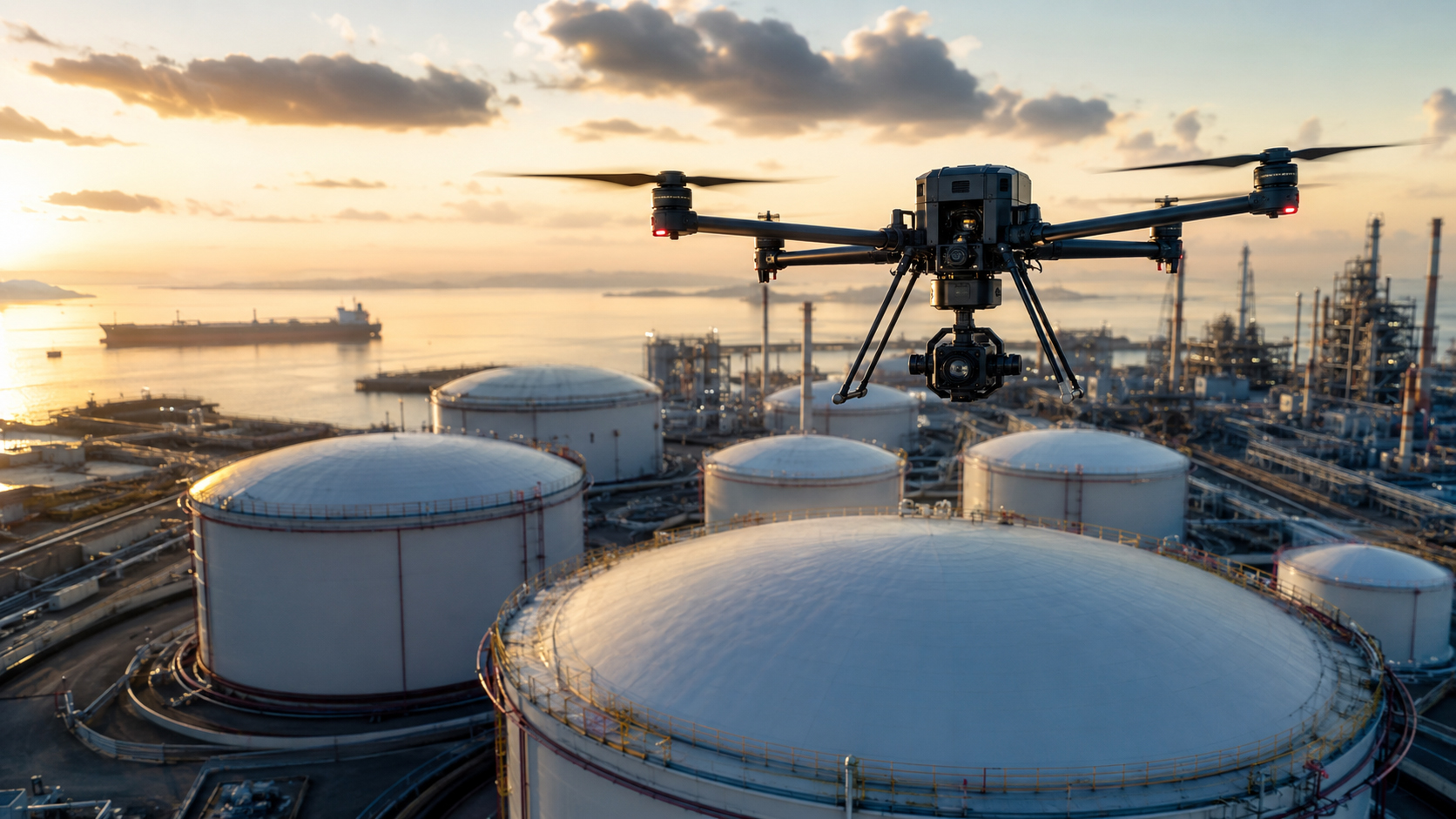
Why do oil tanks and plants matter? Because they are large, hot, high, dangerous, and expensive to stop. Tank roofs, boilers, pipes, chimneys, flare stacks, power equipment: human inspection can require scaffolding, shutdowns, fall protection and long work hours. Drones can raise inspection frequency, capture images, thermal data and 3D records, and help detect early warning signs.
But industrial drones are not magic. Flying is only the first layer. Industrial inspection requires stable control near structures, indoor flight where GPS may not work, strong sensors, data analysis, alignment with inspection standards, field training, and a customer workflow that actually changes. The winner is not simply a drone vendor. It is a company that can help change how work is done.
Terra Xross 1 and the reality of dark, narrow places
In 2025, Terra Drone launched Terra Xross 1, a Japan-made indoor inspection drone, simultaneously in Japan and the United States. “Indoor inspection drone” sounds modest. In industry, modest is often where the money lives.
Older factories, pipe-filled plants, confined spaces, tank interiors, ceiling voids, underground facilities: before a human enters, a small machine can shine a light, capture images and identify danger. That is workplace safety. It is asset maintenance. It is insurance. It is management.
Japan’s infrastructure is aging. Skilled workers are retiring. Industrial sites cannot survive forever on heroic human effort. Inspection drones are not a futuristic show. They are tools for an aging industrial country trying to keep tomorrow’s work possible.
Ukraine changed the economics of the sky
The defense turn changed Terra Drone’s 2026 story. In March, the company announced a strategic investment in Ukraine-based Amazing Drones and the launch of Terra A1. In April, it announced operational deployment of Terra A1 in Ukraine. In June, it announced that it would acquire 50% of Amazing Drones through Terra Defense Europe and consolidate the company as a subsidiary.
Behind that move is the new air-defense arithmetic exposed by the war in Ukraine. If defenders keep firing expensive missiles at cheap drones, the defender loses money even when the shot succeeds. Shahed-type long-range drones, cheap FPV aircraft, and massed small systems have changed the cost structure of air warfare. The interceptor must become cheaper, faster and easier to update.
Reuters reported in April that Gulf states were eyeing low-cost interceptor drones such as Terra A1, as cheap drone attacks strained costly missile stocks. The reported comparison was brutal: expensive missile interceptors on one side, relatively cheap incoming drones on the other. Terra Drone’s new hypothesis is that Japanese manufacturing, quality control and scale-up discipline might matter in defense-drone economics.
The hard part of being a Japanese defense-drone company
This cannot be treated as a clean applause line. Japan has a deeply cautious political culture around defense equipment transfers and arms exports. Drones are dual-use technology. That ambiguity is useful. It is also combustible.
Inspection drones protect equipment. Agricultural drones support food production. Delivery drones can help mountain towns. Interceptor drones are clearly defense tools. When they connect to Ukraine, an active war zone, corporate responsibility becomes heavier.
Japan.co.jp should not smooth this over. Japanese technology being valued in the global defense market is industrially significant. But companies, investors, government officials and readers must keep asking what is being sold, where it will be used, and under what rules. Economic security is not a magic phrase that removes ethical and political complexity.
Terra Drone’s strength is that it is not only one kind of company
Terra Drone is not a pure aircraft maker. It is not a pure software company. It is not only an inspection contractor. That makes it harder to describe — and more interesting.
Industrial inspection puts the company inside real customer pain. UTM forces it to understand airspace, regulation and software infrastructure. Overseas expansion teaches local partnerships, procurement cultures and support models. Defense work in Ukraine brings frighteningly fast feedback from a brutal environment. If these layers connect, Terra Drone becomes less a drone seller and more a low-altitude operations company.
Low altitude is the commercial layer between the ground and traditional aviation. Inspection, delivery, agriculture, surveying, surveillance, disaster response, defense and advanced air mobility all want pieces of it. Terra Drone is trying to make parts of that layer operable.
The cold reality: revenue is not profit
At this point, Terra Drone can sound like a future winner. The public-company reality is colder. Drone businesses consume cash: research, engineering talent, overseas offices, regulatory work, sales, local support, insurance, inventory and quality control. Revenue can rise before profit arrives.
Defense markets are large, but they are slow. Government procurement follows budgets, politics and national-security logic. Oil-and-gas inspection can take a long route from proof-of-concept to contract. Agriculture and logistics depend on regulation, labor shortages and price. Terra Drone has many opportunities, which means it also has many promises.
Investors should watch the practical path: which line becomes recurring revenue? How quickly does the Aramco relationship move? Can the Amazing Drones defense effort move from field feedback to production, export and support? When do UTM and AAM software become durable business pillars? The company will be judged by execution, not by the cinematic quality of its drone videos.
What it means for Japan
Japan’s drone industry has long had to think about its dependence on Chinese drones. On price and scale, Chinese manufacturers are formidable. But government, critical infrastructure, defense, disaster response and energy facilities cannot choose only by price. Where does the data go? Can the parts supply stop? Who manages software updates? Can the system be supported domestically in an emergency?
If ACSL represents Japan’s secure domestic aircraft argument, Terra Drone represents the global operations argument. They are both “Japanese drone companies,” but they are not fighting the same battle. ACSL pushes Japan-made hardware trust. Terra Drone pushes overseas field operations, industrial inspection, airspace management and defense networks.
If Japan wins in drones, it may not be by flooding the world with the cheapest aircraft. A more Japanese path may be reliability, field operations, critical infrastructure, security and long-term support. Terra Drone is one of the companies testing that thesis most aggressively.
What to watch
| Signal | Why it matters |
|---|---|
| Aramco work | A move from trials to contract would validate Terra Drone’s industrial inspection ambitions at global scale. |
| Terra A1 | Low-cost interceptor drones could alter air-defense economics, but export controls and political risk are serious. |
| Amazing Drones consolidation | Moving from investment to a 50% stake makes defense a more formal group strategy. |
| Indoor inspection | Terra Xross 1 and similar tools could create repeat demand across aging plants and infrastructure. |
| UTM/AAM | As low-altitude airspace gets busier, traffic-management software and regulatory expertise become more valuable. |
Conclusion: not a sky company, a field company
To understand Terra Drone, do not stare only at the aircraft. Look at the field. The roof of an oil tank. The inside of a power plant. A construction site. A farm. The rules of low-altitude airspace. A battlefield in Ukraine. The common problem is that humans alone are too exposed, too slow, too expensive, or too few.
Terra Drone has been inserting drones into that problem. In 2026, the insertion point expanded to defense. That is a growth story. It is also a risk story.
Japan’s drone industry can no longer be reduced to hobby photography or future package delivery. It now touches critical infrastructure, disaster readiness, agriculture, defense, international politics, export controls and public-company earnings. Small machines have flown into a much larger world.
Terra Drone is becoming one of the companies carrying that complexity.
- Terra Drone listed on the Tokyo Stock Exchange Growth Market in November 2024.
- The company operates across surveying, inspection, agriculture, UTM and AAM-related fields.
- Its Aramco relationship could become a major test of global industrial drone inspection.
- Its Terra A1 work with Ukraine’s Amazing Drones moved the company directly into the defense-drone conversation.
- As a Japanese company, Terra Drone must explain defense technology, export controls and economic security with care.
Sources and references
This article draws on Terra Drone’s listing announcement, Aramco MOU, inspection materials, Terra Xross 1 announcement, Amazing Drones and Terra A1 announcements, and Reuters reporting. Currency language follows the Japan.co.jp market strip: 1 US dollar = 161.58 Japanese yen.
- Terra Drone: Tokyo Stock Exchange Growth Market listing announcement
- Terra Drone: MOU with Aramco on drone, robotics and AI-driven oil-and-gas solutions
- Reuters: Terra Drone and Aramco inspection cooperation
- Terra Drone: Inspection solutions for petrochemical and electric power industries
- Terra Drone: Terra Xross 1 Japan-made indoor inspection drone
- Terra Drone: investment in Amazing Drones and Terra A1 launch
- Terra Drone: Terra A1 operational deployment in Ukraine
- Terra Drone: Amazing Drones consolidated as subsidiary