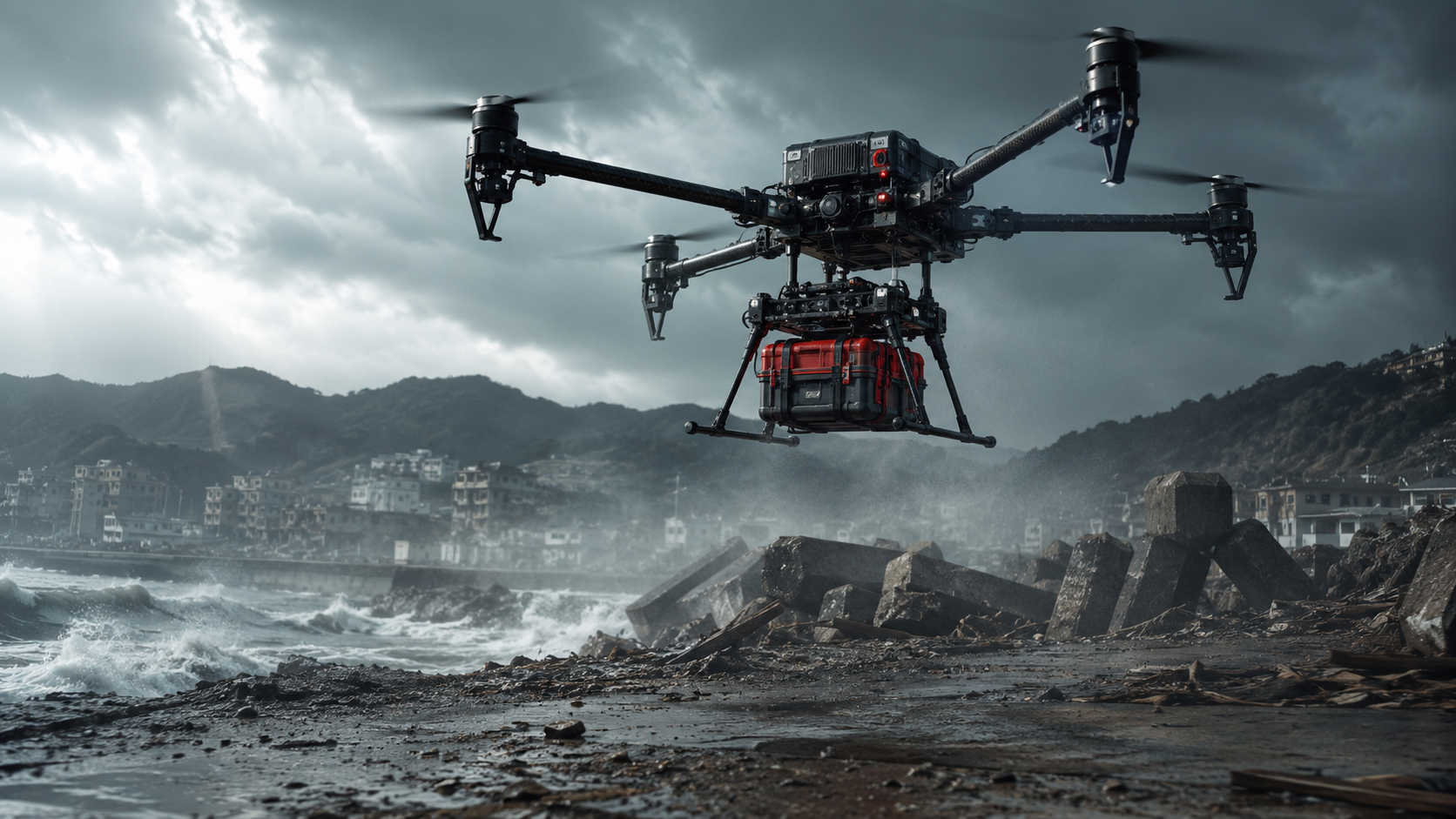
Japan does not only need beautiful drones. It needs working drones.
Drone stories often become too light too quickly. A flying camera. A trade-show hover. A futuristic machine above a polished booth. But Japan’s industrial sites need something tougher and less glamorous. A drone that can inspect a bridge, carry equipment into the mountains, fly over a disaster zone, land on water, deploy an underwater robot, and come back without turning the workday into a science fair.
Nagoya-based PRODRONE is interesting because it sits in that harder, more practical part of the market. It is not mainly selling the romance of flight. It is selling the idea that different missions require different aircraft: logistics, rescue, inspection, surveying, maritime work, agricultural tasks, and difficult environments where a standard consumer drone is the wrong tool.
In Japan’s 2026 drone story, ACSL gives you the economic-security chapter, Terra Drone gives you the global and defense chapter, Aeronext gives you the rural-logistics chapter, and Liberaware gives you the tiny-inspection chapter. PRODRONE gives you the workshop chapter: the idea that the job should define the machine.
From flying camera to flying work machine
The first industrial drone image was simple: put a camera in the air. Photograph a roof. Map a field. Inspect a tower. That alone changed many industries. But a more mature market asks harder questions. Can the drone carry something? Can it deliver something? Can it hold, lower, retrieve, or deploy equipment? Can it work near water? Can it become part of a rescue or disaster-response system?
PRODRONE’s public materials point directly into that next phase. The company describes purpose-built tools for critical missions, including a sea-air hybrid drone for underwater inspections, the high-speed PRODRONE GT-M, the PRODRONE RESCUE drone, and an AI-powered Grand Control Station for safe autonomous flights. The message is clear: one aircraft will not solve every job.
That is also a very Japanese manufacturing idea. A factory jig, a custom tool, a machine modified for the site, a part shaved and fitted until it works. PRODRONE looks like the flying version of that culture. Start with the work. Then design the aircraft.
Heavy lift is a dull phrase for a very hard problem
Flying a small drone and safely carrying heavy cargo are different worlds. The aircraft gets larger. Rotors become more dangerous. Batteries suffer. Wind matters more. Payload swing becomes a real engineering problem. Landing zones, maintenance, flight permissions, communication links, insurance and training all become part of the system.
PRODRONE’s industrial materials describe a long-distance logistics drone connecting 175 km in the Tokai area, the gasoline-powered helicopter-type PDH-GS120 with a 10 kg payload and two-hour flight capability, and the PD6B-Type2 with maximum payload of 30 kg for short-range logistics. The point is not just that the numbers are larger. The point is that Japan’s drone logistics problem is not only a small box in a city. It is also mountains, ports, islands, forests, construction sites, disaster zones and aging infrastructure.
A heavy-duty drone is not an urban novelty. It is a response to labor shortage, dangerous work, damaged roads, isolated communities and infrastructure that still has to be inspected even when the human workforce is shrinking.
The sea-air hybrid shows the island-country logic
One of PRODRONE’s most memorable concepts is the sea-air drone created with KDDI and QYSEA. Public coverage describes a system that combines PRODRONE’s heavy-duty aerial drone with QYSEA’s underwater ROV. The aircraft can fly to a site, land on water using inflatable mounts, deploy the ROV, complete underwater inspection work, retrieve it and take off again.
It sounds odd until you remember Japan’s geography. Japan is a country of ports, bridges, fishery infrastructure, offshore-energy prospects, sea walls, cables, ferries, islands and typhoon-damaged coastlines. A drone that only flies is useful. A robot that only swims is useful. A system that links the two can be useful in a different way.
This is where PRODRONE becomes more than another UAV maker. It is experimenting with mission chains. Air to water. Search to inspection. Flight to data. Communications to field operation. That matters for an island nation where some of the hardest work begins at the shoreline.
Disaster response: not heroic, useful
JETRO’s company profile says PRODRONE has been developing drones for about 10 years and can create durable and safe drones that fly reliably even in harsh natural environments such as disaster sites. That sentence is not flashy, which is why it matters. Disaster-response equipment is not supposed to be glamorous. It is supposed to work.
Japan faces earthquakes, torrential rain, landslides, typhoons, fires, volcanoes and coastal disasters. Drones can help in many ways: confirming isolated communities, checking roads, moving small urgent supplies, inspecting slopes, surveying port damage and giving first responders eyes before people enter dangerous areas.
But the drone should not be treated as the hero. It is not the firefighter. It is not the Self-Defense Force unit. It is not the civil engineer. It is a tool that extends their eyes and sometimes their hands. For PRODRONE, the mission is to build machines that fail less often when the site is ugly.
The civilian-defense boundary is getting thinner
In 2026, no serious drone industry story can ignore security. The war in Ukraine has shown governments, companies and emergency planners that unmanned aircraft are no longer just inspection tools. They are logistics assets, reconnaissance systems, counter-drone targets, communications nodes and, in some settings, defense equipment.
PRODRONE stands near that boundary because its technologies are inherently dual-use. A logistics drone can carry supplies in a flood zone or support a remote security operation. A rugged inspection aircraft can check a bridge or a critical facility. A command station can serve civilian operations, emergency management or security workflows.
This does not mean every Japanese drone company becomes a military company. It does mean that resilience, logistics, inspection, disaster response and national security are now connected by the same aircraft families and operating systems.
How to watch PRODRONE
| Lens | Why it matters |
|---|---|
| Mission specificity | The company’s logic is not one universal drone, but aircraft shaped around logistics, rescue, inspection and maritime tasks. |
| Heavy-duty work | Large payloads and long-distance logistics point to industrial problems beyond urban parcel delivery. |
| Sea-air systems | For an island country, connecting aerial mobility with underwater inspection opens a practical maritime niche. |
| Disaster readiness | Japan needs machines that can operate in rough, dirty, dangerous conditions, not just clean demonstrations. |
| Field implementation | The decisive question is whether drones fit into operations, training, maintenance, communications and regulations. |
The risk: heavy-duty drones are hard to adopt
Heavy-duty drones face a tougher path than small flying cameras. Larger aircraft demand stronger safety cases. They create more noise, more risk, more maintenance burden and more regulatory complexity. Operators need training. Customers need landing zones, procedures, insurance and fallback plans.
The customer’s work process also has to change. Buying a drone does not automatically transform inspection or logistics. Packages, schedules, dispatch systems, data handling and emergency response must be redesigned around the aircraft.
That is the challenge for the whole Japanese industrial drone sector. Good airframes are not enough. The market grows when institutions learn how to use them repeatedly, safely and economically.
A Nagoya kind of advantage
PRODRONE’s geography feels right. Aichi is one of Japan’s manufacturing centers, shaped by automobiles, aerospace, machine tools and parts suppliers. This is not a Tokyo app story. It is a machine story. Listen to the site, build the tool, test it, modify it, and send it back into the field.
If Japan’s drone industry is going to matter globally, it does not need every company to become a giant platform. It needs companies that are strong in difficult, specific, annoying, high-consequence work. PRODRONE is one of those candidates.
A flying machine can be beautiful. But beauty is not the business. The business is carrying the load without dropping it. Flying over a disaster area without failing. Getting data from a seawall, port, bridge or mountain site. Becoming a tool the field wants to use again.
PRODRONE’s heavy-duty drones are not here to decorate the future sky. They are here to help Japan keep working when the job is too dangerous, too remote, too heavy or too short-staffed for humans alone.
- PRODRONE is a Nagoya-based industrial drone maker focused on mission-specific aircraft for logistics, inspection, rescue and maritime work.
- Its industrial materials refer to a 175 km long-distance logistics drone, a gasoline helicopter-type aircraft with 10 kg payload and two-hour flight capability, and a 30 kg-class short-range logistics drone.
- The KDDI/QYSEA/PRODRONE sea-air drone concept links aerial transport with underwater inspection, a practical idea for an island nation.
- JETRO describes PRODRONE as a company able to develop durable, safe drones for harsh natural environments such as disaster sites.
- The main challenge is not aircraft performance alone, but regulation, operations, maintenance, training and real field adoption.
Sources and references
This article is based on PRODRONE’s official materials, the company’s industries page, JETRO’s company profile, public coverage of the KDDI/QYSEA/PRODRONE sea-air drone, and Japan Drone 2026 information.