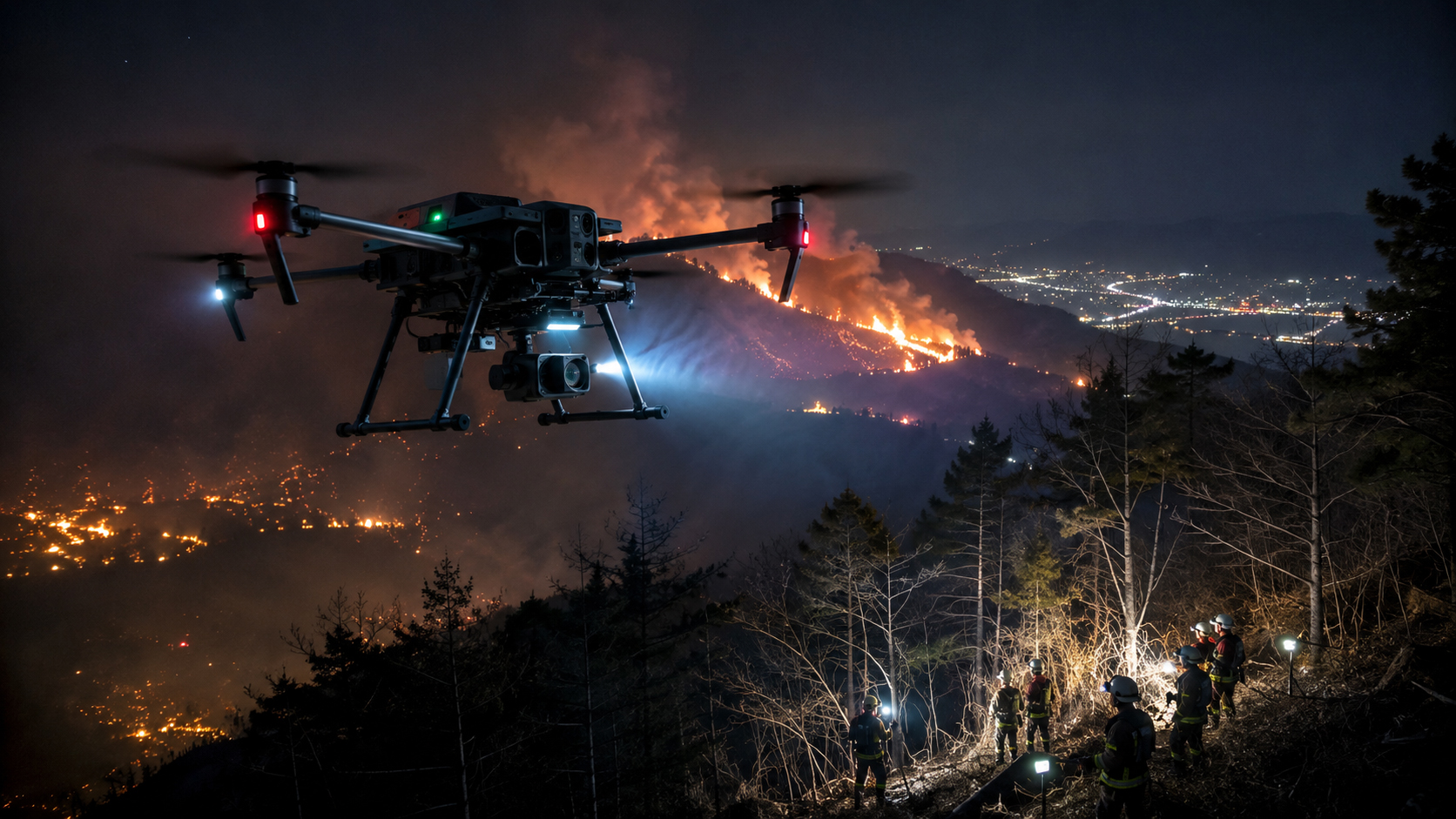
In a disaster, the scarcest thing is not courage. It is a reliable view from above.
A mountain burns. The road is narrow. Night falls. Smoke cuts visibility. Firefighters are tired. Helicopters cannot fly forever. On a map, a wildfire may look like one red patch. On the ground, it is wind, slope, ravine, ridgeline, power lines, villages, forest roads, darkness, smoke, and human limits arriving all at once.
That is the right place to begin the story of Blue Innovation. The Tokyo company is often placed in the simple category of “drone company.” But that label is too small. Blue Innovation is better understood as a robotic systems company: it works on ways to plug drones and other robots into disaster response, inspection, security, facilities management, and field operations. The aircraft matters. But in an emergency, the real question is larger: when does it fly, who sees the data, who shares the video, and what decision does it improve?
In March 2026, during a forest fire on Mount Ogi in Yamanashi Prefecture, Blue Innovation deployed drones for nighttime aerial imaging and fire mapping. Reports said the company responded to a dispatch request from the Japan Ground Self-Defense Force Eastern Army, relayed through JUIDA, the Japan UAS Industrial Development Association. The important headline is not merely that a drone flew. The important point is that another set of eyes was available when helicopters were limited, ground access was difficult, and incident commanders needed information.
Blue Innovation turns drones from equipment into operations
Japan’s drone industry often gets described through hardware: flight time, payload, wind resistance, battery life, sensor quality. Those things matter. But for disaster response and infrastructure management, hardware alone is not enough. The missing layer is the system that ordinary organizations can actually use.
Blue Innovation describes itself as a robotic system platform provider supporting infrastructure for a decentralized autonomous society. That sounds a little formal, but it is useful. Japan’s social problems are not simply that there are too few drones. Natural disasters are increasing in severity, infrastructure is aging, municipal workforces are stretched, and dangerous places still need to be checked. Buying one aircraft does not solve that. Building repeatable operations might.
In disaster response, the useful system includes aircraft, docks, communications, cameras, maps, video-sharing tools, trained operators, municipal officials, fire departments, police, the Self-Defense Forces, port managers, public-address capability, and evacuation decisions. Blue Innovation’s BEP platform concept points toward that connective tissue. It tries to make drones part of an emergency workflow rather than lonely machines in the sky.
The night at Mount Ogi: filling the operational gap after helicopters stop
The Mount Ogi case is interesting precisely because it does not make drones into superheroes. It makes them practical. In a wildfire, daytime helicopter operations and ground crews are critical. But night changes the conditions. Aircraft operations become more constrained. Visibility from the ground worsens. Commanders still need to know where fire remains active and how the fire line has moved before the next morning’s plan.
If a drone can identify burned areas, active fire points, and the direction of spread during those hours, it can support the next day’s helicopter and ground operations. What is burning? Which ridge is threatened? Which road or valley is still safe? Where should people go, and where should they not go? Nighttime aerial imaging does not put out the fire. It improves the map inside the command post.
Drones are not magic. Smoke, wind, batteries, communications, flight permissions, pilot safety, and airspace coordination all matter. But constrained environments are exactly where remote observation becomes valuable. The point is not to replace firefighters. The point is to help them make earlier, safer, and more accurate decisions.
Japan does not have one disaster problem. It has many.
When discussing disaster drones in Japan, wildfire should be only one chapter. Japan is an earthquake country, a tsunami country, a typhoon country, a flood country, a landslide country, a volcanic country, a heavy-snow country, and an aging-infrastructure country. A drone strategy built for only one emergency will not be enough.
During a tsunami warning, drones can fly over coastal areas and broadcast evacuation messages where fixed speakers may not be heard. After heavy rain, they can check river levels and landslide damage before municipal workers enter risky zones. After an earthquake, they can inspect bridges, ports, rooftops, roads, shelters, and isolated districts. Near volcanoes, they can monitor restricted areas. During wildfires, they can track burn areas and active fire points at night.
That is why Blue Innovation’s BEP Port Disaster Prevention System matters. In coastal and port areas, drone systems can automatically launch, issue evacuation announcements, capture real-time video, and reduce the need for workers to enter danger zones. This is not a glamorous drone show. It is a tool for small towns and port communities that need to reach residents and see conditions when roads, phones, and staffing may all be under pressure.
The memory of 2011 and the practical future of disaster technology
The Great East Japan Earthquake changed Japan’s disaster imagination. Seawalls, evacuation routes, hazard maps, emergency alerts, public loudspeakers, and drills were all reconsidered. Yet the problem of information scarcity has never disappeared. The wider the disaster, the slower and more fragmented ground truth becomes.
Drones matter because the sky often remains available after roads have failed. They can look before people enter. They can help determine which roads are open, which bridges look damaged, which neighborhoods are isolated, and where rescue resources should go first. In emergency response, minutes can matter.
But Japan also has very Japanese difficulties. Disaster technology does not move forward by technology alone. Municipal budgets, fire and police coordination, aviation rules, resident explanation, privacy, night operations, operator training, maintenance, and repeated drills all matter. A company like Blue Innovation has a hard job because the sale does not end with the aircraft. It has to enter the workflow of local crisis management.
Japan Drone 2026: disaster drones are moving beyond demonstration
At Japan Drone / International Advanced Air Mobility Expo 2026, logistics, inspection, agriculture, defense, disaster response, air mobility, and traffic management all appeared under the same roof. The show’s own framing is important: drones are being treated as tools for solving infrastructure and social problems, not just exciting aircraft.
That trend helps Blue Innovation. Japanese municipalities and companies no longer have the luxury of treating disaster drones as occasional demonstrations. Heavy rain, typhoons, heat, wildfire risk, earthquake risk, and aging infrastructure have made the question more immediate: what can actually be used?
The most useful disaster system may not be something pulled from storage only when the sirens sound. It may be something used in ordinary times for inspection, security, port monitoring, drills, and facility management, then switched into disaster-response mode when needed. Systems that only run during rare emergencies are systems that often fail during rare emergencies. Systems used every week have a better chance of working when the mountain is burning.
Be honest about the weaknesses
A Japan.co.jp drone issue should not become drone worship. Disaster drones have weaknesses. Strong wind can ground them. Rain and smoke can degrade imaging. Mountain terrain can break communications. Batteries are finite. Night flights and emergency airspace coordination are complicated. In a real disaster, power, staff, and communication lines may all be scarce.
Municipal procurement creates another problem: maintenance. The first year is exciting. Three years later, batteries have aged, personnel have rotated, training may have slipped, and the budget may be tight. A disaster drone that is not maintained becomes an expensive object in a storage room.
This is why Blue Innovation’s systems approach matters. If the business ends at hardware sales, it is fragile. If the company can provide continuing service, training, docks, software, remote operations, maintenance, video sharing, and operational manuals, the technology has a better chance of remaining alive. The real competition in disaster technology is not just what flies on the demo day. It is what still works on a rainy Tuesday three years later.
What it means for local governments
Japan’s local governments are not gaining endless staff. Many towns and villages must watch mountains, rivers, ports, bridges, tourist areas, schools, shelters, elderly-care facilities, and coastal zones with limited personnel. In an emergency, the number of places to check expands faster than the number of people available.
Drones do not erase that burden. But they can extend local capacity. They can look before someone drives into danger. They can check places without sending staff into a hazard zone. They can broadcast warnings from above. They can share video with a disaster headquarters. In disaster work, small improvements matter: a little earlier, a little safer, a little clearer, a little more informed.
Blue Innovation matters in Japan because it is trying to turn that “little” into a system. Not a flashy military aircraft. Not a fantasy of instant drone delivery. Evacuation messages. Fire mapping. Port monitoring. Hazard-zone video. Facility inspection. Japan’s disaster resilience will be strengthened by that kind of unglamorous implementation.
A checklist for disaster-response drones
| Question | Why it matters |
|---|---|
| Can it operate at night? | The hours after helicopter operations stop can shape the next morning’s plan. |
| Does it connect to municipal workflows? | A good drone is not enough if the video never reaches the people making decisions. |
| Can it launch remotely or from a dock? | Remote and automated operations matter when people cannot safely reach the site. |
| Can it warn residents? | For tsunamis and floods, public-address capability can be as important as video. |
| Is it used in normal times? | Inspection and security use during ordinary weeks make emergency use more realistic. |
Conclusion: Japan does not need flying heroes. It needs working eyes.
There is no need to oversell Blue Innovation’s disaster drone story. One drone cannot extinguish a mountain fire. It cannot stop a tsunami. It cannot prevent an earthquake. But it can deliver information. It can see before humans enter. It can bring an evacuation message to places that might not hear fixed speakers. It can reduce the number of times a person must walk into danger just to find out what is happening.
Japan’s disaster readiness will not be built only by seawalls and roads. It will also be built by small eyes in the sky, fast video, safer distance, and systems that work before the emergency begins.
Blue Innovation shows the maturing of the drone industry. The age when simply flying was news is ending. The new questions are better: whom does the drone serve, when does it fly, what does it see, who decides, and whose life becomes safer because of that information?
At night, over a burning mountain, one more set of eyes can change the situation. That is enough reason to take this company seriously.
- Blue Innovation should be read as a systems company, not only as a drone company.
- The March 2026 Mount Ogi fire showed the value of nighttime aerial imaging and fire-point mapping.
- The BEP Port Disaster Prevention System points toward coastal warning, evacuation broadcasting, and real-time disaster video.
- Japan’s disaster-drone challenge covers wildfires, tsunamis, floods, earthquakes, volcanoes, and infrastructure failures.
- The hardest part is not only aircraft performance. It is sustained operation across municipalities, firefighters, the Self-Defense Forces, and residents.
Sources and references
This article draws on Blue Innovation public materials, reporting on the Mount Ogi nighttime wildfire imaging deployment, reporting on the BEP Port Disaster Prevention System, and Japan Drone 2026 exhibition information.
- DroneLife: Blue Innovation deploys drones for nighttime wildfire imaging in Japan
- DroneXL: Nighttime wildfire mapping and the gap after helicopter operations stop
- DroneLife: Blue Innovation announces implementation of BEP Port disaster prevention system
- Blue Innovation: corporate guide and robotic system platform
- Japan Drone / International Advanced Air Mobility Expo 2026