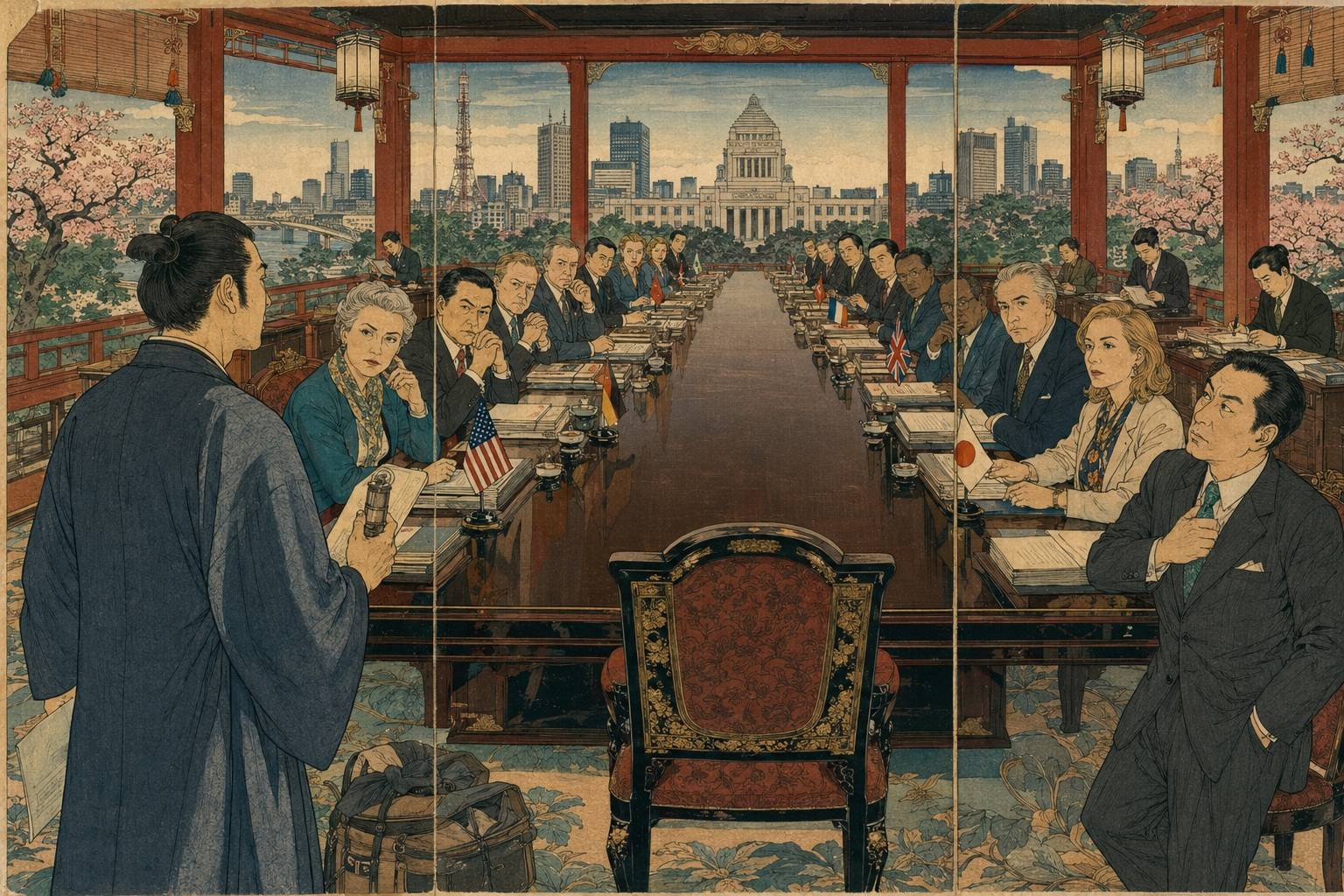
The chair at the near end of the table
Imagine a founder arriving at a policy meeting with a laptop, a five-person payroll and one regulatory problem capable of ending the company. Around the table sit lawyers, public-affairs specialists and country heads from corporations that can keep experts on an issue for years. Everyone may hold a membership card. They do not arrive with equal time, information or staying power.
That distinction is the starting point for judging the American Chamber of Commerce in Japan (ACCJ), British Chamber of Commerce in Japan (BCCJ), Canadian Chamber of Commerce in Japan (CCCJ), CCI France Japon, German Chamber of Commerce and Industry in Japan (AHK Japan), Australian and New Zealand Chamber of Commerce in Japan (ANZCCJ), and European Business Council in Japan (EBC). Their websites use words such as voice, access, influence and government relations. Those are legitimate functions of an association. They also demand public questions: whose voice, access to whom, influence over what, and with what visible record?
This report examined current membership prices and eligibility, election and voting rules, named board affiliations, committee structures, published policy papers, approval processes, event access, office locations and the public trail left by advocacy. It does not infer misconduct from a private meeting or a large-company director. Nor does it treat a published position paper as proof that government adopted it. The test is narrower and more useful: can a member and an outsider understand how a commercial interest becomes a chamber position, who is entitled to shape it and what happened next?
First principle: a chamber is not “the foreign community”
A foreign chamber is a private, voluntary, member-funded association. It is not an embassy, a regulator, a parliament or a union. Its leaders are accountable under its own constitution and corporate form, not through universal suffrage among residents or businesses of the nationality in its name. Many accept Japanese and third-country members. ACCJ says 55 percent of its members are Japanese citizens; BCCJ is open to all nationalities; AHK Japan accepts companies of any nationality.
That openness is a strength, but it makes language such as “the voice of global business” easy to overread. The voice is the result of a self-selecting membership, filtered through committees and governing bodies. A startup that cannot afford the dues, a company that declines to join, a worker, consumer, patient or competitor does not acquire representation merely because a chamber speaks about its industry. The chamber is entitled to advocate. Government remains responsible for weighing that advocacy against other evidence and the public interest.
The sharpest distinction is between access and authority. Chambers can arrange ministry meetings, embassy briefings, Diet visits, public comments and policy papers. They cannot enact a regulation or sign a treaty. Even when a chamber recommendation precedes reform, causation is rarely exclusive: officials, Japanese industry groups, civil society, courts, treaty bodies and political negotiations may all contribute.
How the architecture was built
The oldest large chamber examined here, CCI France Japon, dates to 1918. It grew from a period when foreign commercial communities needed durable institutions to navigate distance, language and a Japanese market that could not be managed through occasional visits from Europe. The postwar settlement produced a second wave. ACCJ was founded on August 24, 1948 by representatives of 40 companies; BCCJ also began in 1948, when rebuilding trade meant exchanging basic information as well as cultivating official relationships.
Japan’s high-growth decades and increasingly technical market created a third layer. AHK Japan has operated since 1962 and today combines three roles: a membership network, a professional service provider and Germany’s official foreign-trade promotion institution in Japan. ANZCCJ and the organization that became EBC both date to 1972. CCCJ began in 1975. Their timing reflects a shift from postwar reconstruction to market entry, investment and regulatory coordination.
The method matured with the economy. Receptions and embassy introductions remained important, but standing committees began to compare company experience, draft bilingual recommendations and return to the same ministry after personnel changed. ACCJ developed Diet and Washington doorknocks. EBC turned sector complaints into a recurring White Paper and later a searchable digital set of recommendations. Bilateral chambers created working groups on tax, digital technology, health, energy, labour and economic security. The informal relationship became an institution with staff, archives and a calendar.
That history explains both the public value and the imbalance. Persistence can reveal a badly designed approval rule that no single company can fix. It also rewards organizations able to lend specialists to a committee for years.
How an issue travels from a company to government
| Stage | What happens | Where unequal resources matter |
|---|---|---|
| 1. Identify | A member raises a tax, licensing, data, labour, procurement or market-access problem. | Companies with in-house legal, regulatory and government-affairs teams detect issues earlier and document them faster. |
| 2. Build consensus | A committee compares experience and decides whether the problem affects a sector rather than one firm. | Attendance, language, technical evidence and command of the drafting process shape what survives. |
| 3. Approve | Committee leaders, staff and sometimes a board or policy council review the text. | Voting eligibility and leadership composition determine the formal gatekeepers. |
| 4. Translate and publish | The chamber may issue a viewpoint, White Paper, survey, public comment or joint statement. | Translation and research cost money; some positions remain less visible than others. |
| 5. Advocate | Staff arrange ministry, Diet, embassy, advisory-council or bilateral meetings and follow up. | Established networks and repeated presence matter more than a single reception. |
| 6. Decide | Japanese public institutions accept, modify or reject the recommendation. | Without a public contact log, outsiders often see the paper and final rule but not the intervening discussions. |
ACCJ publishes the clearest rulebook among the organizations reviewed. Its advocacy guide says a position should address an industry-wide issue, not one company’s interest. Drafts circulate to committee members for consensus, then pass through staff review and the External Affairs Advisory Council and Board of Governors. The guide specifies review periods, Japanese translation, expiry rules and tools including meetings with officials, media work and Diet or Washington doorknocks. ACCJ also publishes current viewpoints and public comments. This is meaningful voluntary transparency.
Yet the same guide exposes a practical barrier: committees normally bear translation costs. Even when annual dues are affordable, an entrepreneur must contribute scarce hours and perhaps pay for evidence or Japanese drafting. The opportunity cost is not printed in the membership brochure.
Japan’s missing middle: no lobbying register
The wider Japanese system leaves an important gap. The OECD’s 2024 Anti-Corruption and Integrity Outlook country note says Japan met none of its criteria for lobbying regulation or practice and has no specific lobbying law or central monitoring body. Its 2026 Economic Survey of Japan again recommends requiring public officials to disclose interactions with lobbyists through public digital registers or open agendas.
Japan is not devoid of transparent rulemaking. Under the Administrative Procedure Act, the e-Gov public-comment system normally publishes a draft rule for at least 30 days. When the rule is made, the agency publishes the opinions received and its responses; e-Gov stresses that substance, not the volume of duplicated submissions, is considered. Government advisory councils also often publish agendas, papers and minutes.
But these formal records do not form a comprehensive map of influence. A bilateral briefing, private doorknock, embassy liaison conversation or chamber–ministry meeting may leave only a chamber news item—or no public item at all. Japan has no central register naming the organization, subject, officials met, client or member interests represented, and resources spent. The absence of that infrastructure is not proof of improper influence. It is a limit on what the public can verify.
The membership audit: low-cost doors, unequal rooms
All seven organizations publish a route aimed at smaller organizations or individuals. That matters. It disproves the claim that foreign chambers are formally closed clubs for multinationals. The details also show that access rights are not uniform.
| Organization | Lower-cost route found | Higher tier or formal limit | Accountability reading |
|---|---|---|---|
| ACCJ | Small company under 30 global employees: ¥150,000 plus ¥15,000 entry; individual ¥75,000; under-30/graduate ¥24,000. | Corporate Sustaining ¥1.8m; President’s Circle ¥7.5m with priority access and a deeper advisory role. Only representative members of U.S. member companies vote in board elections. | Broad participation and a dedicated Independent Business Committee coexist with a narrower electorate and premium access products. |
| BCCJ | Entrepreneur, up to 25 employees and not controlled by a listed company: ¥100,000 in Kanto, ¥80,000 non-Kanto; individual ¥50,000/¥30,000; NPO/charity ¥50,000. | Corporate Kanto ¥250,000. Primary Members cast the confidential Executive Committee ballot. | Clear SME and regional discounts; the 2026 elected committee includes four individual members among 15, unusually visible counterevidence to a purely corporate club. |
| CCCJ | Small business, NPO or professional: ¥70,000 for two representatives; individual ¥40,000; young professional ¥5,000. | Sustaining ¥600,000 includes 25 registrations, selected complimentary seats, head-table priority, advertising and higher visibility. Young professionals cannot vote, govern or chair committees. | Entry is genuinely inexpensive, but premium dues buy representation and prominence while the cheapest tier lacks a formal franchise. |
| CCI France Japon | Individual/freelancer/micro-structure ¥80,000; startup under three years ¥140,000; regional ¥150,000. | Benefactor ¥650,000 promises maximum exposure and exclusive services; the 25-member board is led mainly by large corporate and professional affiliations. | Strong regional and startup services, but its visible leadership still reflects firms with established scale. |
| AHK Japan | Startup under 10 employees and less than five years old ¥50,000; nonprofit ¥50,000; new or nonresident ¥70,000. | Full member ¥200,000–¥430,000. Only full members may vote at the members’ meeting, vote for the board or stand for election. | Startups can enter the network but cannot formally elect or become its governing board. |
| ANZCCJ | Individual/sole entrepreneur ¥32,500; non-Kanto ¥25,000. Bronze corporate ¥97,500; non-Kanto ¥50,000. | Platinum invite-only ¥850,000. Current benefits grid gives Platinum/Gold/Silver four votes, Bronze two and Individual one; constitution requires at least seven corporate councillors and at least two individuals. | The clearest formal weighting toward corporate tiers, partly balanced by mandated individual seats and open nomination eligibility. |
| EBC | Stakeholder-chamber company with fewer than 250 employees: ¥65,000, including committee voting and eligibility for committee office. | Certain nonstakeholder European or non-European companies pay ¥260,000 but receive no committee vote or office eligibility. Pinnacle sponsorship is ¥900,000 and may include keynote visibility. | A comparatively low SME committee price and public policy record, but rights depend on institutional category, not simply the amount paid. |
Fees were checked on public pages through July 18, 2026 and may exclude event tickets, tax, entry fees or membership in a prerequisite national chamber. Benefits should not be confused with policy authority. A sponsor’s logo or speaking opportunity is visible commercial exposure; it becomes an accountability concern when sponsorship, committee approval and the substance of an official chamber position cannot be distinguished.
Who actually sits on the boards?
Leadership affiliation provides a snapshot, not a complete measure of influence. A director from a global company may argue for a startup-friendly rule; an independent consultant may serve large corporate clients. Still, published boards reveal who carries formal fiduciary and agenda-setting responsibility.
ACCJ’s 2026 president is Boeing Japan president Eric John. Disclosed board affiliations include Amway, Northrop Grumman, Edelman, the Pharmaceutical Research and Manufacturers of America, White & Case, Morgan Stanley MUFG, Cisco, Viatris, the Business Software Alliance, Bloomberg, General Motors, Citi, Pfizer, Google, EY, K&L Gates, MGM and Eli Lilly, alongside regional and entrepreneurial exceptions. The accurate description is not “no small business”; it is a board whose published employer affiliations are dominated by major corporations, trade associations and professional-services firms.
CCI France Japon’s president is Jérôme Chouchan of Godiva Japan; its senior officers include Toyota Tsusho, LVMH, L’Oréal and Crédit Agricole, while its wider board also contains smaller advisory and entrepreneurial businesses. AHK Japan’s board spans Archion, TÜV SÜD, SAP, Bosch, DHL, Infineon and specialized German manufacturers. Their composition fits institutions built around major bilateral commercial relationships.
The counterexamples are important. BCCJ’s April 2026 election chose 15 committee members from 22 candidates, including four identified as individual members, alongside executives from IHG, Barclays, Clifford Chance, Robert Walters, BAE Systems, Intralink and smaller firms. CCCJ’s current governors include lawyers and real-estate advisers but also Rain Interactive, Canada Wood, Invest Alberta, JK Holdings and Vanten. ANZCCJ’s constitution requires at least two individual members on the Executive Council. Diversity is not evenly distributed, but it is real enough that a blanket multinational-only verdict would be false.
The second price of admission is time
Published dues are the easiest barrier to count and often not the decisive one. Effective advocacy requires someone to attend monthly calls, read a Japanese consultation, compare competitor experience, write a recommendation, negotiate wording, fund translation, meet officials and return after an inconclusive answer. A global pharmaceutical, financial or technology company can assign policy staff. A founder does that work after sales, payroll and immigration paperwork.
Geography compounds the difference. ACCJ has Kansai and Chubu chapters; BCCJ, CCCJ, CCIFJ and ANZCCJ publish regional prices or programming; CCIFJ maintains desks from Osaka and Fukuoka to Nagoya, Gunma, Fukui and Hokkaido. Hybrid meetings help. Yet most headquarters, embassy interfaces and central ministries remain in Tokyo. A regional discount lowers the invoice but not the Shinkansen time.
Technical consensus can also silence minority experience without bad faith. A committee wants a position that several competing companies can support. The narrow problem of a young entrant may be too specific, or a reform favoured by incumbent importers may burden a new platform. Consensus strengthens legitimacy when it prevents one-company lobbying; it weakens it when dissent disappears without a trace.
A transparency ladder: from evidence to opacity
| Level | What an outsider can inspect | Examples and missing pieces |
|---|---|---|
| 1. Public receipt | Dated position, recommendation, committee, approving process, target agency, government response and status. | e-Gov comments provide much of this chain; few chamber-led bilateral contacts provide all of it. |
| 2. Substantial voluntary disclosure | Public bylaws, fees, named leadership affiliations, election rules, committee membership and current advocacy texts. | ACCJ’s advocacy guide and papers; EBC’s named sector members and issue-status pages. Participant denominators and meeting outcomes can still be thin. |
| 3. Institutional disclosure | AGM notice, board list, annual recap, accounts approved and auditor appointed. | BCCJ and CCCJ publicly describe AGM approvals, but a recap is not the same as publishing detailed financial statements for outsiders. |
| 4. Publicity without a record | A photograph or brief release says leaders held a constructive exchange. | Useful evidence that a meeting occurred; insufficient to know the requested change, participants, conflicts, response or follow-up. |
| 5. No public trace | The meeting, representation and result cannot be found. | Japan’s lack of a lobby register makes the total volume and distribution of such contact unknowable from public sources. |
EBC is unusually inspectable at the policy-output level. Its digital White Paper names committees, dates recommendations and labels issues new, in progress, urgent or resolved; some committee pages list participating companies. ACCJ publishes a procedural guide that explains how committee consensus becomes an approved paper. BCCJ publishes fees, election mechanics and a mixed elected committee. CCCJ publishes its constitution, membership rights and self-nomination route. AHK publishes articles of association, fees and the precise franchise restriction. ANZCCJ publishes a code of conduct, council requirements and tiered benefits. CCIFJ publishes its board, fees and annual-activity material.
No single organization reviewed publishes a complete, machine-readable annual advocacy register covering every official contact, the members represented, position taken, meeting date, government response and result. Because Japan does not require one, the gap is shared between private advocates and the public system.
What fairer influence would look like
Publish a “policy receipt.” Every official chamber position should identify the approving committee, date, recommendation, evidence, target authority and status. It should describe participation—named companies where appropriate, or at least the number and categories represented—and explain how conflicts and material dissent were handled.
Separate sponsorship from policy rights. A paid logo, seat, introduction or keynote should be labelled as sponsorship. Chambers should state plainly that higher commercial visibility does or does not confer extra authority over an advocacy text. Where votes are weighted, the weights should appear beside the membership price, not only in an election notice or benefits grid.
Measure the missing members. Publish annual figures for members, committee participants and board seats by company size, individual/corporate status, gender and region. A chamber need not impose rigid quotas to discover that a nominally open committee is attended almost entirely by Tokyo multinationals.
Fund small-firm participation. Hybrid access, rotating regional meetings, translation pools, short consultation summaries and a small-company impact statement for major positions would attack the time barrier. Reserved independent or SME seats, as a minimum or target, can ensure that inexpensive membership is not merely an audience ticket.
Give the public system a register. Japan should act on the OECD recommendation for digital disclosure of official interactions with lobbyists and open agendas. A proportionate system could record the organization, topic, public officials, represented interest and documents supplied without turning routine consultation into a bureaucratic trap. Stronger public disclosure would protect legitimate chambers from insinuation as much as it would expose undue access.
Verified chamber contacts
These are chamber secretariats, not embassies or public regulators. Details were checked against official pages available through July 18, 2026. Arrange an appointment before visiting; many offices are in controlled buildings or shared workspaces.
| Organization | Current address | Telephone, email and direct website |
|---|---|---|
| ACCJ | Toranomon Hills Business Tower 15F 1-17-1 Toranomon, Minato-ku Tokyo 105-6415 | 03-6807-3655 info@accj.or.jp accj.or.jp / contact |
| BCCJ | WORK STYLING, Midtown Tower 18F 9-7-1 Akasaka, Minato-ku Tokyo 107-0052 | 03-4560-4190 info@bccjapan.com bccjapan.com / contact |
| CCCJ | Toranomon Hills Business Tower 15F 1-17-1 Toranomon, Minato-ku Tokyo 105-6415 | 03-6811-2391 info@cccj.or.jp cccj.or.jp / contact |
| CCI France Japon | Nihonbashi Honcho YS Building 2F 2-2-2 Nihonbashi Honcho, Chuo-ku Tokyo 103-0023 | 03-4500-6505 ccifj.or.jp/en / access |
| AHK Japan | Sanbancho KS Building 5F 2-4 Sanbancho, Chiyoda-ku Tokyo 102-0075 | 03-5276-9811 info@dihkj.or.jp japan.ahk.de/en / access |
| ANZCCJ | UCF635 Win Aoyama 2-2-15 Minami-Aoyama, Minato-ku Tokyo 107-0062 | 03-4400-2972 info@anzccj.jp anzccj.jp / contact |
| EBC | Toranomon Hills Business Tower 15F 1-17-1 Toranomon, Minato-ku Tokyo 105-6415 | General 03-6807-5932 Membership 03-6807-5931 ebc@ebc-jp.com ebc-jp.com / membership |
Upcoming events and meetings found
The public calendars were checked on July 18, 2026. Inclusion is not an endorsement and does not mean a place is available. Some events are members-only, committee-only, sold out or past their deadline; prices, venues and access can change. Follow the direct organizer page before paying or travelling.
| Date and time, JST | Event | Access and accountability note |
|---|---|---|
| Thu, Jul 23 14:30 | EBC Medical Equipment & Diagnostics Committee | Hybrid committee session; not advertised as a public ticketed event. Confirm eligibility, venue and link with EBC. |
| Thu, Jul 23 16:00–18:00 | AHK Young Leaders Forum 2026, Vol. 3 | DHL Global Forwarding; free, AHK members only. |
| Wed, Jul 29 19:00–21:30 | Joint Chamber Summer Cocktail 2026 | Hilton Tokyo Beer Garden Terrace; 19 chambers and 300-plus professionals. Published member/nonmember prices were ¥10,500/¥14,000; registration was closed when checked. |
| Thu, Jul 30 17:30–20:00 | The Changing Landscape for Immigration in Japan CCCJ, ACCJ and BCCJ | Embassy of Canada, 7-3-38 Akasaka. Register by Jul 24; members ¥4,000, nonmembers ¥6,500; government photo ID required. |
| Mon, Aug 3 12:00–13:30 | BCCJ Present with Impact — Emerging Leaders Workshop | Dale Carnegie Training Japan; hands-on program for BCCJ Emerging Leaders. Confirm eligibility. |
| Tue, Aug 25 16:00–19:00 | AHK Driving Operational Excellence Through Digital & AI | At AHK Japan; English; free for members; published deadline Aug 21. |
| Thu, Sep 3 18:30–20:30 | ANZCCJ Kiwi Aussie Mixer — Tokyo Edition | YOTEL Tokyo Ginza, 1-7-7 Shinbashi; ¥7,500; registration closes Aug 27 at 17:00. |
| Fri, Sep 11 18:30–21:00 | CCCJ Kansai Next-Generation Leaders Mentorship Forum | Waldorf Astoria Osaka; capacity 60; register by Sep 3; members ¥5,000, nonmembers ¥6,500. |
| Wed, Sep 16 14:00–20:00 | CCI France Japon Energy Conference — Business Leaders Forum | L’Espace CCI, Nihonbashi; English/Japanese with interpretation; members ¥12,000, nonmembers ¥16,000. |
The verdict: a seat is available, but power is not evenly distributed
Do foreign chambers in Japan represent entrepreneurs and small companies? Yes, in part. There are explicit small-business, startup, individual, young-professional, nonprofit and regional categories. ACCJ has an Independent Business Committee. BCCJ’s elected leadership includes individual members. CCCJ permits self-nomination with member support. ANZCCJ constitutionally protects individual council seats. EBC charges its lowest stakeholder-company rate to firms under 250 employees.
Do they primarily reflect multinational corporations? At the most resource-intensive and visible levels, often. Large-company affiliations dominate several boards. Premium tiers buy more representatives, visibility, preferred seating or briefings; in some chambers they receive more votes or are the only categories with a franchise. Even where formal rights are equal, large firms can contribute more staff, evidence and years of attention.
How transparent is their policy influence? Uneven and incomplete. ACCJ and EBC make substantial parts of their policy machinery inspectable; all seven publish useful elements of governance or membership. But chamber disclosure is voluntary, and Japan’s public system does not require a comprehensive record of lobbying contacts. The public can often see the opening recommendation and the eventual rule while missing the conversations between them.
The answer is not to bar companies from the table. Regulation improves when officials hear precise evidence from people who must implement it. The answer is to lengthen the table, label the seats and publish the receipt. A chamber should be able to say whom it represents without pretending to represent everyone. A government should be able to hear business without asking the public to trust an invisible process. And an entrepreneur should not discover that the advertised open chair exists only after the agenda has already been written.
Sources and further reading
- OECD Economic Surveys: Japan 2026 and OECD Anti-Corruption and Integrity Outlook 2024 country note: Japan.
- e-Gov explanation of Japan’s public-comment system and Administrative Procedure Act.
- ACCJ Advocacy Guide, current advocacy papers, membership categories, voting and governance FAQ, Independent Business Committee, and 2026 Board of Governors.
- BCCJ membership and fees, 2026 election process, elected Executive Committee and AGM recap, and government relations.
- CCCJ categories, rights and fees, 2026 nominations, Board of Governors, and the chamber’s resources section for its constitution and bylaws.
- CCI France Japon membership, Executive Board, and institutional profile and history.
- AHK Japan membership rights and fees, Board of Directors, and official role and history.
- ANZCCJ membership benefits and current vote weighting, governance, and 2026 AGM/election and current events.
- EBC membership, voting rights and sponsorship, organization and funding, Digital White Paper, and an example of a public committee-member list.
Editor’s note: Research was checked against official chamber, OECD and Japanese government material available through July 18, 2026. Membership and leadership affiliations describe public institutional records, not an audit of each person’s conduct or every client interest. “Not publicly found” is not proof that a record does not exist internally. Event information can change. The supplied exchange-rate display is reproduced exactly—“1 US Dollar = 162.39 Japanese Yen”—and its UTC timestamp has been converted to Japan Standard Time: July 19, 2026 at 4:07 AM JST. The hero is a contemporary digital editorial illustration, not an archival print, documentary photograph or record of an actual meeting.