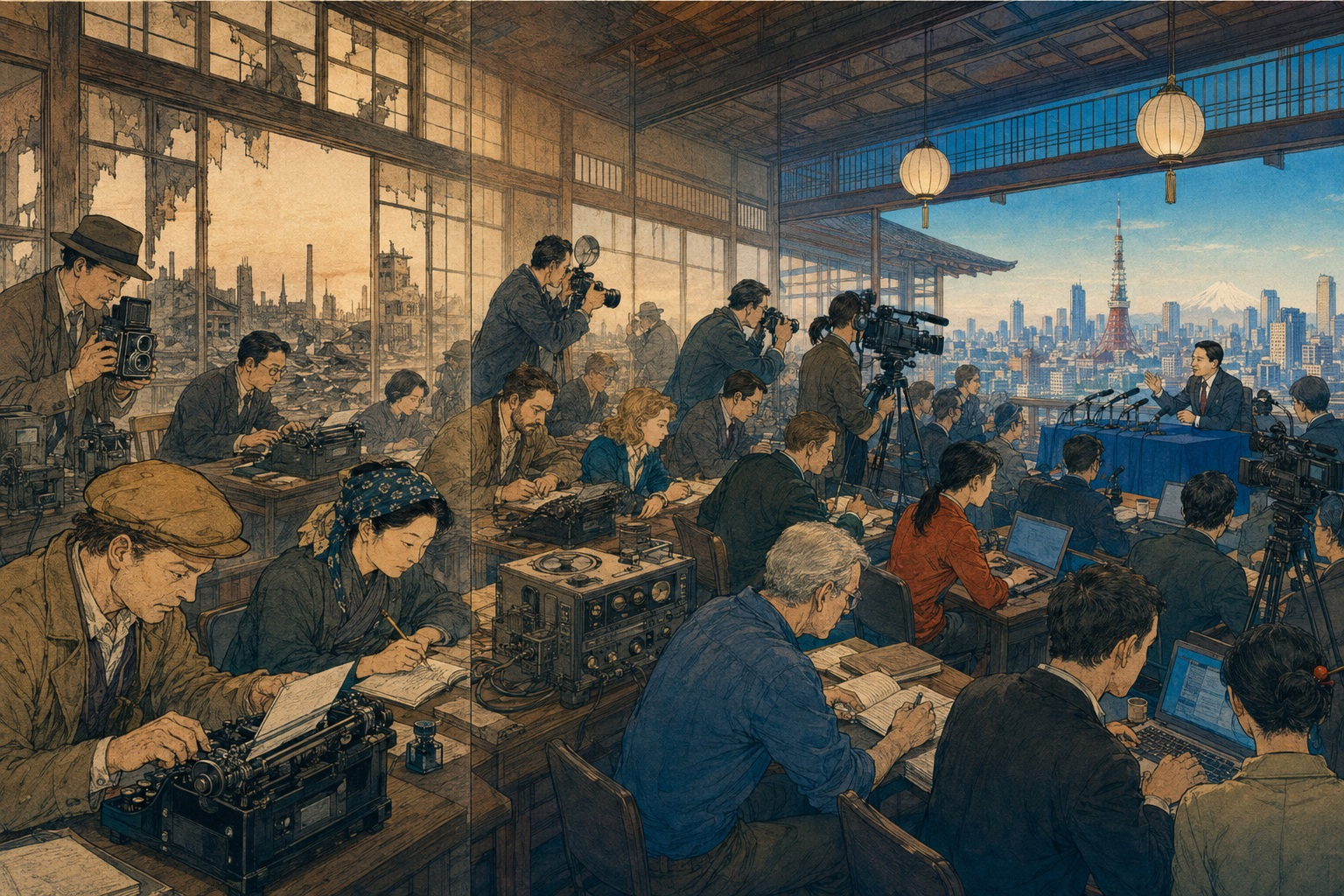
One Friday contained the club’s whole dilemma
On July 10, the Foreign Correspondents’ Club of Japan staged two press conferences that could have been designed as an editorial about its past and future. At 10:30, Jelani Cobb, dean of Columbia Journalism School, spoke about low trust, artificial intelligence, political attacks and the shrinking professional pathways facing young reporters. At 14:00, Bruce Aitken described his role carrying cash into Japan in the Lockheed bribery operation that helped define the country’s most famous postwar political scandal.
The first event asked whether journalism’s institutions can survive. The second demonstrated why institutional memory matters. Between them stood the FCCJ: a public-interest association occupying two floors of expensive Marunouchi real estate, presenting a speaker in a room, translating when necessary, putting working journalists in charge of the questions and sending the result onto a global stream.
Its July calendar was not nostalgic. It included Japan’s artificial-intelligence policy, Ukrainian drone technology, the Strait of Hormuz, the Tokyo stock market and the weak yen. Former prime minister Fumio Kishida had appeared on June 26. Yet the same month the club told members that they had approved repurposing a ¥20 million relocation reserve for current operations, capital spending and retirement payments, while dissolving both that reserve and a ¥60 million relocation liability. The FCCJ is busy. It is also confronting the cost of remaining a place.
Housing came before headlines
FCCJ began with a fight over access and beds. In the confused weeks after Japan’s surrender, the occupation authorities restricted the number of correspondents allowed into the country, citing inadequate accommodation. War reporters objected. A small group formed the Tokyo Correspondents Club, with Howard Handleman of International News Service as president, Don Starr of the Chicago Tribune and William Dunn of CBS as vice-presidents.
They leased the battered five-storey Marunouchi Kaikan between Tokyo Station and General Douglas MacArthur’s headquarters in the Dai-ichi Seimei Building. Repairs began before Tokyo had recovered from bombing. By November, the building was housing roughly 170 correspondents. Its ground-floor dining room and bar acquired the address-like nickname “No. 1 Shimbun Alley”; upstairs were sleeping quarters and space for briefings and press events.
The origin matters because it corrects two persistent simplifications. MacArthur did not found the club; correspondents organized it partly in resistance to the occupation’s controls. And it was not initially a ceremonial dining society. It was infrastructure assembled by reporters who needed somewhere to sleep, work, exchange information and insist that more of their colleagues be admitted.
MacArthur chose the room when he had news
MacArthur declined the club’s first invitations, apparently wary of creating a precedent. On March 17, 1947, he made his only appearance. He used the luncheon to say the military task was complete, the political phase was nearing completion and a peace treaty should be negotiated as soon as possible. Continuing the occupation, he argued, risked harming Japan’s economic recovery.
The San Francisco Peace Treaty would not take effect until 1952, but the episode established a pattern: the room’s value lay less in furniture than in the combination of an international audience, questions and a record that could travel. A speaker who wanted the outside world to hear something about Japan knew where to go.
Membership had already fallen to about 40 by mid-1947, and dances and dinners helped keep the organization solvent. The Korean War reversed the decline. Japan became the logistics and reporting base for the conflict, membership rose to about 350, and a plaque now commemorates 18 correspondents who died covering it.
From occupation hostel to Japanese public-interest body
When sovereignty returned in 1952, the Tokyo Correspondents Club came under Japanese law, adopted the name Foreign Correspondents’ Club of Japan and became a nonprofit incorporated association under Foreign Ministry sponsorship. The 1953 Korean armistice again reduced the transient press population. In 1954, the club left its hostel and moved into the former American Club premises on Marunouchi Naka-dori. Associate membership expanded and the war-correspondent dormitory culture faded.
The institution moved with Tokyo and with journalism. It occupied the former American Club building, then the Chiyoda Annex, and from 1976 spent 42 years on the twentieth floor of the Yurakucho Denki Building. In November 2018 it opened its present home in the Marunouchi Nijubashi Building. Every relocation changed the mix: war reporters gave way to occupation specialists, then business and trade correspondents, then a broader body of Japanese and international journalists, executives, diplomats, authors and professionals.
| Period | Home and institutional change | What it represented |
|---|---|---|
| 1945–1954 | Marunouchi Kaikan, “No. 1 Shimbun Alley” | Hostel, bar, newsroom and briefing space for occupation and Korean War correspondents. |
| 1952 | Renamed FCCJ under Japanese law | From occupation-era club to a Japanese nonprofit incorporated association. |
| 1954–1967 | Former American Club building, Marunouchi | The dormitory era receded; associate membership and economic reporting grew. |
| 1967–1976 | Chiyoda Annex | Professional events expanded as Japan became a global industrial power. |
| 1976–2018 | Yurakucho Denki Building, 20F | The iconic high-rise club of the trade-war, bubble and post-bubble eras. |
| 2014 | Public-interest incorporated association | At least half of spending had to serve public benefit; operations were restructured. |
| Since 2018 | Marunouchi Nijubashi Building | A modern conference, broadcast, work, archive, dining and events platform. |
How the press conference became the product
Professional events were once occasional. FCCJ’s archive records two in 1956, about 30 a decade later and more than 100 annually from 1991. The Professional Activities Committee now organizes press conferences and related programs; its current description makes the governance point explicit: future events are chosen by a rotating group of working journalists.
That is different from renting a ballroom to anyone who can pay. The editorial value comes from subject selection, briefing, interpretation, question time, recording and the expectation that a speaker will face journalists rather than deliver an advertisement. Current notices allow reporters to register through the reception address, watch on the FCCJ YouTube channel and submit questions online. Television crews reserve positions. For FCCJ-hosted conferences, non-members may film for reporting but the club now reserves live retransmission for members.
The format has also erased the walls. A press conference that once reached overseas desks by telephone dictation can now be watched globally in real time. That multiplies FCCJ’s public reach, but it also weakens the exclusive practical reason for paying dues and commuting to Marunouchi. The stream is both the club’s distribution system and its competitor.
The moments on the wall—and what they actually mean
FCCJ’s corridors display an extraordinary cast. Some gave formal club press conferences; others attended luncheons, receptions, film events or appeared before FCCJ journalists elsewhere. The distinctions matter. Emperor Hirohito’s consequential 1975 meeting with the foreign press, for example, took place at the Imperial Palace, not in the club’s dining room. A serious history should not turn every famous photograph into the same kind of event.
| Date | Person or event | Why it remains in the record |
|---|---|---|
| Mar. 17, 1947 | General Douglas MacArthur | His sole club appearance; he called for an early peace treaty and end to the occupation. |
| Apr. 18, 1966 | Yukio Mishima | The author’s appearance became one of the archive’s defining cultural images. |
| Oct. 22, 1974 | Prime Minister Kakuei Tanaka | Questions about his finances helped move a magazine investigation into national political crisis. |
| Sep. 22, 1975 | Emperor Hirohito and the foreign press | An FCCJ-linked foreign-press encounter at the Imperial Palace, central to postwar imperial communication. |
| Jun. 18, 1976 | Muhammad Ali and Antonio Inoki | Ali’s theatrical club appearance promoted their cross-code bout and produced enduring photographs. |
| Apr. 1995 | Aum Shinrikyo spokesman Fumihiro Joyu | The cult’s first major press conference after the Tokyo subway sarin attack drew worldwide coverage. |
| Sep. 14, 2001 | Prime Minister Junichiro Koizumi | A sitting prime minister returned to the club at a moment of global shock and domestic reform. |
| Mar. 2011 | Earthquake, tsunami and nuclear disaster | The club served as a hub for Japan-based reporters and hundreds arriving from overseas. |
| Jan. 8, 2019 | Carlos Ghosn’s lawyers | One of the largest events in club history, drawing about 350 people into the new premises. |
| Jul. 10, 2026 | Journalism’s future and the Lockheed past | Jelani Cobb and Bruce Aitken embodied the club’s twin functions: looking forward and preserving memory. |
The Tanaka luncheon: power, questions and myth
The most repeated FCCJ story concerns Kakuei Tanaka. In October 1974, Bungei Shunju published Takashi Tachibana’s investigation into the prime minister’s financial and property dealings. Japanese newspapers had treated it cautiously. At the FCCJ luncheon, correspondents pressed Tanaka on the allegations; he left before the scheduled end. Domestic outlets then reported the confrontation, the financial story widened, and Tanaka announced his resignation on November 26.
Club lore sometimes compresses that sequence into “FCCJ brought down a prime minister.” The club’s own later myth-busting history is more careful. The magazine investigation supplied the evidence; political and media systems converted it into a crisis; the FCCJ event was an accelerant and a legitimizing news moment. Its importance was not that foreign reporters possessed magical power. It was that they asked publicly about material domestic media had not yet fully pursued.
The Lockheed scandal erupted in 1976 after a United States Senate investigation exposed secret payments. Tanaka was arrested months later. By returning in July 2026 to hear Aitken describe moving cash, FCCJ did not discover a new scandal. It performed another institutional function: reopening a contested record while participants can still be questioned.
FCCJ is not the kind of “press club” foreign reporters fought
English creates confusion here. FCCJ is a voluntary membership association, venue and professional network. Japan’s kisha kurabu are beat-based reporters’ clubs attached to ministries, agencies, police departments, political parties and business bodies. The latter can organize briefings and facilitate daily access, but historically they also limited entry to reporters from approved media companies.
The exclusion became a defining FCCJ concern in 1959, when foreign media encountered barriers covering the wedding of Crown Prince Akihito and Michiko Shoda. FCCJ sponsored Foreign Press in Japan, or FPIJ, to work on access problems. Its mediation helped foreign coverage of the 1964 Tokyo Olympics. Decades of pressure culminated in a concrete 2004 change: after EU proposals in the Japan–EU regulatory dialogue, the Foreign Ministry asked official bodies to admit holders of Foreign Press Registration Cards to on-the-record press conferences, and the Japan Newspaper Publishers and Editors Association issued a parallel request to kisha clubs.
That did not abolish the system or guarantee equal access in every situation. The newspaper association argues that kisha clubs support fast, accurate reporting and should be open, while critics see source dependence and barriers to freelancers, online outlets and outsiders. FCCJ’s role is therefore partly practical and partly symbolic: it provides a room that can place officials, dissidents, whistleblowers, corporate executives and victims before an international and Japanese press corps without requiring membership in a ministry’s information circle.
Freedom of the press became a legal mission, not a slogan
Article 3 of FCCJ’s Articles of Association says the club exists to defend press freedom and the free exchange of information while building understanding between Japan and other countries. Its Freedom of the Press Committee issues statements, hosts threatened or excluded voices and runs annual awards covering Japan and the Asia-Pacific.
The 2026 awards, presented May 28, recognized journalists and organizations working to preserve facts amid government crackdowns and technological manipulation. Reporters Without Borders’ 2026 index placed Japan 62nd of 180 countries, up from 66th the year before. RSF describes Japan as a democracy where media freedom and pluralism are generally respected, but says political pressure, traditional and business interests and gender inequality impede watchdog reporting. An index is an advocacy organization’s comparative assessment, not a court judgment, but the result challenges any easy claim that constitutional protection has settled the issue.
FCCJ’s strongest freedom-of-press work has often been specific: access to official conferences, attention to detained journalists, public support for reporting under threat and a platform for investigations that powerful institutions would prefer to ignore. Its weakness is the same one facing any member-run body: committees wax and wane, declarations depend on volunteers, and internal club politics can consume energy meant for outside barriers.
A microphone is not an endorsement
FCCJ has hosted prime ministers and their critics, corporate leaders and whistleblowers, religious organizations and their accusers. Aum spokesman Fumihiro Joyu’s 1995 appearance after the sarin attack remains the most disturbing example of the dilemma. More recently, the club questioned leaders of the former Unification Church after the assassination of Shinzo Abe turned its political ties and fundraising practices into a national issue.
Providing a platform can illuminate, but it can also manufacture prestige or distribute propaganda. The defensible line is procedure: speakers are chosen by working journalists; notices explain the news value; claims are challenged; question time is real; translation is accurate; and video remains available so audiences can judge the full exchange. Celebrity photographs alone are not a journalistic mission.
This is also why the club’s mixed calendar should not be mistaken for confusion. Dining, film screenings, concerts, exhibitions and sports generate community and revenue. Press conferences are the editorial core. The institution survives only if members and the public can tell the difference.
The business model underneath the byline
FCCJ’s current membership page says the club has about 1,500 members. Regular members are practicing foreign correspondents or journalists with substantial foreign-correspondent experience. Professional Associates are journalists who do not meet that exact definition. Associates include people from business, diplomacy, academia, law, culture and other fields who support the club’s purposes.
That mix is historically necessary and structurally delicate. Correspondents control the journalistic program, but a large associate body and dining-and-events activity help pay for the physical institution. Technology has reduced the practical need for a shared workroom: reporters file from phones, conduct interviews by video and watch conferences online. Foreign news organizations also operate with tighter bureaus and more regional coverage. A club built to supply beds and telephones must now sell access, trust, community, archives and professional judgment.
From April 1, 2026, a standard Regular membership carries a ¥37,500 initiation fee, ¥40,000 deposit and ¥15,000 monthly dues; younger and outside-Kanto categories are cheaper. Standard Associate membership carries a ¥400,000 initiation fee, ¥40,000 deposit and ¥20,000 monthly dues, with diplomatic, five-year, young, corporate and regional variants. The structure makes the bargain visible: journalism supplies identity and public purpose; the broader membership supplies scale and much of the economics.
| Current category | Who it is for | Published standard terms from Apr. 1, 2026 |
|---|---|---|
| Regular | Active foreign correspondents and similarly qualified journalists | ¥37,500 initiation · ¥40,000 deposit · ¥15,000 monthly |
| Professional Associate | Practicing journalists outside the Regular definition | See current application table; young and outside-Kanto variants available |
| Associate | Non-journalists approved as contributing to FCCJ’s objectives | ¥400,000 initiation · ¥40,000 deposit · ¥20,000 monthly |
| Corporate and other variants | Organizations, diplomats, younger members, regional members and fixed-term residents | Different fees and eligibility; use the current official applications page |
The warning lights are public
It would be unfair to declare FCCJ in crisis simply because it adjusts dues or repurposes a reserve. Member institutions routinely revise budgets. But the sequence is material. A 2025 general meeting authorized a donation and sponsorship campaign and temporarily reduced initiation fees for Regular members. The president reported continued fundraising and a drive to reverse demographic decline. In January 2026, members approved a revised dues structure to strengthen the financial foundation. In June, they approved using the ¥20 million relocation reserve for operations, capital spending and retirement payments and dissolving the associated ¥60 million liability.
The club’s public financial-statements page, checked July 18, lists FY2024 as the latest downloadable year even though members have approved FY2025 accounts. Publication lag is not evidence of wrongdoing, but timely financial disclosure would strengthen the credibility of an organization that asks others to answer questions.
Governance was also in transition as this report closed. The July issue of Number 1 Shimbun carried the 2025–26 board. A newer homepage notice says the 2026–27 election concluded after that issue was prepared. Because the indexed public notice available at the research cutoff did not expose the complete new roster, this article does not relabel the outgoing list as current. The institutional fact is clearer than the names: leadership turns over annually, committees depend heavily on volunteer labor, and the club needs new journalists willing to govern as well as report.
The archive may be the bridge to a digital FCCJ
FCCJ has more than nostalgia. Its photographs, recordings, transcripts, books and film document how Japan presented itself across occupation, reconstruction, high growth, trade conflict, disaster and demographic decline. In August 2025, A+E Global Media Japan began producing short documentaries from the archive with the History Channel, at its own production cost, while the club provided archive access. The program calls for two short pieces a month and a longer documentary; by June 2026 the numbered series had reached 21.
This is a possible model for the club’s future: turn the physical room into durable bilingual digital material, use the archive to add context to current events and make an international audience larger than the membership. But digitization must do more than decorate the brand. Useful public metadata, searchable dates, speaker identities, full recordings where rights permit and clear distinctions between club events and outside encounters would convert a celebrated collection into research infrastructure.
The club’s monthly Number 1 Shimbun, founded in 1968, already provides a bridge between institutional memory and current media criticism. The Swadesh DeRoy Scholarship supports aspiring journalists, with applications due each September and awards presented later in the year. A library and workroom serve journalist members. These are quieter than a famous press conference but closer to the public-interest case for the club’s survival.
Verified address, telephone and direct services
The current official contact page gives “3-2-3 Marunouchi,” while an English display line on the same page also reverses elements as “2-3, Marunouchi 3-chome.” Japanese postal convention and FCCJ’s magazine masthead consistently use 3-2-3 Marunouchi. Visitors should use the Japanese-format address below and confirm access arrangements before arriving; most club facilities and events are member- or reservation-based.
| Service | Verified contact | Direct website |
|---|---|---|
| FCCJ reception and main office | Marunouchi Nijubashi Building 5F 3-2-3 Marunouchi, Chiyoda-ku Tokyo 100-0005 03-3211-3161 · Fax 03-3201-0677 front@fccj.or.jp | fccj.or.jp access and contact |
| Press events / PAC attendance | Register with name, media outlet and membership number when applicable front@fccj.or.jp · 03-3211-3161 | press events FCCJ live channel |
| Membership | membership@fccj.or.jp 03-3211-3161 | categories, eligibility and fees |
| Freedom of the Press | Committee chairs listed by FCCJ: David McNeill and Ilgin Yorulmaz Main enquiries through the club | awards and committee record committee directory |
| Swadesh DeRoy Scholarship | membership@fccj.or.jp 03-3211-3161 | application and past recipients |
| Calendar and publication | Reservations normally through reception; access conditions vary by event | full calendar Number 1 Shimbun |
Upcoming events found
FCCJ’s official calendar, checked July 18, did not list a future Professional Activities Committee press conference after July 15. The events below are the public upcoming listings found for July 21 onward. Some are limited to members and guests; a public webpage is not a promise of public admission. Confirm availability, price and eligibility with reception before travelling.
| Date and time, JST | Event | Published access information |
|---|---|---|
| Through Fri, Jul 31 | “Today Is a Good Day”—Kazutaka Tsugaoka exhibition | FCCJ exhibition; confirm visiting access and service hours with reception. |
| Mon, Jul 27 10:00–20:30 | Takeyama Jewelry Exclusive Sales Event | Multipurpose Room 2; advertised for members and guests; cash or credit card. |
| Mon, Jul 27 17:30–18:35 18:55–20:00 | Wine Tasting—Mikuni Wine | Two sessions; ¥2,200 per person; advance reservation recommended; 48-hour cancellation rule. |
| Tue, Jul 28 18:00–21:00 | Sneak Preview: Ghost of Ueno | Japanese with English subtitles; Q&A with director Wang Qi and actors Mugi Kadowaki and Naoto Takenaka; primarily members and guests. |
| Fri, Jul 31 18:30 | “Last Friday” Imperial Palace Run | Free 5 km run, jog or walk; guests welcome; registration recommended for weather notice; no club showers. |
| Sat, Aug 1 09:00–21:00 | YC&AC International Bon Odori invitation | YC&AC, Yokohama; for FCCJ members and guests; pool access capped at 20 registrations; festival 17:30–21:00. |
| Sat, Aug 1 18:30–21:00 | Saturday Nite Live—The Mary Quartet | Free for members; ¥1,000 music charge for guests and non-members present after the first set begins. |
| Fri, Aug 7 18:30–21:00 | Tokyo Sinfonia English Serenade Dinner-Concert | ¥11,000, or ¥10,500 per person for reservations of two or more; reserve early; 48-hour cancellation rule. |
| September | Swadesh DeRoy Scholarship application deadline | FCCJ says submissions close each September; check the current form for the exact 2026 date. |
The future is not the room alone
FCCJ’s uncertain future is not a referendum on whether journalists still like meeting over lunch. The question is whether a club designed for scarcity—scarce beds, telephones, briefings and access—can become essential in an age of information abundance and attention scarcity.
The answer begins with what cannot be automated cheaply: trusted selection, adversarial bilingual questioning, protection of reporters, introductions across closed networks, context drawn from archives and a physical place where a person in power must face a room that can answer back. It also requires financial transparency, a broader and younger journalist membership, digital access that does not hollow out membership, and public-interest work visible beyond the bar.
In 1945, the correspondents solved a practical problem and created an institution. In 2026, the order may have to reverse. FCCJ must decide the institution it wants to be, then redesign the room—physical and digital—to serve it. Japan will still need a place where it faces the world’s press. The harder question is who will pay for it, who will be allowed to ask, and whether the answers will remain on the record.
Sources and further reading
- FCCJ official history by Charles Pomeroy; About FCCJ; official 80th-anniversary founding date.
- MacArthur’s 1947 appearance; Tanaka luncheon history; Aum, access and later club history.
- FCCJ history, part one; 1975 imperial foreign-press conference; premises through 2018.
- FCCJ committees and their functions; Freedom of the Press program; 2026 awards report.
- Foreign Ministry’s 2004 foreign-press access request; Japan Newspaper Publishers and Editors Association guidelines; RSF 2026 Japan profile.
- Jelani Cobb press conference; Bruce Aitken press conference; current press-event record.
- July 2026 president’s message and reserve decision; 2025 donation campaign vote; public financial-statements index.
- membership categories and 2026 fees; current membership description; scholarship program.
- History Channel archive partnership; Number 1 Shimbun; current events calendar.
Editor’s note: Research was checked against official FCCJ, Japanese government, Japan Newspaper Publishers and Editors Association and Reporters Without Borders pages available through July 18, 2026. The club’s live homepage says its 2026–27 board election concluded after the July magazine roster was prepared, but the indexed notice available at cutoff did not expose the complete new officer list; this article therefore does not present the outgoing slate as current. Financial decisions are described from FCCJ’s own published notices and are signals to examine, not proof of insolvency. Event access varies and can change. The exchange-rate display supplied for this edition is reproduced exactly—“1 US Dollar = 162.39 Japanese Yen”—with its UTC update converted to July 19, 2026 at 4:07 AM JST. The hero is a contemporary digital editorial illustration, not an archival print or documentary photograph.