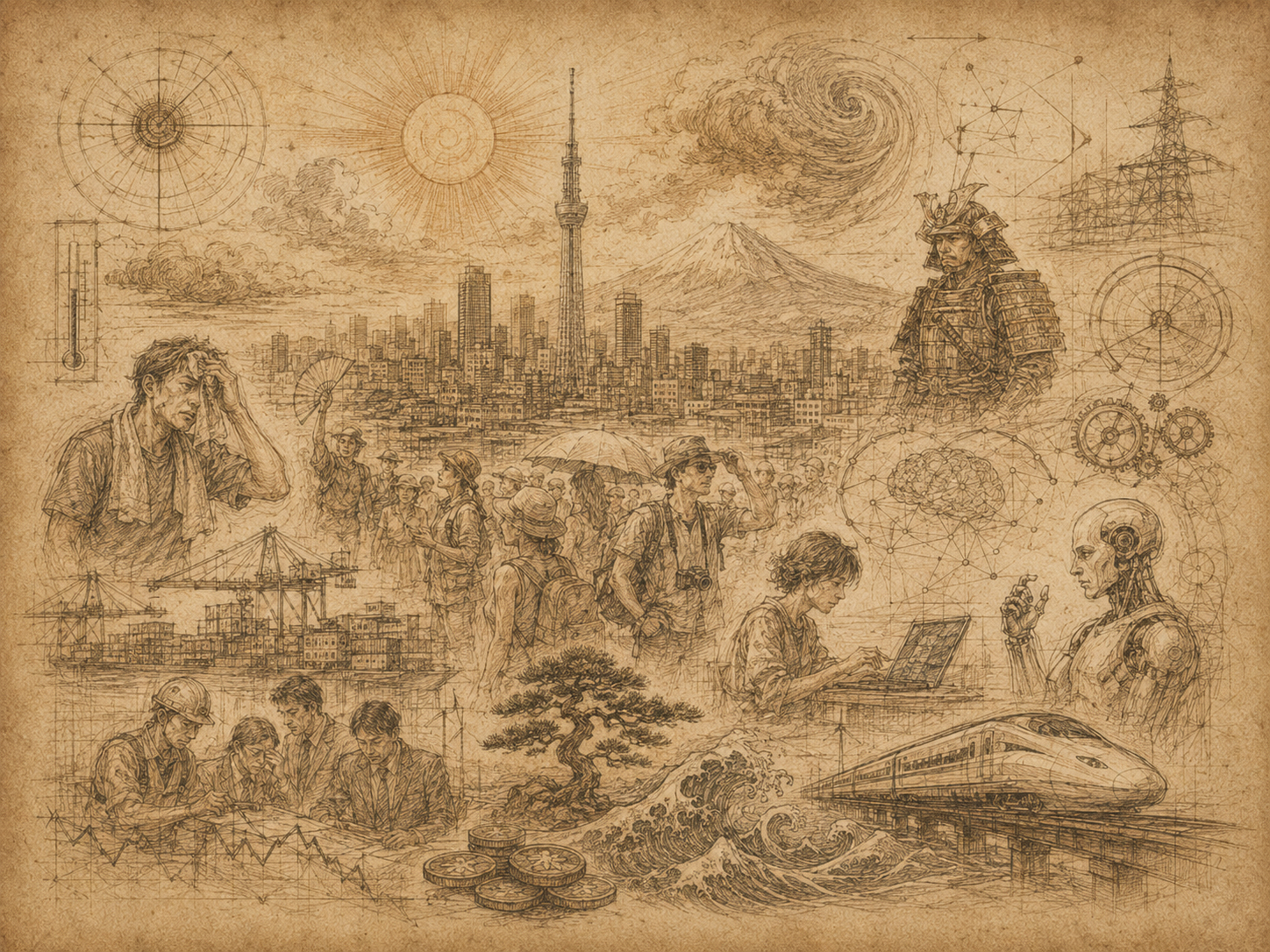
Japan is nearing a boiling point. That is partly metaphor. But in July 2026, the metaphor feels physical. The Japan Meteorological Agency has introduced a new term, kokushobi, for days of 40°C or higher. The yen is still trading around ¥161 to the dollar, squeezing households even as exporters and global firms find room to breathe. The Bank of Japan’s Tankan survey shows large manufacturers at their strongest sentiment level in eight years. SoftBank has put another $10 billion into OpenAI. Tourist sites are experimenting with local discounts and higher non-resident prices. Mt. Fuji now requires more discipline, more money and more planning. And Samurai Blue has left the World Cup after losing to Brazil, not humiliated, but not yet satisfied.
The theme of this Sunday edition is pressure. Heat pressure. Currency pressure. Tourist pressure. Demographic pressure. Technological pressure. Sporting pressure. The pressure of a mature country being asked to change its shape.
Pressure can break things. But pressure can also refine them. It turns ore into metal, carbon into diamond, hesitation into decision. The question for Japan in the summer of 2026 is not whether pressure exists. It plainly does. The question is whether the country can convert pressure into design.
When heat changes the national vocabulary
Societies reveal their anxieties through the words they invent. Japan has always had a rich vocabulary for summer: mōsho, kokusho, humid nights, lingering heat, cicada heat, heat that rises from asphalt after sunset. But the need to define 40-degree days as a regular category marks a threshold. Summer is no longer merely a season of festivals, shaved ice and wind bells. It is now a test of public policy.
Heat changes school calendars, construction schedules, tourist itineraries, sports events, festival planning, elder care, electricity demand and the daily rhythm of work. A hot day used to be weather. A brutally hot summer is infrastructure. It asks whether buses arrive on time, whether public buildings can serve as cooling shelters, whether outdoor workers are protected, whether tourists understand the risk, whether children and elderly people have somewhere safe to go.
Japan once managed summer through water, wind and timing. Edo’s canals, shaded streets, evening entertainment, river culture, uchimizu, sudare, ghost stories and summer foods were not nostalgia; they were survival arts. Postwar Japan added concrete, air-conditioning and mass electric comfort. Now that same built environment stores heat. The modern solution has created a new modern problem.
A strong Tankan inside a weak-yen economy
The economic picture is not bleak. In fact, corporate Japan looks unusually resilient. The June Tankan showed the large-manufacturer sentiment index rising to +22, its highest level in eight years. Large non-manufacturers reached +37. AI demand, semiconductor orders, tourism, price pass-through and planned capital expenditure all point to a Japan that is not standing still.
Yet the yen around ¥161 to the dollar tells another story. For exporters, a weak yen can flatter earnings. For households, small businesses and import-dependent sectors, it raises the cost of fuel, food, components, travel and daily life. A strong corporate survey and a weak household mood can exist at the same time. That is exactly the tension Japan must confront.
Japan’s postwar history has been shaped by exchange-rate turning points: the Nixon Shock, the shift to floating rates, the Plaza Accord, the bubble, the lost decades, zero interest rates, Abenomics and the post-pandemic weak-yen era. Currency is never just a price. It is a national distribution mechanism. It decides who gains, who pays and which industries appear competitive.
The Tankan strength is good news. But it must not become an excuse for complacency. If corporate confidence is real, then wages, training, regional investment, housing, child care and productivity must follow. A country cannot live forever on strong balance sheets and weak family budgets.
SoftBank and OpenAI: another giant bet on the future
SoftBank’s July 1 announcement that it had completed a second $10 billion investment tranche in OpenAI belongs in this edition because it is not merely a corporate financing event. It is a statement about where Japanese capital believes the next world will be built: artificial intelligence, computing infrastructure, corporate automation, robotics, data centers and enterprise software.
Masayoshi Son’s bets have always looked too large until they either became prophetic or painful. SoftBank’s history runs through software distribution, Yahoo Japan, broadband, mobile phones, the iPhone, Alibaba, Arm, the Vision Fund and now AI. The question is not whether the check is bold. The question is whether Japan can turn AI investment into Japanese capability.
That matters because Japan’s domestic problems are exactly the kind AI will be asked to touch: labor shortages, elder care, manufacturing, logistics, construction, education, government paperwork, local medical access and disaster response. AI will not solve those problems by magic. But a country with too few workers cannot afford to ignore tools that may extend human capacity.
The danger is dependency. Japan missed much of the platform era dominated by American and Chinese internet giants. In the AI era, Japan must decide whether it will merely buy tools or help shape them. The difference will determine whether AI becomes another imported layer or a new domestic operating system for industry.
Tourism succeeded — and then became a management problem
Inbound tourism is one of Japan’s clearest economic wins. It fills hotels, restaurants, shops, museums, trains and rural experiences. It brings foreign currency into regions that need demand. It exports Japanese culture through lived experience rather than advertising.
But success has a cost. Kyoto buses, Mt. Fuji trails, famous convenience-store photo spots, shrine districts, castle towns and narrow old streets all now feel the strain. Local residents live inside places that the world consumes as images. That is why Himeji Castle’s two-tier pricing debate matters. Is a lower resident price unfair discrimination, or is it a legitimate local discount? Is a higher non-resident price a foreign surcharge, or a practical way to fund preservation?
Historically, tourism has always balanced welcome with protection. Edo-period pilgrimages, Meiji railway travel, postwar group tours and bubble-era resort development all brought money and friction. What is new is the speed: social media, a weak yen, online booking and global air routes can overwhelm a town before it has redesigned its streets, staffing or expectations.
Japan’s next tourism strategy cannot be “more” alone. It must be better timed, better priced, better distributed and better explained. The answer is not hostility to visitors. The answer is an edited visitor economy: reservations, off-peak incentives, local reinvestment, crowd controls, multilingual education and transparent pricing.
Mt. Fuji is a mountain, not a backdrop
Mt. Fuji is the national image. It is also a physical mountain with weather, altitude, toilets, rescue risk, trash, erosion and exhausted hikers. The 2026 rules — including the ¥4,000 fee, entry controls and restrictions for climbers without hut bookings — mark a new stage in Japan’s tourism management.
Fuji has been many things: sacred mountain, pilgrimage route, subject of woodblock prints, symbol of the nation, modern climbing destination, World Heritage site and social-media trophy. Each age has projected its own desire onto the mountain. Now the question is whether love for Fuji can mature into restraint.
The restrictions may look inconvenient. They are also honest. A mountain cannot be infinitely open without being damaged. A rescue system cannot be infinitely stretched without risk. A World Heritage site cannot be reduced to a backdrop for rushed midnight climbing. The fee is not merely a toll. It is a reminder that access has obligations.
Japan lost to Brazil — and that hurt for the right reason
Japan’s 2-1 World Cup loss to Brazil was painful because Japan was close enough to feel the gap. Kaishu Sano gave Japan a halftime lead. Brazil adjusted. Casemiro equalized. Gabriel Martinelli scored in stoppage time. The old story would have been: Japan fought bravely. The new story is harder: Japan had a path and did not finish it.
That is progress. Since the heartbreak of Doha in 1993, the J.League era, the 1998 debut, the 2002 co-hosted tournament and later wins over global powers, Japan has moved from participation to expectation. Japanese players now belong in Europe’s top leagues. The national team is no longer content to be charming, organized and admirable. It wants to win knockout games against giants.
Losing to Brazil does not prove Japan is weak. It proves the standards have changed. The next questions are specific: game management, late substitutions, final-third quality, physical intensity, defensive concentration and how to kill a match against a top-tier opponent. Pain becomes useful only when it turns into detail.
The night train as a quieter answer
At first glance, a summer rail story about the WEST EXPRESS Ginga seems lighter than heat, AI, currency or football. But it belongs here. A night train from Kyoto toward Shingu, with ocean views and regional food, represents another kind of progress: not faster, but richer.
Postwar Japan became a high-speed country. The Shinkansen changed time, business, tourism and national imagination. But the mature travel economy is rediscovering slower movement: scenic trains, local food, coastal routes, station stops, overnight departures, sunrise arrivals. The journey itself becomes the product.
That matters for regional Japan. Not every rural area can win through volume tourism. Some places need higher-value, lower-impact, story-driven travel. Rail can become an editor of local experience: food, scenery, craft, lodging, history and time stitched together by the route.
The boiling point is an editing point
The phrase “boiling point” sounds like crisis. But boiling also changes state. Water becomes steam. A closed surface becomes motion. In social terms, a boiling point is the moment when old arrangements cannot remain invisible.
Japan is nearing several such points at once: summer heat, currency weakness, tourist concentration, AI investment, labor scarcity, sports ambition, regional transport and cultural preservation. Each problem can be described separately. But together they reveal a deeper question: what kind of mature country does Japan want to become?
The answer is not pure optimism or pure pessimism. The answer is editing. Heat requires both safety and culture. A weak yen requires both industrial strategy and household protection. Tourism requires both welcome and limits. AI requires both capital and ethics. Football requires both pride and hard analysis. Transport requires both speed and slowness.
Japan.co.jp’s view
Japan on July 5, 2026 is uncomfortable — and fascinating. Corporate confidence is strong. AI investment is enormous. Tourism is globally magnetic. Culture is moving from screen to stage and from Japan to the world. Football ambition is real enough that losing narrowly to Brazil feels like failure, not a souvenir. Mt. Fuji is being protected with rules, and night trains are reminding travelers that time itself can be part of the destination.
At the same time, heat is dangerous, the yen is weak, residents are tired, AI is disruptive and many local communities are under strain. The old habit of separating “good news” from “bad news” is not enough. The same forces that make Japan attractive also make it fragile.
There are two futures for a country at boiling point. One is evaporation: pressure escapes, institutions weaken, people retreat. The other is power: pressure becomes steam, steam moves machinery, and machinery changes the shape of the future. Japan should choose the second. Convert heat into policy. Convert yen pain into productivity. Convert tourism into preservation. Convert AI capital into domestic capability. Convert sporting heartbreak into the next level.
If Japan can do that, the summer of 2026 may be remembered not only as brutally hot, but as the season when a mature country began to re-edit itself.
Reader takeaways
| Theme | How to read it |
|---|---|
| Extreme heat | “Kokushobi” is not just a weather term. It is a signal that public systems must adapt. |
| Economy | The Tankan is strong, but yen weakness and prices divide corporate confidence from household reality. |
| AI | SoftBank’s OpenAI investment is a bet on whether Japan can regain influence in the next platform era. |
| Tourism | Dual pricing and Fuji rules show that success now requires management, not just promotion. |
| Culture and sport | Ghibli on stage, night trains and Samurai Blue all show Japan renegotiating its relationship with the world. |
Sources and references
This editorial draws on official releases and major reporting on weather, markets, tourism, AI investment, football, rail travel and Mt. Fuji climbing policy.
- Japan Meteorological Agency: introduction of “kokushobi” for days of 40°C or higher.
- Reuters: June 2026 Tankan, large manufacturers at +22, non-manufacturers at +37, capex plans.
- SoftBank Group: completion of the second $10 billion OpenAI investment tranche.
- The Guardian: Himeji Castle dual pricing, tourism taxation and overtourism debate.
- Official Mt. Fuji Climbing Website: 2026 Mt. Fuji climbing fees, rules and entry controls.
- Reuters: Brazil-Japan World Cup report and Moriyasu postmatch comments.
- JR West: 2026 WEST EXPRESS Ginga Kinan-route summer schedule.