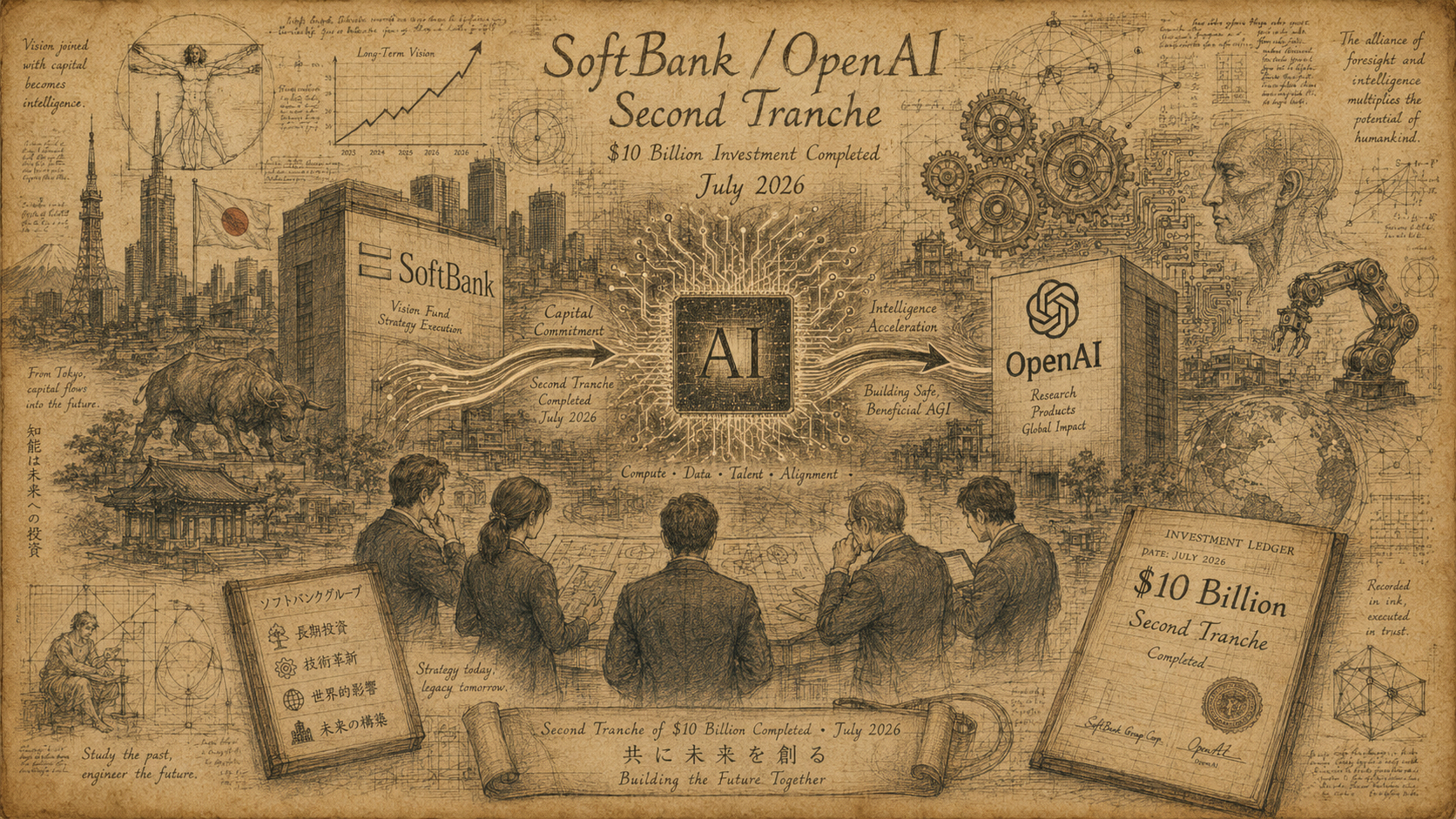
SoftBank Group has placed another enormous marker on the table. On July 1, 2026, Japan time, the company executed the second $10 billion tranche of its follow-on investment in OpenAI Group PBC. SoftBank put the yen figure at ¥1.6273 trillion. The investment was made through SoftBank Vision Fund 2 and forms the middle installment of a previously announced $30 billion follow-on investment plan.
On paper, it is a financing event. In story terms, it is something larger: Masayoshi Son has decided that the center of the “information revolution” he has pursued for decades is no longer search, smartphones, ride-sharing, or shared offices. It is generative AI, enterprise agents, chips, data centers, and the physical infrastructure needed to make artificial intelligence a global utility.
SoftBank had already invested an aggregate $34.6 billion in OpenAI through Vision Fund 2 since September 2024. In its February 27 announcement, SoftBank said that once the full $30 billion follow-on investment is completed, its cumulative OpenAI investment is expected to reach $64.6 billion, representing an ownership interest of about 13%. The July 1 payment shows that the blueprint is moving from promise to execution.
The meaning of $10 billion
The important point is not only the size of the check. It is the structure. SoftBank is acquiring preferred shares that automatically convert into OpenAI common shares upon an IPO or related listing transaction. In other words, this is not merely a short-term trade. It is capital designed around the possibility that OpenAI becomes a defining public company of the AI era.
SoftBank’s February plan divided the commitment into three equal installments: April 1, July 1, and October 1, each for $10 billion. That makes the phrase “executed the second tranche” important. In mega-financing, a promise and a closing are not the same thing. Between them stand markets, credit conditions, currency moves, private-company valuations, legal paperwork, and lender risk appetite.
For OpenAI, the capital supports research, products, infrastructure, and enterprise deployment. For SoftBank, it is both a financial stake and the center of a broader AI system. Son described OpenAI in February as a clear leader with a global user base and said the additional investment would support OpenAI’s research and ecosystem while advancing SoftBank’s own ASI strategy.
The financing behind the bet
Big bets require big financing. On March 27, SoftBank announced a $40 billion bridge facility primarily for the OpenAI follow-on investments and general corporate purposes. The borrowers are SoftBank Group and an overseas wholly owned funding subsidiary. The lenders listed in the announcement include JPMorgan Chase, Goldman Sachs, Mizuho Bank, Sumitomo Mitsui Banking Corporation, and MUFG Bank. The maturity date is March 25, 2027, and the facility was announced as unsecured.
That detail matters. SoftBank did not simply reach into a cash drawer and quietly buy more shares. It built a financing machine around the OpenAI commitment. The company said borrowings under the bridge agreement are expected to be repaid in stages through existing assets and other financing measures.
This is classic SoftBank. Son rarely tiptoes into a market. He identifies a long arc, takes a large position early, and accepts volatility that most companies would avoid. When it works, the story looks like Alibaba or Arm. When it fails, it becomes WeWork. This OpenAI commitment carries both memories.
From information revolution to AI revolution
SoftBank’s corporate history is a history of enormous pivots. It began in software distribution, moved into internet services, became a major force in Yahoo! Japan, built a mobile business, acquired Vodafone Japan, promoted the iPhone in Japan, bought Sprint in the United States, and acquired Arm in 2016.
In 2017, the SoftBank Vision Fund announced a first major close with more than $93 billion in committed capital. Apple, Foxconn, Qualcomm, Sharp, Saudi Arabia’s Public Investment Fund, Mubadala, and SoftBank were among the names in the structure. It was not just a fund. It was a new style of capital: enormous checks intended to accelerate companies that SoftBank believed could define entire categories.
That era brought fame, influence, and pain. WeWork’s collapse, falling private-tech valuations, higher interest rates, and the unwinding of easy-money exuberance turned SoftBank from the emblem of startup abundance into a cautionary tale. Son spent a period emphasizing defense, liquidity, and balance sheet discipline.
But the core idea never disappeared. Son believes information technology changes civilization, and that the companies at the center of each wave become more than ordinary businesses. After ChatGPT, the next center looked obvious to him: OpenAI.
Why OpenAI?
OpenAI is no longer merely a research lab. ChatGPT put generative AI in front of the mass public. Its platform has expanded across enterprise products, APIs, multimodal models, reasoning systems, and agentic workflows. SoftBank is not only buying model performance. It is buying into a user base, a developer ecosystem, enterprise adoption, infrastructure demand, and the narrative of artificial general intelligence.
SoftBank’s February release described OpenAI Group PBC as a public benefit corporation with the same mission as the OpenAI Foundation: to ensure that artificial general intelligence benefits all of humanity. That structure itself is part of the story. OpenAI is trying to be both a mission-driven institution and a capital-intensive technology company. SoftBank is betting that the two can coexist long enough to build one of the world’s most important platforms.
The economics of AI have also changed. Advanced models require not just software genius but vast compute, talent, data, electricity, networking, cooling, chips, and capital. AI may feel weightless when a user types a prompt, but the industry behind the answer is increasingly heavy. SoftBank’s money is a ticket into that infrastructure-heavy era.
The Japan channel: Cristal intelligence and SB OAI Japan
This investment is not only a Japanese company buying into an American AI company. It also connects directly to a Japan rollout strategy. In February 2025, OpenAI, SoftBank Group, Arm, and SoftBank Corp. announced a partnership to develop and market “Cristal intelligence,” described as advanced enterprise AI that securely integrates each company’s systems and data in customized form.
SoftBank said it would spend $3 billion annually to deploy OpenAI solutions across the group, making itself an early large-scale customer. SoftBank Corp. said it aimed to automate over 100 million workflows using Cristal intelligence. That is the operational side of the capital story: SoftBank wants OpenAI not just as an asset but as a tool inside its own businesses.
In November 2025, SoftBank Group, SoftBank Corp., and OpenAI launched SB OAI Japan GK. The joint venture is designed to market “Crystal intelligence” exclusively in Japan, with availability planned for 2026. The company is owned 50-50 by OpenAI and C Holdings; C Holdings is owned 51% by SoftBank Corp. and 49% by SoftBank Group.
Read that way, the July 1 tranche is part of a larger chain: capital for OpenAI, OpenAI technology for SoftBank, SoftBank implementation for Japanese enterprises, and a potential enterprise-AI bridge between Silicon Valley and Tokyo.
Stargate and the weight of infrastructure
In January 2025, OpenAI, SoftBank, Oracle, and MGX announced the Stargate Project, a new company intended to invest up to $500 billion over four years in AI infrastructure for OpenAI in the United States, with $100 billion to begin deploying immediately. The headline was almost surreal, but it captured a real shift: AI competition is becoming an infrastructure competition.
The question is no longer only which model is smartest. It is who can secure the most compute, power, data-center capacity, cooling, land, transmission, and chips. Training and inference at frontier scale turn AI into an industrial project. They require construction, energy contracts, semiconductors, specialized networking, and political permission.
That is why SoftBank’s OpenAI investment is also a story about semiconductors, energy, real estate, and communications. For Japanese companies, the issue is not only how to use AI tools. It is where the compute comes from, who controls it, and how Japan participates in the next layer of global digital infrastructure.
The risks: the crown is expensive
The risk is obvious. First, valuation. The February release set the pre-money valuation for the three tranches at $730 billion. That places OpenAI among the most valuable private companies ever. If growth, revenue, and margins support that valuation, SoftBank may look prescient. If monetization disappoints or compute costs overwhelm revenue, the valuation could become a burden.
Second, financing. The $40 billion bridge facility accelerates SoftBank’s AI push, but it also creates repayment pressure. SoftBank says its LTV and cash-position policies are unchanged, but markets will watch the balance sheet closely as AI investments continue.
Third, technology and regulation. The model race moves quickly. A leader in one generation may be challenged in the next. Copyright, data protection, national security, safety rules, labor-market effects, and cross-border AI governance can all shape OpenAI’s future. The more powerful AI becomes, the more political its growth becomes.
Fourth, implementation. Enterprise AI is not magic. Companies need clean data, workflow redesign, security controls, training, governance, and trust. SB OAI Japan can sell a package, but the real test will be whether Japanese enterprises can actually change how work is done.
Why Son is still willing to bet
Son’s investment philosophy has always been uncomfortable to people who prefer incremental forecasts. He does not usually ask whether something is cheap next quarter. He asks whether it will define the next civilization-scale platform. If AI restructures industry, healthcare, education, manufacturing, research, administration, and creativity, then a major stake in a leading AI company may be worth far more than a conventional valuation model can easily capture.
Arm strengthens that logic. SoftBank owns a strategic chip-design asset that matters from cloud to edge. Combine OpenAI’s models, Arm’s compute ecosystem, SoftBank Corp.’s telecom and enterprise base, and SB OAI Japan’s go-to-market channel, and SoftBank can argue that it is not simply a financial investor. It is assembling an AI operating system for business.
That may prove grandiose. But Son’s best wins once looked grandiose too. Alibaba, Arm, and Japanese mobile all began as bold moves that invited skepticism. OpenAI now sits in that lineage.
What it means for Japan
For Japan, the story is not distant. The country faces a productivity problem, a labor shortage, aging demographics, wage pressure, and intense global competition. Enterprise AI could become one of the few tools large enough to change the slope of those problems. Reports, customer inquiries, coding, design, procurement, legal review, compliance, factory planning, translation, and management analysis are all potential fields of automation and augmentation.
Japan’s corporate culture is careful, process-heavy, and quality-oriented. That can slow AI adoption. It can also create an advantage if AI is implemented responsibly. The next phase will not be about putting a chatbot in the corner of the office. It will be about embedding AI agents into workflows with accountability, security, and measurable productivity gains.
SoftBank and OpenAI are positioning themselves at precisely that point of insertion. If Crystal intelligence works, it could become a practical route for major Japanese companies to adopt AI without building everything themselves. If it disappoints, it will join the long list of enterprise-transformation projects that promised a new era and delivered consulting decks.
Japan.co.jp view
The July 1 tranche is a declaration: SoftBank does not intend to watch the AI revolution from the sidelines. It is investing capital, arranging financing, building a Japan joint venture, connecting with OpenAI’s models, pointing toward infrastructure, and trying to turn the whole stack into a business system.
If it works, SoftBank becomes a major shareholder in one of the defining companies of the AI age, a seller of AI transformation to Japanese enterprises, a participant in global compute infrastructure, and a bridge between Tokyo and the frontier of AI. If it fails, the same things that make the story powerful—massive valuation, massive debt, massive infrastructure—will make the pain equally large.
Masayoshi Son is borrowing the future again. This time, the future’s name is OpenAI.
Reader takeaways
| Item | Meaning |
|---|---|
| What happened | SoftBank Group executed the second $10 billion tranche of its follow-on investment in OpenAI on July 1, 2026. |
| Yen equivalent | SoftBank announced the amount as ¥1.6273 trillion. |
| Total plan | The February 2026 plan consists of three $10 billion tranches in April, July, and October. |
| Valuation | The tranches were set at a $730 billion pre-money valuation. |
| Expected position | After completion, SoftBank expects cumulative OpenAI investment of $64.6 billion and about 13% ownership. |
| Japan connection | The investment connects to SB OAI Japan and Crystal intelligence, SoftBank’s enterprise-AI rollout strategy for Japan. |
Sources and references
This article draws on SoftBank Group official announcements, OpenAI/SoftBank partnership materials, the SB OAI Japan launch release, the bridge facility announcement, and Reuters reporting.
- SoftBank Group: Execution of Follow-on Investment (Second Tranche) in OpenAI, July 1, 2026.
- SoftBank Group: Follow-on Investments in OpenAI, February 27, 2026.
- SoftBank Group: Execution of Bridge Facility Agreement Primarily for the Follow-on Investments in OpenAI, March 27, 2026.
- SoftBank Group: Execution of Follow-on Investment (First Tranche) in OpenAI, April 1, 2026.
- SoftBank Group / OpenAI / Arm / SoftBank Corp.: Partnership to develop and market Advanced Enterprise AI, February 3, 2025.
- SoftBank Group / SoftBank Corp. / OpenAI: Launch of SB OAI Japan, November 5, 2025.
- Reuters: SoftBank financing and OpenAI stake-backed loan talks, July 1, 2026.