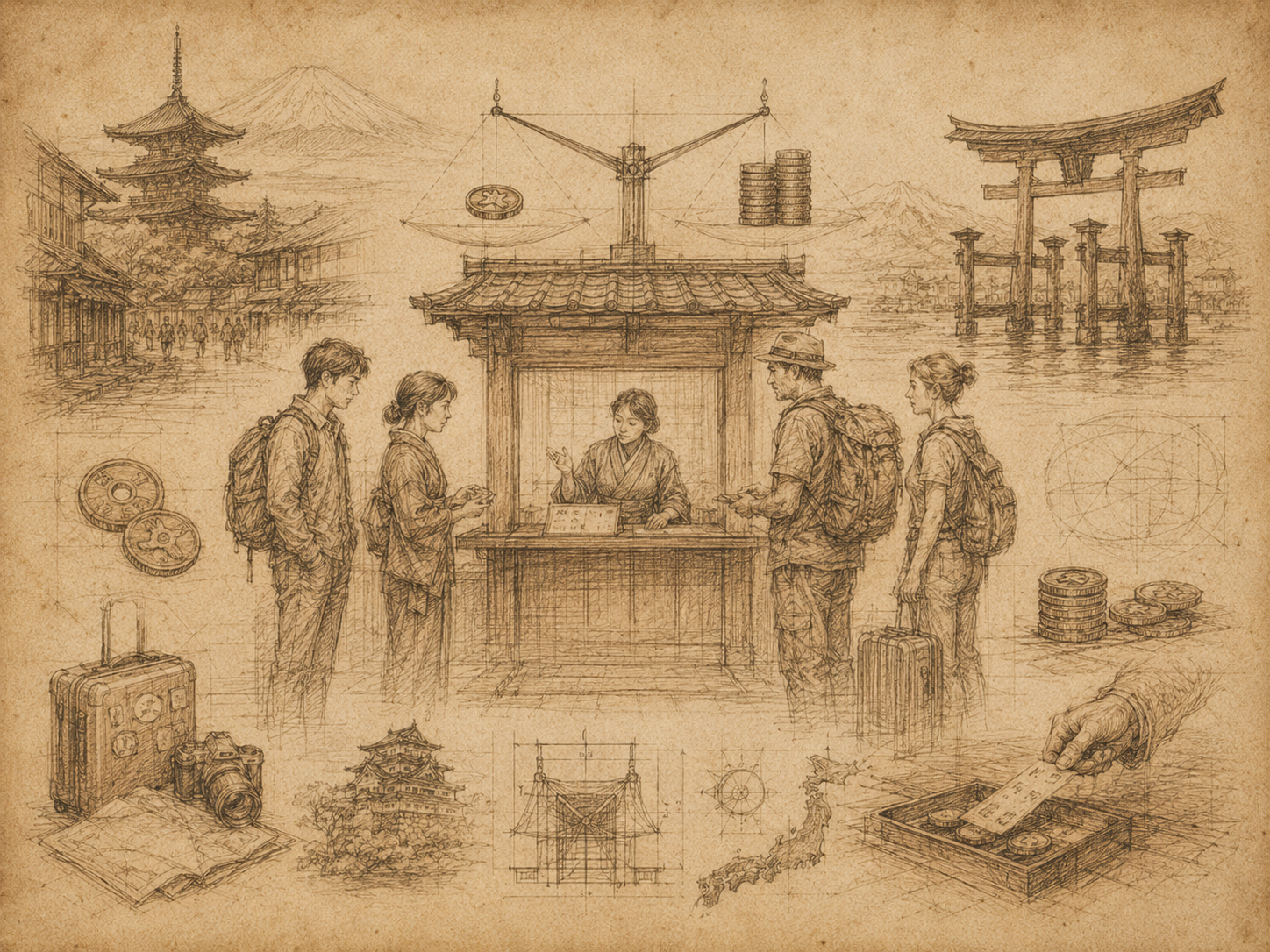
From a distance, Himeji Castle still looks serene: white plaster, layered roofs, the famous “white heron” silhouette rising above the city. But at the ticket gate in 2026, Japan’s tourism future has become visible. Should visitors pay more? Should local residents pay less? Is a higher fee a fair contribution to preservation — or the first line of a more divided tourism economy?
On March 1, 2026, Himeji Castle changed its adult admission structure. Non-residents pay ¥2,500. Himeji city residents who show identification can still enter for ¥1,000. The official framing matters: this is not presented as a foreigner surcharge, but as a resident discount. Still, both foreign media and Japanese tourism observers see Himeji as the clearest example yet of a broader shift toward two-tier pricing.
The pressure behind the change is Japan’s own tourism success. Japan set a record for inbound travel in 2024 and moved even higher in 2025. The national government’s long-term goal is 60 million inbound visitors and ¥15 trillion in spending by 2030. But Kyoto buses, Mount Fuji trails, heritage maintenance, hotel prices, restaurant capacity, labor shortages, and neighborhood frustration all point to the same problem: growth is no longer just a marketing challenge. It is a management challenge.
Foreigner surcharge, or local discount?
The language of pricing is political. “Foreigners pay more” sounds exclusionary. “Residents pay less” sounds like compensation for local burden. Himeji chose the second structure: Japanese visitors from outside Himeji and foreign visitors both pay ¥2,500; city residents pay ¥1,000. The line is drawn by residence, not nationality.
That distinction is not cosmetic. Heritage sites, temples, mountains, beaches, buses, ferries, markets, and old streets are not only tourism products. They are part of local life. As visitor numbers rise, so do costs: cleaning, repairs, crowd control, toilets, signage, security, interpretation, multilingual support, waste management, and safety. Residents get some economic benefit from tourism, but they also live with the congestion.
A resident discount is therefore not just a discount. It is a political statement that local people carry some of the burden of a destination’s popularity. The difficulty is that other Japanese visitors may ask a fair question: if a castle is a national treasure and receives public support, why should only city residents receive the discount? That is the dilemma at the heart of two-tier pricing. Who belongs? Who pays? Who benefits?
Japan had become too cheap for its own tourism success
The weak yen is central to the debate. By the mid-2020s, Japan had become an unusually attractive bargain for many overseas visitors: world-class food, clean transport, temples, anime culture, ski resorts, hotels, castles, convenience stores, and department stores at prices that often felt low to travelers holding stronger currencies.
Inbound spending became a major economic pillar. Reuters has described visitor spending as an export-like sector, ranking behind automobiles and ahead of some traditional export categories in economic significance. Tourism is no longer a pleasant bonus. It supports local employment, railways, restaurants, airports, department stores, hotels, and heritage facilities.
But a destination that remains too cheap can become a destination under stress. Low entry fees may not cover restoration. Low bus fares may not pay for more service or drivers. Low prices may bring crowds without funding the infrastructure needed to receive them. Cheap tourism, at scale, can become expensive for locals.
Why Himeji Castle became the symbol
Himeji Castle is not just another attraction. It is a UNESCO World Heritage site, a national treasure, one of Japan’s finest surviving castle complexes, and a symbol of both national history and local identity. Every visitor adds a small amount of wear: to stairs, floors, plaster, paths, ticketing systems, safety management, and staff time.
According to The Guardian’s reporting, overseas visitors to Himeji Castle rose from 387,000 in 2018 to 547,000 in 2025, and the site’s long-term management plan suggests that number could eventually reach 1.2 million annually. After the new fee began, admissions reportedly dropped about 17% in the first month, while ticket revenue more than doubled. For destination managers, that is a powerful signal: fewer people, more money, and potentially better preservation.
But revenue is not the only value. A heritage site is also a public classroom. If prices rise too far, access narrows for families, students, domestic travelers, young people, and budget visitors from abroad. Culture should not become a luxury product. The best two-tier systems must preserve access while asking high-impact visitors to contribute more.
Kyoto’s bus problem: before pricing comes daily life
Kyoto has become the shorthand for overtourism in Japan. Kiyomizu-dera, Gion, Arashiyama, Fushimi Inari, Nishiki Market — for visitors, Kyoto is a dream. For residents, it is a working city. When buses are packed with tourists, local people cannot move. When old streets become photo sets, private life gets squeezed. The issue is not just “too many people.” It is the collision of visitor time and resident time.
That is why Kyoto has considered different fare structures for non-residents on crowded buses. If designed carefully, such a policy would not be punishment. It would be an effort to protect basic mobility. Tourists also benefit from a city that functions. A slightly more expensive but less chaotic Kyoto may be better than a cheaper Kyoto that locals and visitors both struggle to use.
Public transport, however, is much harder than castle admission. Who counts as a resident? What about commuters, students, nearby municipalities, part-time workers, and domestic travelers? How do operators verify status without slowing down the system? A price policy that looks elegant on paper can become messy at the bus door.
Japan already has local pricing traditions
Two-tier pricing is not entirely new to Japan. Municipal pools, gyms, museums, ferries, hot springs, ski passes, and public facilities often distinguish between residents and non-residents. The logic is simple: residents support facilities through taxes, so they receive a lower rate.
Japan has also used the opposite kind of price difference. For years, foreign travelers enjoyed special rail passes and tax-free shopping benefits that Japanese residents could not access in the same way. Japan’s tourism pricing history is not a simple story of charging foreigners more. For much of the modern inbound era, Japan discounted itself to attract visitors.
What is changing is the phase of the market. When a country wants to fill empty seats, discounts make sense. When buses are full, heritage sites are worn, trails are crowded, and workers are scarce, prices become a tool to manage demand.
Common overseas, sensitive in Japan
Two-tier pricing is common elsewhere. The Taj Mahal, Angkor Wat, national parks in Thailand and Indonesia, and some European museums and cities have charged visitors and residents differently. The arguments usually involve conservation costs, public subsidy, income differences, crowd management, and the fact that iconic places are often maintained by local taxpayers.
Japan’s debate is more delicate because of its self-image as a country of omotenashi, or hospitality. A destination that prides itself on welcome can feel uneasy at a gate that divides people by price. Nationality-based fees risk being perceived as discriminatory. That is why Japan is more likely to use resident/non-resident structures, local discounts, cooperation fees, or congestion-management fees.
Communication matters. A “foreigner surcharge” invites backlash. A “heritage preservation contribution” or “resident discount” explains the purpose. Many travelers are willing to pay more when they understand that the money supports repair, cleaning, crowd control, safety, interpretation, or local transport.
The key is transparency
The success of two-tier pricing depends less on the number at the gate than on the use of the revenue. If a visitor pays ¥2,500, what improves? Is a wall repaired? Are toilets cleaner? Are staff better paid? Are crowds better managed? Are local buses protected? Is the money publicly accounted for?
Without transparency, two-tier pricing looks like a cash grab. With transparency, it can become a social contract. Visitors contribute to the places they love. Residents receive visible relief. Heritage managers get funding for preservation. Businesses benefit from a destination that does not collapse under its own popularity.
Japan.co.jp’s view is that this is the most important test. Higher prices can be justified. Vague higher prices cannot.
The 60-million-visitor era
The government’s 2030 target — 60 million inbound visitors and ¥15 trillion in spending — is not just a tourism slogan. It is a national strategy touching regional revitalization, cultural export, transportation, hospitality, labor policy, airport capacity, language services, disaster readiness, and digital infrastructure.
But 60 million visitors is also a heavy number. It means more people at airports, stations, hotels, temples, restaurants, ski resorts, islands, buses, and mountain trails. Japan cannot simply invite more people. It must design when they come, where they go, how they move, and how they contribute.
Two-tier pricing is one tool in that design. It is not enough by itself. Japan will need timed reservations, dynamic pricing, visitor caps, luggage delivery, regional dispersion, multilingual etiquette systems, digital crowd information, local tourism taxes, mountain fees, and more serious investment in workers and infrastructure.
Japan.co.jp’s view
Charging tourists more should not be celebrated casually. But neither should artificially cheap tourism be treated as a virtue. Heritage wears down. Streets clog. Workers tire. Residents have lives. The more the world loves Japan, the more Japan must build systems capable of receiving that love without being damaged by it.
The right question is not “Should foreigners pay more?” The right question is: “How should visitors, residents, businesses, and governments share the cost of maintaining places that everyone wants to enjoy?” Nationality-based systems deserve caution. Resident discounts, preservation contributions, and congestion fees deserve serious discussion.
Himeji Castle’s pricing shift is a sign that Japanese tourism is entering maturity. The era of simply attracting visitors is ending. The era of receiving, preserving, pricing, and explaining has begun. At the gate, price is not only a number. It is a promise about what kind of tourism Japan wants to build.
Reader guide
| Question | Answer |
|---|---|
| What happened? | Japan is seeing growing debate over two-tier pricing at tourist sites, led by Himeji Castle’s resident/non-resident admission system. |
| Main example | Himeji Castle charges ¥2,500 for non-residents and ¥1,000 for Himeji city residents. |
| Why now? | Inbound travel growth, a weak yen, heritage maintenance costs, local congestion, and residents’ quality-of-life concerns. |
| Main concern | Fairness, discrimination risk, access to culture, and whether revenue is clearly returned to preservation and local services. |
| Japan.co.jp view | Two-tier pricing can work only if it is transparent, resident-focused, and tied to visible preservation or congestion relief. |
Sources and references
This article draws on reporting about Himeji Castle’s pricing change, The Guardian’s local interviews, national tourism targets, JNTO statistics, and 2024–2026 reporting on overtourism and Japan’s inbound travel economy.
- The Guardian: Himeji Castle pricing, Kyoto bus debate, departure tax, visa fees, tourism targets.
- Time Out Osaka: Himeji Castle fee increase to ¥2,500 for non-residents.
- Prime Minister's Office of Japan: 2030 target of 60 million visitors and ¥15 trillion spending.
- Japan National Tourism Organization: Visitor arrivals statistics.
- Reuters: 2024 record arrivals and visitor spending context.
- Reuters: Tourism boom and visitor spending as export sector context.