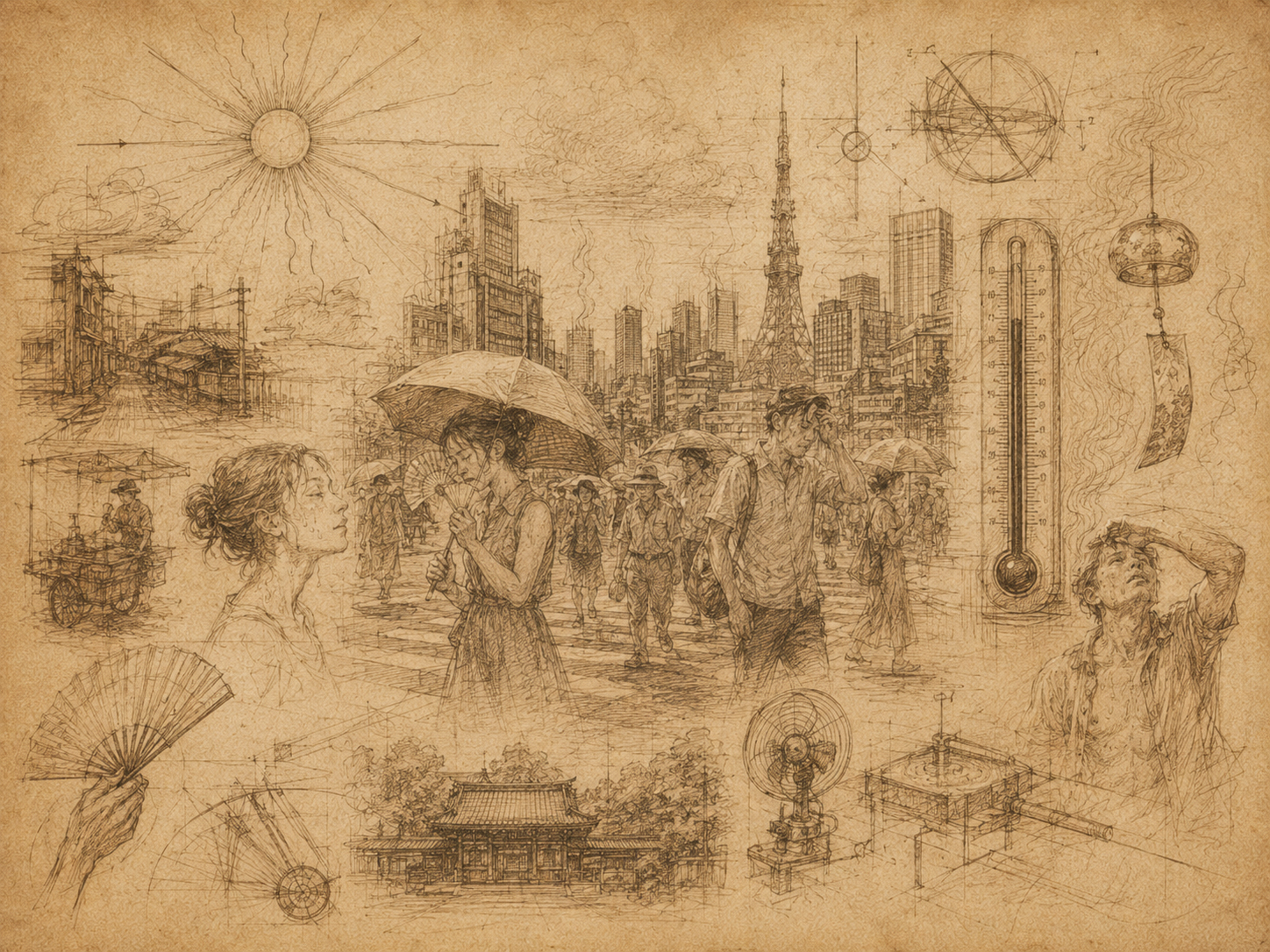
Japan’s summer has become so hot that the country needed a new word. On April 17, 2026, the Japan Meteorological Agency announced that days with a maximum temperature of 40°C or higher would officially be called kokushobi — severely, brutally, even cruelly hot days. The word now sits above the familiar ladder of Japanese summer terms: natsubi, manatsubi, and mōshobi.
Weather vocabulary is not just vocabulary. It is a national alarm system made of language. A country names what it must learn to live with. For decades, “midsummer day” was enough. Then 35°C days became frequent enough to require “extremely hot day.” Now 40°C has its own official category. The lexicon is catching up with the climate.
The JMA said the decision followed an online survey conducted from February 27 to March 29 and consultation with experts. The term kokushobi received the strongest public support. The Japan Weather Association had already used the word independently since 2022, but the 2026 JMA decision brings it into the official language of national forecasts.
The numbers behind kokushobi
The official ladder is simple: 25°C, 30°C, 35°C, 40°C. But the lived experience is not simple. Thirty-five degrees is already dangerous. Forty degrees in a humid Japanese city — with asphalt, concrete, weak wind, air-conditioner exhaust and hot nights — can be life-threatening.
The Japan Weather Association has forecast that 2026 may see 40°C or higher temperatures at a cumulative seven to fourteen observation points across the country. That does not mean every town will reach 40°C. It means Japan is now planning for 40°C-class heat as a recurring public risk, not a once-in-a-generation surprise. JMA daily statistics now count midsummer days, extremely hot days and kokushobi in the same national frame. Once a danger is named, it can be counted. Once it can be counted, it can be governed.
Why Japanese summer language is so precise
Japanese has always been unusually sensitive to seasonal nuance. Spring has late cold snaps and plum-rain moods. Autumn has lingering heat, typhoon rain and the first cold winds. Summer has its own dense vocabulary: humid heat, fierce heat, oppressive heat, lingering heat, midsummer heat, murderous heat. These are not merely poetic terms. They describe the body’s relationship to air, sunlight, humidity, shade and time of day.
The geography explains part of it. Japan is a long archipelago wedged between the Pacific and the Sea of Japan, with mountains, basins, coastal plains, monsoon rains, typhoons and föhn winds. Cities such as Tokyo, Osaka and Nagoya trap heat. Inland and basin cities can spike. Nights do not always cool. Humidity changes the meaning of every number on the thermometer.
The JMA added mōshobi, an extremely hot day of 35°C or above, to forecast terminology in 2007. Nearly twenty years later, 40°C needed a name of its own. When climate changes, dictionaries change too. Weather language becomes a record of what a society has been forced to notice.
How the records accumulated
The new term did not appear suddenly. Japan has been accumulating heat records. In 2018, Kumagaya in Saitama Prefecture reached 41.1°C, a national record at the time. In 2020, Hamamatsu in Shizuoka matched 41.1°C. In 2024, 40°C-class readings again appeared in the national conversation. In 2025, Japan recorded its hottest summer since records began, with the national average temperature for June through August reported at 2.36°C above the 1991–2020 normal.
The important point is not one record. It is the sequence. Japan’s 2023, 2024 and 2025 summers were all historically hot. By 2026, the country was not simply describing a weather event. It was institutionalizing a pattern. Kokushobi is a name born from repetition.
Extreme heat is not just a weather story. It is a health story, a power-grid story, a labor story, a tourism story, an agriculture story, a school story and an urban-planning story. At 40°C, schedules begin to fail. Midday becomes unusable. Outdoor work becomes dangerous. Festivals, sports, travel itineraries and construction sites need heat plans. In a kokushobi summer, the clock changes.
Heatstroke alerts and the WBGT index
Kokushobi is based on air temperature, but heatstroke risk cannot be judged by air temperature alone. Humidity, solar radiation, wind and heat from the ground matter. Japan’s heatstroke-prevention system therefore relies heavily on the Wet Bulb Globe Temperature, or WBGT, known in Japanese as the heat stress index.
The Ministry of the Environment and the JMA provide heat illness prevention information based on WBGT. A WBGT of 31 or higher is treated as “danger,” where exercise should generally be stopped. Heatstroke alerts are issued when the index is forecast to reach dangerous levels. Japan has also added a special heatstroke warning alert for more extreme, wider-area conditions, designed to push municipalities and residents toward stronger action before the next day’s heat arrives.
In practice, the words work together. Kokushobi tells the public, in ordinary language, that 40°C-class heat is possible or present. WBGT tells people how dangerous the actual conditions are for the body. Alerts turn that knowledge into action: avoid unnecessary outdoor activity, use air conditioning, drink water and salts, check on older people, protect children, and make cooling plans before leaving home.
Why cities store heat
Japan’s extreme heat is shaped by climate change, but also by the built environment. Asphalt and concrete absorb radiation. Narrow streets and tall buildings reduce airflow. Vehicles, air conditioners and machinery release heat. The fewer trees and water surfaces a district has, the more daytime heat remains after sunset. This is the urban heat-island problem.
The nighttime dimension matters. A 40°C afternoon is dangerous, but a hot night that never lets the body recover can be just as threatening. In large Japanese cities, tropical nights stack up, sleep worsens, dehydration accumulates and older residents become more vulnerable. Kokushobi may be a daytime maximum-temperature word, but the real story is twenty-four-hour heat.
Japan’s cities are now being asked to think like disaster systems for heat: more shade, more trees, more cool shelters, better pavement, water features, rooftop greening, school schedule changes, labor rules, public warnings and accessible cooling spaces. Heat is no longer background weather. It is infrastructure pressure.
Tourism must adapt too
Japan in summer is also a tourism product, and that product is changing. Kyoto, Asakusa, Nara, Hiroshima, Kanazawa, Mt. Fuji and castle towns all require walking, waiting, climbing stairs, navigating crowds and carrying bags. Visitors from cooler climates may not understand Japanese humidity. A beautiful itinerary can become unsafe when noon heat, jet lag and dehydration meet.
A kokushobi-era itinerary should be designed around time. Temples, shrines and outdoor walks in the morning. Museums, hotels, department stores, underground malls and cafés at midday. Evening walks, festivals and riverside meals after the heat breaks. Travelers need hats, umbrellas, cooling towels, oral rehydration drinks and permission to cancel outdoor plans without guilt.
For tourism operators, heat safety is becoming hospitality. Shade in queues, multilingual heat warnings, water points, shorter daytime tours, cooling rooms, later operating hours and more evening culture are no longer luxuries. They are part of making Japan livable for visitors as well as residents.
Old coolness, new danger
Japan has a deep culture of cooling: uchimizu water-sprinkling, bamboo screens, reed blinds, wind chimes, verandas, yukata, shaved ice, ghost stories, riverside dining, evening festivals. These practices were not merely charming. They were technologies for living with heat: blocking sunlight, moving air, evaporating water, shifting activity into evening and changing the feeling of the season.
But old coolness cannot replace modern safety. A wind chime cannot protect someone from 40°C heat. Water-sprinkling is not a substitute for air conditioning. The task is not to choose tradition or science. It is to combine them. Use shade and screens, but also check the WBGT. Enjoy the evening festival, but plan water and rest. Wear yukata, but know where the cool shelter is. Japan’s summer wisdom now needs both beauty and measurement.
That is the deeper meaning of kokushobi. It does not erase summer culture. It forces summer culture to become safer.
Schools, workplaces and homes
Kokushobi changes the daily institutions of life. Schools must rethink physical education, club activities, excursions and sports days. Employers must rethink construction, delivery, security, agriculture, kitchens, warehouses and events. Families must rethink how to protect elderly relatives, children and people living alone.
Heatstroke is not only an outdoor problem. It happens indoors, especially where people avoid air conditioning, cannot afford it, live alone, or do not notice dehydration. Older people may not feel thirst quickly enough. Some still believe air conditioning is unhealthy or wasteful. In a kokushobi society, using cooling is not indulgence. It is prevention.
For companies, heat has become a management issue. It affects productivity, legal risk, staffing, delivery reliability, insurance, electricity use and brand reputation. The weather forecast is no longer just a small talk topic. It is operational intelligence.
Japan.co.jp’s view
The arrival of kokushobi should not be read only as grim news, although the danger is real. It should also be read as a sign that Japan is naming a new reality clearly. Unnamed risks are easy to ignore. Named risks can be shared, reported, mapped, regulated and prepared for.
Japan has built disaster language for earthquakes, typhoons, floods and heavy rain: evacuation orders, alert levels, special warnings, linear rainbands. Now heat is joining that civic vocabulary. Kokushobi, WBGT, heatstroke alerts and cooling shelters are the language of a new kind of summer preparedness.
In 2026, kokushobi still sounds like a new word. In a few years, children may use it casually: “Today is a mōshobi,” or “Tomorrow might be kokushobi.” That is a frightening possibility, but also a practical one. Naming the heat is the first step toward living with it intelligently.
Do not underestimate the heat. Do not give up on summer. Japan’s new summer demands both.
Reader’s guide
| Question | Answer |
|---|---|
| What is kokushobi? | The official JMA term, adopted April 17, 2026, for days with maximum temperatures of 40°C or higher. |
| How does it fit the older terms? | Natsubi is 25°C+, manatsubi is 30°C+, mōshobi is 35°C+, and kokushobi is 40°C+. |
| Why does it matter? | It turns 40°C-class heat into a shared public-safety category that can change behavior. |
| What should people watch? | Not only air temperature, but WBGT, heatstroke alerts, humidity, sun exposure and nighttime heat. |
| Japan.co.jp view | Kokushobi is weather vocabulary, but also a word that changes cities, tourism, work and home life. |
Sources and references
This article draws on the Japan Meteorological Agency’s April 17, 2026 announcement, JMA temperature statistics, Ministry of the Environment/JMA heat illness prevention information, 2026 heat outlook coverage, and public records on Japan’s recent extreme summers.
- Japan Meteorological Agency: Official decision naming days of 40°C or above “kokushobi.”
- JMA PDF: Press release on kokushobi.
- JMA: Daily counts of summer days, midsummer days, extremely hot days and kokushobi.
- Ministry of the Environment / JMA: Heat Illness Prevention Information and WBGT heatstroke alerts.
- The Japan Times: JMA introduces new name for days of 40 C heat.
- World Economic Forum: How Japan is preparing for the extreme heat of summer 2026.
- tenki.jp / Japan Weather Association: 2026 outlook for 40°C-class heat.
- The Japan Times: Special heatstroke warning alert system details.
- Nippon.com: Japan’s hottest summer on record in 2025.