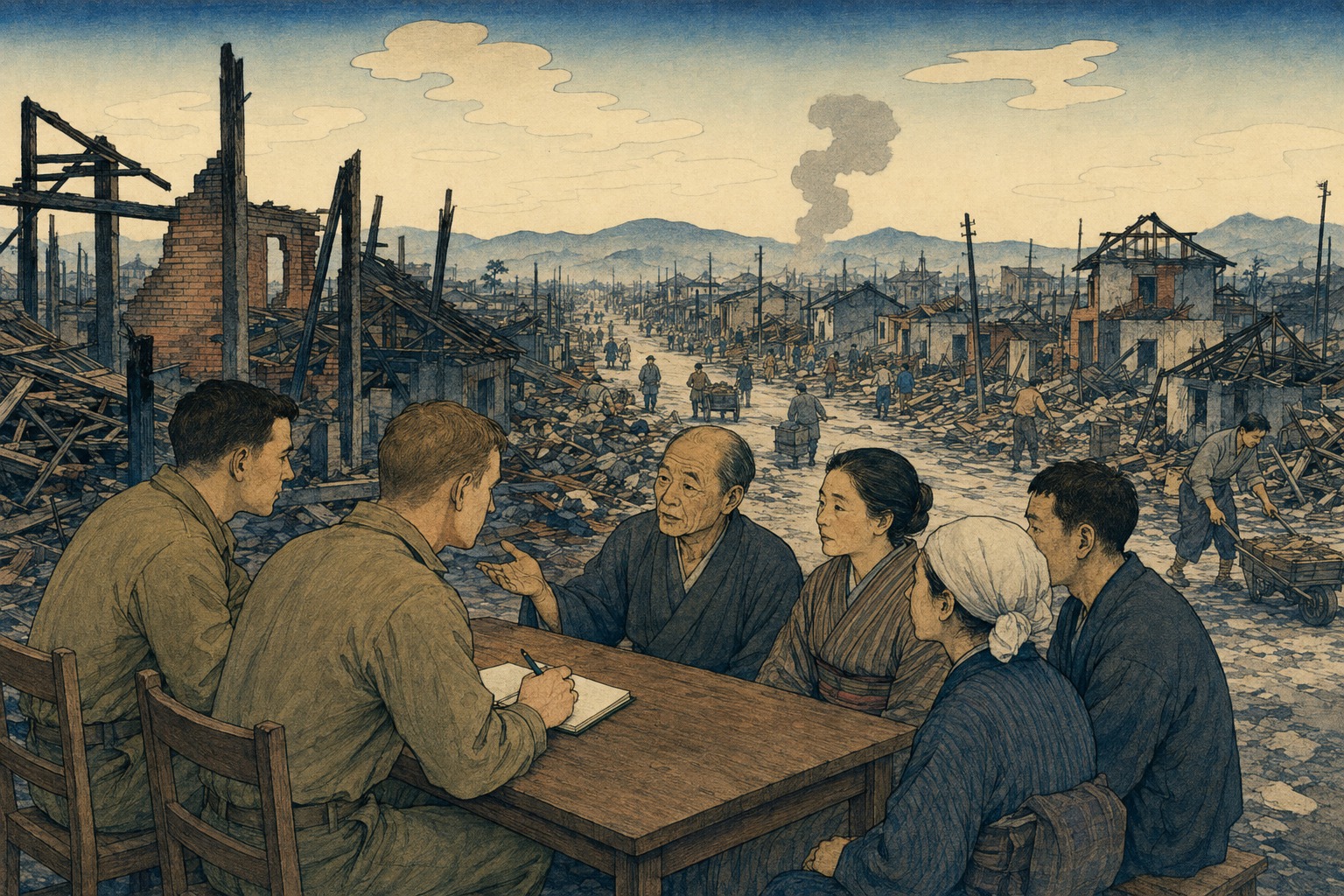
The distance across the table may have been a meter. On one side: an occupation investigator, a questionnaire, a pencil and, if required, an interpreter. On the other: someone who had lost a house, worried about a missing relative, felt relief that the war was over and still did not know where tomorrow’s food would come from. Beyond the room lay open lots and roofless blocks left by the fires of July.
That is a scene, not a recovered transcript. The structure of the encounter is real. In the winter of 1945, the United States Strategic Bombing Survey—usually shortened to USSBS—was questioning civilians in Japan. Its mission was not commemoration or relief. It wanted to measure what bombing had done to people’s willingness and capacity to work, endure, obey, trust their leaders and continue the war.
Eighty-one years later, the Utsunomiya records have been shown in their city for the first time. Through Yoneyama’s work locating and translating the American papers, residents’ answers have moved out of a military archive and back into the community from which they came. The route contains a profound paradox. Testimony of civilian life survived because the country that bombed the city wanted to test whether the bombing had worked.
On July 12, the urban area was the primary target
On the night of July 12–13, 1945, B-29s of the 58th Bombardment Wing flew north from the Mariana Islands toward the Kanto region. The American operation record called it Mission 263. Of 130 aircraft airborne, 115 bombed the primary target and five attacked targets of opportunity. That primary target was not named as one aircraft plant. It was Utsunomiya Urban Area.
The bomb load combined 100-pound AN-M47A2 incendiaries with 500-pound E46 clusters designed to open above the target and scatter many burning units. The mission record places 802.9 tons on the primary. Bombing ran from 12:19 to 2:30 a.m. under ten-tenths cloud. These were not weapons for distinguishing one household from the next. The operational purpose was to make fire propagate across built-up blocks.
Utsunomiya’s educational material says more than two-thirds of the central city burned, more than 620 people died and more than 1,100 were injured. An Army Air Forces chronology records 0.94 square mile—about 2.4 square kilometers—destroyed, or 34.2 percent of the city. Those percentages are not necessarily contradictory. The civic figure describes the center; the American percentage uses a broader city or target-area denominator. A percentage without its map can hide as much as it reveals.
One map makes the spread visible. The First Demobilization Ministry’s December 1945 War Damage Overview Map: Utsunomiya fixes the burned districts against streets and waterways. Japan compiled such maps nationwide in only a few months, in part because returning service members’ first question was what had happened to home. That damage map and the winter interviews measured the same city in different ways. One marked burned ground. The other tried to mark life and thought after the burning.
How Utsunomiya became a military city
Why Utsunomiya? The answer begins long before 1945. The municipality became a city in 1896 with a population of 35,234. Following the Russo-Japanese War, Japan created the 14th Division, whose full garrison presence in Utsunomiya took shape in 1908. Infantry, cavalry, artillery, transport units, a military hospital and their compounds changed the physical and economic geography. Roads, waterworks and commerce grew around soldiers, families and military demand.
The army was not simply imposed on a passive locality. Civic and business leaders campaigned for the division as a prize of regional development. Military spending generated work and infrastructure while binding the city more closely to an imperial system of mobilization. Any account that remembers Utsunomiya only as a victim and erases Japan’s wars of aggression and colonial rule gives up half of the history.
Yet a familiar local memory—that the 14th Division remained in Utsunomiya until the end—is also too simple. The division left for Manchuria in 1940 and was later sent farther south. By 1945, American target intelligence emphasized a major inland Kanto city within the capital’s defensive network, with rail links, an airfield and arsenal, aircraft-related production, other industry and population. The U.S. incendiary campaign had moved from the largest cities to smaller regional centers. Ichinomiya, Tsuruga and Uwajima were attacked on the same night.
- Imperial Japan waged aggressive war across Asia and the Pacific. Utsunomiya’s government, transport, industry and civilian economy became part of military mobilization.
- Military functions in a city did not make infants, older people, conscripted students, patients and householders uniformly into combatants. Urban-area incendiary attack killed and injured civilians and destroyed the systems of ordinary life.
From bomb plots to a table of “morale”
The U.S. secretary of war established the Strategic Bombing Survey on November 3, 1944, under a directive from President Franklin Roosevelt. Its first task was to assess the air war in Europe. After Japan’s surrender, President Harry Truman expanded the work to the Pacific. The staff included military officers, economists, engineers, lawyers, statisticians and social scientists.
They followed bombs into factories, rail networks, electric systems, government offices and private memory. How accurate was the attack? How long did production stop? When did leaders understand that the war was lost? Survey teams entered the defeated countries quickly, before records disappeared and recollections changed. One result was the 1947 report The Effects of Strategic Bombing on Japanese Morale.
“Morale” in that title did not mean mood or bravery alone. It meant the willingness and capacity of a population to work, accept sacrifice and support continued war. Investigators therefore did not ask only how much people suffered. They sought the connection between suffering and production, obedience, political confidence and surrender. A questionnaire turned lived experience into evidence about military effect.
The published survey literature describes approximately 3,150 interviews nationwide, conducted from about November 10 through December 29, 1945. Sampling combined locality, occupation, sex, age and exposure to bombing in an effort to make civilians statistically legible. A related evacuation study reached several thousand evacuees in 57 cities and preserved accounts of air-raid anxiety, the logistics of flight, conflict in receiving villages and shortages of food, shelter, clothing and medicine. The accessible record reviewed here does not establish precisely how the Utsunomiya respondents fit those national samples.
What did the investigators want to know?
The national questionnaire and published tables reveal the survey’s interests. What had people feared during a raid? Had they evacuated? When did they begin to expect defeat? What did they think of Japan’s war leadership? Had attitudes toward the military, government or emperor changed? How did they react to the announcement of surrender? How serious were shortages of food and housing? What did they expect from occupation and the future?
This does not prove that every question appeared in identical words and order on Utsunomiya’s forms. Without the full city answer sheets, no responsible account can reconstruct a local interview line by line. But the national report sorts answers into categories such as emotional response to surrender, bombing’s effect on morale and causes of dissatisfaction. The instrument was plainly designed to draw individual experience into those analytic channels.
| What the survey sought to measure | What civilians were living | The interpretive caution |
|---|---|---|
| Decline in “morale” from raids | Fire, injury, family death, repeated alarms and sleeplessness | Fear can rise without moving in a straight line toward antiwar belief or support for surrender |
| Effect on production | Destroyed workplaces, broken transport, evacuation, hunger and illness | Being unable to work is not the same as being unwilling to work |
| Reaction to surrender | Relief, grief, shock, anxiety and liberation at the same time | Do not compress multiple answers or changing feelings into one emotion |
| Trust in leaders | Censorship, thought policing, neighborhood pressure and fear of occupation | Neither silence nor candor can be detached from the power surrounding the question |
| Sources of dissatisfaction | Food, shelter, clothing, fuel, work, returning soldiers and missing family | Survival itself may have overwhelmed abstract political “morale” |
Four temperatures in Utsunomiya’s answers
The local responses described in 2026 reporting do not form one coherent “defeat emotion.” The first theme is relief that the war had ended. The second is a feeling of release from militarism. The third is anxiety about an unknowable future. The fourth is the hardship said to affect roughly nine in ten of those questioned.
Those feelings do not cancel one another. A person could welcome the end of bombing, feel freed from the system that had prolonged the war, fear the occupation and still be consumed by the search for food and shelter. Someone unsure whether family would return, whether money would retain value or whether work still existed could not reasonably fit the end of the war into one box marked happiness or misery.
The national tabulation also records emotional plurality. In a question allowing more than one response, about 30 percent gave answers categorized as regret, misery or disappointment; 23 percent as surprise, shock or bewilderment; 22 percent as relief or happiness; and 13 percent as anxiety or worry. Those figures cannot be transferred to Utsunomiya. They do, however, show the survey’s own evidence resisting any story in which “the Japanese” met surrender with a single feeling.
How should “nine in ten in hardship” be read?
Nine in ten is a powerful figure. It should not be made more precise than the evidence allows. How many people formed the denominator? How were burned and unburned districts represented? Were interviewees heads of households, or did the sample include women and young people independently? Was “hardship” a selected response, or a category later applied to open answers? Without those details, no sampling error can turn it into a citywide estimate.
The substance is nevertheless consistent with wider contemporary evidence. In the national USSBS material, 85 percent reportedly mentioned inadequate food among sources of dissatisfaction in November and December 1945. A newspaper account translated by the occupation authorities on December 3 said only 15,620 of 300,000 planned emergency housing units across Japan—about five percent—had been completed by November 15. The same report described construction delays in Tochigi.
A burned city lost not only structures but chains of living: shop inventories, places where ration coupons could be used, wells and water pipes, clothing, schools, clinics and workplaces. Evacuated relatives returned. Demobilized soldiers and repatriates arrived. Proximity to farmland did not ensure fair access to food. A person without cash for the black market could be hungry in a region where food existed.
The nine-in-ten figure therefore cannot be called the effect of bombing alone, or surrender alone. It is a winter cross-section of prolonged mobilization, maritime blockade, disrupted distribution, inflation, destroyed housing and mass return. The survey tried to separate causes and assign a portion to bombing. In the life of a respondent, those causes arrived together.
Could a civilian speak honestly to the occupier?
Japanese archival and news descriptions sometimes call the USSBS material jinmon kiroku—interrogation records. The National Diet Library’s Entry 43 is a broad documentary group that includes questioning of former officers, officials, industrial leaders and scientists. The word’s presence does not establish that a sampled civilian interview involved detention or coercive interrogation. For that reason, this report generally uses “interview” or “questioning” for the civilian material.
It was not, however, an encounter among equals. The questioner represented the country that had bombed the city months earlier and now occupied Japan. An interpreter could move dialect, hesitation, euphemism and emotional force into another language. Some people may have thought a favorable answer safer, or hidden anger at a former enemy that now controlled security and public policy.
The pressure could run in the other direction too. Japan’s thought police, wartime censorship, neighborhood surveillance and demands for military conformity had just collapsed. Some respondents may have been able to criticize the military or admit relief for the first time. Fear of the occupation could close one kind of speech while the end of the old regime opened another. A careful reading holds both possibilities rather than declaring every answer either free truth or coerced performance.
| Layer of the record | What may disappear | What an exhibition should show |
|---|---|---|
| Questionnaire design | Feelings outside the offered categories and causes the survey did not imagine | Exact wording, response choices, order and probing instructions |
| Selection of people | Children, the poorest, evacuees still away, ill people and others hard to reach | Number, age, sex, occupation, district, damage exposure and refusal rate |
| Interpretation and note-taking | Tone, ambiguity, dialect, long narrative and silence | Original beside translation, interpreter identity and whether notes are verbatim or summarized |
| Coding and tabulation | Simultaneous emotions and minority answers | Coding rules, multiple responses, missing data and denominator |
| Final report | A person’s life, causes other than bombing and cases that complicate the thesis | The editorial path from answer sheet to table and conclusion |
The survey was not a neutral mirror
The USSBS is indispensable. It preserved Japanese state and military papers, factory records, strike photographs, technical analysis and thousands of interviews. It built part of the documentary foundation of postwar scholarship. Utsunomiya voices may not have survived on paper without it.
But the survey did not hover above the air war as a disinterested eye. It worked close to the institutions of American air power and evaluated how much bombing contributed to victory. Its findings mattered to the creation of an independent U.S. Air Force, postwar nuclear strategy, budgets and the doctrine of future wars. Historian Gian P. Gentile has located its work along the contested line between assessment and advocacy.
That does not make every number propaganda. The useful discipline is to separate observation from inference. How many aircraft flew? What kinds and weights of incendiaries did they drop? Which responses did selected civilians give? Does that evidence support the further conclusion that strategic bombing was decisive? The first three can remain valuable records while the causal claim is tested separately.
The Pacific summary forcefully argued that air attack and blockade destroyed Japan’s economy and capacity to continue. Yet intensified civilian fear and hunger do not, by themselves, establish why the government surrendered when it did. Soviet entry, the atomic bombs, blockade, military collapse and decisions by the emperor and Supreme War Council interacted. One Utsunomiya answer must not be turned into a ballot in that enormous counterfactual debate.
- It can answer: how selected civilians responded to particular questions in winter 1945, and how American investigators recorded and classified those responses.
- It can answer conditionally: how Utsunomiya attitudes toward raids, surrender and hardship resembled or differed from other places. That requires the sample information and answer sheets.
- It cannot answer alone: the “true feelings” of the entire city, bombing’s isolated causal effect, the moral legitimacy of urban incendiary attack, or when the war would have ended without it.
How memory becomes a civic institution
Utsunomiya’s remembrance did not begin with this document exhibition. The city issued a Peace City Declaration in April 1996. July 12 is Utsunomiya Peace Day, and July 12 through August 15 is the city’s Peace Month. Public gatherings, survivor talks in schools and recorded testimony have carried the history forward.
A war-record preservation project in fiscal 1999 and 2000 gathered roughly 500 photographs, diaries, domestic objects, incendiary fragments and other items. The report The Air Raid on Utsunomiya followed in 2001, and an annual exhibition has continued. A city video records Jun Okawa’s account of living through the raid at age 13. Shimotsuke Shimbun’s digital air-raid map and surviving places such as Matsugamine Catholic Church and a great ginkgo tree return aggregate destruction to location and life.
Local commentary has nevertheless noted that Utsunomiya has no dedicated permanent museum for its war-damage collection. An annual exhibition is valuable, but documents retreat from view when the run ends. Witnesses die and material kept in homes disperses. The importance of the American interviews added in 2026 is more than accumulation. They connect testimony about the night of July 12 with what residents said about living, surrender and the future only months later.
1908 The 14th Division’s full garrison presence takes shape in Utsunomiya, accelerating its physical and economic development as a military city.
July 12–13, 1945 Mission 263 drops 802.9 tons of incendiaries on the primary target, “Utsunomiya Urban Area.”
Winter 1945 USSBS personnel interview Utsunomiya civilians about surrender, life, bombing and the future.
1996 Utsunomiya issues its Peace City Declaration; July 12 later becomes the city’s Peace Day.
1999–2001 A preservation project collects records and produces The Air Raid on Utsunomiya.
August 10, 2026 American interview records researched and translated by Kazuya Yoneyama go on local display for the first time at Seimeikan.
A good exhibition does not show answers alone
“Nine in ten in hardship” is an effective entrance to the record. Preservation requires the route behind the headline. The original English page, archival identifier, question, answer, handwritten correction, code, Yoneyama translation and annotation should sit together. If the selection method is unknown, the display should say “unknown.” A nationwide percentage and an individual Utsunomiya answer should not be printed in the same visual language.
The interviews can then be linked to later local testimony, damage maps, victim certificates, ration documents, reconstruction records, school materials and photographs. How did someone who was 20 in winter 1945 describe the same experience 50 years later? Where does an American investigator’s single-line summary meet a survivor’s long life history, and where do they diverge? Difference is not merely faulty memory. It can show experience acquiring meaning over time.
- Page images and searchable transcription, each with a persistent URL
- National Diet Library and U.S. National Archives record identifiers
- Questionnaire, interviewer instructions, sample-area list and coding scheme
- Non-identifying age, sex, occupation, district and damage exposure
- Whether a record is verbatim or summarized, and whether an interpreter was used
- Original and Japanese translation side by side, with uncertain readings and notes
- Links to maps, contemporary diaries and later oral histories
- Correction history, reuse terms, classroom material and research data
Two postwars survive on the page
A Utsunomiya civilian did not sit down in winter 1945 in order to become a “historical witness.” Many were occupied simply with surviving the day. Relief, liberation, anxiety, hunger: the answers entered an American form, were classified and moved toward a report about bombing effectiveness.
Two histories therefore inhabit the same record. One is what people in a burned city felt and needed. The other is why the victor asked about those feelings, how it counted them and what conclusions it wanted the count to support. Read only the first and the power of the survey disappears. Read only the second and people remain trapped as data.
The central question still has a second half. What did the country that bombed Utsunomiya ask—and what did it never ask? A family name. The smell of the burned house. The hours in a ration line. The reason for a silence. Those gaps should not be filled with invented scenes. They should be approached by opening the original, placing it beside local testimony and marking honestly what cannot be known.
Yoneyama brought documents across an ocean and back to the city they described. The questionnaire now changes sides. It is asking us what we will remember, what we will measure and which voices we will carry forward.
Sources and reporting basis
- Shimotsuke Shimbun, report on Utsunomiya respondents’ hardship and first display of the U.S. interview records (August 2026; Japanese)
- National Diet Library Research Navi, Records of the U.S. Strategic Bombing Survey, Entry 43 (Japanese)
- U.S. Strategic Bombing Survey, “List of sample areas,” Report No. 14a(29), National Diet Library Digital Collections
- U.S. Strategic Bombing Survey, The Effects of Strategic Bombing on Japanese Morale, Report No. 14 (1947)
- Open Library record and public-edition access for The Effects of Strategic Bombing on Japanese Morale
- Air University Press, The United States Strategic Bombing Surveys: European War, Pacific War
- U.S. Strategic Bombing Survey, Summary Report (Pacific War) (1946)
- Dylan J. Plung, “The Impact of Urban Evacuation in Japan during World War II”, The Asia-Pacific Journal (2021)
- Gian P. Gentile, “Advocacy or Assessment? The United States Strategic Bombing Survey of Germany and Japan”, Pacific Historical Review 66(1) (1997)
- XXI Bomber Command mission summary, July 1945, Mission 263
- U.S. Army Air Forces chronology, July 1945, Mission 263 entry
- Utsunomiya City, “Reading the Utsunomiya Air Raid through U.S. military records” (Japanese)
- Utsunomiya City, municipal chronology (Japanese)
- Japan Center for Asian Historical Records, 14th Division reference (Japanese)
- Mainichi Shimbun, history of Utsunomiya as a military city (2025; Japanese)
- Mainichi Shimbun, American targeting of Utsunomiya (2025; Japanese)
- National Archives of Japan, War Damage Overview Map: Utsunomiya (December 1945; Japanese)
- National Archives of Japan, overview of the national war-damage maps (Japanese)
- SCAP, Press Translations Japan, report on emergency housing progress (December 3, 1945)
- Utsunomiya City, peace programs and Utsunomiya Peace Day (Japanese)
- Utsunomiya City, video testimony of air-raid survivors (Japanese)
- Utsunomiya City, Jun Okawa’s air-raid testimony (Japanese)
- Shimotsuke Shimbun, Utsunomiya Air Raid Digital Map (Japanese)
- Utsunomiya Keizai Shimbun, history and contents of the annual air-raid exhibition (2025; Japanese)
- Shimotsuke Shimbun editorial on preserving Utsunomiya air-raid material (2025; Japanese)
- Tochigi Co-op, guide to Utsunomiya’s surviving war sites (2023; Japanese)
Editor’s note: The Utsunomiya interview themes in this report are based on reporting available by 3:14 a.m. Japan Standard Time on August 15, 2026. We have not reconstructed unseen answer sheets. National interview counts, percentages and question areas come from the USSBS national report and related scholarship; they are not Utsunomiya sample statistics. “Interrogation” is used in archival and news labels for the broader record group, but this article calls the sampled civilian encounters interviews or questioning. Casualty and destruction figures vary with each source’s boundaries and definitions.