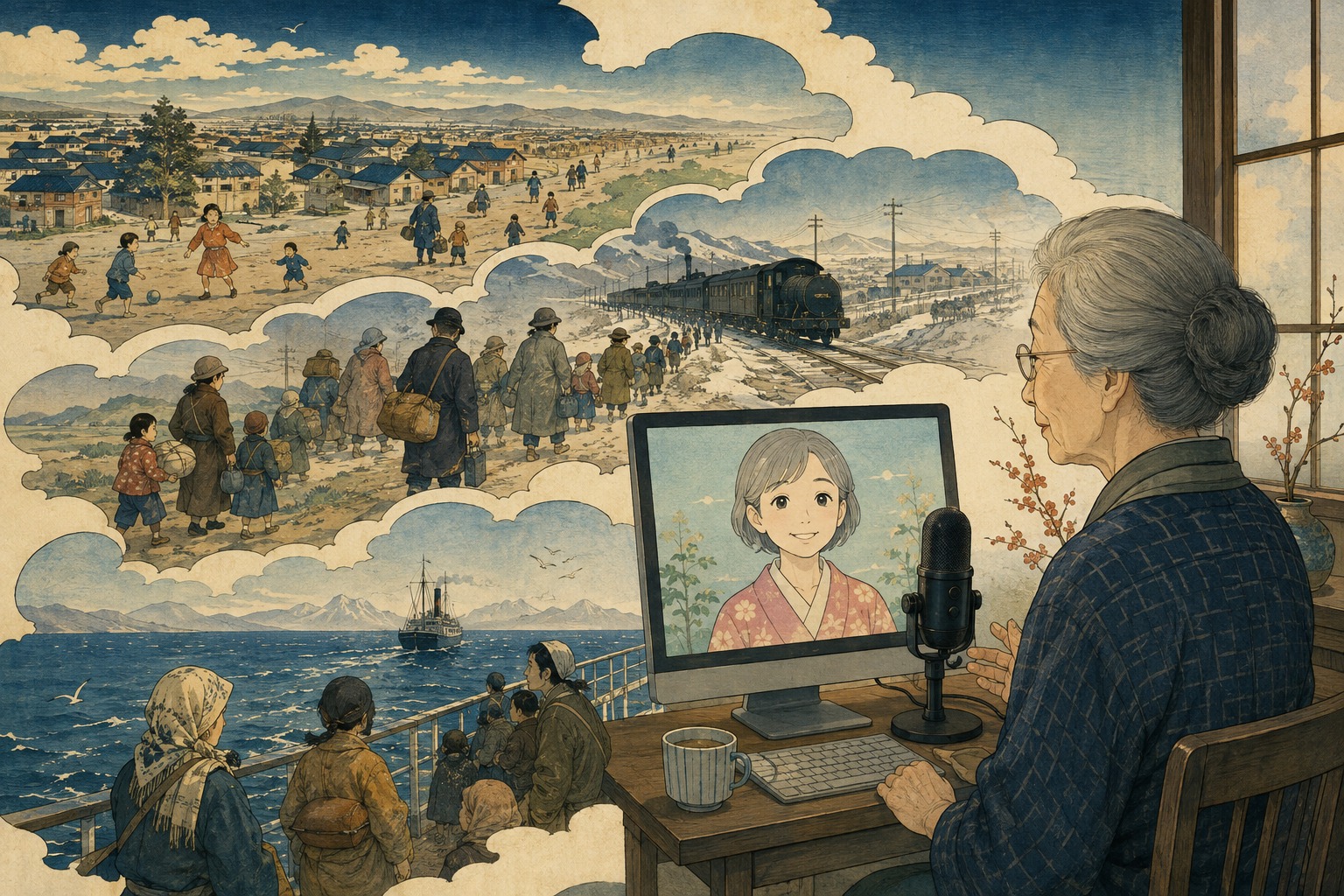
The person on the screen does not age. Her outline is smooth, her hair moves in saturated color, and her blinking follows the faint motion that a camera detects in a human face. The voice moving her, however, carries 83 years.
Kuniko Asai chose the form of a VTuber—a computer-drawn double through which a person speaks. Most such performers play games, sing or chat with viewers. Asai is putting something else into the vessel: a child’s time in the part of northeast China that imperial Japan called Manchuria, and a family’s experience of returning to Japan after the empire collapsed.
The surface is new. The question inside it is old and approaching a deadline. Who speaks when no one with living memory of the war remains? Is a video recording enough? Can a character that continues to move after its performer dies bring testimony closer, or does it begin to detach the testimony from the person who lived it?
How should we read the memory of a two-year-old?
Counting back from age 83 in August 2026 places Asai’s birth in late 1942 or 1943. At Japan’s defeat in August 1945, she would have been about two. That is not a footnote. It is a condition that determines what kind of evidence the phrase “she remembers” can honestly describe.
Memories from very early childhood can exist. A sound, light, smell, the sensation of being carried or the fear moving through adults may remain as fragments. At the same time, stories repeatedly told by parents, captions attached to photographs and history learned later can join a person’s own mental image. That does not make testimony false. It means memory is not a recording device; it is a human act of reconstructing the past from the present.
| Layer of memory | What it can contain | How to present it |
|---|---|---|
| Personal sensory memory | A scene, sound, taste, bodily sensation or fear retained by the young child | Label it in the first person: “This is how I remember it” |
| Family transmission | Routes, illness, separation and return later described by parents or siblings | Name who told the story and, where possible, when |
| Contemporary record | Registers, repatriation papers, diaries, photographs, ship lists and official files | Cite and date the source; compare it with the account |
| Later interpretation | The meaning Asai gives the experience now, including a wish for peace or a warning | Respect it as interpretation rather than a recovered event |
Asai’s project will be strongest when those four layers are neither blended nor torn apart. A toddler’s surviving image cannot establish the name of a ship or the date of a train. It can document the world of a child holding an adult’s hand in flight. An official record can count people in motion, but it cannot preserve the temperature of that hand.
“Manchuria” was not an empty new frontier
In Japanese recollection, the two characters for Manchuria can wrap cold plains, broad streets, railway stations, company housing and farm settlements into a single picture. But this was not vacant land awaiting development. Northeast China already held Chinese, Manchu, Mongol, Korean and Russian communities, farms, cities and trade routes.
Japan’s reach deepened after the Russo-Japanese War, when the South Manchuria Railway and the Kwantung Leased Territory became platforms for economic and military power. In September 1931, officers of the Kwantung Army blew up a small section of the railway near Liutiao Lake and used the incident to expand their occupation. In March 1932, Japan sponsored the creation of Manchukuo under Puyi, the last Qing emperor. It had the form of an independent state but depended on Japanese military force and policy—a puppet state built to serve imperial interests.
Official slogans promised “harmony of five races” and a “paradise of the kingly way.” Power was not harmonious. Japanese residents remained a small minority but occupied privileged positions in the railways, bureaucracy, industry and allocation of land. As historian Mariko Asano Tamanoi has shown, farmers who were themselves victims of depression and rural poverty in Japan entered the circle of colonizers in Manchukuo, receiving land that the Japanese military had confiscated from Chinese farmers through coercive transfers.
In 1936, the government adopted a plan to send one million farm households—five million people—over 20 years. It promised land to struggling villages in Japan, planted a demographic barrier near the Soviet frontier and sought to make occupation irreversible. Propaganda pictured abundance. Many settlers knew little about the climate or local agriculture and depended on Chinese and Korean labor. The plan was never completed, but agricultural migrants and their families numbered in the hundreds of thousands before defeat.
- Japanese children, women and older people suffered hunger, disease, violence and separation during the 1945 collapse and the flight that followed.
- The settlement project that placed their families in Manchuria was part of Japan’s military invasion and colonial rule, damaging the land and lives of local people.
Erase either truth and history shrinks into memorial alone or indictment alone. Receiving Asai’s testimony seriously does not mean blaming a toddler for empire, and it does not mean erasing the empire around her.
August 9: a state boundary collapses overnight
The Soviet Union declared war on Japan on August 8, 1945. After midnight on August 9, Soviet forces began their vast invasion of Manchuria. Mechanized columns advanced from Mongolia and across the northern and eastern frontiers, breaking through the Kwantung Army’s defenses. Japan announced acceptance of surrender to its people on August 15 and signed the formal instrument on September 2. For civilians near the border, the days between those events could be the difference between escape and entrapment.
The Kwantung Army had already transferred many of its best units south. It then mobilized adult men from the settlements, despite earlier promises that had encouraged migration. Women, children and older people predominated in exposed villages. Military and official withdrawals sometimes moved ahead of civilian evacuation. The people sent close to the border as instruments of national policy were abandoned in that policy’s last act.
What followed was not a single event called repatriation. Some groups walked south. Some found freight trains. Some wintered in cities or entered camps. Some encountered Soviet attack or raids by local armed groups. Entire settlements were driven toward group suicide. Fathers and older brothers disappeared into Soviet detention. Hunger, typhus, dysentery and cold continued to kill after organized combat had ended.
The testimonies held by Japan’s Peace Memorial Exhibition Museum show how different the routes could be. Mankichi Oshima survived Soviet attack and a mass suicide that killed family members, then lived as a refugee in Xinjing for about a year. Motohiko Tezuka lost his father in Soviet detention and his mother to illness, then brought two younger sisters home from Huludao. Ayako Yamamura lost her child after living on muddy water, while also remembering kindness from Chinese people. A history that records harm but not local people who helped survivors is incomplete in another direction.
Return was not one ship journey
More than one million Japanese civilians were in Manchuria at defeat; some historical estimates place the number near 1.55 million. A U.S. State Department document from May 1946 recorded an estimate of 700,000 Japanese civilians and 600,000 prisoners of war still in the region, and reported that repatriation operations from Huludao began on May 7. Numbers varied because people were scattered across zones controlled by Soviet, Chinese Nationalist and Chinese Communist forces while civil war shattered transport and administration.
Even so, the lift soon reached an extraordinary scale. A U.S. dispatch dated December 28, 1946, recorded that 993,476 Japanese civilians and 17,361 military personnel—a total of 1,010,837—had been repatriated from Manchuria by the previous day. Huludao in Liaoning was one of the principal exits. People converged by train, cart and foot, crowded into the holds of ships and disembarked at Hakata, Sasebo, Maizuru and other ports.
Reaching Japan was not the end. Repatriates were permitted little luggage and restricted amounts of money, then arrived in a burned and hungry country. A family home or farm might no longer exist. Returnees could be stigmatized as people from “outside.” Orphaned children moved into institutions or relatives’ homes. Women often remained silent for decades about sexual violence and bargains made for survival. The postwar period continued through poverty, illness, missing household registers, interrupted education and discrimination at work.
1905 After the Russo-Japanese War, Japan acquires the Kwantung lease and South Manchuria Railway interests.
September 1931 The Kwantung Army uses the railway explosion near Liutiao Lake to occupy Manchuria.
March 1932 Manchukuo is established under Japanese sponsorship.
1936 Japan adopts its million-household agricultural migration plan for Manchuria.
August 9, 1945 Soviet forces invade; the settlements and urban Japanese population enter flight and collapse.
May 1946 Large-scale repatriation begins through Huludao.
1972 Japan and the People’s Republic of China normalize relations; later inquiries and returns by stranded Japanese accelerate.
2016 Kizuna AI begins activity as a “Virtual YouTuber.”
2026 Asai, 83, applies the VTuber form to the transmission of war memory.
The children who could not return
Some Japanese children lost parents in the disorder. Some were entrusted to Chinese households because it was the only way to keep them alive. Many were raised by Chinese adoptive parents. Postwar Japan called them “Japanese orphans left behind in China,” a phrase that cannot fully express decades lived in the Chinese language and within Chinese families.
Japanese health ministry figures as of July 31, 2014, listed 2,818 people in the identity-investigation category for such orphans; 1,284 had been identified. Permanent returnees classified as orphans, women and others numbered 6,706, or 20,879 when accompanying family members were included. This was never simply a homecoming to an original nation. Some left Chinese families, struggled with Japanese, met discrimination in employment and found the word “home” split between two countries.
That Asai reached the age of 83 in Japan is an ending not granted to every child in the same historical storm. One successful return can therefore lead toward those who did not return, those who returned decades late and those who never found a secure place after they did.
Why a VTuber?
Modern VTuber culture spread after Kizuna AI began activity at the end of 2016 and identified herself as a “Virtual YouTuber.” A camera or sensor tracks the performer’s face and body and transfers motion to a two- or three-dimensional character. A creator can speak with timing, laughter and glances without placing a human face continuously before the camera.
The form seems distant from war testimony, but it has affinities. It can enter the feeds of young people who would not search for a “historical education” video. It can reduce the pressure of being stared at and judged for appearance. It can visualize a childhood place with few surviving photographs, provided every reconstruction is plainly labeled. It can divide a long account into episodes and let questions or documents guide each installment.
An avatar is not only a mask that hides age. It announces that the face and the speaking body are not identical. Testimony, too, is mediated: the child who lived, the 83-year-old who remembers, the family who supplied stories and the editor who selects all overlap. The avatar’s obvious artifice could make that mediation more visible, not less.
An algorithm is not an archive
Publishing on YouTube is not the same as preserving a historical record. A video can be deleted, an account suspended, a company policy revised and a file format abandoned. If only the most emotional seconds are clipped, the context carefully laid down by the narrator disappears. If the bright character attracts too much attention, viewers may remember the novelty of an “83-year-old VTuber” and forget the history of Manchuria.
The Oral History Association treats preparation, interviewing, preservation and access as one process. Its guidance calls for informed consent, a chance for the narrator to review the work when possible, a high-quality original recording, redundant copies, durable nonproprietary formats, metadata connecting photographs and documents, and transcripts or time-coded indexes. The U.S. Library of Congress likewise recommends transcripts or indexes that allow a future researcher to find the relevant moment without scanning an entire recording.
- Keep the source: preserve the highest-quality audio and video before avatar processing.
- Label provenance: distinguish personal memory, family transmission and documentary reconstruction on screen or in notes.
- Corroborate place and date: compare family registers, repatriation certificates, ship lists, photograph captions and testimony from the same locality.
- Provide a path to the whole: link each short episode to a full interview and transcript.
- Renew consent: let the narrator understand and revise terms for access, monetization, reuse and use after death.
- Place other voices nearby: include records from Chinese and Korean communities, stranded children, women and former settlers.
- Deposit beyond the platform: place a preservation copy in a library, museum or other durable public repository.
What the avatar must never claim
While Asai speaks and uses an avatar as her form of expression, the source and responsibility of the voice remain clear. The future is harder. If a synthetic voice trained on her recordings starts answering questions she never answered, that is no longer testimony. It is inference. The more software generates expressions, removes pauses and makes the story frictionlessly “clear,” the more it risks deleting hesitation, silence and changes in emotion that carry historical meaning.
An interactive “digital witness” that continues after death can be compelling in a classroom. But every answer must distinguish the narrator’s recording, an editor’s summary and an AI-generated explanation from documents. Otherwise a child may receive all three as Asai’s own words. New synthetic speech should not borrow her face or voice without conspicuous labeling. Sometimes the most honest answer a system can give is: “There is no surviving record.”
A narrator’s age makes preservation urgent; it does not make consent less necessary. A family story contains the privacy of other people who may still be alive. Sexual violence, adoption, illness and suicide require special care before being made searchable. Asai and her family must understand not only today’s upload but also what future users may do with a downloadable voice and character.
Keeping “cute” from making history weightless
A short video needs an opening hook. A thumbnail demands an emotion. Recommendation systems reward anger, surprise, tears and conflict more readily than long context. Those forces can deliver testimony and turn experience into merchandise at the same time.
The answer is not to dismiss VTubers as disrespectful. Books, newspapers and museum exhibitions also select, shape and stage the past. The decisive issue is whether the editing is visible. Put years and place names on the screen; add the current Chinese name. Do not draw a historical border as if it were natural and uncontested. Never present a dramatic reconstruction as an archival image. Link the evidence in the description and preserve a correction log. Give a viewer a route onward.
Nor can Asai’s hardship begin with the clock on August 9, 1945. The story must first pass through the 1931 invasion, the 1932 creation of Manchukuo, land transfers and state migration. It must then refuse to assign an empire’s policy to a small child caught in its collapse. That order allows colonial harm and Japanese civilian suffering to be understood without forcing one to erase or defeat the other.
A successor is not a copy of the witness
At the Maizuru Repatriation Memorial Museum in 2025, university students worked as student storytellers of the history of return. In Nagasaki, readers under 25 have voiced the written accounts of atomic-bomb survivors. A person who did not live an event can read a witness’s words without impersonating the witness. By making the source and the interpretive distance explicit, a successor accepts the responsibility of a listener.
The same principle can govern a VTuber. The avatar is not Asai. It is a stage designed to receive her voice. If another generation operates the character, it should mark “what Asai recorded” and “what we later researched and explain.” The fantasy that a digital double lives forever is less respectful than an archive that lets viewers hear that the originating voice was finite.
Sending a voice into the future
The material history of repatriation survives in small things: identity tags, death notices, diaries, handmade clothes and models of ships. The end of an empire becomes human-sized when it is compressed into a death certificate written by a 12-year-old boy for his mother, or a dress sewn from the diaper of a baby who did not survive.
Asai’s avatar could join that line of objects: a small, bright container made by the culture of 2026. Fill it with fragments of childhood and family narrative. Support them with documents. Leave the missing parts visibly missing. Future viewers would then see not a seamless heroic tale, but the process by which one person tried to hand memory onward.
The figure on the screen does not age. The voice pauses for breath, searches for a word and sometimes stops. Preserving the stopping is part of the work. The avatar cannot make memory immortal. Memory lives again only when a listener follows the sources, opens space for other voices and passes the account on accurately.
Sources and reporting basis
- National Archives of Japan, “August 1945: Atomic bombings and Japan’s surrender”
- Japan Center for Asian Historical Records, “The Shrinking Japanese Empire: Surrender, Demobilization and Repatriation” (2025)
- JACAR, “Post-World War Two: Demobilization and Repatriation”
- JACAR, “Japanese Expatriate Liaison Offices”
- U.S. Department of State historical document, telegram of May 22, 1946 (Huludao operation and contemporary estimates)
- U.S. Department of State historical document, telegram of Dec. 28, 1946 (repatriation totals)
- Peace Memorial Exhibition Museum, Overseas Repatriation Gallery
- Peace Memorial Exhibition Museum, recorded accounts of repatriates
- Ministry of Health, Labour and Welfare, statistics on Japanese remaining in China (as of July 31, 2014)
- Mariko Asano Tamanoi, “Victims of Colonialism? Japanese Agrarian Settlers in Manchukuo and Their Repatriation”
- Takemaro Mori, “Colonies and Countryside in Wartime Japan: Emigration to Manchuria”
- Rowena Ward, “Left Behind: Japan's Wartime Defeat and the Stranded Women of Manchukuo”
- Tatsuhiko Yoshizawa, “The Manchurian Incident, the League of Nations and the Origins of the Pacific War”
- Oral History Association, “Oral History Best Practices”
- Library of Congress Veterans History Project, “Transcribing Interviews”
- Kizuna AI official biography
- Ministry of Health, Labour and Welfare, “Student storytellers inherit the history of a repatriation city” (2025)
- Nagasaki National Peace Memorial Hall, under-25 reading of atomic-bomb testimonies (2025)
Editor’s note: Biographical information specific to Kuniko Asai is limited here to the name, age and purpose stated in the news material for this edition. Because a public primary video or official channel could not be verified, this report contains no invented quotations, residence, family structure, route or date of return. Historical population figures use different definitions and dates. This article is based on material available by 3:14 a.m. Japan Standard Time on August 15, 2026.