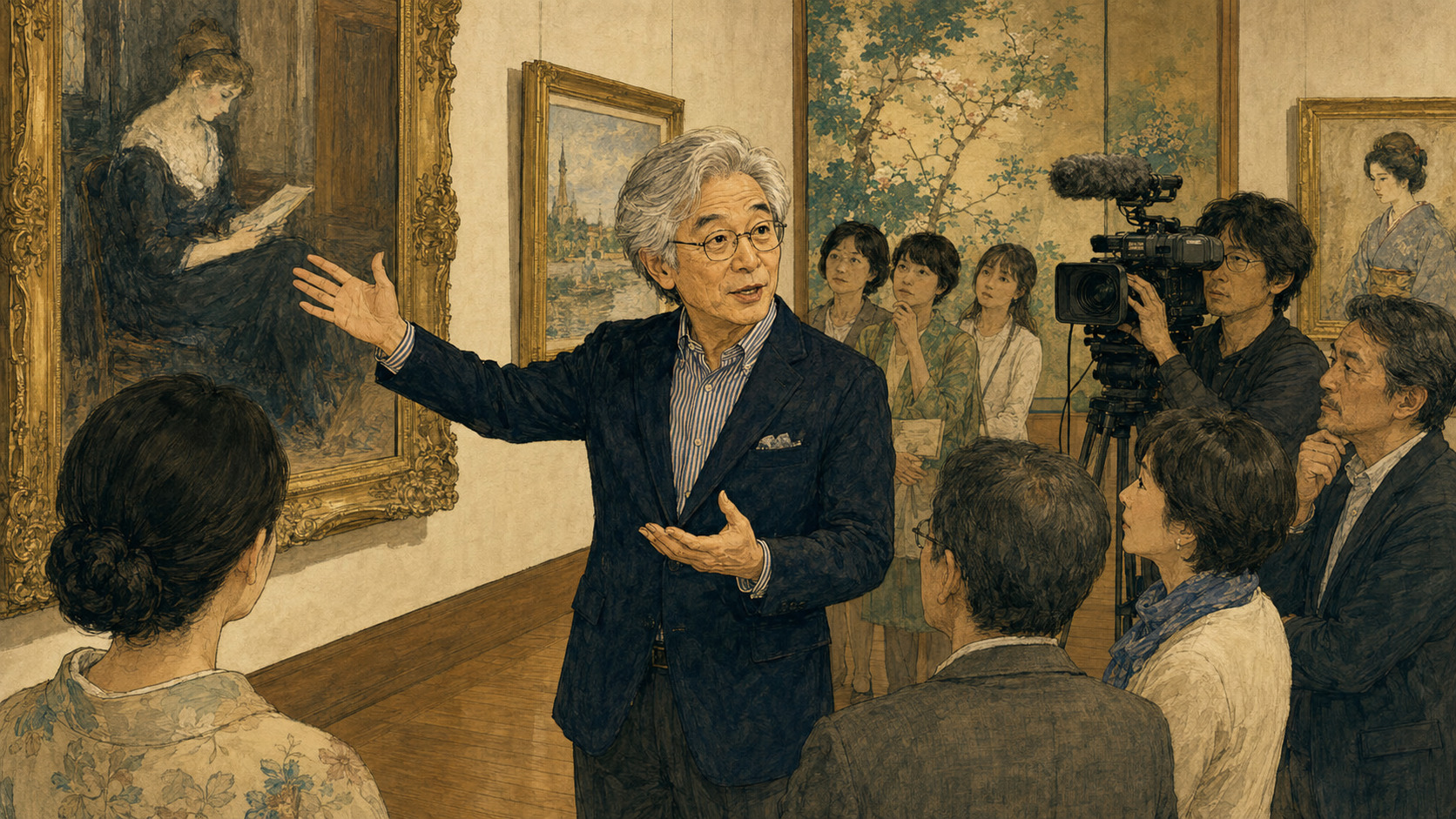
The most intimidating object in a museum is sometimes not a painting. It is the silence around it. A visitor stands before a canvas carrying centuries of religion, money, politics, technique and argument. The label is brief. Other people appear to know where to place their hands and how long to look. One honest question—Why is that corner so dark? Who paid for this? Is that face supposed to be beautiful?—can feel like a confession that one does not belong.
Goro Yamada’s particular talent was to remove the shame from that question. He knew the chronology and could identify the machinery behind a style, but he rarely presented knowledge as a velvet rope. He made it something people could pick up in conversation. A joke created room. A detour supplied history. A co-host’s doubt became the viewer’s permission to doubt. By the time the answer arrived, the painting was no longer an examination question. It was evidence in a lively story.
On Sunday, August 23, BS NTV will honor Yamada by rebroadcasting the final episode of Bura Bura Art and Museum (『ぶらぶら美術・博物館』), the program he guided from April 2010 to September 2023. The 55-minute memorial begins at 6 p.m. Japan time. It returns Yamada, comedy duo OgiYahagi and model Mariko Takahashi to the permanent collection of the National Museum of Western Art in Ueno, moving from Renaissance painting to Rubens, Courbet, Monet, Degas, Rodin and Le Corbusier.
The episode was first shown on September 27, 2023. It was the series finale then; it was not filmed as a posthumous farewell. Yamada died on July 14, 2026, at 67. His official YouTube channel announced the death on July 22. The distinction matters. Sunday’s program is not a new tribute assembled from solemn fragments. It allows his working method—curious, comic, exacting and companionable—to speak again in its original form.
What BS NTV is showing—and what it is not
The broadcast is titled In Memory of Goro Yamada: Bura Bura Art and Museum—A Complete Guide to Western Painting! Best Selections from the National Museum of Western Art. It airs on free-to-view BS NTV from 6:00 to 6:55 p.m. on August 23. The participants are Yamada, Ken Yahagi and Hiroaki Ogi of OgiYahagi, and Mariko Takahashi.
The museum sequence explores the permanent collection rather than a temporary blockbuster. The channel’s preview highlights Monet’s roughly two-meter-square Water Lilies, purchased after industrialist Kōjirō Matsukata visited the painter at Giverny; a Courbet hunting picture that helped break academic conventions; Spanish still life; and a painting by Le Corbusier, architect of the museum’s main building. The announced episode crosses several centuries, but it is not literally a complete history of all Western art. The title promises orientation, not encyclopedic closure.
| Program | In Memory of Goro Yamada: Bura Bura Art and Museum |
|---|---|
| Broadcast | Sunday, August 23, 2026, 6:00–6:55 p.m. JST, BS NTV |
| Original airdate | September 27, 2023; the final episode of the regular series |
| Location | National Museum of Western Art, Ueno, Tokyo |
| Participants | Goro Yamada, OgiYahagi and Mariko Takahashi |
| Focus | Highlights of the permanent collection and a route through Western art history |
The last walk begins with a collection that came home
The National Museum of Western Art is an especially fitting endpoint because the institution is itself a story about bringing art within reach. Its foundation is the Matsukata Collection, assembled principally in Europe by shipping industrialist Kōjirō Matsukata from 1916 onward. Matsukata imagined making Western art available to the Japanese public. War and financial upheaval scattered the collection; works remaining in France became French property under the postwar settlement.
Their return required diplomacy and a building. Japan agreed to create a national museum; France agreed to donate and return a group of works after it was completed. Formal arrangements were signed in January 1959, the collection arrived in Yokohama that April, and the museum opened to the public in June. It was not simply a warehouse for objects. It was a postwar symbol of repaired relations between Japan and France.
The architecture carries another lesson in how looking is organized. Le Corbusier designed the main building, with Japanese architects Junzō Sakakura, Kunio Maekawa and Takamasa Yoshizaka supervising. Completed in March 1959, it was designated an Important Cultural Property in 2007 and became part of the transnational UNESCO World Heritage listing of Le Corbusier’s architectural work in 2016. The museum’s collection has grown beyond 6,000 works across painting, sculpture, prints, drawings, manuscripts and decorative arts.
Thus the finale’s “walk” passes through three kinds of history at once: the dates of the pictures, the odyssey of Matsukata’s collection, and the modern building that directs bodies around them. Yamada’s format was suited to that layering. A conventional lecture might separate art history, collecting history and architecture. A person walking through a museum encounters them together.
Before “bura-bura”: Japanese television taught viewers to face art
Yamada did not invent televised art appreciation. NHK’s Sunday Museum began in April 1976 and, by 2026, had reached its 50th anniversary. It established a durable grammar for serious cultural television: artists, critics, writers and other interpreters stand close to works, connect image to life and let the camera travel where the home viewer cannot. A 2006 exhibition marking its 30th year described it as a pioneer that had already aired more than 1,500 times.
Commercial television developed other approaches—artist biographies, the drama behind a masterpiece, high-definition close-ups, exhibition previews. These programs expanded the public language of art. Yet prestige could also reinforce the fear that a painting comes with a correct response that experts possess and viewers must receive.
Bura Bura Art and Museum altered the posture. The reduplicated bura-bura means wandering or strolling without hurry or a sharply instrumental destination. The official program description promised a “live strolling sensation” through paintings, sculpture, cultural properties, museums and historic places. It did not begin from the command to appreciate. It began from motion: let us go in, walk around and see what catches us.
That apparently casual choice was a design decision. A stroll allows interruption. One person can notice a frame while another notices a dog in the corner. A joke can delay the march toward the masterpiece. The museum becomes not a temple where speech is forbidden but a public place where attention can be negotiated.
1959 — The National Museum of Western Art opens around the returned Matsukata Collection.
1976 — NHK’s Sunday Museum begins a long-running national tradition of televised art interpretation.
1980s–1990s — Yamada learns mass communication as a Kōdansha magazine editor and later editor-in-chief.
April 2010 — Bura Bura Art and Museum begins on BS NTV.
2020–2021 — Pandemic disruption helps push the program’s production team toward an online art format.
September 2023 — The series ends at the National Museum of Western Art after 13½ years.
2025 — Yamada receives the 17th Juzo Itami Award for the dialogic originality of his YouTube art program.
August 2026 — BS NTV returns the finale to the screen as a memorial.
The art guide was first a magazine editor
Yamada was born Masahiko Takeda in Tokyo in 1958. He studied at Sophia University and spent a year at the University of Salzburg studying Western art history. That training mattered, but it does not fully explain his public voice. The other half was editorial.
After university he entered Kōdansha hoping to make art books. Instead, he was assigned to the youth information magazine Hot-Dog Press. He worked on fashion and consumer culture, eventually becoming the magazine’s editor-in-chief and later a senior editorial executive before going independent in 2004. In an interview, he recalled that the assignment was not what he had wanted. He also explained a discipline he learned from it: face the subject in front of you hard enough to find why it can be loved.
A mass-market magazine is an underrated school for cultural explanation. Its editor cannot assume that a reader has enrolled in the subject. The headline must open a door. A photograph, caption, sidebar and anecdote must create several entry points. Specialized vocabulary has to be retained where it carries meaning and translated where it protects status more than knowledge. Pace matters.
Yamada brought that page architecture into speech. A segment might begin with a familiar painter, move to a patron’s money, pause over clothing, cross into church politics or industrial chemistry, and return to the mark on the canvas. The detour was not failure to stay on topic. It was the editorial connective tissue that let a non-specialist locate the work in a world.
| Art-historical training contributed | Magazine editing contributed |
|---|---|
| Chronology, iconography, styles and relationships among artists | Headlines, pacing and an instinct for the first question a reader will ask |
| Attention to sources, objects and the limits of attribution | A willingness to connect high culture with fashion, money and daily life |
| A map of Western art beyond the most famous names | Compression without losing the reason a detail is interesting |
| The ability to compare what changed across periods | Respect for an audience that has not chosen to become a specialist |
Four people, not one lecturer
The program’s accessibility cannot be credited to Yamada alone. Its stable ensemble supplied a miniature public. Yamada served as navigator. Yahagi and Ogi brought the instincts of comedians: timing, skepticism, exaggeration and the sharp response of a person who senses that an explanation has become too grand. Takahashi contributed attention without pretending to be a proxy for ignorance. Curators and specialists at each location supplied institutional and object-specific knowledge.
This arrangement solved a problem in educational television. If every participant already knows the answer, the viewer’s uncertainty becomes invisible. If one host is assigned the role of the fool, curiosity becomes humiliation. Bura Bura kept the roles more fluid. A comedian could ask a perceptive formal question. The expert could be teased. Delight could precede explanation. Nobody had to pass an entrance test before speaking.
The conversational rhythm also exposed how interpretation is made. Yamada would offer context; another person would test it against what was visible. The camera returned to the detail. A curator refined the claim. The result did not always reproduce the long qualification of a scholarly catalogue, but it showed knowledge as something assembled in relation to an object rather than dispensed from nowhere.
- Notice: begin with something visible—a pose, color, crack, costume or improbable animal.
- Ask: permit the direct question before introducing terminology.
- Contextualize: connect the detail to a patron, belief, market, technology or biography.
- Test: let humor or skepticism expose an explanation that has become too neat.
- Return: look at the object again, now carrying more possible meanings.
The formula sounds simple because good hosting makes design disappear. It required research, location access, object photography, rights clearances, curatorial cooperation, scripting and editing. “Strolling” was the audience experience, not the production condition.
Humor did not lower the art; it lowered the threshold
There is an old anxiety around cultural broadcasting: if the presenter jokes, the subject has been trivialized. Yamada’s best work showed the opposite. Humor can identify the moment when reverence prevents seeing. A saint’s unusual gesture, a mythological family’s impossible relationships or a wealthy sitter’s carefully advertised status may be easier to understand once the strangeness is acknowledged.
His humor usually traveled with information. The laugh was not “old art is ridiculous.” It was closer to “human beings have always had vanity, deadlines, clients, competition and bodies.” This preserved distance from the masterpiece without denying its achievement. A painting could be profound and made within a market; technically radical and socially ambitious; sacred and full of earthly negotiation.
Comedy also performed an ethical function. It allowed Yamada to wear expertise lightly. Viewers could borrow his knowledge without having to admire his authority first. When a co-host interrupted or challenged him, the program did not collapse. It became more welcoming.
There were limits. Biography and scandal can crowd out formal experience. A memorable anecdote may remain after its uncertainty has vanished. National schools and long periods can become a sequence of colorful personalities. Responsible popularization therefore depends on strong research, curatorial correction and clarity about what is documented, disputed or interpretive. Yamada’s legacy should be copied as a method of invitation, not as permission to replace evidence with charm.
Why the final episode chose the permanent collection
Temporary exhibitions create urgency: see it before it closes. Permanent collections produce a different promise: return. The National Museum of Western Art can place late medieval and Renaissance works on a route toward seventeenth-century painting, Romanticism, Realism, Impressionism and modern art because its collection has been deliberately developed to show historical change. The museum’s own history notes a policy shift toward filling gaps from the late Middle Ages through the early twentieth century.
For a final episode, this offered more than famous names. It gave Yamada a structure large enough to summarize the program’s purpose. A viewer could watch Rubens change the energy of the picture plane, Courbet challenge hierarchy, Monet make surface and light unstable, and Le Corbusier turn modernism into both painting and building. Art history became a sequence of problems artists inherited and altered, not a row of isolated geniuses.
Monet’s Water Lilies carries the Matsukata story inside its paint. The channel emphasizes the work’s heavy impasto and unusually strong condition, as well as Matsukata’s visit to Giverny. A televised close-up can make those raised pigments visible; only the museum can restore their scale and relation to the viewer’s body. The episode therefore performs an ideal division of labor. Television prepares attention. The museum completes it.
The choice of a permanent display was also democratic. A major loan exhibition may be expensive, crowded and gone before a replay. A collection episode leaves directions. The viewer can step off at Ueno, enter Le Corbusier’s building and test the broadcast against the object.
When a pandemic closed galleries, the conversation found another room
The program’s influence did not end with broadcasting. At the 2025 Juzo Itami Award ceremony, Yamada explained that his YouTube program, Goro Yamada’s Adult Liberal Arts Lecture, grew out of the pandemic. Exhibitions were canceled, leaving both him and the production company behind Bura Bura without their usual work. A young assistant director, known to viewers as Wada, wrote a proposal for an online program.
The migration changed the architecture of explanation. Instead of walking among objects, Yamada sat at a table with images, notes and an off-camera questioner. Episodes could spend longer on an artist, move across reproductions and let the invisible listener ask what a home viewer might type in a comment. The channel addressed adults from their twenties through later-life study, promising knowledge that could make ordinary life “a little richer.”
In 2025, the Juzo Itami Award selection committee honored the program specifically for the originality and pleasure with which it explored art dialogically. The word matters: dialogically. The award did not merely recognize a repository of facts or a celebrity lecture. It recognized a relationship between explanation and response. The official profile recorded 720,000 subscribers in July 2025, evidence that a television sensibility had found a large on-demand audience.
This was continuity through transformation. The museum walk became a table talk; broadcast scheduling became an archive; the co-host ensemble became a voice from off camera and a comment community. Yet the essential movement remained: notice, ask, detour, laugh, return to the image.
Illness, work and the danger of turning a life into a lesson
In October 2024, Yamada disclosed that he had stage-four cancer of unknown primary origin and was receiving treatment. He continued television, radio and online work. His death notice, delivered by his manager on the official channel, said he died on the evening of July 14 and that his funeral had been held privately. The public announcement did not give a cause of death; this article does not infer one.
After his death, the channel published a previously recorded final class on memento mori—the long visual and philosophical tradition of remembering death. The subject inevitably invites viewers to hear biography in every sentence. It should also remain what Yamada had spent years teaching people to recognize: a cultural idea with a history, an iconography and changing uses.
Memorial writing can turn continued work during illness into a demand placed on everyone else. That would be the wrong lesson. Yamada’s decision to keep working belonged to him, to his medical circumstances and to the collaborators who adapted production around him. The humane tribute is not “work until the end.” It is that he chose to keep conversing, and his colleagues built formats in which that remained possible.
Nor should death make him infallible. Yamada was a mediator with uncommon range, not the final authority on every object he discussed. His strength was compatible with correction. Indeed, a conversational culture of art requires correction: the freedom to ask again, check the catalogue, listen to a curator and revise the engaging story when evidence changes.
A rebroadcast is a modest and powerful memorial
A documentary tribute might summarize Yamada’s career, display famous clips and gather testimony about his kindness and intelligence. BS NTV has chosen something simpler: give him the hour. Let viewers encounter the pace, companionship and act of looking that made the affection possible.
Replaying the finale also refuses to separate Yamada from the ensemble and institutions that shaped the work. OgiYahagi interrupt. Takahashi notices. The museum supplies objects and curatorial knowledge. Camera operators make surfaces legible; editors decide when to hold and when to move. Yamada is central, but he is not isolated into a monument.
There is a media-preservation lesson here. A television series can occupy hundreds of hours in public memory while remaining difficult to revisit after broadcast. Music, artwork rights, changing platforms and commercial archives complicate access. One memorial replay cannot substitute for a durable, licensed archive of cultural television. It can remind broadcasters that these programs are not only schedules. They are records of how a society learned to talk about what it values.
- Notice when the camera shows the whole work and when it moves to a detail.
- Listen for who asks the question that changes the direction of the explanation.
- Separate what is visible in the object from the history supplied by narration.
- Watch how a joke changes the group’s willingness to speak.
- Ask which museum voices, makers and histories remain outside the hour.
- Choose one work to meet in person rather than trying to remember every fact.
The museum door remains open
Yamada’s lasting contribution is not that he made art “easy.” Art is not always easy, and difficulty is not a defect to be edited away. He made the first move easier. He supplied a social script for entering a room where one might otherwise feel underqualified: look at something specific, say what is strange, allow another person to know more, and keep the conversation alive long enough for history to arrive.
That script was built from an unusual career. Western art history gave him a map. Fashion magazines taught him to edit for people who had not requested a lecture. Comedy taught him the intelligence of timing. Television taught him ensemble. Museums gave him objects that could resist even the most attractive story. YouTube showed that dialogue could survive a change of room.
On Sunday evening, the National Museum of Western Art will appear again as it did in 2023. Monet’s pigment will remain raised. Le Corbusier’s building will continue to organize light and movement. Ogi and Yahagi will interrupt; Takahashi will look; Yamada will connect one unexpected fact to another. Nothing in the recording knows it has become a memorial.
That may be why it is the right memorial. The hour does not ask the audience to admire a finished legacy from a distance. It invites them back into the practice he valued: stand before the work, risk the question, listen to the answer, laugh when certainty becomes pompous—and look again.
- BS NTV, official memorial-broadcast announcement, August 19, 2026
- BS NTV, Bura Bura Art and Museum program page and final-episode guide
- BS Nippon press release, broadcast schedule, participants and episode contents
- Goro Yamada’s official YouTube channel, agency announcement of his death
- TV Asahi, obituary, career and 2024 disclosure of cancer of unknown primary
- Juzo Itami Museum, 17th Juzo Itami Award citation and Yamada profile, 2025
- Hobonichi, Juzo Itami Award ceremony report and Yamada’s account of the YouTube program’s origins
- Mon Oncle, long-form interview with Yamada on Western art history, publishing and Hot-Dog Press
- Central Council for Financial Services Information, interview and career profile
- National Museum of Western Art, institutional overview and collection
- National Museum of Western Art, museum and Matsukata Collection chronology
- National Museum of Western Art, Le Corbusier building history and designation
- Tokyo University of the Arts, Sunday Museum 30th-anniversary exhibition and history
Editor’s note: This article reflects public information available through August 19, 2026. The memorial is an encore of the September 27, 2023 series finale, not a newly produced episode. The regular program ran from April 2010 through September 2023. Yamada’s official channel reported that he died July 14, 2026, aged 67; its death announcement did not state a cause. His earlier public disclosure of cancer is included only to explain the chronology of his later work and is not used to infer the cause of death. Descriptions of the episode and its featured works follow BS NTV’s advance materials; claims about the museum, collection and building are checked against the National Museum of Western Art. Interpretations of Yamada’s teaching and editorial method are this article’s analysis, not quotations attributed to him. Broadcast schedules can change. The exchange-rate display is supplied by the editorial desk.