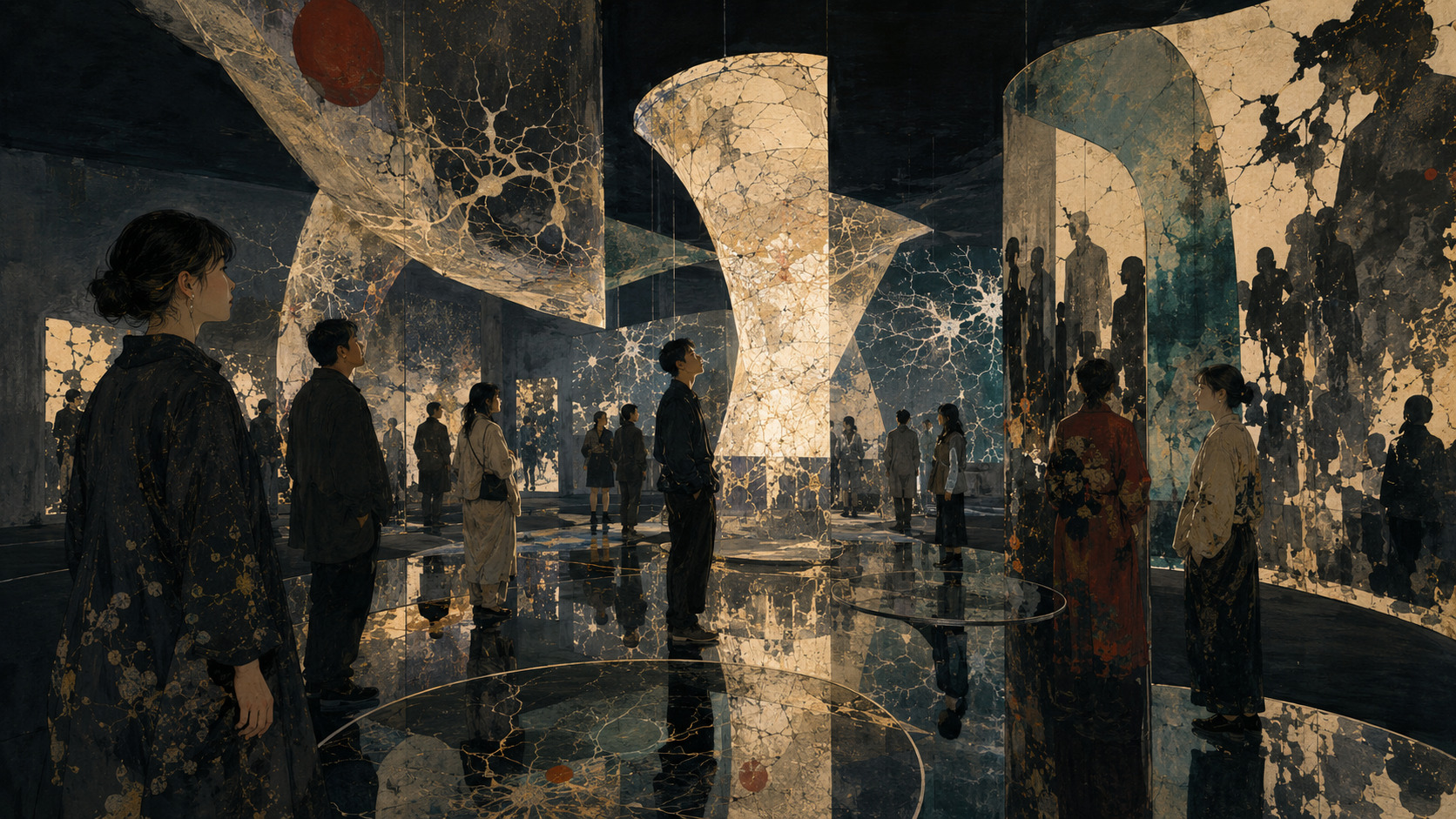
A banana peel is a machine for making certainty ridiculous. The body advances; the floor says otherwise. In slapstick, the audience sees the trap before the walker does and laughs at the brief collapse between intention and result. At a new Tokyo exhibition, the peel is scheduled to stand two meters tall. It will not be hiding. The question is whether visitors can recognize the social traps placed in plain sight.
Collective Madness: Why Do People Confront Each Other? opens August 28 at GARDE ART GALLERY in Minami-Aoyama and runs through September 16. It is the first joint presentation by contemporary artist Shinji Mitsuzuka and Kazuya Horibe, a Special Postdoctoral Researcher at the RIKEN Center for Brain Science. The exhibition brings together Mitsuzuka’s earlier and new work, a large-language-model work by Horibe based on an essay by Mitsuzuka, and a newly made work using a two-meter banana-peel motif.
That is what the organizers have confirmed. They have not published the name of the language model, its provider, prompts, system instructions, temperature, source corpus, number of agents, interaction design, outputs or validation method. Nor have they released a complete checklist or installation photographs; the show has not yet opened. An advance article should not turn that silence into imaginary mirrors, screens or an “AI oracle.” The room can be described only after it exists.
What is known—and what remains inside the black box
| Published fact | Not yet disclosed |
|---|---|
| Horibe has made an LLM-based work from an essay by Mitsuzuka. | The model, prompts, data, interface, outputs and whether visitors interact with it. |
| Mitsuzuka will show previous work and new work developed through the collaboration. | A complete title-and-medium checklist and the gallery layout. |
| A new work with a two-meter banana-peel motif is planned. | Its exact dimensions beyond the stated motif, material and relation to the earlier Slapstick. |
| The collaborators ask whether post-Cold War economic and democratic arrangements, together with digital information systems, structurally produce confrontation. | Evidence that would isolate those causes from institutions, inequality, identity, war, historical memory or offline media. |
From the “mad crowd” to the wise one
The exhibition’s title enters an argument almost two centuries old. In 1841, Scottish journalist Charles Mackay published Memoirs of Extraordinary Popular Delusions, later famous under the expanded title Extraordinary Popular Delusions and the Madness of Crowds. Its stories of speculation, prophecy and fashion helped make collective folly a durable literary subject. It was brilliant journalism and poor controlled social science; some episodes, especially the popular version of Dutch tulip mania, were simplified or sensationalized.
In 1895, French writer Gustave Le Bon offered a darker theory in The Crowd. He argued that people submerged in a crowd lost critical judgment and became susceptible to contagion, suggestion and a commanding leader. The theory was influential because it spoke to elite fears of mass democracy, labor organization and revolution. It also carried the prejudices of its author and era. Modern crowd research does not accept the crowd as an automatically irrational organism. Shared identity can produce coordination, mutual aid and disciplined action as well as violence.
Then came a counter-image. In 1907, Francis Galton reported a weight-judging competition at a livestock fair. The aggregate estimate of the ox’s dressed weight was remarkably close to the measured result. The episode became an ancestor of “wisdom of crowds.” Galton himself was an architect of eugenics; the statistical insight cannot be separated from that troubling history, even though aggregation later found uses far beyond his politics.
1841 — Charles Mackay turns mass delusion into a compelling historical narrative.
1895 — Gustave Le Bon portrays the crowd as suggestible, contagious and diminished.
1907 — Francis Galton’s livestock-fair calculation becomes an emblem of aggregated judgment.
1959 — C. P. Snow describes a gulf between scientific and literary cultures.
1966 — Artists and Bell Labs engineers create Experiments in Art and Technology in New York.
2019 — A 699-person experiment shows that uncertainty, group size and learning strategies can move interactive crowds toward wisdom or herding.
2026 — Mitsuzuka and Horibe place an LLM and a banana peel inside the same question.
A crowd is not wise or foolish by default
The decisive word in collective intelligence is not “collective.” It is “conditions.” Independent estimates can cancel individual errors; correlated estimates repeat them. Diversity can bring different information into a group; pressure to conform can erase that diversity. An aggregation rule can make scattered knowledge legible; a popularity ranking can make yesterday’s winner look like today’s truth.
This conditional view is especially relevant to Horibe’s scientific setting. The RIKEN Computational Group Dynamics Collaboration Unit studies how individual choices produce group-level outcomes and how group conditions feed back into belief and behavior. Its research fields include collective decision-making, social learning, cultural evolution and computational modeling. That is a study of loops, not a search for an irrational “mass mind.”
A 2019 study by Wataru Toyokawa, Andrew Whalen and Kevin Laland used an interactive online experiment with 699 participants. The researchers varied task uncertainty and group size and modeled how individuals used social information. When tasks became difficult, people copied more; large groups facing uncertainty could herd. Yet certain learning strategies also protected a group from bias. The same connectivity that spreads an error can distribute a correction.
| Conditions that can support collective intelligence | Conditions that can turn connection into herding |
|---|---|
| Genuinely different information and perspectives | The same source repeated through many accounts |
| Independent judgment before discussion or voting | Visible popularity signals before a view is formed |
| An aggregation rule suited to the question | Engagement treated as evidence of truth |
| Ability to revise a belief without social punishment | Identity and status tied to never conceding |
| Uncertainty made explicit | Uncertainty filled by confident imitation |
The digital-environment hypothesis
Mitsuzuka’s essay proposes that contemporary values may not have changed as much as the environment in which people encounter and perform them. Digital devices, the internet and social media have reorganized attention, memory and visibility; conflict therefore appears in a new form. It is an artist’s hypothesis with scientific implications, not a settled conclusion.
The hypothesis is plausible because platforms alter incentives. A private irritation can become a public identity signal. A small dispute can be counted through likes and reposts. A ranking system can distribute a message to strangers precisely because it provokes response. Out-group language often attracts engagement, and social context can distract users from judging accuracy. But “the algorithm divided society” compresses many mechanisms into a villain with no variables.
Evidence does not support a single universal effect. A 2018 field experiment paid regular Twitter users in the United States to follow bots that retweeted views from the opposing political side. Exposure did not reliably moderate them; Republicans in the treatment group became substantially more conservative, while the change among Democrats was smaller. Yet a large 2023 collaboration that changed Facebook and Instagram feeds during the 2020 U.S. election found that switching consenting users to chronological feeds altered exposure and behavior without broadly changing measured political attitudes over the study period.
These studies investigate different platforms, populations, moments and interventions. They cannot be combined into “social media has no effect” or “social media inevitably radicalizes everyone.” They show why the exhibition’s word structure is useful: a system changes probabilities and payoffs, but people arrive inside it with histories, identities, institutions and unequal power.
- Interface: what a user sees, in what order, with which counters and controls.
- Model: the ranking or generation process that selects and produces information.
- Institution: moderation, advertising, law, ownership and business incentives.
- Society: inequality, parties, education, media history, war and identity beyond the device.
An LLM can be a mirror, a participant or a stage prop
Horibe’s announced work begins with Mitsuzuka’s essay and an LLM. That pairing is conceptually sharp. A language model is trained from human-made text and generates output by patterns learned from that collective archive. It can compress many voices into one fluent voice. The result may look like collective intelligence, but fluency can also hide disagreement, absence and error.
In a July 2026 survey co-authored by Horibe, researchers proposed separating two goals for LLM social simulations. One is replication: build a model faithful enough to a particular organization, city or other real system to support intervention. That requires calibration and validation against real-world data. The other is theory: use an abstract model to explore a recurring mechanism such as persuasion, segregation, polarization or norm formation. The second can illuminate a process without claiming to predict a named society.
This distinction is an excellent way to enter the exhibition. An artwork can make a mechanism felt. It can repeat, exaggerate, trap, seduce or contradict. That does not make it a validated simulator of democracy. Conversely, a scientific model can be rigorous and still abstract away the texture that lets a viewer recognize a moral problem.
| If the LLM work is read as art | If it is read as scientific evidence |
|---|---|
| Ambiguity, surprise and emotional force may be part of the method. | Methods, inputs, parameters, comparison data and reproducibility become necessary. |
| A biased or contradictory output may reveal the medium’s limits. | Bias and inconsistency threaten the reliability of a conclusion. |
| The visitor’s interpretation can remain open. | The claim must be defined narrowly enough to test. |
| The model may function as material or metaphor. | The model must have a stated relation to the population it represents. |
The banana peel has already traveled through capitalism
Mitsuzuka’s peel is not a visual joke added to make an academic exhibition friendly. It belongs to an ongoing body of work. His giant inflatable Slapstick, roughly six meters long in an earlier installation, won the Toshiko Okamoto Award at the 25th Taro Okamoto Award for Contemporary Art exhibition in 2022 and later appeared at Roppongi Art Night in 2024.
The artist gave the form several linked meanings. The peel is the classic signal of slipping and failure. It also carries the global history of a crop, plantation economies and consumption. And it becomes a comedy of profit maximization amid warming conditions that change where bananas can be commercially cultivated. The joke is scaled until the passerby cannot step around its politics.
The announced 2026 work should not be confused with that earlier object. The press image accompanying the new show is explicitly identified as a work that will not be displayed, while a new two-meter banana-peel work is planned. Two meters is the new motif’s stated scale; the earlier Slapstick reached more than six meters in length. Until installation details are released, their material and exact conceptual relationship remain open.
Comedy matters because a joke demonstrates a group process. The audience recognizes a convention together: peel, foot, fall. Laughter arrives socially and a fraction ahead of analysis. Mitsuzuka has argued that in an age when questions are treated as obstacles, comedy may be one of the few forms in which a question can survive. A pratfall can therefore do what a thesis cannot—it allows the viewer to enjoy the mechanism and then notice they are inside it.
Two lives built from crossing roles
Mitsuzuka’s route into contemporary art was itself nonlinear. He worked as ski patrol, lifeguard and bicycle messenger before entering Tokyo University of the Arts in 1999. While a student, he wrote for children’s television. Magazine editing and television directing followed. He began publicly exhibiting his artwork in 2018, then received the Kanagawa Prefectural Assembly Chairperson’s Award in 2021 and the Toshiko Okamoto Award in 2022.
Horibe holds a bachelor’s background in biological science, a master’s in information science and a doctorate completed at Osaka University in 2021. He became a specially appointed assistant professor in Osaka University’s Graduate School of Engineering Science and joined RIKEN in 2024. His work has moved through computational biology, artificial life and human-agent interaction toward collective decision-making and cultural evolution. He also has earlier installation experience, including Art Hack Day at Miraikan in 2018, the WRO Biennale in 2019 and the Nakanojo Biennale in 2021.
They met through Fundamentals, a Japanese program that pairs scientists with artists for sustained conversation. The 2025 pairing announcement identifies Horibe with biological science and Mitsuzuka with art. It does not ask one to illustrate the other’s expertise. Their public result instead preserves a productive mismatch: an essay becomes input to a model; a model’s logic meets an object designed to make bodies imagine falling.
Beyond the “two cultures”
In 1959, scientist and novelist C. P. Snow described a gulf of mutual incomprehension between literary intellectuals and scientists. His “two cultures” argument became a shorthand for the costs of disciplinary separation. Seven years later in New York, artists Robert Rauschenberg and Robert Whitman and Bell Labs engineers Billy Klüver and Fred Waldhauer founded Experiments in Art and Technology, building practical collaborations rather than merely calling for dialogue.
The Horibe–Mitsuzuka exhibition inherits that history but works in a different technological era. The engineer of the 1960s might have supplied a sensor, radio link or projection system that expanded what a performance could do. The LLM arrives carrying culture inside the instrument: archives of language, social bias, statistical regularity and opaque exclusions. It is both technology and contested representation.
That makes the collaboration difficult in the best sense. Art should not become decorative science communication, and science should not be borrowed as an aura of truth. A successful crossing lets each discipline expose what the other suppresses. The scientist can ask what would count as evidence for the artist’s hypothesis. The artist can ask which human assumptions were turned into variables and which disappeared before the calculation began.
The post-Cold War claim is a proposition, not a period label
The exhibition asks whether economic and democratic structures formed after the Cold War, in combination with digital information environments, now generate confrontation. It is an ambitious frame. The Soviet Union dissolved in 1991; the commercial web, globalization of finance and supply chains, platform companies and new democratic expectations then developed along different timelines and with different effects across countries.
Calling all this “post-Cold War” can reveal a shared horizon, but it can also flatten history. Japan’s long stagnation, the Asian financial crisis, the global financial crisis, widening insecurity, wars, migration, demographic change and regional media systems cannot be reduced to a smartphone interface. Nor did conflict begin with the web. Propaganda, rumor, partisan newspapers and broadcast spectacle long predate it.
The better version of the hypothesis is not that devices manufactured disagreement from nothing. It is that digital systems change the speed, scale, visibility and reward structure through which existing disagreements become identities and actions. That version can be investigated. It invites comparison across platforms, societies and periods. It also allows the uncomfortable possibility that some division comes from genuine conflicts of interest that should be argued rather than optimized away.
How to look at a research exhibition
Visitors do not need to choose between believing the exhibition and dismissing it. They can treat each work as a proposition with a different burden of proof. What does the banana make physically obvious that the essay makes abstract? What does the language model combine, and which voices does its fluency erase? When does a diagram explain, and when does it merely lend authority?
- Which statements are the artist’s hypotheses, which are scientific findings and which are generated by a model?
- What exactly is being called a “collective”: a crowd, a network, a market, a voting public or a dataset?
- Can a participant disagree with the system, and does that disagreement change anything?
- What information is absent from the model or installation?
- Does the work make division feel inevitable, or show a condition that people could redesign?
- Who benefits when attention, agreement or outrage is aggregated?
| Exhibition | Collective Madness: Why Do People Confront Each Other? |
|---|---|
| Artists/researchers | Shinji Mitsuzuka and Kazuya Horibe |
| Dates | August 28–September 16, 2026 |
| Hours | 11 a.m.–6 p.m.; until 5 p.m. on the final day |
| Closed | Sundays and public holidays |
| Venue | GARDE ART GALLERY, NBF ALLIANCE Building 4F, 5-2-1 Minami-Aoyama, Minato, Tokyo |
| Admission | Not stated in the published exhibition notice; confirm with the venue before travel |
The moment before the fall
A slapstick fall divides time into three frames: the confident step, the impossible angle, the body on the ground. Social explanations often begin at the third frame. They condemn the crowd after the rush, the voter after the result, the user after the repost. Mitsuzuka and Horibe are interested in the second frame—the reorganized environment in which a movement that felt reasonable starts to carry someone elsewhere.
The exhibition’s greatest opportunity is not to diagnose society from a gallery. It is to make the machinery of diagnosis visible. The phrase “collective madness” should itself become an object of suspicion. Who names the crowd mad? What alternative information was available? Which errors were independent, and which were copied? What did a platform, institution or artwork count as success?
On August 28, the answer will not be waiting beneath the giant peel. There will be works, propositions and a model speaking from an undisclosed architecture. Visitors may recognize the trap and still step forward. That is not failure. It is where collective intelligence begins: not with immunity from error, but with conditions that let a group see the slip, say what caused it and try another way of moving.
- GARDE Design Magazine, official English exhibition announcement, dates, venue and project description
- Aoyama Design Forum, exhibition release and artist profiles
- Fundamentals, 2025 pairing announcement and collaborator biographies
- RIKEN Center for Brain Science, Computational Group Dynamics Collaboration Unit
- Kazuya Horibe, research biography and selected work
- Mori et al., “Replicating Systems, Understanding Mechanisms,” survey of LLM-agent social simulation, 2026
- Toyokawa, Whalen and Laland, “Social learning strategies regulate the wisdom and madness of interactive crowds,” Nature Human Behaviour, 2019
- Bail et al., “Exposure to opposing views on social media can increase political polarization,” PNAS, 2018
- Guess et al., “How do social media feed algorithms affect attitudes and behavior in an election campaign?” Science, 2023
- Rathje, Van Bavel and van der Linden, “Out-group animosity drives engagement on social media,” PNAS, 2021
- Roppongi Art Night 2024, Shinji Mitsuzuka’s Slapstick and the artist’s account of its metaphors
- Internet Museum, 25th Taro Okamoto Award exhibition and Toshiko Okamoto Award
- Gustave Le Bon, The Crowd: A Study of the Popular Mind, open scholarly edition
- Charles Mackay, Memoirs of Extraordinary Popular Delusions, Internet Archive
- American Physical Society, historical note on C. P. Snow’s 1959 “Two Cultures” lecture
- Experiments in Art and Technology, organizational history
Editor’s note: This article is based on public information available through August 19, 2026, before the exhibition opened. The complete work list, installation, LLM model, prompts, data, parameters, interaction design and validation method had not been published. Descriptions of planned works therefore use future tense and do not infer undocumented technical features. The exhibition’s causal proposition about post-Cold War systems and digital information is identified as the collaborators’ hypothesis, not a demonstrated result. “Collective madness” is treated as a metaphor for group dynamics and not a mental-health diagnosis. The announced two-meter work is distinguished from the earlier six-meter-scale Slapstick; the organizers state that an image of the older work accompanying the release is not itself in the new exhibition. Admission information was not stated in the official notice reviewed. The exchange-rate display is supplied by the editorial desk.