Two deities stand above a sea that does not yet have a country in it. Izanagi and Izanami lean toward the water from the Floating Bridge of Heaven. Between them, a jeweled spear drives diagonally into the dark, unsettled surface. The story says that when the spear is raised, brine falling from its tip becomes Onogoro, the first island. In Kobayashi Eitaku’s painting, creation is not a serene diagram. It is an action: bodies brace, cloth strains, cloud and water churn, and the world seems to condense from the force of a gesture.
The painting, generally dated to the 1880s and held by the Museum of Fine Arts, Boston, gives Eitaku his most memorable entrance into art history. Yet it can also trap him. Seen alone, it makes him look like a specialist in spectacular national mythology. His actual career was far less tidy. He painted hanging scrolls and a disturbing meditation on bodily decay. He designed woodblock news images of current events, illustrated a popular biography of Ulysses S. Grant, supplied commercial pictures and made fairy-tale books that traveled overseas. His brush moved between elite lineages and mass media while the social world around it moved from shogunal Edo to imperial Meiji.
That movement is why Eitaku is today’s strongest art choice. He does not offer a decorative “Japanese style” to place over contemporary reporting. He offers a grammar for pressure: diagonals that make structures bear weight, crowds that become social forces, hands that visibly decide, weather that acts like emotion, and viewpoints that put the spectator inside an unstable event. Those devices can connect an inspection robot below an Osaka bridge, the afterlife of earthquake trauma, two-handed motor research, a ski jumper in flight and an exhibition about collective madness. The connection is compositional, not literal. Eitaku never painted twenty-first-century machines, and the editorial illustrations in this edition are new interpretations rather than lost works or imitations presented as originals.
The fishmonger’s son enters a painter’s institution
Eitaku was born in Edo on April 22, 1843. The University of Oregon’s Lavenberg collection identifies him as the third son of Miura Kichisaburō, a fishmonger at Nihonbashi Uogashi, the great wholesale market that supplied the shogun’s city. His given name is recorded as Tokusen, his familiar name as Hidejirō, and his many art names include Eitaku, Sensai or Issensai, Kadō, Baikadō and Mugyo. The abundance of names is not unusual in nineteenth-century Japanese art, but it makes a scattered career harder to retrieve from catalogues.
Standard biographical accounts say he was adopted by Kanō Eishin and, at twelve or thirteen, became a pupil of Kanō Eitoku Tatsunobu. “Kanō school” can sound like a style label. It was also an institution: a hereditary system of studios, models, patronage and professional discipline that had served warrior governments for centuries. A pupil learned how to control ink, organize screens and large surfaces, render figures according to transmitted patterns, and adjust a picture to a patron and setting. Eitaku’s later freedom did not come from escaping training; it depended upon the visual command that training gave him.
Later biographies also record service as an official painter to Ii Naosuke, the daimyō of Hikone and powerful Tokugawa chief minister assassinated outside Edo Castle in 1860. Details of Eitaku’s early adoption and appointment vary among secondary accounts, so they should not be treated as a perfectly documented employment file. The broad historical break is secure. A teenager trained for a patronage world built around the shogunate reached adulthood as that world was violently coming apart.
1843 — Born in Edo, reportedly into a Nihonbashi fishmonger’s family.
Mid-1850s — Enters formal Kanō training, according to standard biographies.
1860 — Ii Naosuke is assassinated; the political order supporting inherited artistic offices accelerates toward collapse.
1868 — The Meiji Restoration transforms institutions, patrons and the market for images.
1870s — Eitaku designs color prints, illustrated news and current-events pictures.
1879 — Illustrates Kanagaki Robun’s popular Japanese biography of Ulysses S. Grant.
1880s — Produces design books, picture albums, fairy-tale illustration and ambitious mythological paintings.
1890 — Dies in Mukōjima on May 27, aged 47.
The Restoration did not abolish tradition; it changed its customers
When the shogunate fell, painters did not wake up in an empty modern world. Old skills remained valuable, but the networks buying and distributing images changed. Government exhibitions, new collectors, publishers, newspapers, exporters, schools and urban consumers competed with declining hereditary patronage. Photography, lithography and letterpress printing entered a visual economy still powered by hand-cut woodblocks. Synthetic pigments created colors—especially fierce reds and purples—that looked unlike the mineral and vegetable palette of earlier prints.
Eitaku traveled and eventually settled in Nihonbashi. Accounts place him in the orbit of artists such as Kawanabe Kyōsai and Tsukioka Yoshitoshi; Roger Keyes’s research, summarized by the University of Oregon, describes a period of study and travel with Yoshitoshi in the 1870s before a disagreement separated them. The exact boundaries between pupil, colleague and rival are not always recoverable. What matters visually is that Eitaku entered the competitive field of commercial woodblock design without surrendering the large-scale thinking of a Kanō-trained painter.
He also absorbed more than one outside influence. Biographical summaries point to Chinese Ming painting, literati or nanga practice and Western-style picture-making. “Western depth” should not be turned into a claim that every picture follows European one-point perspective. In Eitaku, it may appear as modeled volume, recession into turbulent space, dramatic illumination or a low and oblique viewpoint. The result is not a neat East-West synthesis. It is a toolbox assembled for different assignments.
When news became a picture
One of Eitaku’s most important workplaces existed for only a few years. Around 1874, publishers began issuing nishiki-e shinbun: full-color woodblock sheets that joined a recent incident, a compact text and an arresting picture. The University of Tokyo’s historical exhibition describes roughly forty varieties published in Tokyo, Osaka and Kyoto, with their main boom ending around 1877. Frames printed in red and purple, sometimes ornamented with Western-looking angels, turned the sheet into a visual window.
Daily newspapers were not yet easy reading for everyone. Their classical or Chinese-inflected prose favored educated readers. The nishiki-e newspaper translated the new category of “news” into a familiar popular medium. It supplied furigana, condensed the account into a few hundred characters and staged the event like theater. Murder, accident and scandal were common, but the larger significance lies in the public habit it created: a recent event could be possessed, viewed and discussed as an image.
Eitaku worked on series including Kakushu Shimbun Zukai and illustrated items connected to the Yokohama Mainichi Shimbun and Eiri Jiyū Shimbun. Waseda University’s database records his woodblock news and battle subjects, including prints related to the 1877 Satsuma Rebellion. These were not photographs from the scene. Designers often transformed written reports into persuasive tableaux. A commander is raised above a surge of bodies; smoke divides the field; a weapon or road drives the eye toward the crisis. The image delivered an emotional map of the event, not neutral eyewitness evidence.
The National Diet Library situates this experiment within a larger Meiji transformation. Earlier censorship had restricted pictures of immediate political events. The new era brought railways, bridges, factories, foreign visitors and exhibitions into print. Western methods of perspective, shading and light appeared alongside imported pigments. Then the same technical change accelerated: letterpress, lithography and photography gradually displaced the woodblock news sheet. Eitaku was not merely an artist who happened to illustrate newspapers. He worked at the moment when Japanese mass culture was inventing visual news and then abandoning its first format.
A studio with many doors
The archive shows how widely that intelligence traveled. In 1879, Eitaku illustrated Kanagaki Robun’s life of former U.S. president Ulysses S. Grant, published during Grant’s celebrated visit to Japan. The assignment joined global diplomacy to popular biography. Waseda records illustrated medicine advertisements associated with Ginkō Kishida’s Rakuzendō, books on manners and history, current-events series and albums under different signatures.
A surviving Drawing Book of Designs for Everything, dated about 1880–82 and now at Scripps College’s Ruth Chandler Williamson Gallery, ranges from mythical beings to observed natural forms. Its likely function was practical: a storehouse of motifs and solutions an artist could consult and adapt. The gallery notes the coexistence of ukiyo-e subject matter and Kanō economy. The book dissolves the romantic idea that inspiration arrives whole. Eitaku built imagination by indexing forms.
Sensai Eitaku Gafu appeared in 1884; Eitaku Manga followed from the mid-1880s. He also supplied pictures for Hasegawa Takejirō’s crepe-paper Japanese Fairy Tale Series—small, textured books whose translated stories found international readers. Waseda records Eitaku editions of The Monkey and the Crab, The Old Man Who Made the Dead Trees Blossom, The Crackling Mountain and The Tongue-Cut Sparrow, among others. The same artist who made political violence legible could give a folktale its animals, gestures and moral rhythm.
| Field | What Eitaku carried into it | What the field demanded back |
|---|---|---|
| Kanō painting | Disciplined line, inherited motifs, command of large compositions | Adaptability to patrons, formats and established visual authority |
| Ukiyo-e and news prints | Staged crowds, decisive gesture, rapid narrative clarity | Deadlines, current events, popular legibility and publisher control |
| Commercial illustration | Memorable figures and objects, compression of a message | A product or text had to become instantly graspable |
| Design books | A repertory spanning deities, humans, animals and plants | Repeatable forms that could migrate between commissions |
| Mythological painting | Scale, atmosphere and emotional weather | Old stories had to feel newly present in Meiji time |
| Export picture books | Clear action and expressive silhouettes | Stories had to cross language, format and audience |
How the pictures move
Eitaku’s most compelling pictures do not merely contain action. They allocate force. A spear connects heaven to sea. A horse turns the mass behind it. Wind pulls a robe against the intention of the person wearing it. A crowd is arranged in layers so the eye reads both individual reaction and collective pressure. The empty region around a figure may function like a held breath before impact.
Hands do unusual work. Because many of his subjects depend on decision—prayer, combat, creation, testimony—gesture becomes structure. In the Boston painting of Izanagi and Izanami, four arms and the long spear organize a cosmic task. This is why Eitaku’s visual thinking unexpectedly suits a 2026 report on bimanual coordination: not because he anticipated motor-control mathematics, but because he understood that two hands can belong to one intention while occupying different arcs, speeds and burdens.
Perspective is equally active. Viewpoints often feel close to the ground, angled across a field or suspended near a dangerous edge. This does not simply imitate a Western camera. It combines several spatial habits—layered Japanese composition, Chinese-derived landscape recession, theatrical staging and Meiji experiments with shadow and depth. The viewer is denied a comfortable seat outside the event.
- Find the dominant diagonal. It often carries the picture’s physical or moral pressure.
- Follow the hands. Gesture tells you who acts, who receives and who hesitates.
- Separate crowd from protagonist. Then notice how the crowd changes the protagonist’s meaning.
- Read weather as an actor. Cloud, rain, wave and wind do more than set the scene.
- Ask where you are standing. The chosen viewpoint determines whether you judge, witness or participate.
Myth after political revolution
Why would an artist experienced in journalism return to the oldest gods? In Meiji Japan, myth was not outside modernity. The new state was reorganizing ritual, history and imperial legitimacy; publishers and museums were redefining the national past; new audiences were learning to encounter old narratives as public culture. Eitaku’s mythological paintings belong to that charged field, even when their exact commissions and original viewing conditions are not fully known.
Izanagi and Izanami Creating the Japanese Islands, generally dated around the mid-1880s, turns origin into muscular process. The composition is vertically compressed and psychologically immediate: an enormous metaphysical event depends on balance, touch and directed energy. The work now in Boston is often reproduced because its story is readable in one glance. What reproductions lose is the tension between meticulous contour and engulfing atmosphere.
Another Boston painting, Sugawara no Michizane Praying on Mount Tenpai, usually dated about 1880, shows Eitaku’s gift for emotional weather. Michizane—the scholar-official exiled from court and later revered as Tenjin—addresses heaven amid a landscape that seems to register grievance and resolve. The subject links biography, political injustice and supernatural transformation. It also reveals a broader Eitaku principle: an individual emotion becomes credible when the entire environment is made to bear it.
These are not simply survivals of Edo painting. They are Meiji acts of reactivation. The old story is subjected to a new demand for presence. The gods and historical heroes must compete with the speed of illustrated news.
A difficult scroll about the body
Eitaku’s range includes a work that requires slower, more careful looking. The British Museum holds the 1870s handscroll Body of a Courtesan in Nine Stages of Decomposition. It belongs to the long Buddhist-derived tradition of kusōzu, images of the body’s decay used to contemplate impermanence and attachment. Its subject is explicit and may be disturbing.
The scroll should not be reduced either to medical illustration or to macabre spectacle. It asks how visual attention can be turned against denial of death. At the same time, the tradition repeatedly chooses a woman’s body—often a court lady or courtesan—as the object through which a presumed viewer is taught detachment. Modern viewing must keep that gendered structure in sight. Spiritual instruction, curiosity, fear and the power to expose another body coexist uneasily.
Placed beside the creation myth, the scroll expands Eitaku’s scale from the first land forming to the final loss of personal form. Few artists can be represented by a cosmic beginning, daily news and bodily dissolution without the range feeling accidental. In Eitaku, all three are problems of transition: when matter becomes world, event becomes public memory, and body becomes impermanence.
The labels could not agree
Eitaku’s later neglect is sometimes explained as if taste simply failed to recognize a genius. The historical evidence is more interesting. The Tokyo National Research Institute for Cultural Properties has indexed contemporary painter rankings that place his name under different headings. An 1880 sheet calls him ukiyo-e; an 1881 ranking places him among first-rate painters; an 1883 document uses “new painting”; an 1889 list returns him to the Kanō school. Later compilations can call him a great ukiyo-e painter.
These are not merely contradictory mistakes. They record a culture trying to rebuild its filing system while artists were still working. “Japanese painting” was becoming a modern institutional category. Ukiyo-e would eventually be narrated as a lineage of collectible masters, while commercial illustration, newspaper work and export books were often pushed to the margins. Kanō painting could be treated as the official old order. Eitaku’s career crossed every border that the new art history wanted to draw.
Materials mattered too. Early collectors and scholars often preferred Edo-period restraint to the aggressive synthetic reds of Meiji prints. Reproduction could flatter line while flattening atmosphere. Large paintings and fragile books entered different departments. Works overseas were catalogued under variant romanizations and signatures. A biography broken among museum painting, print room, rare-book library and commercial ephemera can look smaller than it was.
Tim Clark of the British Museum has described him as prolific and versatile and argued that his reputation remains lower than it should be. The insight is strongest when joined to the catalogue evidence: the problem is not only rank but classification. Recovery therefore requires more than locating a masterpiece. It requires reassembling the visual economy that let one person be painter, reporter, designer and storyteller.
Why this one artist can hold an entire edition together
Using Eitaku as a visual anchor across today’s reports is not an attempt to make modern Japan look antique. It is a way to borrow compositional questions from an artist who lived through institutional rupture. How can a structure reveal stress? How does a community appear as more than a row of faces? What can one hand do that the other cannot? How does invisible memory occupy a landscape? Where should a spectator be placed when a body leaves the ground?
| August 20 report | Eitaku-derived visual principle | Editorial boundary |
|---|---|---|
| AI bridge inspection in Osaka | Structural diagonals, an underside viewpoint, small human figures against engineered mass | No historical claim that Eitaku represented modern machinery |
| Fifteen years of earthquake trauma | Weather and landscape as carriers of memory; restrained gesture within a larger environment | No disaster spectacle and no invented survivor portrait |
| Two-handed movement research | Hands as separate trajectories serving one action | No suggestion that brushwork is scientific measurement |
| Iiyama ski jumping | A body on a long diagonal, framed by wind, mountain and collective gaze | Modern equipment and athletes remain accurately contemporary |
| Collective madness exhibition | Crowd layers, unstable viewpoints and the tension between actor and group | Psychological complexity is not converted into horror imagery |
| River habitat and invasive beetle | The design-book habit of observing roots, water, insects and patterned living forms | Ecological facts remain grounded in research, not symbolic nature |
The distinction matters ethically. Historical style can easily become a filter that erases the specificity of present people. The Eitaku-inspired images in this edition should preserve contemporary clothing, technology, geography and stakes. What they take from him is choreography: a method for making relationships visible under pressure.
Standing on the bridge between categories
The most useful place to leave Eitaku is not in front of one masterpiece but inside his archive. A news sheet makes a recent conflict theatrical. A design book holds a fox, deity or leaf ready for future use. A translated fairy tale turns Japanese woodblock craft into an international object. A large painting asks two deities to create land again for a modern public. A scroll insists that every body returns to matter.
Each object answers a different commission. Together they show a mind working through the central visual problem of early Meiji: how to make inherited forms carry events that had not existed when those forms were made. Eitaku’s solution was not stylistic purity. It was controlled collision. Kanō discipline met ukiyo-e immediacy; Chinese-derived space met experiments in Western depth; newspaper urgency met mythic time.
That collision helps explain the force of the jeweled spear. Izanagi and Izanami are creating a country, but Eitaku is also creating a position for himself—a place suspended between old patronage and new media, learned painting and popular circulation, Japan’s origin story and its accelerating present. The position was unstable. It may have contributed to his later obscurity. It is also exactly where his art becomes most modern.
The spear rises. Drops fall. An island appears. Eitaku’s deepest subject was never stillness; it was the charged interval in which one state becomes another. That is why his pictures can speak across this edition. They do not make change comfortable. They make it visible.
- University of Oregon, Jordan Schnitzer Museum of Art/Lavenberg Collection, Kobayashi Eitaku biography and bibliography
- British Museum, Kobayashi Eitaku biographical authority record
- British Museum, Body of a Courtesan in Nine Stages of Decomposition, 1870s
- Waseda University Library, Japanese & Chinese Classics database search for Kobayashi Eitaku
- Tokyo National Research Institute for Cultural Properties, historical painter-ranking entries for Kobayashi Eitaku
- National Diet Library Image Bank, “Nishiki-e in the Meiji Era”
- University of Tokyo, “What is a nishiki-e newspaper?” historical exhibition
- Ruth Chandler Williamson Gallery, Scripps College, Eitaku’s Drawing Book of Designs for Everything
- Museum of Fine Arts, Boston, Sugawara no Michizane Praying on Mount Tenpai
- Museum of Fine Arts, Boston collection image data via Wikimedia Commons, Izanagi and Izanami Creating the Japanese Islands
- Smithsonian National Museum of Asian Art, Satsuma Rebellion current-events triptych and contextual label

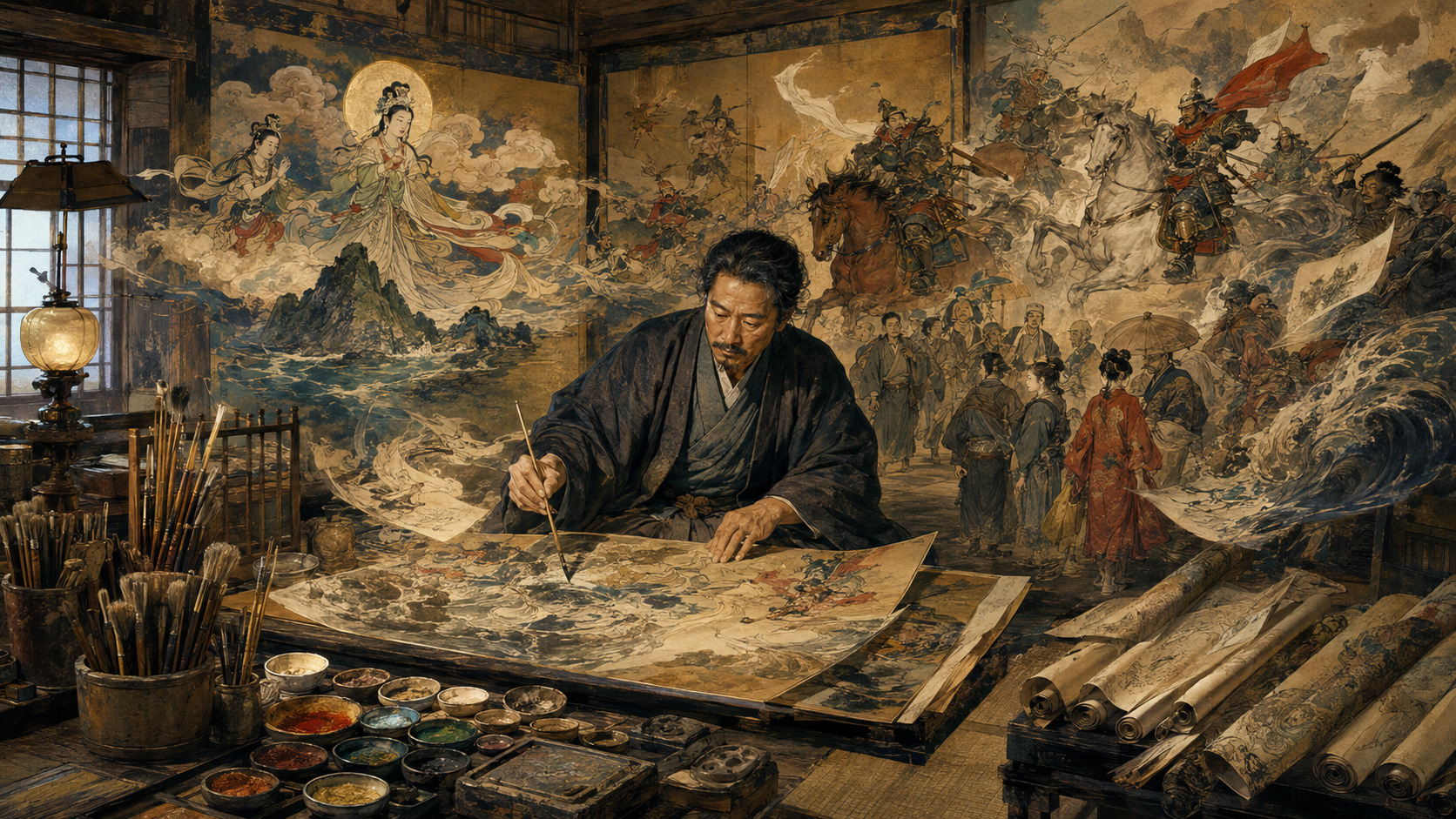
Editor’s note: This article reflects sources available through August 19, 2026. Names, dates and professional relationships in Eitaku’s early biography vary among later accounts; uncertain details are attributed rather than presented as a complete employment record. The article uses “Western depth” for documented influence and visible spatial devices, not to claim formal European training or one method across every work. Dates for the Boston mythological paintings are approximate. Nishiki-e news images are treated as mediated popular journalism, not eyewitness documentation. The discussion of Eitaku’s reputation and the visual connections across this edition is editorial analysis. The hero image and related illustrations are contemporary editorial interpretations inspired by his compositional energy, not reproductions, authenticated works, archival portraits or claims about how the artist’s studio looked. The exchange-rate display is supplied by the editorial desk.