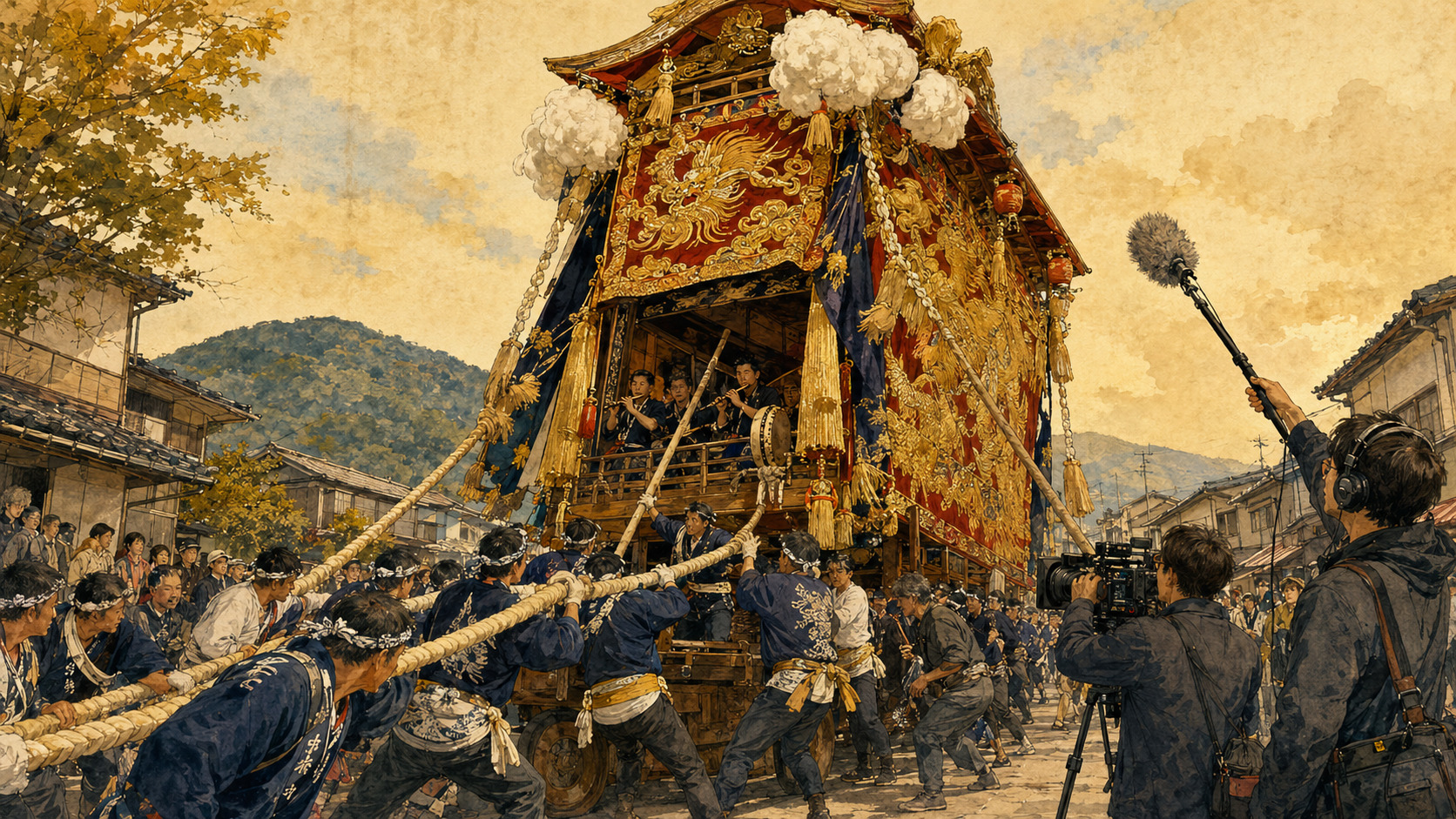
Before a chōsa moves, a neighborhood has to remember how to build it. Long poles are lashed with rope. Cushions rise in red tiers. Embroidered hangings—dragons, tigers, clouds, gold thread—are inspected and repaired. The huge float carries a drum and rides on wheels, yet it is not merely a vehicle. It is a year of work condensed into three festival days, a structure made movable by shared muscle and inherited knowledge.
That makes a chōsa an unusually exact image for a regional film. A screenplay may begin with one writer, but getting it onto a screen requires a temporary neighborhood of its own: director, producer, performers, camera and sound crews, location owners, drivers, cooks, public officials and residents willing to wait while an ordinary street becomes a set. The finished work may look self-contained. The labor that holds it upright is communal.
In western Kagawa, that work is now under way on Cotton and Chōsa—The Things I Loved, the English rendering used here for the Japanese title Wata to Chōsa: Boku ga Sukidatta Mono (『綿とちょうさ〜僕が好きだったもの〜』). Kagawa Prefecture announced on August 18 that the film, directed by Tomohisa Kamaji and produced by Tsuyoshi Yamashita, was shooting with the goal of a first screening at the Sanuki Film Festival in February 2027.
The production began not with an established studio property but with the winning entry in the festival’s ninth screenplay competition. Twenty-four scripts were submitted. The writer, a 67-year-old Takamatsu resident using the pen name Rei Shinoda, won the grand prize in February 2025. Her story is now being filmed around Toyohama in Kan’onji—the landscape where cotton once helped create prosperity and where chōsa floats still gather each autumn.
The film that exists—and the film that does not yet
The known story is built around a return. Ryota Fujikawa, 44, works for a foreign-owned merger-and-acquisition company. Eighteen years after leaving home, he comes back too late for his mother’s death. He encounters a taciturn father, a sister who stayed and protected the family, an old friend and the town’s chōsa festival. Among memories of cotton fields and the pressure of festival day, he must decide what he loved before ambition and distance taught him to forget.
A casting notice describes the father, Satoru, as stubborn but deeply devoted to his family; Ryota’s sister, Asuka Yamashita, as a local anchor; and childhood friend Shinichi Komine as an openhearted helper. The director’s statement frames the premise broadly: many people end up living lives unlike the ones they imagined as children. The film hopes to awaken a memory of what viewers once wanted and loved.
Those are production facts and intentions, not a review. Shooting has begun, but a final cut, runtime, complete credit list, distribution plan and public schedule beyond the intended festival premiere had not been announced in the materials reviewed for this article. A film changes during editing. A scene central on the page can disappear; a glance discovered on location can become the emotional center. The honest story in August 2026 is about a movie being made.
| Confirmed | Still to be determined or announced |
|---|---|
| The script won the ninth competition and is the subject of Kagawa’s FY2026 production-support project. | Final cut, runtime, rating and a complete scene-by-scene account. |
| Tomohisa Kamaji is directing and Tsuyoshi Yamashita is producing. | Complete final credits and whether all announced performers remain in the finished film. |
| Filming is centered in Toyohama, Kan’onji, with residents and local locations involved. | The production’s total budget and verified local economic impact. |
| The intended first screening is the February 2027 Sanuki Film Festival. | Exact screening date, later theatrical, broadcast or streaming distribution. |
Cotton: the soft industry beneath the town
The title’s first noun is easy to misread as rustic scenery. In Toyohama, cotton is economic history. During the Edo period, salt, cotton and sugar became known as Sanuki’s “Three Whites,” industries that bound the province to trade beyond its borders. Cotton was planted, picked, ginned, carded, spun and turned into products that could travel. Its whiteness hid a chain of cultivation and household labor.
Local tradition connects the beginning of cotton cultivation to Sekiya Hyoe Kunisada. A monument at Wata Shrine says he opened land in the area around 1532; the shrine honors him as the figure who introduced the crop. Cultivation flourished from the Edo period, and by the late Edo years the making and sale of cotton for bedding had become active. Fields later receded, but bedding factories and shops preserved the industrial afterlife. A street marker still calls the district “Cotton Town.”
The city’s Toyohama Folk Museum—commonly known as the Cotton Museum—places that history on its second floor. Its exhibits explain cotton’s place among the Three Whites and the stages of spinning. The museum matters because vanished labor is otherwise difficult to film. A field can become housing; a factory can close; a skill survives for a generation in the hands of someone no camera recorded.
In the movie’s synopsis, cotton fields belong to Ryota’s remembered hometown. Whether every remembered field survives in the final cut is not yet known. But the symbol does precise narrative work. Cotton is soft after processing and demanding before it. It absorbs, pads and warms. It can therefore carry a family story about labor that went unnoticed until absence made it visible.
Chōsa: a town made taller than itself
The second noun is loud, heavy and public. Kan’onji counts 118 chōsa drum floats, according to the city’s Chōsa Hall. An actual float displayed there weighs about two metric tons. In Toyohama, the lavish structures can rise more than five meters: red tonbo at the top, seven tiers of red cushions, gold-and-silver embroidery and vast hanging quilts with dragons or tigers. The modern sumptuous form is generally traced to the years after 1887, though the area’s festival history reaches back into the Edo period.
A chōsa is related to the broader family of Japanese festival floats but has its own vocabulary and local engineering. The platform, wheels and poles are stored; neighborhoods begin assembly in October. Rope fastens the poles. The official construction guide emphasizes that nails are not used. Decorations vary by district, and old components are repaired rather than treated as disposable stage dressing.
During Toyohama’s autumn festival, more than 20 neighborhood floats are associated with prayers for harvest and fishing. They move through roads not designed for monuments. That tension produces the spectacle: something too large for everyday space is made to pass through it by coordination. The float is religious object, neighborhood emblem, work of textile art, acoustic instrument and moving archive.
| Cotton | Chōsa |
|---|---|
| A former foundation of local production and trade | A continuing structure of ritual and neighborhood cooperation |
| Often invisible after it becomes thread, batting or memory | Deliberately visible: towering, embroidered, sounded by a drum |
| Associated with household labor, warmth and a receding landscape | Associated with public effort, display and an annual return |
| Preserved through a shrine, museum, shops and industrial memory | Preserved by assembly, repair, performance and transmission |
Why these two symbols belong in one title
A less rooted screenplay might use a generic festival as a backdrop for reconciliation. This title does something harder. It joins an industry whose fields have largely disappeared to a ritual that must be physically rebuilt every year. One asks how a place remembers vanished work. The other shows remembrance as work.
That pairing also keeps nostalgia from becoming simple. Cotton prosperity was an economy, not a sepia photograph. Chōsa requires time, money, physical stamina, storage and agreement; it can include some residents more easily than others. A returning son may admire the float while failing to understand who stayed home, cared for parents and carried the neighborhood through ordinary years. The production synopsis gives Ryota a sister who remained. That choice places the glamour of return beside the ethics of staying.
The plot’s M&A profession sharpens the contrast. Ryota’s working life is devoted to pricing, combining and transferring companies. Back home, he meets value that resists easy valuation: family obligation, an old friendship, a vanished crop, a festival object no single participant owns in the ordinary sense. That does not make business cold and tradition pure. It asks a better question: which assets appear on a balance sheet, and which hold a community together without ever becoming line items?
A regional film is strongest when location changes the moral problem. Toyohama should not be interchangeable with an attractive rural background. Its cotton history explains loss; its chōsa practice explains return. If the finished film makes those forces active rather than ornamental, the title will have earned both nouns.
The festival that decided screening was not enough
The Sanuki Film Festival has been held since 2006 with a public mission to promote film and video culture and contribute to Kagawa’s vitality. By February 2026 it had reached its 20th edition, spread across three venues. Film screenings remain the visible event, but the festival’s deeper distinction is a production pipeline: screenplay classes, a contest, financial support, a requirement to shoot in Kagawa and a festival screen for the result.
Most festivals receive completed films. This one also tries to create the conditions from which a local film can emerge. The screenplay contest is open to amateurs aged 15 and older whose stories concern people, history or other subjects connected to Kagawa. Entries must be original and unpublished, and actual adaptation is presumed rather than treated as a remote prize.
The grand-prize writer receives ¥100,000. More consequentially, the selected work receives priority for a separate production subsidy of up to ¥1 million, on condition that the film is shot in Kagawa, and gains a path to a festival screening. The distinction matters: a writing prize recognizes a text; the production program forces institutions to confront the cost and complexity of making the text public.
| Stage | What the Sanuki system contributes | What still depends on people |
|---|---|---|
| Learn | Screenplay instruction and a visible route for beginners | Time to write, revise and accept criticism |
| Select | A juried competition centered on Kagawa stories | Judgment about character, structure and filmability |
| Finance | Prize money and priority for production aid | Additional cash, equipment, labor and in-kind support |
| Locate | A Kagawa-shoot requirement that ties the work to place | Permissions, schedules, residents and practical local knowledge |
| Premiere | An intended audience and festival deadline | Finishing the edit, sound and delivery to exhibition standard |
| Remember | Retrospectives that keep earlier winners in view | Archiving and access after the applause ends |
A first-time writer at 67 changes the meaning of “talent development”
When Rei Shinoda accepted the 2025 prize, she credited screenplay instructor Otsu with teaching her that writing scripts was enjoyable. She said she felt she had begun to understand it and wanted to continue. The statement is modest. Its institutional meaning is not.
Arts policy often uses “emerging talent” as a synonym for youth. A 67-year-old amateur winning a production-oriented competition exposes the limitation. Talent can emerge after a career, after caregiving, after children leave home, or after someone finally encounters a form that matches experiences accumulated over decades. A region that builds only a youth ladder discards much of its memory before asking anyone to write it down.
Jury chair Yūzō Asahara praised the script for addressing depopulation and regional renewal, for the strength of its story and the detail of its characters. He expected those details to give the adaptation realism. The jury also included Takashi Inoue, Keiko Tani, Kazuhito Hashimoto and Hiroki Oda. Their choice did not guarantee a good film; juries cannot do that. It did move an older beginner from classroom to public production.
The festival’s mentorship history has a poignant figure. Director Sadao Nakajima supported the event from its early period, taught and judged, and worked to cultivate successors before his death in June 2023. A prize established in his name keeps that labor visible. The strongest memorial to a teacher is not a plaque alone. It is another person making a first work.
The ¥1 million question
One million yen is meaningful seed money and a small film budget. It can rent equipment, cover transport, feed a crew, insure a production, pay for post-production or solve a location problem. It cannot, by itself, purchase all the professional labor needed for a feature-scale project. The subsidy’s real function is leverage: official selection makes it easier to recruit partners, request locations and convince residents that the production is real.
That leverage also carries risk. Community film projects often depend on discounted labor, favors and enthusiasm. Local casting and nearly 100 volunteer extras helped a previous winning film, Shiomachi Moyō: Hatsukoi no Yukue, reach the 2025 festival after production difficulties that included a festival cancellation. Participation can create skill and ownership, but “local passion” should not become a euphemism for invisible labor or unsafe practice.
The production’s social posts and casting material point to shooting at places around Toyohama, including the station area and other familiar community locations, with local performers and extras. These details show embedded production; they do not establish a measured tourism windfall. A location shoot can buy meals, rooms and services, but regional revival is not proved by the presence of a camera.
- Turn a contest winner into a scheduled, accountable project.
- Lower the first barrier to equipment, transport, insurance and editing.
- Give residents a reason to learn production roles and see their town as filmable.
- Create a cultural record and a shared premiere.
- That the film will reverse population decline or produce lasting tourism.
- That all volunteer or low-paid participation is equitable.
- That local specificity automatically creates artistic quality.
- That a festival screening guarantees broad distribution or archival survival.
A chain of films, not a single lucky break
The strongest evidence for the festival’s model is continuity. At its 2026 edition, the festival screened the first seven grand-prize adaptations together: Yoiyami no Ryūge, Itadaki Girl, Gururi 1200 Kiro, Hajimari no Tabi, Jizō Chōsakan, Jinmei no Shima, Bonsai Rhapsody and Shiomachi Moyō: Hatsukoi no Yukue. The eighth, Watashi, Hakkō Shimasu!, premiered on opening day. Cotton and Chōsa is the ninth link.
The contest itself reached its tenth round in 2026 and drew a record 40 entries. Those numbers are modest beside a national studio pipeline and substantial for a prefectural culture project. They show repetition—the unglamorous administrative achievement on which cultural scenes depend. Rules are published. Writers submit. Judges read. A winner moves into production. Earlier works are shown again.
Circa 1532 — Local tradition dates Sekiya Hyoe Kunisada’s opening of cotton land in the Toyohama area.
Edo period — Cotton becomes one of Sanuki’s “Three Whites”; chōsa festival culture develops.
After 1887 — Toyohama chōsa take on the towering, lavish form recognized today.
2006 — The Sanuki Film Festival begins its annual regional film program.
February 2025 — Rei Shinoda’s script wins the ninth screenplay competition from 24 entries.
February 2026 — The 20th festival premieres the eighth winner and revisits the first seven adaptations.
August 2026 — Kagawa announces that Cotton and Chōsa is filming.
February 2027 — Target month for the new film’s first festival screening.
This is how a regional canon starts: not with a declaration that every work is a masterpiece, but with the accumulation of imperfect attempts that later creators can see. A writer considering the contest no longer has to imagine an abstract possibility. Eight preceding scripts reached a screen. Seven returned in a retrospective. The institution has left tracks.
Regional revival without the magic wand
Kan’onji’s official planning documents describe continuing population decline and an aging population. Those are structural conditions shaped by employment, education, housing, care, transport and national demographics. A film festival cannot reverse them by itself. Claims that a single production “revitalizes” a region should therefore be made with care.
Cultural capacity is a narrower, defensible outcome. A production maps people who can record sound, arrange meals, act, secure a road, find an old photograph or explain how a float is assembled. It creates weak ties between residents who might not otherwise work together. It tells younger people that their surroundings can be authored rather than merely left. It gives older residents a reason to name details that outsiders would miss.
National cultural policy recognizes festivals, production support and training as connected parts of film culture. The Japan Film Commission similarly emphasizes that location work depends on practical services and permits, not scenery alone. Kagawa’s small program fits that logic from below. Its most plausible success is not instant visitor spending. It is the slow construction of people and procedures capable of making the next work.
There is also a democratic value in deciding that a regional life deserves dramatic form. National screens tend to use rural places as origin stories, retreats or problems viewed from a metropolis. A locally selected script can reverse the gaze. It can ask what the person who left fails to understand about those who stayed. It can make a factory, shrine, station or festival route legible from inside.
What the camera preserves—and what it changes
A film does not preserve a festival the way a specimen jar preserves an object. The camera chooses an angle. Editing rearranges time. A chōsa that takes weeks to prepare may appear for minutes. Residents become performers of practices they usually conduct for neighbors or deities. The presence of a production can alter the thing it records.
That is not necessarily falsification. Cinema can reveal structure ordinary attention misses: hands pulling rope in different directions, worn embroidery beside new thread, a father’s face drowned briefly by a drum. But a regional film owes its subjects clarity about what is staged, what is archival and what belongs to living ritual. It should resist treating a sacred or communal object as free production design.
The same caution applies to cotton. “The old days” were not uniformly secure, and lost industry is not redeemed simply by looking beautiful on screen. Historical specificity—who cultivated, who spun, who sold, who inherited businesses, why fields disappeared—can keep memory from turning into advertising. The story’s family conflict gives the filmmakers a route to that complexity if they choose it.
Archiving the completed film will matter as much as premiering it. Websites vanish, formats become obsolete and rights can leave community productions unavailable. The 2026 retrospective was encouraging precisely because it returned earlier winners to public view. A durable pipeline must eventually answer where masters, subtitles, stills, scripts and production records will live.
What to watch for in 2027
The first question at the premiere should be artistic: does Ryota’s return feel earned, or does the festival solve what the family cannot say? Does his sister have an interior life beyond representing those who stayed? Does the father’s silence become character rather than shorthand? Can the movie show why an M&A career once appealed to Ryota without caricaturing the life he built away from home?
The second question is regional: do cotton and chōsa act on the story, or merely decorate it? The best location films make geography causal. A road is narrow enough to require cooperation. A vanished field becomes evidence of economic change. A museum object reveals work someone neglected to value. A float does not simply arrive on cue; its assembly changes relationships before the parade begins.
The third question belongs to the institution. Who learned enough on this production to lead the next one? Were local contributors credited and treated safely? Will the film receive accessible Japanese captions and English subtitles? Can residents who supplied locations and memories see it after the festival? Does the tenth contest winner inherit better tools because the ninth project documented its lessons?
| Film | Cotton and Chōsa—The Things I Loved (『綿とちょうさ〜僕が好きだったもの〜』) |
|---|---|
| Screenplay | Rei Shinoda, pen name of a Takamatsu entrant aged 67 at the 2025 award |
| Director / producer | Tomohisa Kamaji / Tsuyoshi Yamashita |
| Setting and principal production area | Toyohama, Kan’onji, Kagawa Prefecture |
| Status | In production as of the prefecture’s August 18, 2026 announcement |
| Intended first screening | Sanuki Film Festival, February 2027; exact date to be announced |
The things a town loved
Ryota’s title speaks in the first person: the things I loved. Yet the production around him is conjugated in the plural. A writer learned in a class. A jury chose her script. A prefecture offered a modest bridge to production. A crew entered Toyohama. Residents lent streets, faces and knowledge. An old cotton economy and an autumn float gave the drama its nouns.
This is the compelling wager behind the Sanuki Film Festival. Regional culture is not sustained merely by showing people excellent work made elsewhere. It also needs a mechanism by which someone nearby can say, “I know a story,” and discover what comes next. Instruction without production can feel weightless. Production without memory becomes a one-off. A festival can join them.
When the chōsa moves, no spectator sees every knot bearing the load. When a film plays, no audience sees every request, rehearsal, delayed meal or revision that carried it to the screen. But the structure holds because those hidden connections exist. In February, if the edit is finished and the festival plan holds, a darkened room will watch Ryota return after 18 years. The most important homecoming may be the screenplay’s: paper becoming street, private memory becoming a town’s moving image.
- Kagawa Prefecture, FY2026 production announcement for Cotton and Chōsa, August 18, 2026
- Sanuki Film Festival, 2025 festival report, ninth screenplay competition and jury comments
- Sanuki Film Festival, screenplay competition rules, prizes and production pathway
- Kagawa Prefecture, 20th Sanuki Film Festival opening and record tenth-contest entries, 2026
- Sanuki Film Festival, 2026 winning-film retrospective and eighth-winner premiere
- Production casting notice, synopsis, principal characters and director’s statement
- Kan’onji City, Toyohama Folk Museum/Cotton Museum
- Kan’onji City, Wata Shrine and the history of Toyohama cotton
- Kagawa Museum, Sanuki’s “Three Whites”
- Kan’onji City, Chōsa Hall and the city’s 118 floats
- Toyohama Festival official site, history and form of the chōsa
- Toyohama Festival official site, float assembly and component guide
- Agency for Cultural Affairs, Japanese film support and human-resource programs
- Japan Film Commission, the functions of regional film commissions
Editor’s note: Reporting reflects public information available through August 19, 2026. The official Japanese title is 『綿とちょうさ〜僕が好きだったもの〜』; “Cotton and Chōsa—The Things I Loved” is an editorial English rendering rather than a separately announced international title. The production was still filming, and no final cut, runtime, full credit list, exact premiere date, broad distribution plan, complete budget or independently measured economic impact had been published. Character and plot details are drawn from the production casting notice and may change in the finished edit. Romanized personal names follow the order and readings available in public materials; the Japanese edition retains kanji where appropriate. Historical claims about cotton and chōsa are based on Kagawa and Kan’onji cultural sources and local tradition, which is identified as such. “Regional revitalization” is treated as a policy objective, not a demonstrated outcome of this one film. The exchange-rate display is supplied by the editorial desk.